- Three prints, three ways of seeing a changing capital
- The young artist from Asakusa
- Why light mattered in the Meiji woodblock
- Azumabashi, 1887: the visual ambition of an iron bridge
- Ginza at night: modernization within the darkness
- Yanagibashi in rain: ordinary people come back into focus
- An exhibition in three visual scales
- From postcard-sized views to triptychs
- What a woodblock print can—and cannot—prove
- Why this young artist still matters
Three prints, three ways of seeing a changing capital
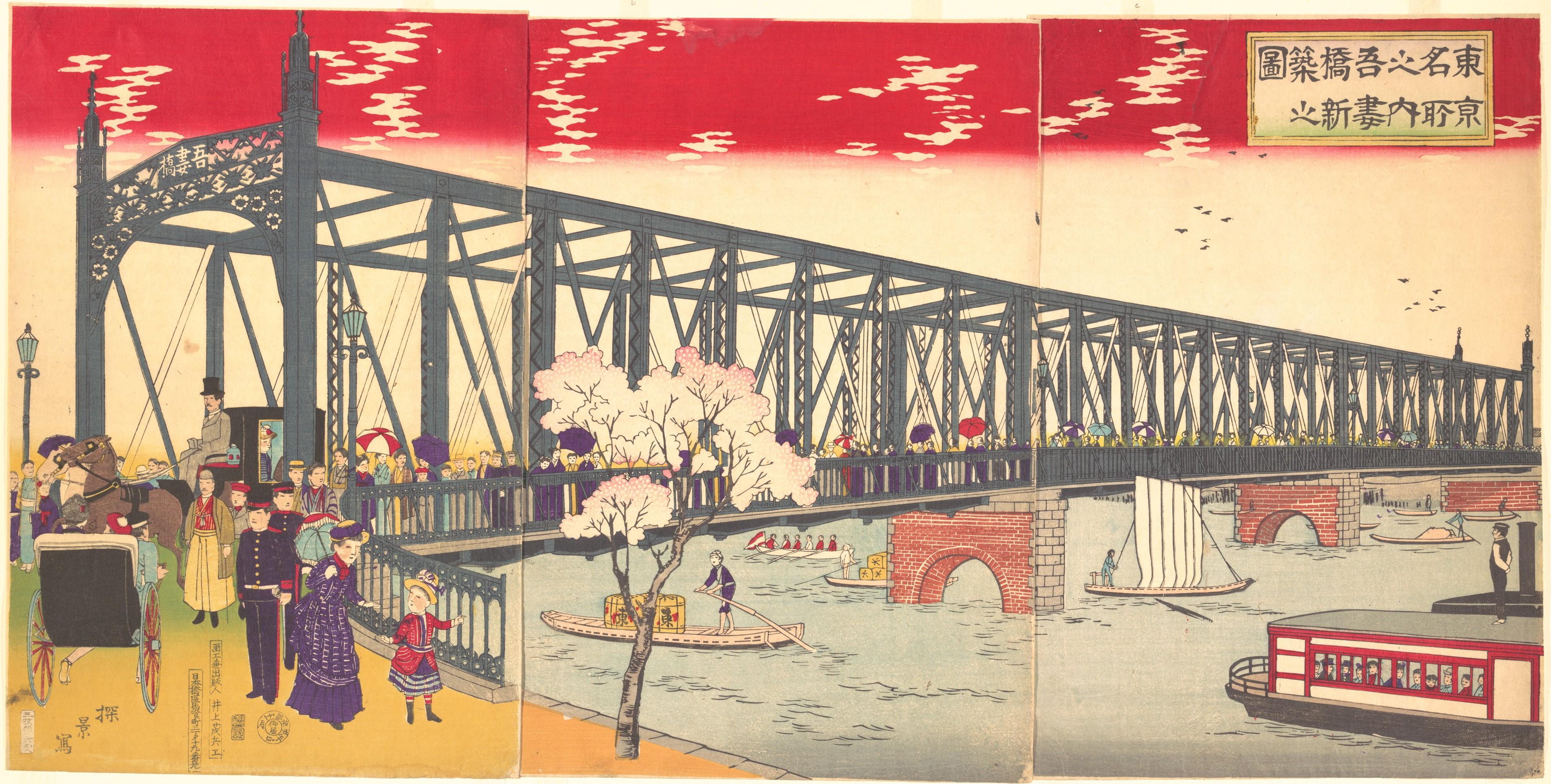
An iron bridge stretches diagonally over the Sumida River beneath a red sky. People in different styles of dress crowd its deck; boats and carriages move below and beside it. Inoue Yasuji’s 1887 triptych of Azumabashi announces a new Tokyo with almost theatrical confidence. Now look at his Ginza street after dark, where isolated windows glow against the surrounding gloom. Then look at Yanagibashi in the rain, a street inhabited by umbrellas, a rickshaw and ordinary pedestrians rather than monumental structures.
These images together tell a more revealing story than any single image of Meiji progress. They show not simply a city replacing the old with the new but a society learning to live amid different technologies, rhythms and types of illumination. This Art Choice feature curates three prints provided for JAPAN.co.jp and uses collection records to place them within the artist’s career. It is an archival study, not firsthand museum reporting or a claim that these particular digital files have been independently authenticated as specific impressions.
The young artist from Asakusa
Inoue Yasuji was born in 1864 in Asakusa Namiki-chō, an area now within Kaminarimon in Tokyo. His birth name was Yasujirō, and he died on September 14, 1889. Japanese cultural databases give his name as 井上安治, read Inoue Yasuji. The later professional name Inoue Tankei, written 井上探景, belongs to the same artist, not to a separate printmaker. Keeping those names connected matters because works in different collections may be catalogued under different signatures.
Inoue trained with Kobayashi Kiyochika, an influential artist who helped transform the visual language of Meiji Tokyo. Accounts of Inoue’s early artistic education also mention Tsukioka Yoshitoshi. A frequently repeated story has the young Inoue approaching Kiyochika while the older artist sketched the Sumida River in winter; it is attractive, but it should be treated as an anecdote unless contemporary evidence for the encounter is produced. The documented career is already compelling without embellishment: in a remarkably short life, Inoue moved from intimate views of Tokyo to vivid large-format prints of new public structures.
Sources: 文化庁アートプラットフォームジャパン|井上安治(生没年・出生地) · オレゴン大学所蔵・ラヴェンバーグ資料|井上安治の経歴
Why light mattered in the Meiji woodblock
The older ukiyo-e tradition had long depicted celebrated landscapes, seasonal outings and busy urban streets. By the 1870s, however, the city appearing before artists’ eyes was changing physically. Gas lamps lit new streets. Western-influenced buildings emerged among traditional wooden houses. Horse-drawn rail vehicles and iron bridges reordered how people moved. A familiar medium—carved blocks and printed paper—had to find a visual vocabulary for unfamiliar scenes.
Kiyochika’s celebrated kōsen-ga, commonly translated as “light-ray pictures,” brought twilight, lamplight, shadow and tonal contrast to the center of the composition. The Ota Memorial Museum notes the influence of Western painting, lithography and photography in his work. Inoue followed that experimentation closely, but his own pictures often direct attention through lucid arrangements of architecture and comparatively restrained human gestures. It is not that he merely recorded what a camera might see; his prints ask viewers to notice what light reveals, what darkness withholds and how everyday life persists inside both.
Sources: 国立国会図書館|夜景の光線画に見えるもの · 太田記念美術館|闇と光―清親・安治・龍son(英語案内)
Azumabashi, 1887: the visual ambition of an iron bridge
The Suntory Museum of Art catalogs Inoue’s 大日本東京吾妻橋真画, or True View of Azumabashi in Tokyo, as a three-sheet print made in 1887. The Edo-Tokyo Museum independently records a triptych under his later name Tankei. This sprawling composition is especially revealing when contrasted with his smaller night scenes. Structural members recur across the entire bridge, forming a pattern that leads the eye far into the distance. The brilliant red sky, clusters of umbrellas and costumes, and boats beneath the deck turn the new bridge into a public spectacle.
Azumabashi’s predecessor was lost in the 1885 flood, and a replacement iron bridge opened in 1887. It represented a practical change in engineering and transport, but the print makes clear that infrastructure was also a social event. People come to cross, look, travel and participate in a transforming city. The human figures matter because they give proportion to the steel structure, preventing it from becoming an abstract diagram of progress. Its authority as an image lies in that mingling of engineering, commerce and curiosity—not in assuming that every architectural detail is a surveyor’s exact rendering.
Sources: サントリー美術館|大日本東京吾妻橋真画(1887年) · 江戸東京博物館|大日本東京吾妻橋真画(井上探景)
Ginza at night: modernization within the darkness
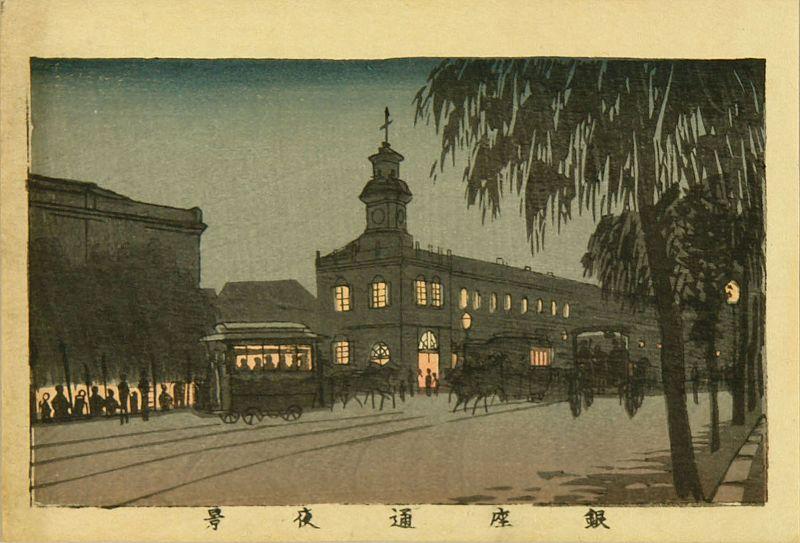
The second selected print carries the title 銀座通夜景, Night Scene of Ginza Street. In the National Diet Library’s study of night landscapes, Inoue’s Ginza scene is connected to the Kyōya clocktower near Ginza Fourth Street, gas illumination and a horse-drawn street railway. The clocktower’s light-filled windows draw the eye upward, while figures and the vehicle emerge only partially from the shadows. The new city is legible through pockets of brightness rather than through an even flood of light.
This is a more subtle image of modernization than one might expect. It does not celebrate invention through a gigantic machine or a parade of flags. Instead, the building’s glowing interior, a route traced by rails, and the small human silhouettes imply systems that continue after sundown. A city equipped for new kinds of commerce and movement still contains extensive darkness. The contrast gives the picture its emotional force: a viewer feels the night as a real environment, not as a decorative backdrop to the technological wonders of the age.
Sources: 国立国会図書館|夜景の光線画に見えるもの · アートプラットフォームジャパン|銀座通夜景
Yanagibashi in rain: ordinary people come back into focus
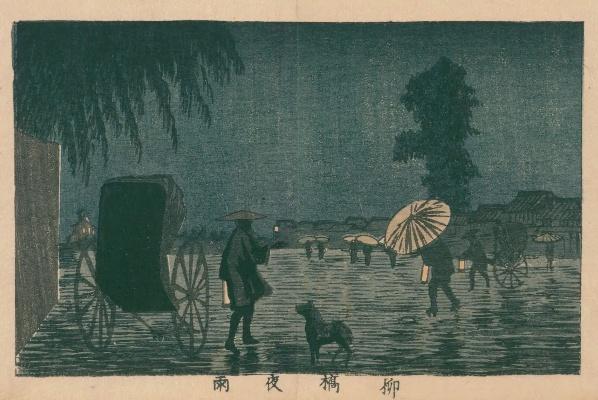
The third print is catalogued by the Edo-Tokyo Museum as 東京真画名所図解 柳橋夜雨, Night View of Yanagibashi Bridge in the Rain. The National Diet Library likewise describes umbrellas and a rickshaw in the rain-soaked street. Here the city has no gleaming iron bridge at its center and no clocktower demanding attention. Willow branches hang overhead; the carriage waits near the edge; people negotiate a wet road whose surface seems to capture the light and weather at once.
The scene conveys the physical texture of ordinary urban travel. A tilted umbrella suggests the direction of movement. The rickshaw calls attention to work and mobility. Reflections and closely repeated strokes make the street appear heavy with rain. None of this establishes a meteorological record of a precise night, and Inoue’s treatment is not photography. Yet it remains historically suggestive: through small observed details, it helps modern readers imagine what it meant to move through a city before electric light, enclosed automobiles and the relentlessly illuminated commercial landscape familiar today.
Sources: 江戸東京博物館|東京真画名所図解 柳橋夜雨 · 国立国会図書館|東京真画名所図解 柳橋夜雨
An exhibition in three visual scales
Placed together, the three prints can be read as an exhibition of scale. In Azumabashi, a public engineering structure supplies the dominant geometry and individual people become small accents. In Ginza, a building and its lit windows set the rhythm. In Yanagibashi, there is almost nothing monumental; the basic unit of meaning is a human trying to stay dry. The contrast is not evidence of a straightforward progression from simple to complex, but of an artist willing to change visual emphasis for each subject.
Light is the unifying material. The red sky above an iron bridge is a different artistic decision from the amber windows of Ginza or the muted reflections of a rainy night. Each reveals something about the uses of the city. Inoue could describe the theatre of a public opening and also pay attention to the modest persistence of people working, walking and sheltering from weather. Viewed together, the prints resist a simplistic claim that Meiji Tokyo became instantly Western or uniformly modern. Different worlds existed beside one another.
From postcard-sized views to triptychs
Inoue began publishing views of Tokyo in the early 1880s, including small images that could be handled and collected with unusual intimacy. The National Diet Library identifies his Tokyo views as a vivid visual record of the urban environment in the first Meiji decades. The miniature format made room for bridges, shrines, riverbanks and rainstorms, subjects often less grand than an officially celebrated modernization project but no less important to a city’s identity.
Around 1884 he began using the art name Tankei and increasingly worked in other print formats and topical subjects. The three-panel Azumabashi print shows a different scale of ambition, using a panoramic arrangement that could accommodate architecture, crowds, traffic and a spectacular sky. This is not a separate artist suddenly appearing under a second name. It is the same maker responding to the needs of publishers and audiences in a fast-changing market for images. Understanding that continuity helps explain why a delicate rain scene and a brightly colored bridge can belong to one remarkable career.
Sources: 国立国会図書館|夜景の光線画に見えるもの · オレゴン大学所蔵・ラヴェンバーグ資料|井上安治の経歴
What a woodblock print can—and cannot—prove
Historical prints provide evidence, but they are not neutral measuring instruments. Artists chose their viewpoint, eliminated distractions, sharpened contrasts and arranged figures for legibility. Publishers and printmakers shaped the final result; impressions also differ in coloring, condition and later reprinting. Where a precise bridge date, width or historical event is at issue, curators’ records and documentary sources should be weighed alongside the print itself.
The three images in this feature are the files supplied on JAPAN.co.jp. Their subjects and compositions have been compared with official catalog descriptions, but the provenance of each particular digital reproduction, the photographer or scanner, and the impression state have not been established here. The nineteenth-century underlying works are beyond ordinary copyright terms; permission or restrictions attached to particular digital assets should be checked separately. Museum collection records are linked so readers can follow the attribution rather than being asked to take a website caption on trust.
Sources: サントリー美術館|大日本東京吾妻橋真画(1887年) · 江戸東京博物館|東京真画名所図解 柳橋夜雨 · 東京都立図書館|柳橋夜景、井上安治(探景)
Why this young artist still matters
Less than three decades separated the start of Meiji rule from Inoue’s death, but the city was already undergoing changes that would become foundational to modern Japan. His images preserve a moment when the ordinary night could still be surprisingly dark, a new bridge could draw a crowd, and a rain-soaked street held its own quiet visual drama. The artist was not merely illustrating technological progress. He was finding ways to see the world that progress changed.
Tokyo in 2026 has its own illuminated landmarks, transport networks and digital streetscapes. It would be easy to look backward and identify only the ancestors of today’s infrastructure. Inoue’s art argues for a fuller attention: to a person with an umbrella, a carriage waiting for work, the glow from a shop window, or a bridge made meaningful by the people crossing it. The three prints invite us to understand a modern city not just through what it builds, but through how people inhabit it.
Sources and artwork records
Museum, national library, and Japanese cultural database records are prioritized. Catalogued artwork identities are distinguished from the unverified state of individual digital reproductions.
- 文化庁アートプラットフォームジャパン|井上安治(生没年・出生地)
- 国立国会図書館|夜景の光線画に見えるもの
- 太田記念美術館|闇と光―清親・安治・龍son(英語案内)
- サントリー美術館|大日本東京吾妻橋真画(1887年)
- 江戸東京博物館|大日本東京吾妻橋真画(井上探景)
- 千葉市美術館|銀座商店夜景(1882年)
- アートプラットフォームジャパン|銀座通夜景
- 江戸東京博物館|東京真画名所図解 柳橋夜雨
- 国立国会図書館|東京真画名所図解 柳橋夜雨
- 東京都立図書館|柳橋夜景、井上安治(探景)
- 東京都立図書館|東京名所吾妻橋改良之真景
- 国立国会図書館|明治・大正・昭和初期の風景版画
- オレゴン大学所蔵・ラヴェンバーグ資料|井上安治の経歴