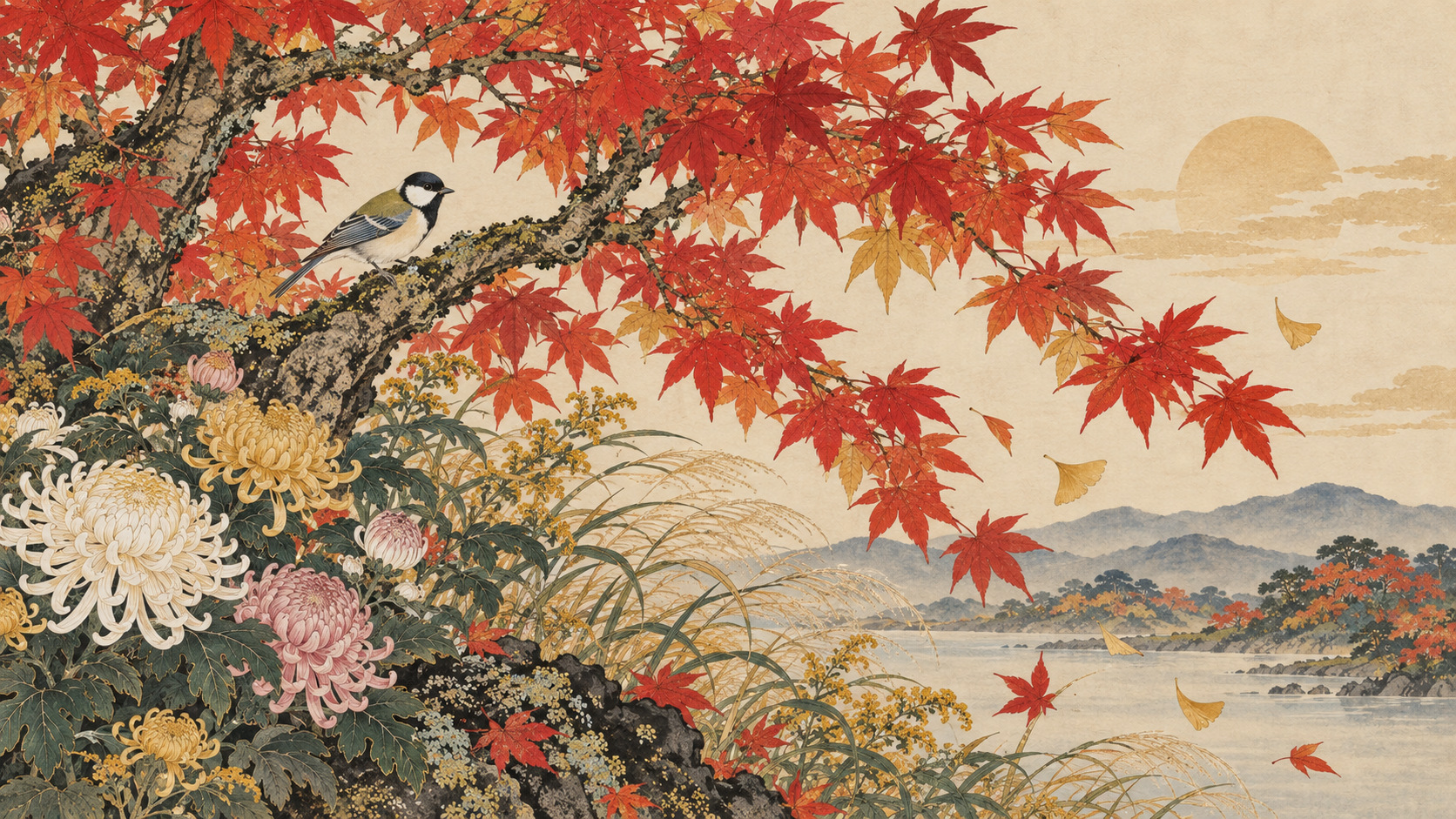
A small bird, and an expansive world
A Japanese tit on an autumn maple branch is hardly a monumental subject. Yet in Imao Keinen's *Maple and Japanese Tit*, an 1892 plate from the autumn volume of *Keinen Kachō Gafu*, every element asks to be examined: the changing leaves, the branching structure, and the bird's balance within the scene. The work belongs to a tradition of flower-and-bird painting, but its force comes from attention to ordinary living things.
That attention makes Keinen an unusually apt choice for Japan.co.jp's October 15 edition. The news today takes readers from an engineered insect able to operate underwater to an exceptionally minimal microbial genome and the changing geography of rice farming. None of these achievements should be retroactively credited to a nineteenth-century painter. But all reward a quality of attention that Keinen made visible: looking closely enough to discover that a familiar creature or landscape is more complex than it first appears.
The painter who grew up among Kyoto’s dyers
Imao Keinen was born in Kyoto on September 13, 1845, into a family associated with the city's yūzen textile-dyeing trade. Japan's National Diet Library identifies early ukiyo-e study under Umekawa Tōkyo and his entry into the studio of painter Suzuki Hyakunen in 1873. These are not incidental biographical details. Kyoto's artistic economy brought textile designs, paintings, printmaking, and the decorative arts into regular contact.
His life straddled a profound shift in Japanese institutions. Born before the Meiji Restoration of 1868, Keinen witnessed the emergence of modern art exhibitions, international world's fairs, new educational markets, and modern publishing. What counted as an artist's audience was changing. A successful image could now circulate not merely as a unique painting but as a reproducible book plate or industrial design reference.
It would nevertheless be misleading to call Keinen a Western-style scientist merely because his images are closely observed. Japanese and East Asian approaches to sketching and studying nature had long histories. His accomplishment was to work within those histories while exploiting the possibilities of a new commercial and cultural age.
Four volumes, four seasons, many collaborators
Published by Nishimura Sōzaemon in Kyoto in 1891–92, *Keinen Kachō Gafu* is a four-volume, color-woodblock publication organized into spring, summer, autumn and winter. The National Museum of Modern Art, Kyoto, preserves a four-volume copy, while the National Diet Library provides digitized records. It is a work whose graceful surfaces could make its complicated production easy to overlook.
A color print requires translation from an artist's design into carved blocks and successive impressions. The National Diet Library's bibliographic records identify the block carver Tanaka Jirokichi and printer Mitsuki Jinzaburō. Fine botanical lines, subtle shifts in color, and delicately distributed forms therefore testify to collaboration between painter, carver, printer and publisher. Keinen's name is essential, but it is not the entire story of how the plates came into being.
The seasonal structure is equally consequential. Instead of treating a bird or flower as an isolated collectible specimen, it situates forms of life within changing conditions. A branch in spring suggests growth; a branch in autumn announces the passage of time. The album makes a seasonal ecology available to the eye, even if it was not written as a modern scientific field guide.
Reading Maple and Japanese Tit
The National Diet Library's autumn image collection explicitly identifies the plate in Japanese as 「カエデ・シジュウカラ」—maple and Japanese tit. That source matters, since reproductions and modern English captions can drift away from the wording used in Japanese institutional records. The plate's subject is strikingly modest: not a rare animal from a distant place, but a small bird and a familiar tree.
Its beauty depends on relationships. Branches establish rhythm; the body of the bird supplies scale; leaves tell us about the season. A viewer can notice the precision of the drawing while also recognizing that this is an artistic arrangement, not a photograph or taxonomic plate. Keinen selected, emphasized and balanced the components. Observational fidelity and expressive composition are not enemies here.
The artist also resists the notion that nature can be reduced to ornamental red and gold. The weight of a body on a branch, the angle of the feet, the space around a leaf: each small decision animates the page. What might appear decorative from a distance becomes surprisingly specific up close.
A flower-and-bird tradition remade in print
*Kachō-ga*—flower-and-bird painting—had long been a major field of East Asian and Japanese art. The interplay of birds, plants and seasonal change could communicate auspicious meanings as well as direct pleasure in the natural world. Kyoto traditions of observational painting, including lineages associated with the Maruyama and Shijō schools, enriched the visual culture from which Keinen emerged.
Color woodblock printing introduced a different scale of circulation. Bound plates were portable, organized, and suitable for close comparison. They could appeal to painters, designers, students and collectors without ceasing to be works made for contemplation. Their accessibility was not unlimited—manufacture still involved skilled labor and expense—but the book form could reach beyond the patron of a single hanging scroll.
Modern digitization extends that story. The National Diet Library allows readers to see seasonal plates that might otherwise require travel or access to rare books. It is important, though, to distinguish the public-domain status of the underlying nineteenth-century art from usage conditions for a specific institutional digital image. The right record should be checked before reproducing a particular scan.
From Kyoto to the world’s fairs
Keinen's reputation reached the international exhibitions of the late nineteenth century. The National Diet Library records an honorary award for his *Eagle and Monkey* painting at the Chicago World's Columbian Exposition in 1893 and a silver medal for *Spring Mountain, Flowers and Birds* at the Paris Exposition of 1900. In 1904 he became an Imperial Household Artist, and in 1919 he was named to the Imperial Art Academy.
These milestones point to a Japan negotiating how its artistic heritage would be represented abroad. International prizes do not establish artistic superiority, but they reveal the institutional pathways through which paintings and crafts entered cross-border view. A Kyoto painter best known to some collectors for birds and plants also participated in the global presentation of Meiji art.
When people abroad think of Japanese prints, names such as Hokusai and Hiroshige often dominate. Keinen offers another entry point: not a roaring wave or a famous road, but an astonishingly observant encounter with feather, foliage and season. The richness of Japanese visual culture is better understood when these quieter traditions are given space.
Why he belongs in an edition about science and society
A disaster-robotics researcher who studies the movement of an insect and an artist who studies its anatomy are not conducting the same activity. Science tests claims with experiments and evidence; art shapes perception and experience. Confusing the two would flatten both. Yet precision of attention is a meaningful bridge between them.
The same applies to Hokuriku's rice fields. Official harvest statistics turn millions of rice plants into hectares, yields and tonnage. Keinen's approach reminds us that each apparently uniform landscape contains individual forms and seasonal changes. The figures and the image are complementary ways of considering the natural world; neither substitutes for the other.
For an international readership, this is a useful corrective to the tendency to frame Japan only through robotics or technological spectacle. The country's modern science and historic visual art can coexist on the same front page without either being used as a decorative excuse for the other.
Which image is the historical artwork?
The hero image used on this Japan.co.jp page is an original contemporary editorial illustration inspired by Keinen's aesthetic. It is not an 1892 woodblock print and must not be presented as a facsimile of *Maple and Japanese Tit*. Readers looking for the authentic plate should consult the National Diet Library's autumn collection linked below, where the Japanese title is listed.
The Smithsonian's National Museum of Asian Art also catalogs a copy of *Keinen kachō gafu*, with some digital images labeled CC0. That institutional collection record does not, by itself, prove that an arbitrary Smithsonian scan corresponds to the same maple-and-tit plate. Any historical reproduction should be selected, attributed and cleared at the level of the individual image.
The enduring invitation to look
Keinen died on October 5, 1924, after a career that began in the late Tokugawa world and continued into Japan's twentieth century. His surviving work is a reminder that formal elegance and exact observation can intensify one another. It also recalls the many craftspeople whose labor made images reproducible and durable.
Nothing spectacular happens in *Maple and Japanese Tit*. A bird rests among leaves. But the closer one looks, the harder it becomes to call the scene uneventful. The branch is not merely a branch; autumn is not merely a color. Keinen's lasting achievement is to make the world feel newly present without making it larger than life.
Primary sources and references
- 国立国会図書館:今尾景年(近代日本人の肖像)
- 国立国会図書館:『景年花鳥画譜』秋之部(収録作「カエデ・シジュウカラ」)
- 国立国会図書館:『景年花鳥画譜』秋之部 書誌・デジタル原本
- 文化遺産オンライン:『景年花鳥画譜』(春夏秋冬四冊)
- 京都国立近代美術館:『景年花鳥画譜』所蔵記録
- 国立国会図書館:『景年花鳥画譜』の出版・技法資料
- Smithsonian National Museum of Asian Art: Keinen kachō gafu, collection record
Sources checked October 13, 2026. The archival artwork and modern editorial illustration are distinct.