An artist’s memory does not live only in paintings. It can remain in a school where she once taught, in a street she once walked, and in the surprise of residents who discover that a world-famous story once passed through their own town.
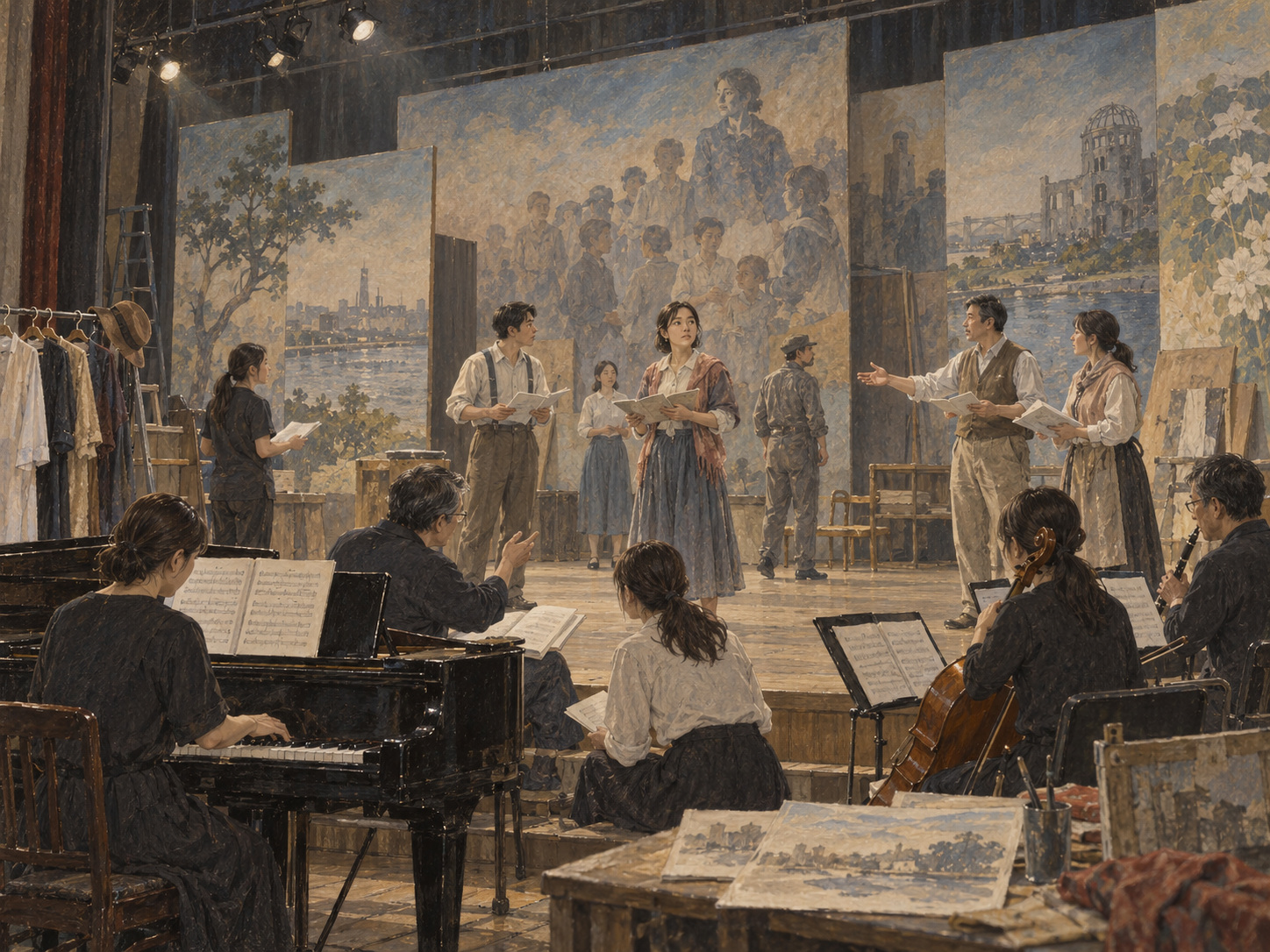
On October 4, Ichikawa Civic Cultural Hall hosts the 12th Ichikawa Citizens’ Musical, Ano Hi Mita Yume — Painter Toshi Maruki and the Ichikawa Story. There are two performances, at 11:00 and 15:30. The work is written and lyricized by Hiroshi Yoshihara and collaborators, directed by Yoshihara, composed by Hiromitsu Ishikawa and choreographed by Masayuki Anzai.
The subject is Toshi Maruki, 1912–2000, one of the major artists associated with postwar Japanese memory. But the project did not begin with the famous Hiroshima Panels. It began with a local discovery: before that work existed, Maruki had been a teacher at Ichikawa Elementary School.
Before Toshi Maruki, there was Akamatsu Toshiko, schoolteacher
The Tokyo National Research Institute for Cultural Properties records that Maruki was born in Chippubetsu, Hokkaido, on February 11, 1912, as Toshiko Akamatsu. After studying oil painting at the Women’s School of Fine Arts, now Joshibi University of Art and Design, she graduated in 1933 and became a teacher at Ichikawa Elementary School.
Regional historical research places her at the former Ichikawa Jinjo Higher Elementary School from April 1933 through March 1937. In April 1937 she left for Moscow.
Long before she became known as an artist of Hiroshima, the young painter stood in front of children in Ichikawa.
The Ichikawa years are not merely a preface
Famous lives are often told backward. Once the great work is known, youth becomes a prelude to destiny.
The civic-musical project instead treats Maruki’s teaching years as meaningful in themselves: a young woman teaching children, painting, looking outward toward the world, before war and Hiroshima transformed the subjects of her art.
That makes local history more than a claim of association. It becomes a way of seeing the artist before history made her famous.
Marriage to Iri Maruki in 1941
According to the Maruki Gallery, Toshi married ink painter Iri Maruki in 1941.
Iri worked in experimental ink painting influenced by abstraction and surrealism. Toshi came from oil painting. Their different visual languages later met inside a joint body of work unlike either artist’s earlier practice.
August 1945: Hiroshima
After the atomic bombing of Hiroshima on August 6, 1945, Iri reached the city within days. Toshi followed about a week later. The gallery says the couple helped relief work and stayed for roughly a month.
They did not immediately know how to paint what they had seen. The Maruki Gallery describes several years of struggling to give the atomic-bomb experience visual form.
In 1950 they presented the first Hiroshima Panel, Ghosts.
Ghosts is 1.8 meters high and 7.2 meters wide
The first panel is a pair of four-fold screens measuring 1.8 by 7.2 meters.
What began as one work, and then a proposed trilogy, eventually became 15 panels created over 32 years, ending with Nagasaki in 1982.
The series is also inseparable from collaboration. Toshi’s oil-painting approach to the human figure and Iri’s ink vocabulary meet in a shared pictorial language rather than two separate signatures.
An actual-size replica came to Ichikawa City Hall
Before the musical, an actual-size replica of Ghosts owned by the Maruki Gallery was shown at Ichikawa City Hall from July 15 through July 29.
The display coincided with the city’s Peace Paper Crane Exhibition. Its 1.8-by-7.2-meter scale allowed local visitors to confront the physical dimensions of the work rather than only a reduced reproduction.
Scale matters. At near-life size, the bodies cease to function as distant art-history images and return to the viewer’s own physical space.
A musical cannot simply “reproduce” a painting
The production follows Maruki from her teaching years through her marriage to Iri, the immediate aftermath of Hiroshima and the 1950 presentation of Ghosts.
But theater is not a substitute for a painting. It translates biography into voices, songs, bodies, music and collective movement.
That means compression and invention are unavoidable. A stage production creates dramatic scenes where archives may offer only fragments. Its historical truth must therefore be understood differently from a museum label or primary document.
The civic cast is part of the meaning
Ichikawa Citizens’ Musical is not structured as a conventional professional touring production. Its stated purpose is cultural exchange and community connection across three generations.
For the 2026 production, rehearsals began in mid-May, primarily on weekends and holidays, with roughly 30 rehearsals planned.
The months of collective preparation are therefore part of the cultural project, not merely the route toward opening night.
The first Ichikawa Citizens’ Musical had 320 performers
The project began on August 31, 2002 with Ichikawa Midsummer Night’s Dream, performed twice at Ichikawa Civic Cultural Hall.
The organization’s own history records 320 performers, an aggregate 550 citizen staff members and 3,200 audience members. It emphasizes that creative work and financing were both citizen-led.
Later participants formed independent dance, chorus and theater groups, meaning the production model created organizations beyond the shows themselves.
For the 12th production, the discovery was a world-known artist hiding in local history
The organizers say they selected Maruki after learning that the artist of the Hiroshima Panels and the picture book Hiroshima no Pika had once taught at Ichikawa Elementary School.
That is a different kind of local-history claim from birthplace tourism.
The point is not that Ichikawa “owns” Maruki. It is that national and international history contains periods visible most clearly from a local archive.
The Hiroshima Panels were not born as museum masterpieces
In February 1950, an early version titled August 6, later the first panel Ghosts, appeared at the Japan Independent Exhibition. In March, a Hiroshima Panels exhibition opened at Maruzen Gallery in Nihonbashi. By August, the first three panels were shown together.
The works then traveled around Japan. Demand became strong enough that recreated versions of the early panels were made so exhibitions could occur in more than one place.
The paintings gained social meaning through circulation before they became fixed museum icons.
The civic musical has a distant echo of that circulation
The 2026 musical is not the same thing as the early Hiroshima Panels touring exhibitions.
But there is an interesting shared principle: memory does not remain only in specialist institutions. It moves into civic space, where people encounter it, reinterpret it and sometimes participate in carrying it forward.
Preservation alone does not transmit memory. Someone must look again, speak again and translate it into the medium of another generation.
From large screens to children’s books
Toshi Maruki was also a major picture-book artist. Hiroshima no Pika, published in 1980, became one of the best-known works for introducing younger readers to Hiroshima.
Much earlier, in 1950, Iri and Toshi published Pikadon. The Maruki Gallery notes that it appeared under Allied occupation and soon after the Korean War began, at a time when public representation of atomic-bomb devastation remained politically sensitive.
Large folding screens and small books served different audiences. The Marukis repeatedly changed medium in order to move memory.
Ichikawa’s children now become the people who perform Maruki
In the 1930s, Maruki taught children in Ichikawa. In 2026, children and adults in Ichikawa spend months learning her history and embodying it on stage.
The reversal is symbolically powerful.
A relationship that once ran from teacher to child now turns back toward the teacher nearly ninety years later. Local history becomes participation rather than information.
The difficulty of making peace theater
War and atomic bombing can easily become simplified into imagery of suffering designed to provoke emotion.
The musical’s organizers have said that their aim is not simply to depict victims but to show people who had ordinary lives, feelings and futures that war interrupted.
Whether the finished stage production achieves that balance cannot be judged before performance. Japan.co.jp does not pre-review its artistic quality or historical fidelity.
One day, two performances
The musical plays October 4 only, at 11:00 and 15:30, with doors opening 30 minutes earlier. It is held in the main hall of Ichikawa Civic Cultural Hall.
First-floor reserved seats are ¥3,000 and second-floor unreserved seats ¥2,500. The Maruki Gallery has promoted the production through its official site.
Local memory needs accuracy—and transformation
Passing memory forward creates a tension.
One responsibility is to preserve historical accuracy. Another is to make the past meaningful enough that later generations feel a relationship to it.
Civic theater is powerful at the second task. Precisely because of that power, audiences also need routes back to the first: paintings, archives, museum records and documented history.
Ichikawa makes Maruki local again without making her exclusively local
Toshi Maruki was born in Hokkaido, studied in Tokyo, traveled to Moscow and Micronesia, witnessed Hiroshima, worked with Iri and built a museum legacy in Saitama. Ichikawa occupies only one chapter in that long life.
But the years from 1933 to 1937 restore a human scale to an artist often encountered only through monumental postwar work.
The October 4 musical does not need to claim Maruki for Ichikawa. Its more interesting act is to accept responsibility for remembering the part of her life that happened there.
Sources
- Ichikawa Citizens’ Musical, official 12th production page
- Ichikawa City, April 4, 2026 municipal newsletter
- Maruki Gallery, Ichikawa Citizens’ Musical notice
- Tokyo National Research Institute for Cultural Properties, Toshi Maruki obituary/biography
- Maruki Gallery, Iri and Toshi Maruki biographies
- Maruki Gallery, The Hiroshima Panels
- Ichikawa Citizens’ Musical, project history
- Maruki Gallery, Pikadon republication and history