- The pleasure of finding something you did not know existed
- A London experiment becomes a Tokyo provocation
- “Then why don’t you do it?”
- Social media solves discovery, not survival
- The advantage of being small
- Pedro Nekoi’s Tokyo begins with ordinary objects
- Everyday Scenes turns overlooked details into a new world
- For independent artists, the obstacle is often the next opportunity
- What visitors can expect in Daikanyama
The pleasure of finding something you did not know existed
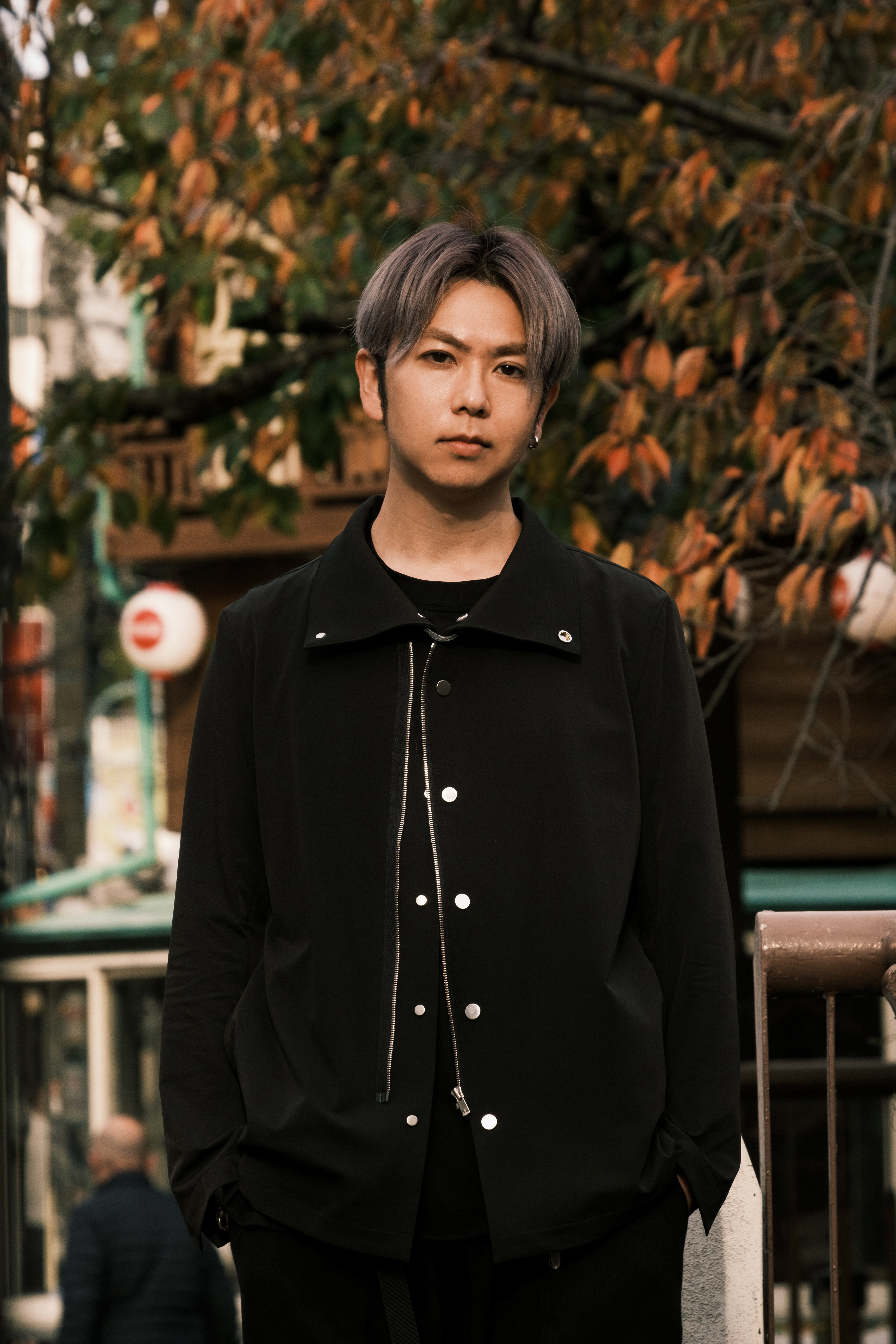
Koji Yoshimura remembers a kind of shopping that begins with a question rather than a search filter. You walk into a store and wonder what you might discover. You pick up an unfamiliar garment, learn its story, and perhaps meet the person responsible for making it. For the founder of the independent Tokyo label HLVTC, that sense of possibility has faded from too many retail experiences.
On November 14 and 15, 2026, Yoshimura—who also goes by yossy—plans to test an alternative. HYPER HYPER — TOKYO UNDERGROUND COLLECTIVE will bring independent fashion designers, artists and other makers together at ZA SPACE DAIKANYAMA in Shibuya. The organizer says visitors can enter free of charge and speak directly with the people showing their work.
In written answers to questions from JAPAN.co.jp, Yoshimura did not simply complain about the internet. He acknowledged that online shopping has made clothing more accessible. What concerns him is the way the experience can narrow into comparisons of price and marketing. A city abundant in products, he suggests, can still leave people short of surprise.
A London experiment becomes a Tokyo provocation
The name HYPER HYPER refers to a specific chapter of British fashion history. The original Hyper Hyper opened on Kensington High Street in 1983. According to the fashion-history study Style City, its premises were subdivided into more than seventy units, offering young designers a place to sell their own clothing. It was a distinctive retail system: compact space, direct exposure, and room for experimental labels that had not yet won the attention of established buyers.
Hyper Hyper should not be confused with Kensington Market, the separate and older indoor market on the same street. Both contributed to the area’s alternative fashion culture, but they had different histories. The original Hyper Hyper later relocated and continued under the name Hype DF before closing in 1999, the historical account records.
Yoshimura came to this story by following the provenance of archival clothing. For nearly two decades he had been buying, wearing and passing on pieces by labels he sometimes had never heard of. Researching garments found in different countries and from different years, he repeatedly encountered designers connected with Hyper Hyper. A building from 1980s London gradually became a question about what Tokyo was missing now.
“Then why don’t you do it?”
Yoshimura eventually spoke to someone who had frequented the London space. When he suggested that Japan could use something similar, the reply was an invitation to act: “Then why don’t you do it?” This is Yoshimura’s account of the exchange, translated from his Japanese interview.
The result is not an attempt to reproduce an entire lost London institution. A two-day gathering in Daikanyama is inevitably smaller and more temporary than the original multi-unit retail destination. Instead, it takes one principle—designers and customers meeting without so many layers between them—and asks whether that principle still has power.
Tokyo is already a sophisticated fashion market, and Yoshimura knows it. His ambition is not to introduce Japanese shoppers to foreign style. It is to make room for expressions that arise from people living and working in Tokyo, including the ways they transform outside influences into something personal. He wants visitors to be able to ask a designer why a particular object exists.
Social media solves discovery, not survival
Asked whether Tokyo has become a harder place for independent designers to build careers, Yoshimura resisted a nostalgic answer. In the 1990s, he said, designers without store placement or magazine coverage had few opportunities to be noticed. Social platforms have lowered that initial barrier: an unknown maker can put work directly in front of people who may care about it.
Visibility, however, is not the same as a durable livelihood. One enthusiastic reaction or a widely shared picture does not automatically pay for fabric, production, shipping, a studio, or the next collection. As Yoshimura put it in his Japanese reply, there is a distance between someone responding once and someone wanting to see what the maker creates next.
The point deserves attention beyond fashion. Digital distribution has changed the cost of reaching an audience, but creative work still depends on a less measurable form of commitment. A buyer who has touched the fabric, heard the maker’s reasoning and remembered the conversation may form a different relationship with the work. Whether that converts into sustainable sales is a question this event can only begin to test.
The advantage of being small
Yoshimura is careful not to turn independence into a moral badge. Large companies and small makers, he says, have different strengths. An independent designer can experiment with a short run that might be commercially uninteresting to a chain store. A person selling their own work can listen to visitors and use those reactions in the next design.
He is especially interested in repetition: people meeting again, rather than a one-off spectacle that disappears after a weekend. A shopper drawn in by clothing might encounter an artist at the next table. Two exhibitors might discover a reason to collaborate. These tiny connections can matter before they become visible in any sales report.
For a creative community, then, the most useful unit may not be the follower but the continuing relationship. It is an intriguing proposal, although this first announced gathering cannot yet be held up as proof that the model works.
Pedro Nekoi’s Tokyo begins with ordinary objects
One of the artists associated with the gathering is Pedro Nekoi, a Brazilian-born digital collage artist whose eye for Tokyo works in almost the opposite direction from conventional destination photography. He is drawn not only to landmarks but to oddly shaped buildings, playful playground structures, street signs and luminous commercial facades.
In his written interview, Nekoi explained that he began making digital collages around age seventeen. His artist name came from the surname Nekoi (猫依) of a favorite character in the manga X; an online nickname eventually became the name by which people knew him. His visual interests include surrealism, realism and the boundary where the physical and digital worlds meet.
Japanese cities have offered him a continuous supply of forms. He points to the colors and eccentric geometries of postmodern architecture and furniture from the 1980s and 1990s, as well as Japan’s bubble-era design culture. His observation is personal rather than a sweeping judgment about either country: he finds himself looking more closely at streets because the everyday design around him so often catches his attention.
Everyday Scenes turns overlooked details into a new world
For international readers meeting him for the first time, Nekoi chose his series Everyday Scenes. The process begins with his own travel photographs—sometimes of traffic cones, signage or the electric neon of Japanese love hotels. He removes those objects from their original context and recomposes them into vivid, surreal three-dimensional digital collages.
The shift is not simply decorative. A traffic cone is normally read as an instruction; in a collage it becomes color, silhouette and memory. A sign designed to be glanced at becomes something worthy of sustained attention. Through digital construction, ordinary things acquire the strangeness they may have had before we learned to ignore them.
Nekoi hopes viewers will look a little more carefully at streets they know and places they visit. There may be, he suggests, small personal treasures hiding among things everyone else passes by. The connection to Yoshimura’s idea is striking: both artists are concerned with the experience of noticing what is already in front of us.
For independent artists, the obstacle is often the next opportunity
When asked about the hardest part of working independently in Tokyo, Nekoi did not choose technical tools or lack of inspiration. He chose the work of turning relationships into professional opportunities. As a Brazilian artist in Japan, he has noticed different expectations around introducing oneself and talking about work.
In his own experience, conversations about professional roles can arise more readily in Japan than they did in Brazil. He still finds it difficult to present his work assertively and feels he is learning how to navigate that social landscape. This is one artist’s account, not a claim about every Brazilian or Japanese professional.
There is a practical overlap with Yoshimura’s project. Independent creators may need more than a storefront and an online portfolio. They need settings where an introduction can lead to a commission, a collaboration, or an invitation to show work again. Even if nobody buys on the spot, the right conversation may have lasting value.
Event details
- When
- November 14–15, 2026, 12 p.m.–9 p.m. each day
- Venue
- ZA SPACE DAIKANYAMA, zaHOUSE 5F
- Address
- 1-34-17 Ebisu-nishi, Shibuya-ku, Tokyo
- Admission
- Free; no reservation required (organizer announcement)
- Access
- About two minutes on foot from Daikanyama Station
What visitors can expect in Daikanyama
HYPER HYPER — TOKYO UNDERGROUND COLLECTIVE is scheduled for Saturday, November 14, and Sunday, November 15, from noon to 9 p.m. at ZA SPACE DAIKANYAMA, on the fifth floor of zaHOUSE, 1-34-17 Ebisu-nishi, Shibuya-ku, Tokyo. Admission is free and the organizer says no reservation is needed.
The venue is a gallery-sized space of about 205 square metres, around a two-minute walk from Daikanyama Station. Beyond independent fashion and art, the organizer expects coffee, sweets and nail creators, extending the idea of a gathering beyond traditional retail categories. Visitors should check the official HYPER HYPER account for any late changes to participants or hours.
London’s Hyper Hyper became memorable not merely because people sold clothes there, but because it gave emerging makers a place to become visible to one another. Yoshimura’s new version is a smaller experiment in a different city and era. Its value will ultimately be measured less by the name on the poster than by what the people who enter the room do next.
Sources and reporting method
The reporting is based on original written interviews with the organizer and artist, compared against independent historical and venue sources. The event has not yet taken place, and the newsroom has not independently inspected every exhibitor.
- Original interviews — Koji Yoshimura and Pedro Nekoi — JAPAN.co.jp written responses provided November 2026
- London fashion history — Hyper Hyper — Style City, fashion history study
- Kensington High Street historical background — Royal Borough of Kensington and Chelsea
- Kensington Market history (distinct venue) — London Museum
- Event listing and practical details — Japan Nakama, November 4, 2026
- ZA SPACE DAIKANYAMA location — Venue listing
- Pedro Nekoi, Everyday Scenes work — Artpoint portfolio
- Pedro Nekoi independent profile — Creative Boom, June 8, 2026
- HYPER HYPER updates — Organizer social account