- A championship decided in the space between cars
- The lap that established the argument
- The pit stop did not reset the contest
- A full-course yellow and the end of a title defense
- The Honda one-two—and a corrected podium
- A new body, a new way to learn
- What a Prelude race car is—and is not
- From JGTC to a Japanese industrial contest
- Why Motegi hosted two consequential races
- The question after a first-year triumph
A championship decided in the space between cars
The final image of Japan’s 2026 GT500 season was not a distant procession. It was a Honda HRC PRELUDE-GT crossing the line at Mobility Resort Motegi after 53 laps, just 1.705 seconds ahead of another Honda. The No. 100 STANLEY TEAM KUNIMITSU entry of Naoki Yamamoto and Tadasuke Makino won the race and the drivers’ title on November 8. It also gave Honda’s new PRELUDE-GT a championship in its first competitive season.
The outcome invites two different questions. How did the leading car win the race? And how did the team climb from a difficult beginning to the top of the season standings? The answers involve a precise qualifying lap, a close Toyota challenge, smart execution during a driver change, traffic management and a dramatic late disruption. None can be understood by focusing on the winning car alone.
The lap that established the argument
Makino’s qualifying time of 1:36.135 put the No. 100 car on pole. Kenta Yamashita qualified the No. 36 au TOM’S Toyota GR Supra second in 1:36.413. That made the front row a head-to-head contest between the primary title contenders. Pole position also carries a championship point in the series, so the lap was more than a favorable starting position.
Yamamoto held the lead as the race began. Once an early safety-car intervention ended, Toyota stayed in range: after ten laps, the official race review places the two cars just 0.669 seconds apart. They were racing on a circuit shared with slower GT300 competitors. The leading driver’s challenge therefore included anticipating where traffic would interrupt the preferred racing line—and doing so without losing the small advantage already earned.
The pit stop did not reset the contest
Both main contenders stopped on lap 22 for fuel, tires and a driver change. Makino took over the leading Prelude and immediately built pace. Meanwhile, the No. 17 Astemo Honda, driven by Koudai Tsukakoshi and Yuto Nomura, moved ahead of the Toyota, with Tsukakoshi resisting Sho Tsuboi’s attempts to reclaim second.
It would be tempting to call that a coordinated manufacturer strategy. The published race chronology supports a narrower conclusion: the No. 17 car’s competitive position materially shaped the race for the No. 100 car. It does not, on its own, establish that teams exchanged instructions or deliberately sacrificed a finishing position. The distinction matters because each entry has its own results to pursue.
Primary source: SUPER GT|第8戦もてぎ GT500決勝レビュー
A full-course yellow and the end of a title defense
On lap 44, contact between GT300 vehicles left debris on the track, prompting a full-course yellow. According to SUPER GT’s official race review, the No. 36 Toyota then contacted a slowed GT300 car and sustained substantial left-front bodywork damage. It returned to the pits and retired on lap 46. Tsuboi and Yamashita’s bid for a fourth consecutive GT500 title ended there.
That incident was decisive for the championship standings, but it should not erase what had gone before it. The Honda No. 100 had taken pole, controlled the opening stint and built its margin after the stops. A careful account can recognize an earned performance advantage while also explaining how an on-track collision closed the remaining route for the defending champions.
The Honda one-two—and a corrected podium
Yamamoto and Makino took their third victory of 2026. The No. 17 Astemo Honda finished second, completing a manufacturer one-two. Third place went to the No. 12 Nissan Z entry of Kazuki Hiramine and Bertrand Baguette in the official timing-based result. The No. 39 Toyota had finished third on the road but was subsequently disqualified after post-race scrutineering. That distinction is essential whenever an early live report is compared with the revised result.
The final GT500 drivers’ table, updated November 8 at 19:26 Japan time, lists Yamamoto and Makino on 85 points, Tsukakoshi and Nomura on 65, and Tsuboi and Yamashita on 62. The data underline why a race victory and a championship are related but not interchangeable achievements. A title combines finishing positions and qualifying points across a calendar, subject to official decisions.
Primary source: SUPER GT|最終ドライバーランキング
A new body, a new way to learn
Honda’s 2026 programme involved more than replacing an old model name with Prelude. The new HRC PRELUDE-GT had first appeared as a prototype at Sportsland Sugo in September 2025, where both eventual champions participated in early testing. Ahead of the 2026 season, Honda introduced a technical-director role spanning its five GT500 teams and appointed Akihiro Hasegawa to improve the flow of information between racing operations and development staff.
Honda described this system as a way to turn driver and team feedback into faster engineering decisions. Public material does not identify an individual aerodynamic adjustment or mechanical revision responsible for a precisely measured lap-time improvement. The real evidence is the sequence: prototype testing, organisational changes, a difficult early season and sustained late-season results that culminated in a title.
What a Prelude race car is—and is not
The racing car carries the Prelude name and visual identity of Honda’s modern production sports coupe, but a GT500 machine is a highly specialised competition vehicle. SUPER GT’s technical framework governs purpose-built cars, safety systems and class-specific performance. It would therefore be inaccurate to imply that the championship proves the retail Prelude delivers equivalent racing capabilities.
There is a legitimate industrial story here. Motorsport brings together aerodynamic development, materials, engines, tire interfaces, data analysis and extremely disciplined maintenance. What cannot be claimed without additional evidence is a direct transfer of a particular race component to road-car production. The championship shows the effectiveness of a racing programme, not the performance of the consumer product.
Primary source: SUPER GT|技術規則
From JGTC to a Japanese industrial contest
Japan’s GT championship began in 1994 as the All-Japan Grand Touring Car Championship, known as JGTC. Its class nomenclature evolved to GT500 and GT300 in 1996; the championship became SUPER GT in 2005. In the following decade, technical convergence with Germany’s DTM helped put aspects of the GT500 framework into an international context.
The series remains distinctive because different classes race together, and because major Japanese manufacturers compete through teams that combine corporate engineering with specialist competition operations. The result is not merely a televised contest between car brands: it is a complex ecosystem of tire specialists, race engineers, mechanics, drivers, circuits and long-term supporters.
Why Motegi hosted two consequential races
The Motegi finale was unusual. Round 3, originally due to take place in Malaysia, was rescheduled to Japan and raced on November 7. Yamamoto and Makino finished fifth in that replacement event, moving into the championship lead. The next day’s Round 8 qualifying and race then settled the title. The Saturday race was won by the No. 12 TEAM IMPUL Nissan.
Two demanding race days create additional challenges for preparation and recovery, and make overnight learning unusually valuable. Yet precisely how much one particular adjustment helped the winning car remains unknown. The official rankings also carry a note about a revised provisional Round 3 GT500 result; any forensic reconstruction of the points battle should use a fixed, dated classification rather than an older snapshot.
Primary source: Honda Racing|11月7日第3戦代替レース
The question after a first-year triumph
For Honda, the result was its first GT500 drivers’ championship since 2020 and the first for the new Prelude-GT. For Yamamoto, it was a third GT500 title, following earlier successes including 2018 with Jenson Button; for Makino, it was a second title. Those are historical distinctions, not predictions of what the next season will bring.
The larger lesson is how a competitive technology programme is assembled: people, feedback, execution and consistency, tested against rivals with equal ambitions. Motegi produced a clear winner. It did not settle the future direction of GT500 regulations, the cost of sustaining a works-supported campaign or which manufacturer will answer Honda’s challenge next year. Those are stories still to be reported.
Sources and verification
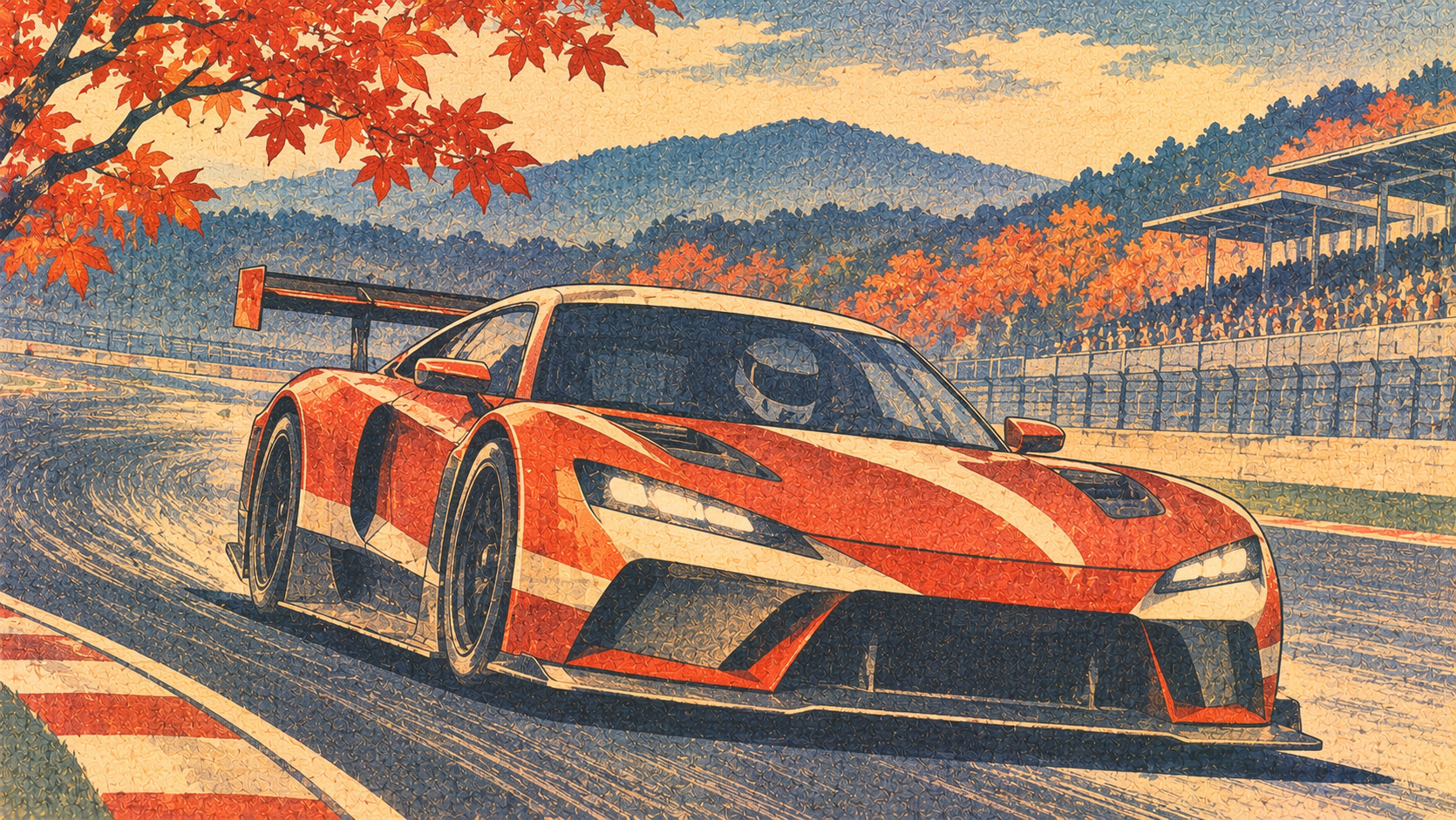
Race and points figures reflect the SUPER GT November 8 update, including post-race classification changes. The header illustration is conceptual rather than documentary.