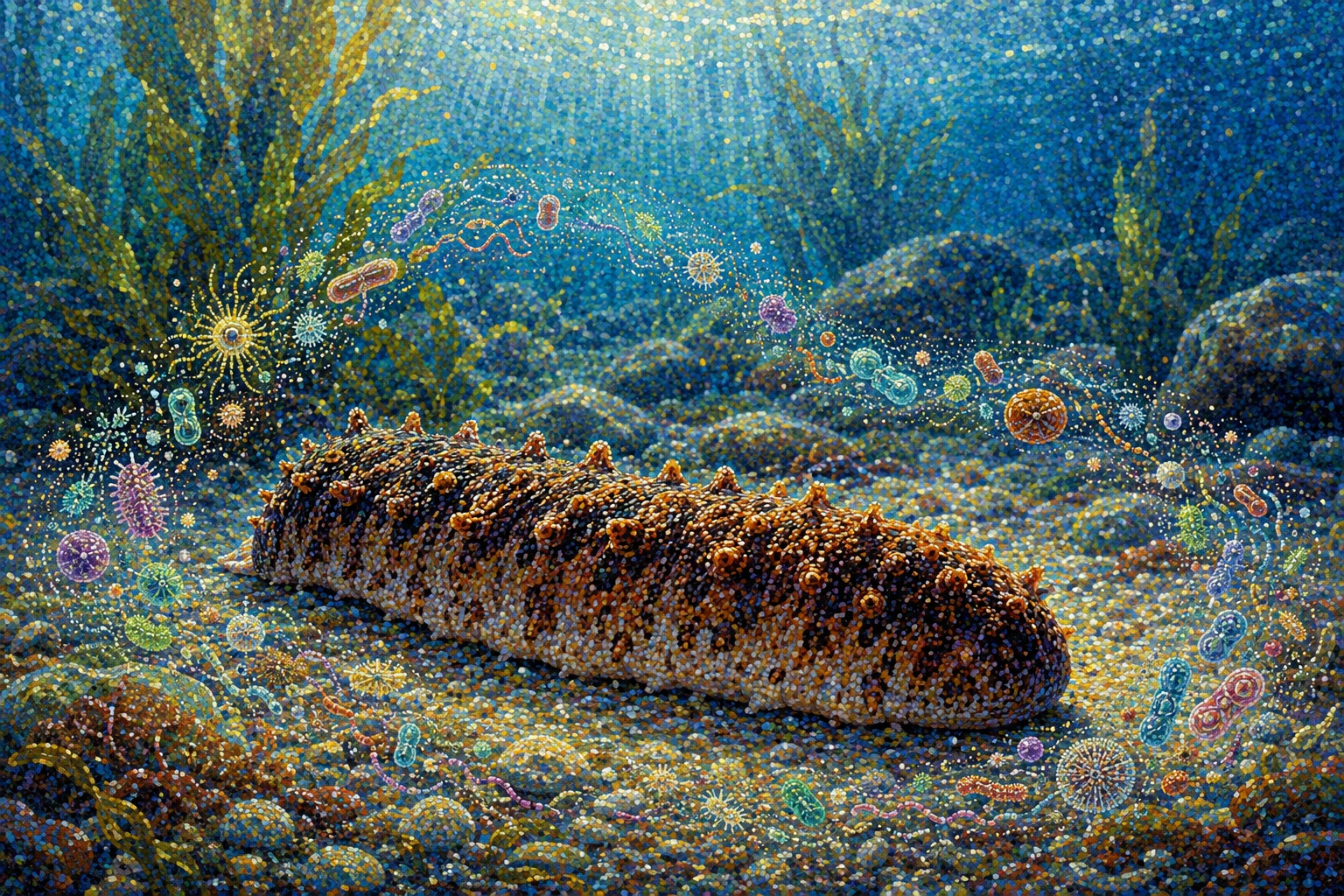
In a hatchery tank in southern Hokkaido, life begins at a scale the eye can barely follow. A fertilized Japanese sea cucumber egg divides, becomes a gastrula, and then takes on the transparent, drifting form of an auricularia larva. A gut develops. Feeding begins. The larva changes again, prepares to settle, and finally assumes a bottom-dwelling life. Long before it looks recognizably like a sea cucumber, a second succession is under way: bacteria arrive, disappear and establish themselves on and within the growing animal.
Conventional seed production is designed around broodstock maturation, spawning, fertilization, water temperature, salinity, food, density and water exchange. Because disease can destroy a cohort, microbes often enter this plan as enemies to exclude or contamination to disinfect. But a sterile animal is neither the natural condition nor necessarily the healthiest one. If some bacteria provide scarce nutrients, occupy space that a pathogen would otherwise seize, or participate in a developmental transition, the objective changes from eliminating microbial life to managing a community.
That is the premise behind work led by Tomoo Sawabe, Sayaka Mino and Juanwen Yu at Hokkaido University’s Faculty of Fisheries Sciences, with Yuichi Sakai and colleagues at the Hokkaido Research Organization’s Hakodate Fisheries Research Institute. Their review, published online by Current Microbiology on July 4, 2026, draws together 126 references and several years of research on Apostichopus japonicus as a “holobiont”—an animal and its associated microbial world considered as an ecological whole.
The review is not a report of one new commercial hatchery trial. Its importance lies in assembling a chain of evidence: three years of microbiome sampling across early development; a living collection of bacteria isolated from eggs and larvae; descriptions of previously unknown species; a 30-day growth experiment with one native bacterial strain; genome analysis; and a five-week study of gene expression in the host. The claim is appropriately narrower than “add bacteria and solve aquaculture.” It asks which organisms appear, when they arrive, what they may do and whether a carefully tested relationship can reduce slow growth and uneven performance in seed production.
Seeing one animal as a community
Holobiont is the name given to a host and the bacteria, archaea, fungi, protists, viruses and other organisms associated with it. The word joins the Greek holos, or whole, with biont, a living entity. Symbiosis scholar Lynn Margulis and collaborators used it in 1991; research on corals, their photosynthetic partners and their bacteria later carried it into wider scientific use.
The useful version of the idea does not pretend that every microbe is a loyal partner. Some organisms persist through much of a host’s life. Others arrive transiently from food or water. A pathogen is part of the associated community too. Cooperation, competition, predation and replacement can occur at once, and a change in temperature or diet may reorganize the cast.
A stronger evolutionary proposition—the “hologenome” as a single unit of selection—remains debated. Many microbes are not reliably passed from parent to offspring, and each microbial lineage retains its own evolutionary interests. In the Hokkaido program, holobiont is most valuable as an operational lens, not a declaration that animal and microbiome have become one indivisible organism. It asks a practical question: what work disappears from view when investigators measure only the sea cucumber?
A hatchery tank does not contain “sea cucumbers” and “water.” It contains a small ecosystem remade daily by hosts, microbes, food, seawater and surfaces.
The echinoderm that tills the seabed
The Japanese sea cucumber belongs to the echinoderms, alongside sea urchins and starfish. It uses feeding tentacles to take in sand and mud, digests organic matter, microalgae and bacteria, then returns the particles to the seabed. This slow passage mixes the sediment and influences oxygen and nutrient cycling. The animal barely seems to hurry, yet its ecological labor as a bioturbator can be considerable.
Its biology is equally unusual. Under severe disturbance, a sea cucumber can expel internal organs and later rebuild its intestine. Microbes also occur in the coelomic fluid, and the gut community is assembled anew during regeneration. Because echinoderms and chordates, including humans, are distant members of the deuterostome branch of animal life, sea cucumbers offer comparative clues about immunity, regeneration and the evolution of host–microbe relationships.
A. japonicus lives along temperate coasts of the Russian Far East, northern China, the Korean Peninsula and Japan, where its range extends from Kagoshima to Hokkaido. Red, green-blue and black color forms are recognized. As summer water becomes warm, the animal can stop feeding, shrink its digestive tract and reduce its metabolism in aestivation. Rising temperatures may therefore alter not only the season available for growth but the microbial community that accompanies it.
Hatchery growth is notoriously uneven. Juveniles produced on the same day, held in the same tank and offered the same food can diverge sharply in size. Genetics, access to food, density, temperature, particle size, nutrition and disease all matter. The Hokkaido team began with the possibility that microbes account for part of the difference—and that the earliest days of life may determine relationships visible months later.
Three and a half centuries of trade, followed by a quiet crisis
In Japan, sea cucumber appears in vinegared dishes at New Year and in restaurants. Salted intestine, konowata, and dried ovary, kuchiko, are prized delicacies. Far beyond Japan, dried sea cucumber is a luxury food and traditional tonic in Chinese cuisine. Trade in dried A. japonicus from Japan to China reaches back at least 350 years, with Hokkaido long serving as one of the industry’s centers.
High prices create danger when an animal is easy to collect from shallow seabeds and needs sufficient local density for successful external fertilization. The FAO’s 2008 global review documented “serial depletion”—fishers exhausting the highest-value species and moving to less valuable ones or new grounds. A later global analysis found that many sea cucumber fisheries remained inadequately managed and often lacked basic biological information. The IUCN assesses A. japonicus as Endangered.
Japan’s history differs from the vast pond-culture industry developed in China. Japanese production has depended heavily on wild capture, reinforced by stock enhancement: hatcheries produce juveniles and release them to coastal grounds. Hokkaido researchers and fishing communities have spent years testing nursery systems, release size, movement, growth, longevity and economics.
Release is not magic. If habitat deteriorates, spawning adults are too sparse, or excessive and illegal harvest continue, adding juveniles is water poured into a leaking vessel. Holobiont research may improve the quality and reliability of seed, but it cannot substitute for closed seasons, minimum sizes, protected grounds, maintenance of broodstock and scrutiny of trade.
The hatchery’s most vulnerable invisible stage
Adults release eggs and sperm into seawater. In artificial seed production, temperature and other cues can be used to induce spawning, after which fertilized eggs are collected. Embryos pass through gastrulation and become bilaterally symmetrical auricularia larvae. Their digestive systems mature as they feed on phytoplankton. Later forms include the barrel-shaped doliolaria and the five-tentacled pentactula, which settles and begins benthic life.
That transition is vulnerable. A small change in water quality, insufficient food, crowding, unsuitable settlement material or an outbreak can erase much of a cohort. Early size differences widen, making it difficult to deliver uniform juveniles for sale or release. Slow growers occupy tanks longer, adding feed, labor and facility cost.
Microbial communities change at the same time. The Hokkaido team repeated production during 2019, 2020 and 2021, collecting 28 host samples at six points: fertilized egg, gastrula, early auricularia, late auricularia, pentactula and juvenile. Twenty-six samples of rearing seawater were taken alongside them. Sequencing a marker in the bacterial 16S ribosomal RNA gene allowed the team to compare what lived with the animal and what lived in its water.
| Developmental stage | Change in way of life | Microbial question |
|---|---|---|
| Fertilized egg / gastrula | No feeding; the fundamental body plan is forming | Do the first pioneer bacteria come from parents, seawater or the facility? |
| Early auricularia | Planktonic life; digestive tract is developing | How does the community shift as the gut forms? |
| Late auricularia | Active feeding; gut is functional | How much do food and seawater supply? |
| Pentactula | Transition from swimming to settlement | Does contact with a substrate recruit a new community? |
| Juvenile | Begins consuming organic material on the bottom | Which core bacteria remain to support growth, digestion or defense? |
What 2.34 million reads revealed
The project generated 2,337,684 Meta16S reads. After quality control, the profiles showed a clear change around development of the working digestive tract. Families including Pseudoalteromonadaceae were prominent early; Rhodobacteraceae became more abundant later. Development did more than reshape the animal. It created new microbial habitats and new sources of food.
The host and seawater shared 64.2% of their bacterial taxa, yet their communities were statistically distinct. SourceTracker modeling estimated that seawater contributed 52% of the larval microbiome before gut development and 58% afterward. Unidentified sources still accounted for an estimated 41% before and 28% after. Water was a major reservoir, but a larva was not merely a bag of seawater: body surfaces, development, feeding and host selection constructed a characteristic community.
The researchers sought more than the bacteria that happened to be abundant in one batch. Their definition of a core combined taxa making up the top 75% of reads with occupancy in more than 70% of samples and a normalized core index. Alteromonadaceae and Rhodobacteraceae appeared in more than 93% of larval samples and together represented 42.1% of the community.
Recurrence across years suggested that some groups may perform functions repeatedly favored by the developing host. Yet 16S sequencing is principally a name tag. It says who appears to be present, not precisely what that organism is doing. Closely related strains can behave very differently. To move from association to experiment, the team needed living isolates.
Two hundred fifty culture tubes, and six names new to science
From fertilized eggs and larvae, the researchers isolated 250 strains and stored them as an A. japonicus pioneer microorganism collection. DNA alone can reveal a sign of life; it cannot be added to feed, tested against a pathogen or made to produce metabolites. A culture collection converts a sequencing observation into material that can be challenged, compared and returned to the host.
Genome-based taxonomy led to proposals for at least six new bacterial species. Aliamphritea hakodatensis represented both a new species and a new genus, while Thalassotalea hakodatensis also carried Hakodate in its name. The other proposed species were Neptuniibacter victor, Marinobacter apostichopi, Pseudoalteromonas apostichopi and Vibrio apostichopi. The epithet apostichopi marks their relationship to the host from which they were recovered.
Novelty is not the same as benefit. The genus Vibrio includes pathogens as well as neutral and potentially useful organisms; a genus label cannot certify safety. Conversely, a familiar marine bacterium may possess a valuable pathway in only one strain. Taxonomy, whole-genome analysis, safety testing and functional evidence must therefore be built strain by strain.
The collection’s deeper value is reproducibility. “A bacterium that seems to occur in sea cucumber larvae” has become a frozen vial that another investigator can revive and test for growth, immunity, nutrition or pathogen suppression. It is an archive of biological possibilities—and a safeguard against telling functional stories from sequence data alone.
BL28, the partner recovered from a larva
One core sequence, ASV0007, matched Sulfitobacter pontiacus strain BL28, isolated from a blastula-stage larva in the 2019 cohort. Sulfitobacter belongs to the marine family Rhodobacteraceae and is associated with sulfur-compound metabolism. BL28’s genome contained distinctive genes connected to amino-acid and fatty-acid biosynthesis, carbohydrate transport, vitamin B12 production and polyhydroxybutyrate metabolism.
For the 2023 experiment, 30 juvenile sea cucumbers from a seed-production facility at Kumaishi were randomly assigned among six tanks. They were held for 30 days at 18°C, salinity of 3.3% to 3.5% and pH 7.8 to 8.0. Commercial powdered feed was offered twice weekly; the treatment received BL28 at a final concentration of 10,000 colony-forming units per milliliter. The outcome was the specific growth rate in body length.
A Bayes factor of 654.777 favored the hypothesis that the BL28 group grew more than the control. In plain language, these data fitted the growth-effect model about 655 times more strongly than the no-difference model. That is strong evidence within this experiment, but the experiment remained small: 30 animals in total, 15 per treatment. It did not establish commercial-tank yield, weight gain, long-term survival or establishment after release.
Metapangenomic analysis added a clue about timing. Reads corresponding to the BL28 genome became more abundant after gut development. That is consistent with BL28, or very close relatives, finding a niche as the intestine begins to work and feeding starts. The candidate was not an arbitrary additive imported from elsewhere; it belonged to the early pioneer community the project had set out to understand.
- Observation: a core sequence appeared across years and developmental stages.
- Isolation: living BL28 was cultured from a blastula-stage larva.
- Genome: researchers identified genes that could contribute to nutrition and metabolism.
- Intervention: a small 30-day feeding test supported faster growth.
- Host response: a later five-week trial measured gene-expression changes in the sea cucumber.
- Not yet reached: commercial scale, multiple facilities, disease challenge, post-release performance or multigenerational effects.
Growth without an obvious stress alarm
In 2025, the group examined the transcriptome—the full pattern of genes being expressed—in juveniles given BL28 for five weeks. Analysis with a pipeline called Dusselpore found significant regulation in host genes associated with lipid metabolism and proteoglycans, including chondroitin-related pathways.
Most of the principal heat-shock protein genes were not induced. These proteins respond not only to temperature but to oxidative stress, toxicity and nutrient shortage. Faster growth accompanied by a strong cellular alarm could suggest that metabolism had been pushed too hard. Its absence led the authors to propose that BL28 promoted growth under a relatively low-stress physiological condition.
Several mechanisms are plausible. BL28 might supply B12 or other metabolites missing from feed, convert difficult ingredients into available nutrients, transfer stored energy through compounds such as polyhydroxybutyrate, impede pathogen colonization, or signal to host lipid and connective-tissue metabolism. But a gene in a bacterial genome is not proof that its product was made in the tank, delivered to the host and caused the measured outcome.
Mechanism now requires direct metabolite measurements; comparison with cell-free supernatant and killed bacteria; strains engineered or selected to lack B12 or PHB pathways; and imaging that shows where BL28 resides in host tissue. Only by separating what is necessary from what is sufficient can a promising isolate become a reproducible hatchery technology.
The power—and traps—of microbiome science
The Hokkaido program is strongest where methods overlap. A 16S amplicon survey follows community change across many samples. Shotgun metagenomics reads the genes carried by the community. Metapangenomics connects the gene inventory of a particular strain with its representation in an environmental sample. Cultivation provides material for causal tests. Host transcriptomics records the animal’s response.
Every layer also has limits. A 16S marker may not distinguish close strains, and relative abundance is not a direct cell count. Detecting DNA does not prove that an organism is alive or active. A metagenomic functional annotation is a capability, not a measured metabolic rate. A shift in RNA expression is not automatically a corresponding change in protein, still less proof of the ultimate cause of growth.
The 64.2% overlap between water and host shows that the facility environment exerts strong influence, but it does not determine every direction of transfer. Seawater, food, wall biofilms, broodstock and equipment can all contribute. Repetition over three years is valuable; the same core still needs testing in other facilities, seasons and broodstock populations.
Nor does “core” mean “indispensable.” A common bacterium may simply prefer the same conditions as its host. Isolating BL28, adding it back and measuring the host response is an important step from correlation toward function. One strain, however, cannot represent every interaction occurring across a microbial community.
Before a probiotic enters the hatchery
A useful bacterium in a research tank is not yet a hatchery product. Engineers must determine concentration, developmental window, duration and delivery route: feed, water or settlement surface. The organism must survive refrigeration or freeze-drying. It must not displace other beneficial microbes, exchange undesirable genes with pathogens, or persist outside the facility in ways that alter coastal ecosystems.
At minimum, whole-genome screening should search for virulence factors and antimicrobial-resistance genes; laboratory assays should assess hemolysis and toxicity; and dose response should be reproduced across parent populations, temperatures and feeds. Multi-site randomized trials must treat the tank—not each animal sharing a tank—as the statistical unit, with enough independent replication to measure survival, size variation, disease, metamorphic success and feed efficiency as well as growth.
BL28 has the advantage of being native to the host system, but “native” is not an automatic synonym for “safe.” Manufacturing must preserve the identity of the strain rather than the species alone, prevent contamination, and control viability and activity in every lot. A designed consortium of strains with complementary functions might prove more stable than a single organism, but each added member multiplies the challenge of safety and reproducibility.
| Implementation stage | What must be checked | What failure would mean |
|---|---|---|
| Strain selection | Whole genome, virulence, resistance, metabolites | A harmful strain or undesirable gene enters production |
| Formulation | Shelf life, viable count, feed adhesion, dosage | Effect changes from lot to lot |
| Hatchery trial | Multiple tanks and sites, temperature, feed, broodstock | A facility-specific accident is mistaken for a product |
| Environmental review | Effluent, non-target species, establishment and disappearance | Microbial ecology changes outside the facility |
| Stock assessment | Post-release survival, dispersal, reproduction and harvest | Better hatchery growth fails to restore the fishery |
A seabed cleaner in circular aquaculture
Because sea cucumbers consume organic material, they are candidates for integrated multi-trophic aquaculture, in which feces and uneaten food from fish, oysters or scallops become resources for another crop. In a Japanese experiment lasting 216 days beneath a Pacific oyster raft, juveniles reached an average 5.5 grams under the raft compared with 2.6 grams at a control site; survival was 100% and 96%, respectively.
Trials under marine fish cages have likewise found high survival and growth while sea cucumbers consumed settling organic matter, with extended culture reaching market size. Returning some carbon and nitrogen from the sediment to useful biomass could combine a local reduction in farm waste with a new source of revenue.
“Cleaner” can nevertheless become a dangerous metaphor. Sea cucumbers have finite appetite and carrying capacity; if stocked too densely, their growth can fall and sediment disturbance can increase. They do not necessarily eliminate pathogens, medicine residues or low oxygen. Carbon from feed does not vanish: it is partitioned among respiration, excretion and new tissue. Depth, currents, deposition, sediment and season determine how many animals a site can support.
The holobiont lens matters here too. Transformation of waste is carried out not by the animal alone but by microbes in its gut and the surrounding sediment. If a suitable community helps extract nutrition from poor deposits, probiotics might eventually tune an ecological service as well as individual growth. That prospect remains a hypothesis requiring ecosystem-scale evidence.
Producing seed is not the same as restoring the sea
Faster, more uniform and resilient juveniles could reduce hatchery cost and stabilize the supply of animals for release or farming. Core early-life bacteria might also serve as health indicators: a hatchery could monitor a community and adjust water or food before it collapses. Establishing a desirable community early may ultimately be more sustainable than responding to disease with antimicrobials.
But successful seed production cannot be equated with recovery in nature. Released animals must be followed to learn where they move, how long they live, whether they mature and whether they breed with the wild population. A narrow broodstock pool may add bodies while reducing genetic diversity and the capacity to adapt to changing water. The consequences of releasing facility-associated microbes at scale also need evaluation.
Hokkaido’s 2025 mini-symposium on sustainable management was revealing in its breadth. It placed trade and CITES discussions beside the longevity, growth, dispersal and economics of released seed; behavior; aestivation; low-nutrient feed; and holobiont research. Sustainable use cannot be achieved by one technical fix. It emerges when trade, harvest rules, habitat, physiology, behavior, nutrition and microbiology are handled as parts of the same system.
A probiotic is not a license to overfish. The more a community invests in high-quality seed, the stronger the case for protected release grounds, enforceable harvest limits, action against illegal trade and patient monitoring. A hatchery and the sea are not separate worlds. They are the first and second halves of one life history.
Hokkaido’s view of a life larger than one animal
Holobiont research does not reduce a sea cucumber to a container for microbes. It does the opposite: it shows, at higher resolution, how much exchange is required to make one animal. The bacteria that first meet an egg, those that expand as the gut forms, and those that reorganize during aestivation or intestinal regeneration trace a history that runs beside the development of the host.
The Hokkaido team moved from correlations in sequences to living isolates, from isolates to an intervention, and from that intervention to the animal’s gene response. BL28 is promising, but it is still a candidate. That restraint is a strength. Success is not merely making one juvenile larger. It is producing animals that perform across years and facilities, without increasing disease, shifting burdens into the environment or failing once released.
For 350 years, dried sea cucumber carried a northern marine animal to distant tables. Hakodate’s next export may be less tangible: the knowledge required to manage life as a community. Instead of trying to sterilize the water and defend the host alone, the hatchery of the future may identify useful relationships and learn how to keep them intact.
On the seabed, the sea cucumber silently swallows sediment and tills the coast with microbes beside and within it. Sustainable seed production may need to resemble that work. It would not push a lone animal through a factory, but cultivate a relationship circulating through feed, water, bacteria, sediment and fishing ground. Hokkaido’s holobiont program has opened the door to an aquaculture designed around those unseen companions.
Sources and references
This article centers on the review published July 4, 2026, and checks it against primary Hokkaido University and Hokkaido Research Organization work on early-life microbiomes, bacterial isolation, the BL28 growth experiment and host transcriptomics, as well as FAO management documents and histories of Japanese farming and trade. The small growth experiment is not presented as proof of commercial performance, post-release survival or stock recovery.
- Yu et al., The Sea Cucumber Holobiont and Probiotics: Recent Progress on Apostichopus japonicus, Current Microbiology (2026)
- Hokkaido University Laboratory of Marine Microbiology, 2026 research topics
- Yu et al., Early Life Core Microbiome and Growth-Promoting Sulfitobacter, Animal Microbiome (2023)
- Sawabe et al., Probiotic Effects of Sulfitobacter pontiacus BL28, Current Microbiology (2025)
- Hokkaido University, research announcement on marine probiotic BL28 (2025)
- Hokkaido University, six new marine bacteria from eggs and larvae (2024)
- Yamano et al., Pseudoalteromonas apostichopi, Vibrio apostichopi and Marinobacter apostichopi (2024)
- Yamazaki et al., Annual Fecal 16S Sequencing and Feeding Behavior, Aquaculture Research (2020)
- Yamazaki et al., Gut Microbiome Dynamics During Regeneration, PeerJ (2020)
- Japanese Society of Fisheries Science, A. japonicus Holobiont and a Growth-Promoting Probiotic Candidate (2026)
- Sakai, Lifespan, Growth, Dispersal and Economics Learned from Seed Release (2026)
- Katow et al., Sea Cucumber Farming in Japan (2015)
- Apostichopus japonicus: Fisheries, Trade, and Foodways in Japan (2015)
- FAO, Sea Cucumbers: A Global Review of Fisheries and Trade (2008)
- FAO, Putting into Practice an Ecosystem Approach to Managing Sea Cucumber Fisheries (2010)
- Yokoyama, Sea Cucumber Culture Below a Pacific Oyster Raft (2015)
- Purcell et al., Global Analysis of Sea Cucumber Fisheries and Overfishing, Fish and Fisheries (2013)
- Bordenstein and the Holobiont Biology Network, The Disciplinary Matrix of Holobiont Biology, Science (2024)