- A roadside can be green without becoming what it once was
- A ten-year test along a road in northern Hokkaido
- Topsoil is not simply a bag of dirt
- An early advantage did not last in the same form
- The lasting signal was species composition
- The longer history of engineered green slopes
- The engineering trade-offs remain real
- A promising tool near sensitive landscapes
- Infrastructure decisions can leave an ecological signature
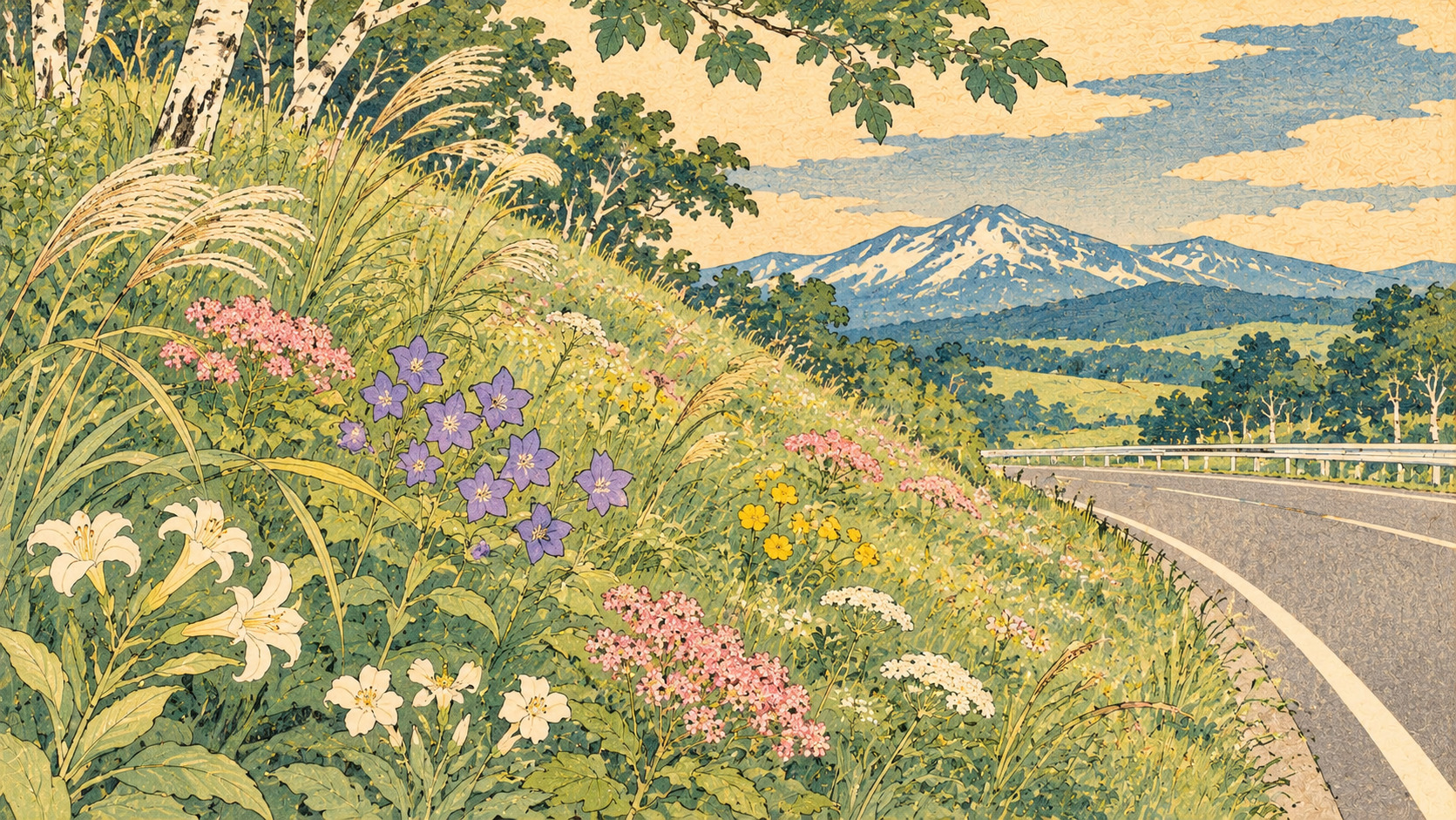
A roadside can be green without becoming what it once was
The embankment looks like an ordinary engineering problem: bare soil beside a road must be protected before rain and wind carry it away. Sowing quick-growing grasses can solve that immediate task. But what if the objective is more demanding—to restore something resembling the plant community that occupied the landscape before construction?
Researchers working in a Hokkaido University experimental forest have followed that question for a decade. Their November 13, 2026 announcement describes a comparison between two ways of reusing topsoil on a road embankment. One method transported intact blocks containing roots, dormant seeds and soil organisms; the other loosened topsoil before replacing it. Both produced vegetation. Only the intact-block treatment consistently maintained a plant community more similar to its source after ten years.
The distinction sounds modest, but it changes how success is measured. Green cover may protect soil while failing to reproduce the original mix of species. For conservation-sensitive infrastructure, the destination may matter as much as how quickly vegetation establishes.
A ten-year test along a road in northern Hokkaido
The study was conducted within Hokkaido University's Nakagawa Experimental Forest, on a fill slope associated with construction of the Route 40 Otoineppu bypass, now known as the Oto-naka Road. It was not a nationwide trial. The researchers established replicated 7-by-7-meter plots for intact topsoil blocks and for loosened-and-replaced topsoil, four replicates per treatment.
Between 2014 and 2023, the team monitored overall plant cover, native and nonnative cover, species richness, the Shannon diversity index, herbaceous and woody species, community height, forest-associated plants and similarity to the vegetation at the donor site. These measures distinguish a surface that has simply become vegetated from one whose species composition has recovered in a particular direction.
The work extends an earlier two-year assessment of a method developed to use conventional construction machinery with relatively simple auxiliary equipment. Long monitoring matters because early winners in a disturbed landscape may lose ground later. A one-season photo cannot establish what a restored ecosystem will look like ten years on.
Topsoil is not simply a bag of dirt
To an engineer, topsoil can be described by depth, texture, moisture and handling requirements. To an ecologist, it is also a living layer: fine roots, seedlings, a seed bank, decomposers, small soil animals and microbial communities occupy a structure shaped over years. Disrupting it can change how those components interact.
The intact-block approach transfers portions of that upper layer while trying to preserve their physical arrangement. Its comparison treatment also reuses local soil, but breaks it apart before spreading it back over the slope. Neither treatment should be confused with doing nothing, and neither is equivalent to simply scattering a commercial grass seed mix.
Japan has used fast-growing introduced grasses and salvaged topsoil in road-slope revegetation since the period of rapid infrastructure expansion in the 1960s. Those methods can be effective for erosion control. The Hokkaido study asks a different, site-specific question: which construction choice better maintains the identity of the surrounding plant community?
An early advantage did not last in the same form
At the beginning of the experiment, the intact-block plots had less cover from nonnative plants. Researchers suggest that transferred native plants and organisms may have contributed to “biotic resistance,” limiting opportunities for outsiders to establish. That remains a proposed explanation for the pattern, rather than direct proof of a particular interaction.
Over time, cover by nonnative plants also declined in the loosened-topsoil plots. By the tenth year, both methods had broadly similar nonnative cover. A dramatic claim that intact blocks permanently prevent invasive plants would therefore misrepresent the findings.
Both sets of plots developed vegetation, and even the loosened-topsoil plots accumulated forest-associated plants. If the only measure were whether the slope became green, both approaches showed success. The sustained distinction lay elsewhere.
The lasting signal was species composition
By the end of the decade, the two treatments supported communities with different species composition. The intact-block plots remained more like the original vegetation at the donor location. That is the central result of the study published online November 10 in the Japanese journal Japanese Journal of Conservation Ecology (Hozen Seitaigaku Kenkyu).
Imagine two fields of similarly dense vegetation. One preserves an assemblage of forest-floor species familiar from the adjacent habitat. The other is green, perhaps equally stable at a glance, but occupied by a different mix. Their photographs could look equally reassuring while ecological monitoring finds different outcomes.
Species composition does not tell the entire story of ecosystem function. The study did not establish complete restoration of soil microbes, invertebrates, pollinators or every underground process. Nevertheless, it shows that choices made during construction can influence the direction of community assembly a decade later.
The longer history of engineered green slopes
Roadside planting sits at the intersection of ecological ambition and engineering necessity. Revegetation commonly starts with the urgent requirement to stabilize disturbed surfaces against erosion. Japan's extensive road construction from the 1960s onward expanded the use of introduced herbaceous plants and approaches based on salvaged soil.
Later guidance from Japan's National Institute for Land and Infrastructure Management emphasized roadside greening compatible with regional ecosystems. Such work reframes planting from an afterthought into part of project design: assess existing habitats, decide what can be salvaged, prepare the receiving slope and maintain the resulting community.
Topsoil-block transplanting also predates this 2026 study. Separate Japanese research published in 2016 evaluated a cut slope 13 years after block transplantation and reported 90% vegetation cover, alongside limitations in tree growth. That is an informative precedent, not a second measurement of the Nakagawa plots; the sites and study designs differ.
The engineering trade-offs remain real
Preserving intact soil blocks may impose logistical requirements: excavation, temporary storage, hauling, installation on a slope and protection against damage. Donor areas must be chosen carefully, and transporting soil can have consequences for the place from which it is removed. Steep slopes, drainage and stability create additional constraints.
These are issues that projects should evaluate, not adverse outcomes established by this experiment. The study was designed primarily around plant-community trajectories, not a comparative accounting of project costs, a full geotechnical safety assessment or performance under every climate and soil condition.
U.S. Federal Highway Administration guidance, for comparison, warns that improperly placed material on steep slopes may create instability under wet conditions. Ecology cannot substitute for slope engineering. If intact blocks are adopted elsewhere, installation design and local conditions still determine whether the approach is appropriate.
A promising tool near sensitive landscapes
Hokkaido University's team identifies national parks, protected forests and areas near rare plant communities as settings where restoring regional species assemblages may be particularly important. In such environments, an embankment dominated by generic cover plants can be a poor substitute for the vegetation it displaced.
There is an intriguing ecological question behind the result: can small differences in the starting conditions direct plant communities toward different long-lived configurations? Researchers mention the possibility of multiple stable states. They are careful not to say that their ten-year trial proved that ecological theory.
Future monitoring will need to look below ground as well as above it. Soil fauna and microorganisms may shape survival and competition, but their long-term recovery was not fully evaluated in this experiment. More sites and climates will also be needed before general rules can be drawn.
Infrastructure decisions can leave an ecological signature
A road improves connectivity for people while changing the landscape around it. There is no engineering formula that makes the disturbance disappear. But projects can choose which part of a site's biological legacy to carry forward and how carefully they will measure the results.
The Nakagawa experiment illustrates the importance of setting an explicit objective. If the goal is rapid cover for erosion protection, a conventional treatment may be entirely sensible. If the goal is to approximate a specific preconstruction species assemblage, intact topsoil transplantation offers evidence of a long-term advantage in this setting.
Ten years after construction, the most telling observation was not that grass had grown beside the road. It was that one group of plots still carried a recognizable botanical connection to the place from which its living soil had come. That is a practical, testable lesson in how infrastructure can be designed with ecological memory in mind.
Primary sources, research and limitations
This desk report draws on Hokkaido University’s announcement, the original paper’s publication information and historical revegetation research. No original interviews or site visits were conducted. Complete soil-biota recovery and multiple stable community states have not been demonstrated.