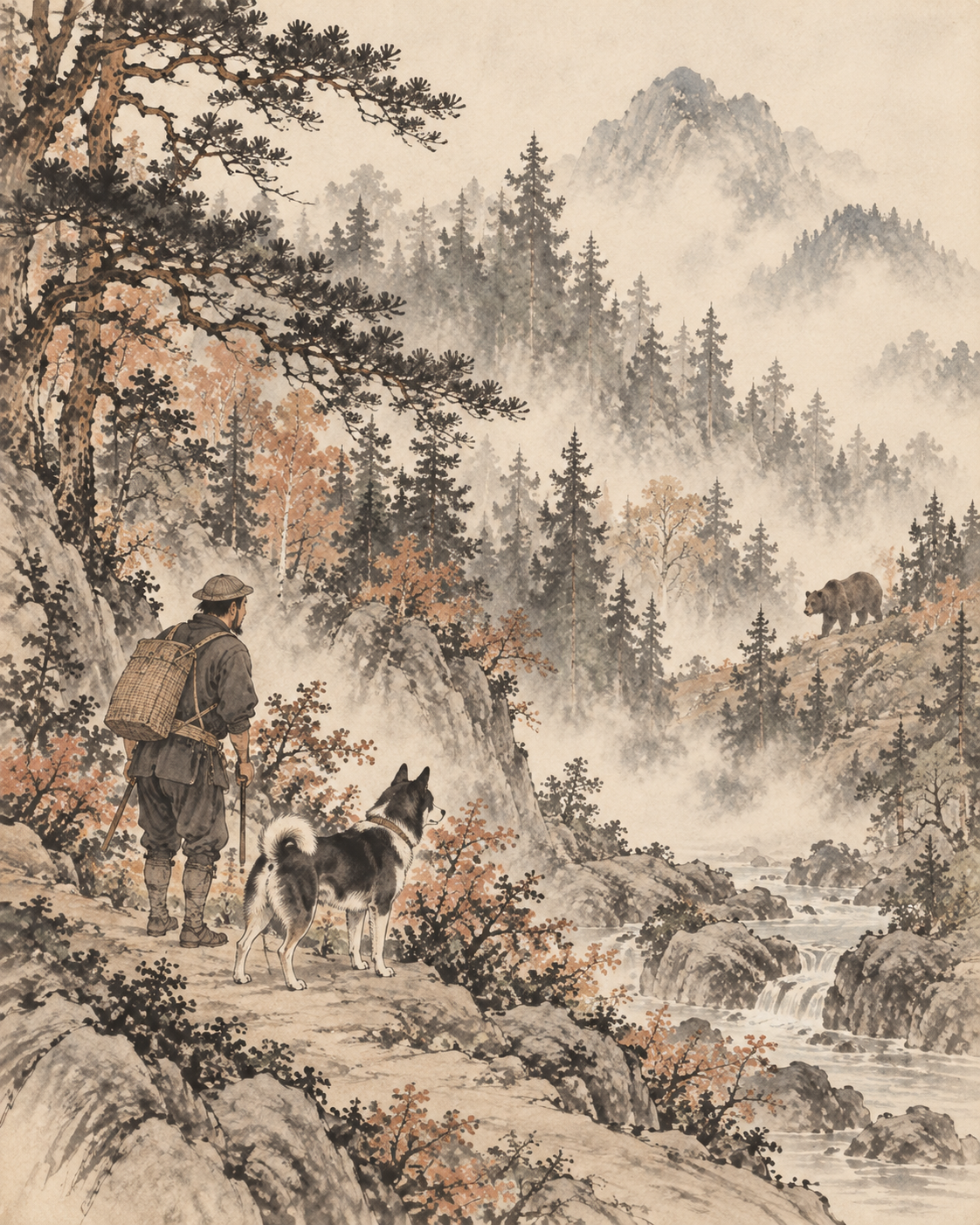
Hokkaido is preparing for an unusual addition to the human side of its long-running conflict with brown bears: a black-and-white dog trained to find them.
The project, however, needs to be described precisely. It is not a Hokkaido prefectural government program. The Sapporo-based nonprofit EnVision Conservation Office is arranging to bring a Karelian Bear Dog named Kai from the Wind River Bear Institute in the United States. Born in February 2026, Kai was still training in Montana in the latest public update. The project schedule calls for arrival in Japan around December, a year of training and adaptation in 2027, and full-scale use in brown-bear work around April 2028.[1][2]
The distinction matters because Hokkaido’s government is simultaneously pursuing its own mix of government hunters, seasonal population management, drones, AI and zoning. Kai is a nonprofit-led experiment intended to add another tool to that larger landscape, not a replacement for the prefecture’s wildlife-management system.[3]
EnVision’s crowdfunding campaign shows the level of public interest. It raised ¥12.078 million from 923 supporters against an initial ¥8 million goal.[4]
Why a dog, and why now?
Hokkaido estimates that its brown-bear population rose from about 5,560 animals in 1991 to 12,190 in 2024—roughly 2.2 times as many. The prefecture says conflict between people and bears has reached an unprecedented level as bears increasingly appear near populated areas.[3]
Human injuries and deaths fluctuate sharply year to year. Hokkaido’s June 2026 public-information material lists nine casualties in fiscal 2023, three in fiscal 2024 and six in fiscal 2025. Agricultural losses rose from ¥249 million in fiscal 2022 to ¥332 million in fiscal 2023 and ¥354 million in fiscal 2024.[3]
Governor Naomichi Suzuki said in June that Hokkaido police received more than 5,000 bear-related reports in 2025, more than double the previous year. Roughly 600 reports had already been logged by the end of May 2026.[5]
EnVision wants detection before deterrence
EnVision was established in 1997 and has worked on biodiversity conservation from Sapporo for nearly three decades. Since 2010 it has also carried out brown-bear response work commissioned by Sapporo City. Its fieldwork emphasizes reading evidence left at an appearance site—scat, hair, tracks and other signs—and sometimes combining those findings with DNA analysis to identify individual bears.[4]
The difficulty is uncertainty. Residents may report a bear-like animal or suspicious scat, yet investigators can arrive and find too little evidence to confirm what happened. That uncertainty can delay decisions, prolong warnings and make it difficult to distinguish a dangerous repeat visitor from a one-time sighting.
Kai is expected first to work as a highly mobile biological sensor. EnVision says a trained dog’s sense of smell could help locate bears and traces that human investigators miss, allowing canine evidence to be combined with DNA and other field information.
Hokkaido is not planning immediate bear-chasing operations
Karelian Bear Dogs are famous for confronting large game with persistent barking, so it is easy to imagine Kai being sent directly at Hokkaido brown bears. EnVision is more cautious.
The nonprofit says active hazing is difficult in Sapporo for several reasons: Hokkaido brown bears are much larger than the Asian black bears managed in Karuizawa; the project initially has only one dog; Sapporo covers a much larger, denser urban area; and local bears generally do not carry radio transmitters that would allow responders to track their movements after being driven away. EnVision describes hazing as a future question rather than the first operating mission.[4]
That matters. Driving a bear from one place is not necessarily successful management if the animal simply moves into another neighborhood. Safe hazing requires knowledge of escape routes, animal location, handler safety and where the bear is likely to go next.
A Finnish hunting breed built to stand its ground
The Fédération Cynologique Internationale lists the Karelian Bear Dog as a Finnish Nordic hunting breed used primarily for elk and bear hunting, where it holds large game at bay by barking. The breed is medium-sized and robust, usually black with sharply defined white markings.[6]
The Finnish Kennel Club traces the breed to the forest regions of Karelia. Systematic breeding began in 1936 with the goal of producing a strong dog that would bark at big game. The name Karelian Bear Dog was adopted that year, the first standard was confirmed in 1945 and the first dogs were registered in 1946. The breed population was almost destroyed during the Winter War and later rebuilt in part with dogs brought from Russian Karelia.[7]
Modern Finnish descriptions emphasize alertness, boldness, independence and an intense hunting instinct. Those qualities explain why the breed can be useful around bears—and why simply owning the breed is not enough. Selection, socialization, obedience, specialized training and a skilled handler are essential.
Japan has more than 20 years of bear-dog experience
Kai will not be Japan’s first working bear dog. In Karuizawa, Nagano Prefecture, the wildlife organization Picchio brought a Karelian Bear Dog named Bullet from the Wind River Bear Institute in 2004, describing him as Japan’s first bear dog. Tama and Nanuq followed in 2015, and Picchio successfully bred Karelian Bear Dogs in Japan in 2018.[8]
Picchio has managed Asian black bears for Karuizawa Town since 2000. Its program combines electric fencing, bear-resistant waste systems, individual identification, radio tracking, habitat management and, where appropriate, dog-assisted hazing. The dogs are also used to find bears, protect field staff and educate residents.[9]
Picchio says residential bear sightings in Karuizawa fell from a high of 36 in 2006 to nine in 2016, and describes bear dogs as one contributor. It would be wrong to assign that decline to the dogs alone: waste control, fencing, monitoring and other management measures were operating at the same time.[9]
Hokkaido is not Karuizawa
The most obvious biological difference is the animal being managed. Karuizawa’s program focuses on Asian black bears. Hokkaido is brown-bear country.
Hokkaido describes adult males as just under two meters long and roughly 150–400 kilograms, with females around 100–200 kilograms.[3] Sapporo also has a large administrative area with long edges where forest meets developed land.
One dog cannot patrol that landscape. A more realistic description of Kai is as an additional sensor and specialist team member—not a dog that will somehow solve Hokkaido’s bear problem on its own.
The prefecture is building a layered response
Hokkaido’s official strategy is becoming more diversified. In June, the prefecture appointed its first “government hunter” to support municipalities and created a capture team from prefectural employees with brown-bear experience. Suzuki also proposed special-duty compensation for employees engaged in dangerous bear-control work.[5]
The prefecture conducts spring management removals in snow conditions that make tracks easier to follow, both to reduce bear density near settlements and to reinforce wariness of people. It is also testing drones and AI for identifying individual bears, while promoting zoning that distinguishes human-use areas from bear habitat.[3][10]
Hokkaido’s guidance also stresses behavior, not simply abundance. It says much serious conflict is associated with “problem individuals” that become attracted to human food or agricultural crops, and that reducing the total population alone will not remove conflict unless those animals are identified and managed appropriately.[11]
Nonlethal management and capture are not opposites
Bear dogs are often presented as a nonlethal tool, and that is part of their appeal. Detection, early warning and carefully managed hazing can create distance between people and bears without killing the animal.
But that does not eliminate the need for capture. Bears that attack people, repeatedly enter populated areas for food or display dangerous habituation may still require removal. Hokkaido explicitly describes capture—including population management—as one of the essential tools of wildlife management.[3]
The more interesting role for a dog comes before that decision. Better information about whether a bear is present, how fresh its tracks are and which direction it moved can allow authorities to make more targeted decisions—sometimes escalating faster, sometimes avoiding unnecessary closures or alarm.
The 2025 Mount Rausu attack showed the cost of uncertainty
After a serious brown-bear incident on Mount Rausu in August 2025, trailheads for Mount Rausu and Mount Iwo and access to the Rausu Lake trail were closed for months. They reopened on July 5, 2026 with new safety measures, while the Environment Ministry urged climbers to carry bear spray and check warning levels and recent sightings before entering the mountains.[12]
That episode illustrates how wildlife management reaches beyond conservation. A dangerous bear can affect hiking access, tourism, local business and public confidence. Underreacting puts people at risk; overbroad or prolonged restrictions carry their own costs. Better field intelligence can help narrow that gap.
Kai is not yet a working Hokkaido bear dog
As of late September, the most important fact is also the simplest: Kai is not yet operating in Hokkaido.
The public project schedule calls for the dog to arrive around December 2026 after training and import procedures, including quarantine requirements. Training and adaptation in Japan are planned for 2027, with full deployment in brown-bear work targeted for around April 2028.[4]
The campaign originally sought ¥8 million to cover transfer, training and care before departure, quarantine and intake costs, vaccinations and travel associated with WRBI personnel. It passed a second ¥11 million goal and closed at ¥12.078 million from 923 supporters.
So the story this autumn is not that a Finnish bear dog is already chasing Hokkaido’s brown bears. It is that a specialist organization has returned to an idea it first explored roughly 25 years ago, watched develop in Karuizawa, and now believes may be useful under Hokkaido’s much more demanding conditions.
One dog will not resolve a conflict spread across Japan’s largest prefecture. But if a trained nose can tell experts what is happening on the other side of a wall of brush before a person can see it, Kai may give Hokkaido something increasingly valuable: better information before the next decision has to be made.
