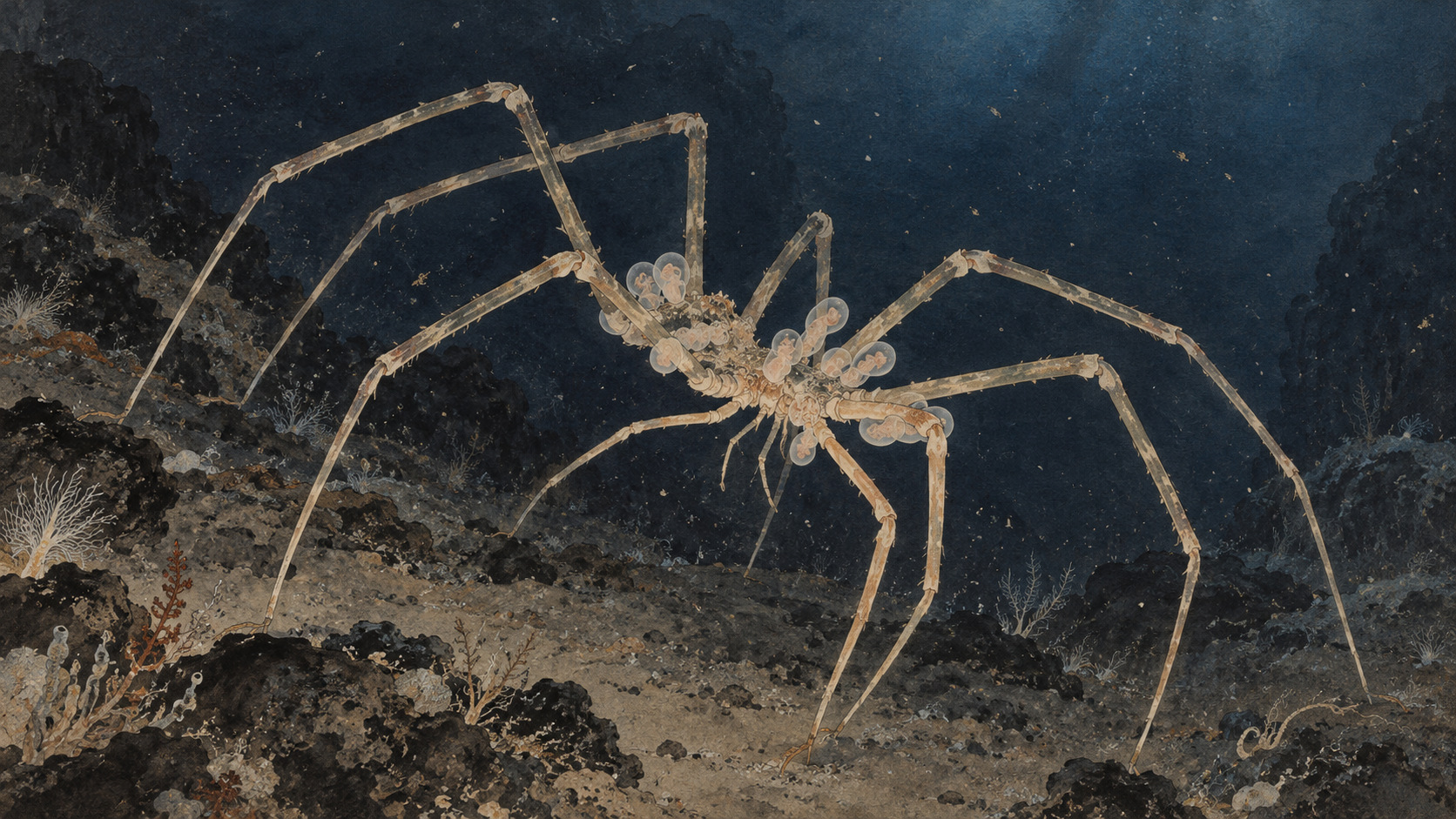
The surprise is not a newly discovered spider. It is the prospect that another animal uses a known sea spider as a nursery.
A discovery hiding on a creature’s back
Almost four kilometers below the surface of the northwestern Pacific, the seafloor is a world of sediment, darkness and sparse hard surfaces. Among its inhabitants are sea spiders: long-legged marine arthropods, not the terrestrial spiders their name suggests. Scientists examining specimens from the Japan Trench noticed something extraordinary attached to one animal’s body. It was carrying eggs that were not its own.
The capsules belonged to a flatworm. And although the adult animal has yet to be found, their presence points toward a previously undocumented relationship: a flatworm using the body of a living sea spider as a place to deposit its eggs. Hokkaido University announced the work October 22, following online publication in the taxonomy journal SPIXIANA on October 16. There is no need to invent a monster or a miracle. The remarkable thing is what the evidence actually shows.
Two specimens, one research voyage
The discovery began during the 2023 KH-23-5 expedition of the Japanese research vessel Hakuho-maru. On September 27, scientists obtained one female sea spider at 3,685–3,693 meters in the Japan Trench. On September 29, they collected one male at 3,890–3,893 meters. The work was led by doctoral researcher Shogo Sekiguchi and lecturer Keiichi Kakui of Hokkaido University.
Close examination and DNA sequencing identified both animals as Ascorhynchus mariae, a species first described in 1971. This is its first reported occurrence in Japanese waters and its deepest recorded collection. The team also supplied previously unavailable details of the female’s anatomy, a reminder that even a species known to science for decades can remain poorly documented. The researchers propose the Japanese common name Hebijita-tokkuri-umigumo, referring to a forked, tongue-like projection on its head.
Five capsules and three possible remnants
On the female’s body the researchers found five egg capsules. On the two specimens combined, they observed three additional structures interpreted as possible remnants of capsules. Appearance alone could not reliably tell them what group of animals had produced these objects. They therefore compared sequences from multiple genes and assessed the capsules’ evolutionary relationships with known species.
The evidence placed them in the flatworm family Trigonostomidae, with a relationship to the shallow-water genus Ptychopera. The genetic separation from described species, together with a very different deep-sea habitat, suggests that the parent may belong to an undescribed species. But the adults were not captured. No new flatworm species has been formally named, and the researchers cannot yet reconstruct its complete life cycle. That limit is not a footnote; it is central to understanding what this discovery does and does not establish.
Why a walking sea spider might make a nursery
Many animals need somewhere firm to attach their eggs. That sounds straightforward in a tide pool or a reef. On great expanses of muddy deep seabed, the choice of a suitable attachment surface may be more limited. A sea spider has a relatively rigid external skeleton and moves above the sediment. Its body offers a hard surface that does not stay buried in the mud.
That is the researchers’ intriguing ecological interpretation: for certain flatworms, the spider may be a mobile nursery. Yet the study did not observe a flatworm laying eggs, document the eggs hatching at sea, or measure whether being carried helps or harms either animal. The possibility of transport or protection is a hypothesis, not an experimentally demonstrated benefit. Nor should an egg capsule attached to another animal automatically be called parasitism. Parasitism implies a biological cost to the host that this study has not shown.
Sea spiders have hosted other passengers
The scientific claim is precise. Sea spiders were already known to carry the eggs of certain leeches in shallow waters and of some gastropods around Antarctica. Other organisms use sea spiders as living substrates. What is new here is the first report of a flatworm using a sea spider’s surface as an egg-laying site, and a rare deep-sea record for a flatworm outside the familiar parasitic groups.
There are roughly 1,400 described sea-spider species globally, according to the university’s release, with about 170 reported from Japan. Their spindly outlines may be unmistakable, but minute organisms attached to them are easy to overlook. Such relationships can be missed when biodiversity surveys stop at identifying the large, conspicuous animal in a sample.
A scientific thread reaching back to 2024
This is not Hokkaido University’s first striking finding about deep-sea flatworm reproduction. In a 2024 paper published in Biology Letters, Kakui and Aoi Tsuyuki described flatworm egg capsules recovered from rocks at 6,176–6,200 meters in the Kuril–Kamchatka Trench. Those black, approximately three-millimeter spherical capsules contained three to seven developing animals in the intact examples examined. The research offered rare direct evidence about the earliest developmental stages of free-living flatworms in the abyss.
The 2024 eggs and the 2026 sea-spider capsules must not be conflated. They were found in different locations and at different depths, and belong to differently identified flatworm lineages. The connection lies in the approach: examine apparently minor materials from deep-sea expeditions, use molecular tools to identify them, and piece together life histories that traditional collection methods rarely reveal.
The art of noticing what nobody came to find
The voyage collected marine organisms for systematic study; it did not set out to photograph a flatworm nursery. The finding emerged when researchers investigated small objects attached to the legs and trunk of a preserved animal. Their methods combined anatomical drawings, microscopic observations and comparisons of genetic sequences, allowing them to turn a mystery object into a testable biological identification.
Taxonomy sometimes has a reputation for being a catalog of Latin names. Here its wider significance is visible. Knowing exactly which sea spider was collected establishes where a species lives and how far down it occurs; understanding the attached capsules reveals an interaction between distinct branches of life. Such ecological connections are easily lost when deep-ocean biology is reduced to inventories of remarkable-looking creatures.
What scientists still need to know
The major unanswered question is straightforward: what does the adult egg-laying flatworm look like? Finding it could allow researchers to compare anatomy with genetic evidence and perhaps formally describe a new species. Other open questions include the frequency of attachment, whether flatworms preferentially choose these hosts, how long the capsules remain in place, whether offspring survive differently on a moving substrate and what consequences, if any, arise for the sea spider.
Researchers found capsules or apparent remains on more than one specimen, suggesting the observation may not be a unique accident. But two sea spiders are not a population-level survey, and no numerical prevalence estimate can responsibly be derived from this sample. The sea spider itself, meanwhile, is a known species newly recorded in Japan—not a newly discovered spider species.
The biggest ocean can hide its smallest relationships
The deep sea remains difficult and costly to sample, while delicate soft-bodied animals can be lost or damaged by collection gear. The capsules provide a way to infer biological activity even when the adults escape capture. That does not eliminate uncertainty. It makes the unknowns more precise.
The image is unforgettable: a spindly animal walking across abyssal sediment with another species’ eggs attached to it. What the discovery really offers is more valuable than a curiosity. It is a way to see the deep ocean as a network of life histories, habitats and quiet dependencies rather than a sequence of isolated species. Somewhere in the Japan Trench, the next stage of that story is still unfolding.
Sources and research notes
Based on original university disclosures and research records. No independent interview was conducted. Hypotheses are distinguished from observations.