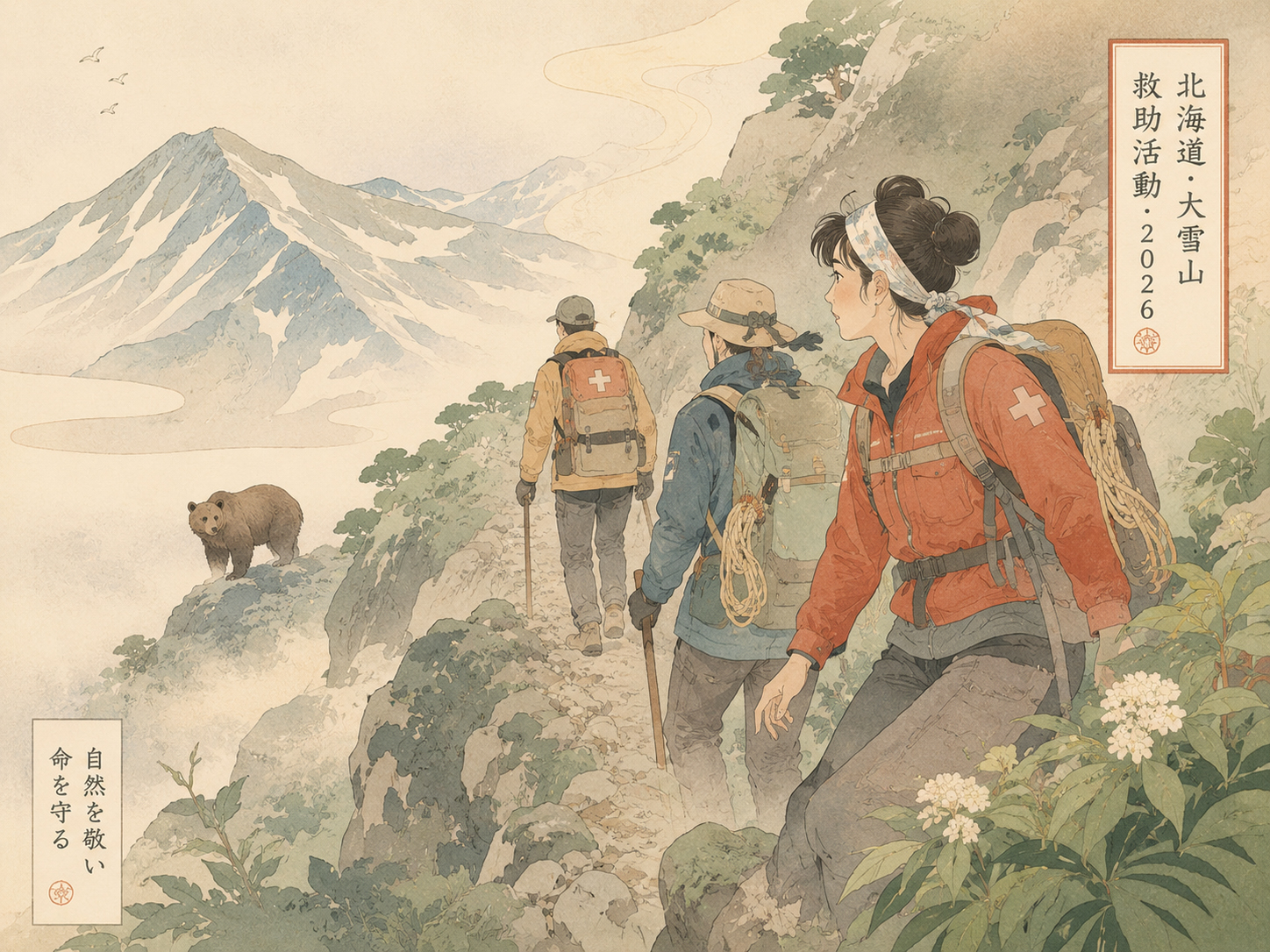
The rescue began with a simple human calculation on a mountain trail: there is a bear ahead, the descent is blocked, and the safest path down may no longer be a path at all. On Saturday afternoon, four climbers on a 2,141-meter mountain in Hokkaido found themselves unable to continue after a brown bear appeared on the trail. Police said a man in his 60s first saw the animal about 50 meters ahead while descending at around 2:30 p.m. Three other climbers later reached him. At about 4:50 p.m., one of the group called for help. After roughly three and a half hours stranded on the mountain, the four were lifted out by helicopter. No one was injured.
The incident would have been a small mountain-rescue item in an earlier Japan. In 2026, it reads differently. It happened as Mount Rausu on the Shiretoko Peninsula, part of a World Natural Heritage landscape, reopened to climbers after routes had been closed since a fatal bear attack the previous August. At the foot of the reopened mountain, city officials and climbers held a morning ceremony and offered prayers. Hours later, another brown bear encounter reminded Japan that reopening a trail does not reopen the old relationship between people and wilderness.
Hokkaido’s brown bears are not mascots. They are powerful, intelligent, adaptable animals living in one of Japan’s last great wild landscapes. They are also increasingly present in the human imagination: at trailheads, on warning boards, in local-government alert systems, in school-closure decisions, and now in the national question of how an aging, shrinking Japan manages the places where people and animals meet.
The mountain story
According to police details reported by Kyodo and carried by Japan Today, the bear was about 1.5 meters long. The climbers did not attempt to force their way past it. They waited, then called emergency services. The rescue was dramatic in form but conservative in logic: avoid provoking a brown bear at close range, avoid descending through uncertainty late in the day, and remove the party before a non-injury incident becomes a fatal one.
That caution is easy to mock from a city screen. It is harder to dismiss in Shiretoko and the wider Hokkaido mountains, where brown bears have shaped human movement for generations. A 50-meter distance in bear country is not comfortable space. It is a warning. The hikers’ restraint may have been the most important decision of the day.
Mount Rausu and the Shiretoko Peninsula occupy a special place in Japan’s nature story. Shiretoko is marketed as wild beauty: cliffs, forests, sea ice, deer, foxes, eagles and bears. Tourists travel there precisely because it is not Tokyo, not Osaka, not a controlled theme park. But the same qualities that make it thrilling also make it unforgiving. In Hokkaido, the edge of the map is real.
Why Japan is suddenly talking about bears
Japan’s bear problem has moved from rural nuisance to national public-safety issue. Ministry of the Environment data summarized by Nippon.com showed Asian black bear sightings jumping from 20,513 in fiscal 2024 to 50,776 in fiscal 2025, the highest figure since sightings were first recorded in 2009. The same fiscal year brought 216 reported bear attacks, 238 human injuries and 13 deaths, all record highs.
Those national numbers are driven mostly by Honshu’s Asiatic black bears, especially in Tohoku. Hokkaido is different. It is brown-bear country. The animal is larger, the terrain is broader, and the symbolic weight is older. Hokkaido’s bears belong to the island’s ecology, Ainu cosmology, settler history, tourism economy and modern conservation debates all at once.
The causes behind rising encounters are not simple. Experts and officials point to overlapping pressures: poor acorn and beechnut crops in some years, climate disruption, warmer seasons, rural depopulation, abandoned farmland becoming brush and forest, fewer hunters, recovering bear populations in some areas, unsecured waste, orchards, crops and human food sources. The boundary between settlement and forest is becoming porous.
Hokkaido’s older bear memory
Hokkaido remembers bears differently from the rest of Japan. The island’s most infamous bear story is the 1915 Sankebetsu brown bear incident, when an enormous bear killed seven people in a settler village in what is now northwestern Hokkaido. The story has been retold in books, documentaries and local memory not merely as horror, but as frontier history: people entering bear country, clearing land, building homes, and discovering that nature did not yield simply because a map said it had.
That memory still matters. Hokkaido’s modern tourism brand often celebrates wilderness as scenery, but its older stories treat wilderness as negotiation. The bear is not simply outside society. It lives beside society. When forests are cut, salmon runs change, garbage is poorly managed, farms are abandoned or hikers enter high-density bear habitat, the negotiation changes.
For the Ainu, the bear has long held sacred significance. The animal was not just danger; it was power, gift and spiritual presence. Modern Japan has not always treated Ainu culture with respect, but the older idea that a bear is a being to be approached with seriousness remains useful. It cuts against both sentimental cuteness and careless fear.
The numbers behind the alarm
When mountains become managed space
Japan’s mountain culture has always contained risk. Pilgrims climbed sacred peaks. Hunters and mushroom gatherers entered forests for food. Alpinists built modern mountaineering traditions in the Northern Alps, Hokkaido and Tohoku. The mountain was a place of discipline, humility and beauty.
What is changing is the machinery around the risk. Today a trailhead may have QR codes, alert levels, multilingual warnings, GPS-tagged sighting maps, social-media updates and emergency helicopter protocols. That infrastructure saves lives. It also changes expectations. A mountain that once demanded total self-reliance now exists inside a public-safety system. When a bear appears, the question is not only “what should the climbers do?” but “what should the municipality, police, fire department, park authority and tourism office have prepared?”
The Hokkaido rescue therefore sits at the intersection of adventure tourism and public administration. Authorities want hikers to enjoy famous landscapes. Local economies benefit from visitors. But every reopened trail carries a duty of warning, response and honesty. If bear alert levels are displayed, people must know what those levels mean. If routes reopen after a fatality, the public must understand that reopening does not mean risk has vanished.
The rural depopulation angle
One reason Japan’s bear story feels so modern is that it is also a population story. Rural communities are aging. Farms are abandoned. Satoyama buffer zones — the worked landscapes between village and deep forest — are weakening. Fewer people cut grass, gather firewood, patrol fields, maintain paths or hunt. As human pressure recedes, animal movement changes.
Reuters has reported that experts connect the rise in bear encounters to climate-linked shortages of natural food and to rural depopulation that leaves abandoned farmland and fewer hunters. AP has reported that the government estimates Japan’s overall bear population at about 57,800 and has adopted a road map that includes more bear-control staff and more traps. The issue is not merely that there are bears. It is that the old human systems that kept people and bears apart are thinning.
This is why the Hokkaido incident belongs in a newspaper next to stories about succession, labor shortages and immigration. Japan’s demographic crisis is not confined to companies, schools and hospitals. It reaches the forest edge.
Tourism, fear and respect
Hokkaido’s tourism economy depends on nature. Skiers come for snow. Drivers come for open roads. Hikers come for volcanoes, alpine flowers and long views. Wildlife tourism is part of the appeal. Yet bear tourism has always required discipline: distance, guides, food control, route knowledge and the willingness to turn around.
The danger now is not that Hokkaido becomes “too wild.” The danger is that visitors consume wilderness as scenery while forgetting that it is habitat. A bear on a trail is not a malfunction in the tourist experience. It is the mountain reminding people what kind of place they entered.
What hikers should take from it
The lesson is not “never hike in Hokkaido.” It is to hike as if Hokkaido is real. Check local bear alerts before entering a trail. Avoid dawn and dusk when bears are more active. Travel in groups where possible. Make human presence known without assuming bells are magic. Carry bear spray where legal and appropriate, and know how to use it. Never approach a bear for a photograph. Never leave food or garbage. If a bear blocks the trail, retreat slowly if possible. Do not run. Do not force a pass. If retreat is impossible, waiting and calling for help may be the responsible choice.
That is exactly what made the July 4 rescue interesting. The climbers did not become heroes by fighting. They survived by not escalating.
Japan.co.jp view
This is a small story with a large shadow. Four climbers were lifted from a mountain because a brown bear stood between them and descent. No one died. No one was mauled. That is the good news. But the story carries the unease of a country relearning its borders with nature.
Japan often presents itself through control: punctual trains, clean streets, precise service, mapped routes, managed parks. Hokkaido resists that fantasy. Its bears are a reminder that not every part of Japan can be smoothed into convenience. The wild is still wild. The modern question is whether Japan can respect that wildness while keeping people alive.
The answer will not come only from helicopters or culls. It will come from better habitat data, smarter warnings, stronger local capacity, serious visitor education, climate adaptation, waste control, enough trained hunters and a public language that avoids both panic and cuteness. Brown bears are not villains. Hikers are not fools. The problem is the shrinking, warming, changing space between them.
Reader takeaways
| Item | Meaning |
|---|---|
| What happened | Four climbers in Hokkaido were rescued by helicopter after a brown bear blocked their descent. |
| Why it matters | The incident came amid record bear sightings and attacks in Japan and after a fatal bear attack had closed nearby routes. |
| Historical frame | Hokkaido has long treated brown bears as both sacred presence and frontier danger. |
| Social frame | Rural depopulation, fewer hunters, abandoned land and climate stress are changing bear-human boundaries. |
| Practical lesson | In bear country, restraint is not cowardice. Turning back, waiting and calling for help can be the right decision. |
Sources and references
This article draws on Kyodo reporting carried by Japan Today on the Hokkaido helicopter rescue, Ministry of the Environment data summarized by Nippon.com, Reuters reporting on Japan’s 2026 bear incidents, AP reporting on national bear-control policy, Guardian reporting on record sightings after hibernation, and background research on Hokkaido brown-bear population and management.
- Japan Today / Kyodo: four climbers rescued by helicopter after encountering a brown bear in Hokkaido.
- Nippon.com: bear sightings and attacks in Japan jump to record highs.
- Reuters: Utsunomiya bear search, school closures, record casualties and causes.
- AP: Fukushima bear attack and Japan’s bear-management road map.
- The Guardian: record bear sightings as bears emerge from hibernation.
- Scientific background: DNA-based estimates of brown-bear population size in Shiretoko.