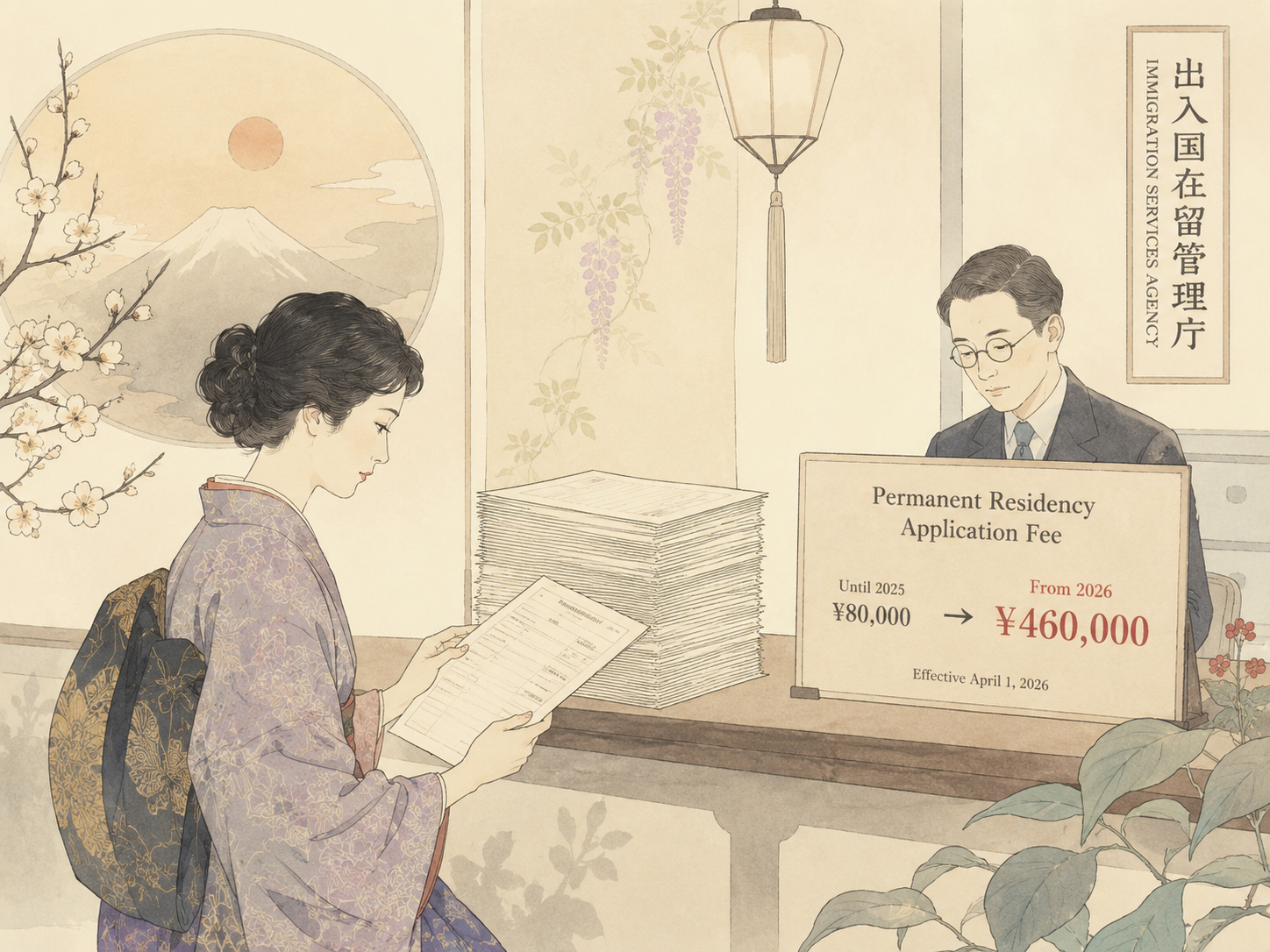
The price of permanence in Japan may be about to change. For decades, the formal fee attached to a permanent-residency application was small enough to feel almost symbolic: ¥10,000, paid not at the beginning, but after approval. In the new immigration-fee framework now moving toward implementation, that amount could become ¥200,000 — a twenty-fold jump that turns a routine administrative stamp into a policy signal.
The number itself is not the whole story. Japan is not simply charging more for paperwork. It is re-pricing belonging. As foreign residents pass four million for the first time, as labor shortages pull migrants deeper into nursing care, construction, agriculture, food service, factories, hotels and startups, and as politics grows more nervous about the visibility of foreign communities, permanent residence has become one of the quiet front lines of Japan’s demographic future.
The government’s draft guidelines would sharply raise fees from October 1, 2026, for people changing or renewing their status of residence and for those applying for permanent residency. Reports say the permanent-residence fee is expected to rise from ¥10,000 to ¥200,000, while the legal ceiling created by the revised law is even higher: ¥300,000. Standard status change and extension fees are also rising dramatically, under a new ceiling of ¥100,000.
From cheap stamp to political signal
Japan’s immigration bureaucracy has long been demanding in documentation while modest in fee. Applicants for permanent residence have had to prove years of residence, stable income, tax compliance, pension and health-insurance payment, good conduct, and a reason why long-term residence serves Japan’s interests. The financial charge, however, remained low.
That bargain reflected an older Japan. The postwar state did not imagine itself as an immigration country. Foreign workers existed, but policy language often treated them as trainees, specialists, ethnic returnees, students, spouses or temporary residents. Permanence was allowed, but rarely celebrated as a national project.
The new fee structure belongs to a different Japan. Foreign residents reached 4,125,395 at the end of 2025, up 9.5% from a year earlier and a fourth consecutive record high. The country is aging, depopulating outside major cities, and increasingly dependent on foreign labor. Yet the state still hesitates to say plainly that immigration is now part of the social model.
The October 1 line
The key date is October 1, 2026. From that point, Japan plans to apply the new residence-permit fee schedule. For permanent residence, the reported jump is the most dramatic because the old fee was so small and the psychological status of PR is so large. PR removes the need to keep renewing a work or family status. It eases mortgage applications, career moves, family planning and business risk. It tells the resident, and often the resident’s employer and bank, that Japan is no longer a temporary assignment.
That is why the fee has stirred anxiety among foreign residents. A skilled worker who has spent years paying taxes, a spouse building a family, a business owner who wants a stable base, or a researcher considering whether to remain in Japan may see the increase not simply as a cost, but as a message. The state wants foreign labor; the state also wants to make settlement feel more conditional.
Numbers that explain the pressure
The old contradiction: workers, not immigrants
Japan’s modern immigration story is built on a contradiction. The economy needed people. The politics preferred not to call those people immigrants. In 1990, a major immigration-law revision opened the door to Nikkeijin, descendants of Japanese emigrants, especially from Brazil and Peru. They could live and work in Japan on the assumption that ancestry would ease social integration. Many ended up doing hard factory work and building real communities in places that had not expected to become multicultural.
In 1993, the Technical Intern Training Program grew into another channel. Officially, it transferred skills to developing countries. In practice, it became a labor supply route for industries with shortages. The program was criticized for abuse, weak worker protections and the fiction that Japan was not really importing labor.
The Specified Skilled Worker program, launched in 2019, marked a more open break with the old language. It accepted that Japan needed workers in designated sectors. Yet even then, the system was designed carefully. Many routes were limited, family accompaniment was restricted, and the term “immigration” remained politically sensitive. Japan wanted labor-market relief without fully embracing settlement.
Permanent residence changes the meaning of migration
Permanent residence is different because it converts a labor relationship into a civic foothold. It does not make someone a citizen. It does not grant voting rights in national elections. But it changes the time horizon. A permanent resident can imagine buying a house, changing jobs without visa anxiety, aging in Japan, raising children in Japanese schools, and investing in a local community.
That is precisely why PR is politically sensitive. Temporary labor can be described as economic adjustment. Permanent residence looks like social transformation. When foreign residents are young, working, paying taxes, marrying, having children and opening businesses, they are no longer only filling vacancies. They are becoming neighbors.
The fee hike therefore sits beside other tightening moves. Japan has strengthened scrutiny of tax and social-insurance payment in PR screening. It has moved toward stricter business-manager visa standards. It has debated revocation rules for permanent residents who willfully fail to pay public dues. It is preparing new pre-screening and digital border-management systems. The pattern is not simply anti-foreign. It is managerial: more acceptance, more surveillance, more conditions, more cost.
Why the government says fees must rise
The official logic is administrative and fiscal. Foreign resident numbers have grown rapidly. Immigration offices process more renewals, status changes, residence-card work, consultation, enforcement and integration-related tasks. Japan is also preparing systems such as JESTA, an electronic travel authorization and screening framework. Fee increases are framed as a way to reflect administrative cost, inflation and the demands of a larger foreign population.
There is a reasonable argument here. The old fees were low by global standards. A country that expects millions of foreign residents needs better multilingual support, faster processing, digital systems, anti-fraud tools, labor-rights enforcement and local integration services. Those things cost money.
But the policy question is distribution. Should people who have already paid taxes, premiums and local consumption taxes bear a large new charge at the moment they seek stability? Should integration be funded by the people trying to integrate? Or should a country that benefits from foreign labor treat permanent settlement as public infrastructure?
The politics of price
Immigration is no longer invisible in Japan. Foreign workers are present in convenience stores, nursing homes, farms, hotels, factories and delivery networks. Foreign students and families are reshaping classrooms. Tourist numbers and resident numbers are both rising, and public frustration over overtourism sometimes spills into broader discomfort with foreigners.
That makes fees attractive politics. A fee hike looks orderly. It is not a ban. It does not use the harsh language of exclusion. It can be defended as cost recovery. Yet it also sends a signal to voters that the state is tightening control. In a country still trying to balance labor necessity with cultural unease, pricing becomes a quiet instrument of immigration policy.
What it means for applicants
For applicants, the practical lesson is simple: timing matters. Anyone close to eligibility before October 1 will want to check carefully whether an application can be prepared under the current fee regime. But rushing is dangerous. Permanent-residence applications are document-heavy, and weak tax, pension, income or guarantor records can damage an application more than a fee increase.
The larger lesson is that Japan is asking foreign residents to become more administratively perfect. Late payments, gaps in pension or health-insurance contributions, unstable income, unexplained job changes, or weak documentation are becoming more consequential. The country needs foreign residents, but it is making long-term acceptance more formal, more expensive and more closely monitored.
Japan.co.jp view
The twenty-fold PR fee story is powerful because it is bureaucratic and emotional at the same time. The form is dry: an amendment, a ceiling, a schedule, a fee. The human meaning is not dry. It is the cost of certainty. It is the difference between being a guest worker and becoming a long-term resident. It is a bill for the right to plan a life.
Japan is not wrong to modernize its immigration administration. A four-million-plus foreign population requires serious systems. But if the country wants workers to stay, care for its elderly, staff its hotels, build its infrastructure, support its factories, start companies, pay taxes and raise children, the state should be careful not to make permanence feel like a penalty.
The deeper question is not whether ¥200,000 is affordable for every applicant. It is whether Japan sees permanent residents as customers of bureaucracy or contributors to the national future. In an aging country, that distinction matters.
Reader takeaways
| Item | Meaning |
|---|---|
| What happened | Japan is preparing sharply higher residence-related fees from October 1, 2026. |
| Permanent residence | The reported PR fee would rise from ¥10,000 to ¥200,000, while the legal ceiling is ¥300,000. |
| Why now | Japan’s foreign resident population topped 4.1 million at the end of 2025, and the state wants to fund more immigration administration and integration systems. |
| Historical context | Japan has long relied on foreign labor while avoiding the language of immigration, from Nikkeijin and technical interns to the 2019 Specified Skilled Worker program. |
| Main issue | The fee hike turns permanent residence into a test of Japan’s willingness to treat foreign residents as long-term members of society. |
Sources and references
This article draws on Japan Times reporting on the 2026 residence-fee framework, the enacted statutory fee ceilings, visa-fee changes, Nippon.com’s summary of Immigration Services Agency foreign-resident data, MOFA and Immigration Services Agency materials on the Specified Skilled Worker program, and historical research on Japan’s 1990 immigration-law revision and Nikkeijin migration.
- The Japan Times: Japan plans to sharply raise residence-permit fees from October.
- The Japan Times: Bill enacted to raise statutory ceilings for immigration-related fees.
- The Japan Times: Visa issuance fees revised for the first time in decades.
- Nippon.com: Foreign population exceeds 4 million for the first time.
- MOFA: Specified Skilled Worker status established in April 2019.
- Migration Policy Institute: Japan’s 2019 labor migration reforms.
- MOFA: Nikkei migration after the 1990 immigration-law amendment.