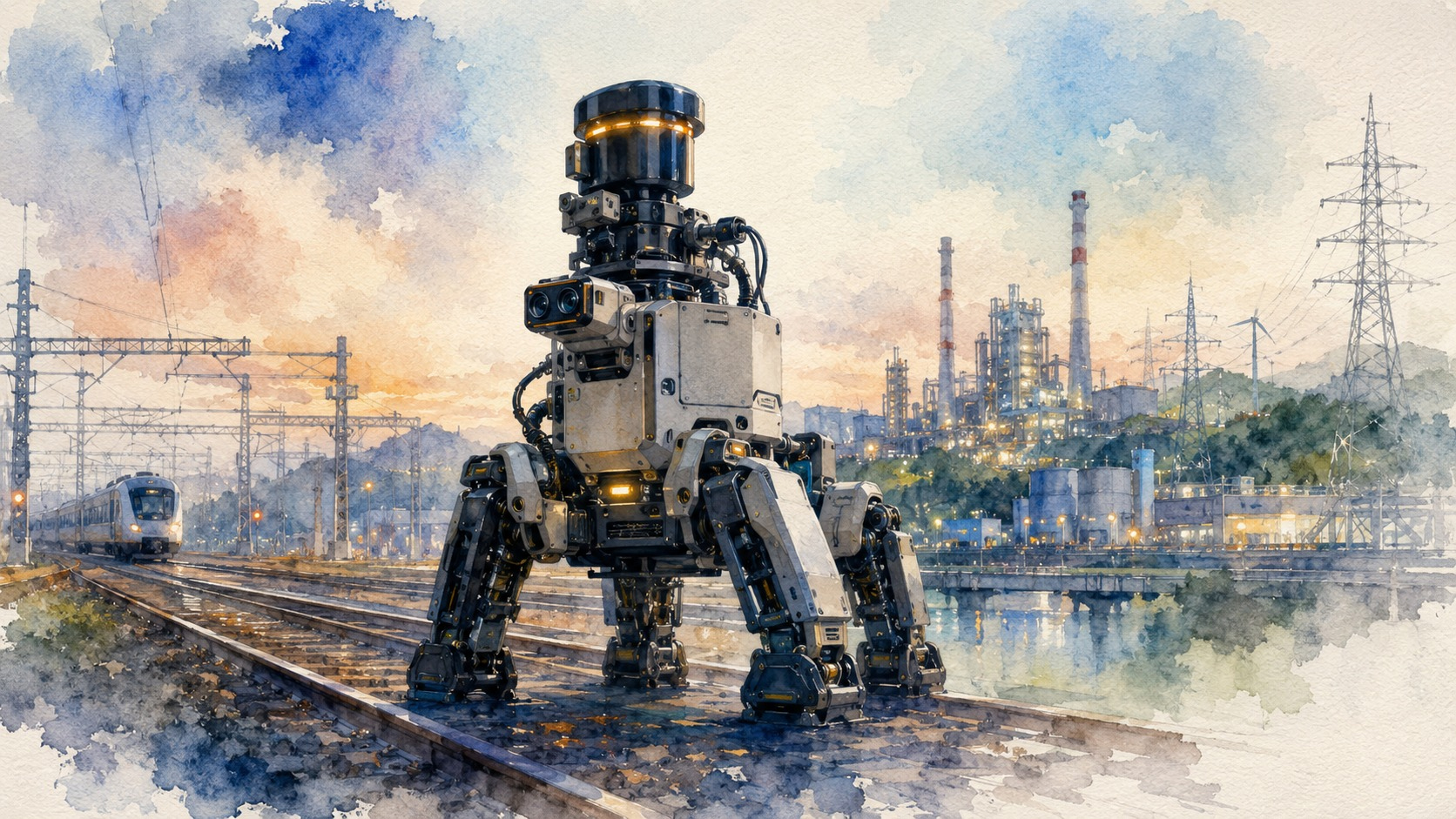
When generative AI writes a bad sentence, a user can correct it. When AI controls a railway signal, substation or factory robot, a mistake can stop trains, interrupt power or injure someone. The “physical AI” Hitachi and Nvidia are bringing to HMAX is not a chatbot placed beside machinery. It is an operating architecture in which machines perceive, predict, decide and act inside hard safety constraints.
On July 16, 2026, the companies announced development of multi-agent orchestration technology connecting AI agents, robots and equipment from multiple vendors across manufacturing and social infrastructure. The goal is end-to-end autonomous operation. It is still development and customer validation—not an announcement that Japan’s railways or power grids have become fully autonomous.
HMAX is not one product
HMAX is a family combining sensors, edge computers, data platforms, AI models, digital twins and managed services. It began in rail digital asset management and expanded in January 2026 across Mobility, Energy and Industry.
HMAX Mobility monitors trains, signaling, track and stations to optimize maintenance, operations and energy. HMAX Energy predicts degradation across transformers, switchgear and grid assets. HMAX Industry applies similar methods to equipment, quality, workers and robots.
Hitachi cites deployments producing up to 15% lower maintenance cost and energy use. Those are maximum results from particular cases, not guarantees for every customer. Route, asset age, traffic and baseline change the outcome.
Operational technology began with a five-horsepower motor
Hitachi began at the Hitachi copper mine in Ibaraki. Founder Namihei Odaira repaired imported equipment and completed a Japanese-made five-horsepower induction motor in 1910, followed by a transformer in 1911. Building, operating and repairing machinery formed the company’s DNA.
It expanded into generation, grids, control, rolling stock, signaling, industrial machinery and computers. In rail it spans trains, traffic management, signals and maintenance; in power, generation through transmission; in factories, motors through controls. That operational technology—OT—is the foundation of physical AI.
A software company may build a model without understanding transformer insulation, wheel flats or fail-safe signaling. An equipment maker knows physics but may lag cloud and AI development. Hitachi’s “IT × OT × products” strategy exists to bridge that gap.
Lumada and GlobalLogic built the software muscle
Hitachi spent decades as a sprawling electrical conglomerate, then disposed of weaker businesses and moved toward digital services for infrastructure. Lumada grew as the platform and method connecting equipment data to customer operations.
In 2021 Hitachi acquired U.S. digital-engineering company GlobalLogic for $9.6 billion. The price signaled a shift from selling hardware once to continuously designing and updating software. Integration of GlobalLogic and Hitachi Digital Services began in 2026, supporting product engineering, cloud and reliability behind HMAX.
The HMAX rail “three-computer” architecture shows the synthesis: real-time processing on trains or trackside, integration at the operating center and fleet learning in the cloud. Compute location follows time constraint rather than sending everything away.
Nvidia’s computing layers
Nvidia IGX provides industrial edge compute near trains and equipment. Holoscan accelerates sensor processing; Metropolis turns video into recognition of people, objects and anomalies. The AI Factory trains, tunes, evaluates and distributes models centrally.
Hitachi Rail announced IGX Thor adoption in 2025, citing up to eight times more AI compute and twice the connectivity. The objective is to process on vehicles and infrastructure data that could otherwise take up to ten days at maintenance facilities.
Nvidia contributes CUDA and software stacks as much as chips. Dependence and lifecycle are risks: infrastructure can last thirty years while AI computers refresh every few. HMAX needs hardware abstraction and long support.
What multi-agent orchestration means
One AI does not rule everything. A maintenance agent forecasts failure; an operations agent adjusts schedules; an energy agent reduces peaks; a safety agent polices allowable actions. Each has different data and objectives.
The objectives conflict. Operations wants a train in service while maintenance requests withdrawal. Energy optimization may limit acceleration while delay recovery demands speed. The orchestrator evaluates priorities, physical limits, rules and future consequences to choose a system-wide action.
| Agent | Goal | Conflict |
|---|---|---|
| Operations | Punctuality and throughput | Maintenance withdrawal |
| Maintenance | Failure prevention and life | Availability |
| Energy | Cost, peak and carbon | Performance and comfort |
| Safety | Prevent hazardous states | Must override other goals |
| Production | Quality, volume and delivery | Equipment stress |
Hitachi and Nvidia promise vendor-neutral connections because real plants and railways contain many makers, generations and protocols. The announcement says they will develop this capability; universal interoperability does not yet exist.
An Integrated World Infrastructure Model as the safety map
Language models learn probabilities in text. Railways and power systems obey physical laws and operating rules. Hitachi’s Integrated World Infrastructure Model, announced in 2025, represents equipment, causality, control limits and maintenance knowledge to ground AI decisions.
A digital twin reflects current state; IWIM describes what is possible and safe; agents propose what happens next. Critical action must retain conventional safety control, verification and authorization. The architecture is not a language model freely commanding brakes and breakers.
- Observe: understand state from sensors and video.
- Advise: explain cause and recommendation; a person acts.
- Limited execution: AI acts only inside an approved envelope.
- Supervised autonomy: normal operations automate, exceptions transfer to people.
- High autonomy: agents coordinate assets under an independent safety layer.
Rail: seeing failure before it arrives
Cameras and sensors on moving trains can observe overhead wires, track, wheels, doors and signaling. Edge AI extracts anomalies and feeds maintenance planning, shifting from calendar inspection toward condition-based work.
The next step coordinates failure forecast with train assignment, depot entry, parts inventory and workforce. Energy optimization can adjust driving curves around grade, occupancy, timetable and regenerative braking.
Autonomous rail still requires signaling standards, cybersecurity, explainability and liability. If AI misses a defect, contracts and regulators must define responsibility among operator, Hitachi, Nvidia and sensor suppliers.
Energy: reliability before speed
Renewables and data centers have flooded utilities with connection requests. AI can assist grid studies, equipment capacity, protection coordination and construction planning. Hitachi and Nvidia have presented a case for reducing time to connect new energy sources by up to 80%; that is a workflow-specific claim, not a guarantee across every grid.
During operation, transformer temperature, dissolved gas, vibration and loading can predict deterioration. Integrating forecasts with batteries, generation and network constraints may reduce outage risk and cost.
Power cannot be “mostly right.” AI must not bypass protection relays or operator authority. The immediate value of autonomy is less removing people than narrowing the exceptions requiring their attention.
Manufacturing: from one robot to the whole plant
Traditional robot AI optimizes one task—gripping, welding or inspection. HMAX aims to coordinate production, quality, maintenance, energy and logistics through multiple agents.
When defects increase, inspection AI identifies the pattern, maintenance AI infers tool wear, production AI moves orders to another line and energy AI reschedules around the peak. The objective is plant-wide loss, not a locally perfect robot.
Legacy equipment is the hard part: decades-old PLCs, proprietary protocols and paper maintenance records must enter the agent system. “Vendor-neutral” will be judged by how well HMAX handles this brownfield reality.
Sovereignty, cyberattack and human skill
Factory recipes, grid topology and railway vulnerabilities are corporate secrets and national-security data. Hitachi calls for closed LLM environments and sovereign-enabled operation, giving customers control over data location, models, logs and access.
As agents command machinery, the attack surface expands. False sensor data, malicious prompts, corrupted model updates and supply-chain compromise require zero trust, signatures, isolation, safe shutdown and audit trails.
Automation addresses labor scarcity, but removing people too far creates skill atrophy and weak recovery during exceptions. Retraining operators as supervisors, retaining manual modes and running drills become resilience measures.
Success is not the spectacle of autonomy
HMAX should be measured by zero accidents, outage minutes, train delay, unplanned downtime, maintenance cost, energy, asset life and recovery—not agent count. Comparisons need pre-AI baselines adjusted for weather, demand and asset age.
Commercially, Hitachi wants recurring services beyond equipment sales. Outcome-based contracts can align customer value but move operational risk onto Hitachi. Nvidia dependence, compute cost, model updates and liability will shape margins.
The five-horsepower motor of 1910 marked Japan’s move from repairing imported machinery to building its own. HMAX marks an equipment maker’s move toward selling the intelligence that understands and coordinates machines. Nvidia compute alone is insufficient; so is a century of Hitachi domain knowledge alone. Their combination will be tested not in a demonstration hall, but after the last train, during a heatwave at a substation and on a production line that cannot stop.