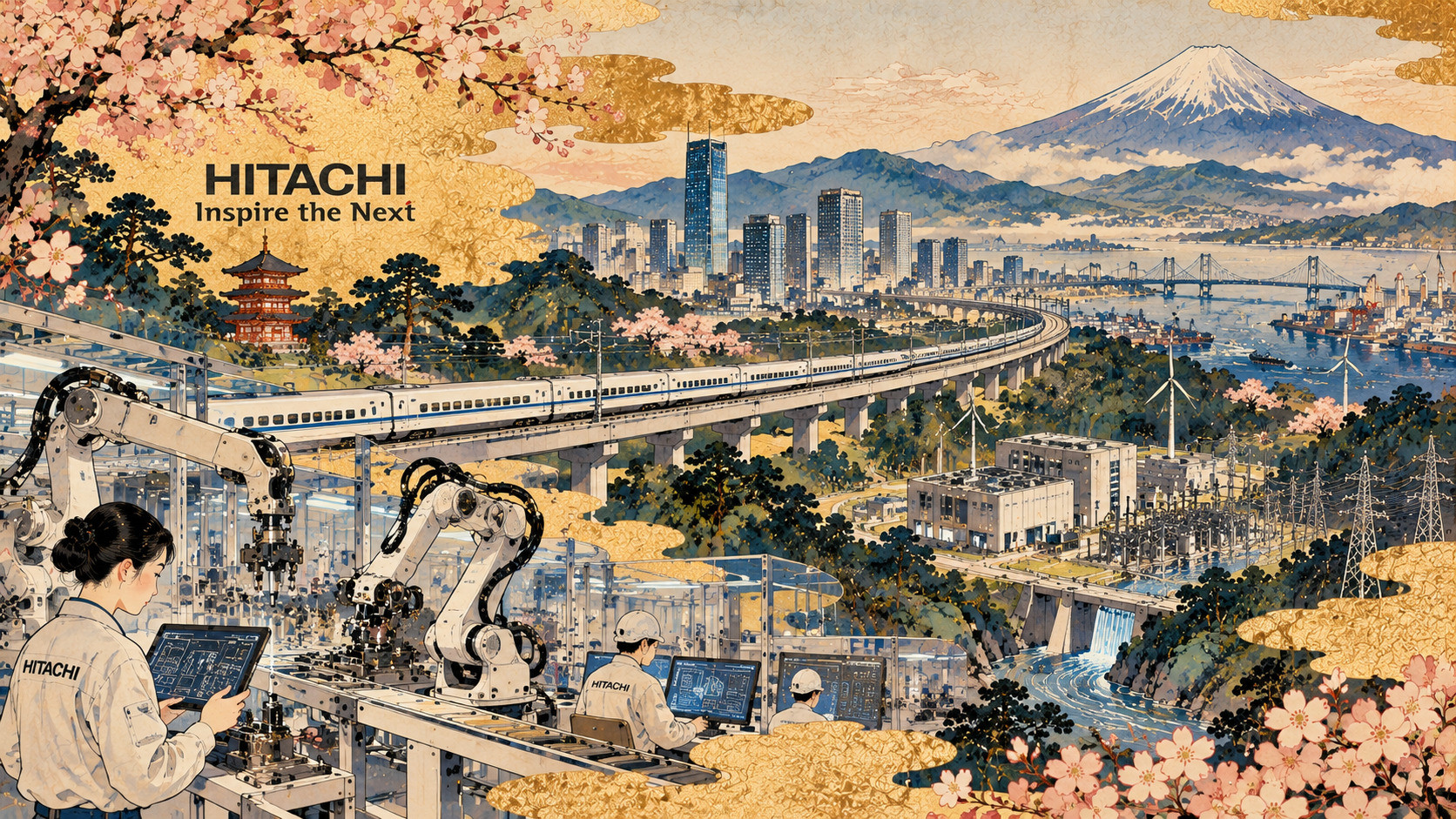
A different kind of industrial company
Hitachi was once shorthand for the sprawling Japanese electronics conglomerate: televisions, refrigerators, turbines and trains under one name. That image now obscures its strategic center of gravity. Today the more consequential question is whether a company that knows how factories, railways and power grids actually operate can make those systems smarter—and turn that expertise into durable, profitable services.
The October earnings test
Hitachi scheduled its results for the six months to September 30, 2026, for October 28, followed by a presentation to analysts and media. At the research cutoff for this edition, the accessible company archive did not yet provide the complete half-year financial statements. Consequently this report does not present purported October revenue, earnings or guidance changes. The most recent complete quarterly release verified here is dated July 29. Investors should check the newly released filing for actual results rather than treating management targets as results.
An electrical motor with an unexpected legacy
In 1910, Namihei Odaira and colleagues produced a five-horsepower induction motor at the Hitachi mine in Ibaraki Prefecture. Japan then relied heavily on imported industrial equipment. A motor built locally was therefore an assertion of engineering independence, not merely a product launch. Hitachi went on to build locomotives, electrical equipment, computers and systems supporting the postwar economy. The company dates its founding to 1910 and formal establishment to 1920. That distinction matters in a story about continuity and reinvention.
From conglomerate to focused infrastructure group
Hitachi spent years reorganizing a remarkably diverse portfolio. Divestments and changes in ownership reduced exposure to some traditional consumer-facing businesses, while acquisitions deepened its position in electricity networks and digital engineering. The GlobalLogic acquisition in 2021 brought software product development capabilities; expanding its ownership of the former ABB power-grid business built what is now Hitachi Energy. These moves created an ambitious proposition: combining engineering, data, and physical assets. They also created integration demands, capital commitments and execution risks.
The meaning of Lumada
Lumada is Hitachi’s framework for delivering solutions built on operational data and domain expertise. It is not simply another consumer AI app or one standalone cloud product. In the industrial world, value is often measured in fewer unplanned outages, longer equipment life, more reliable energy delivery and better maintenance schedules. Those outcomes require sensors and software, but also an understanding of safety rules, physical limits and the professionals who keep systems running.
Why the software business matters
The Digital Systems & Services segment includes systems integration, engineering services and IT products. The business mix matters as much as top-line expansion. A project delivered once carries different economics from a subscription, maintenance or outcome-oriented service. GlobalLogic can help bridge software design and industrial knowledge across segments. Investors should, however, avoid double counting group-wide Lumada activity as if it were a wholly separate subsidiary revenue stream.
The grid is AI infrastructure too
The AI boom is commonly described in terms of GPUs and data centers. But data centers need reliable electricity, and utilities need transformers, switchgear and modern controls. Hitachi Energy is exposed to this less glamorous but indispensable supply chain. Recent company announcements include a Canadian investment in transformer insulation manufacturing and work using NVIDIA Omniverse libraries for grid simulation. Announcements indicate strategic direction, not guaranteed future earnings. Conversion of orders into delivered equipment depends on factory capacity, materials, labor and long project schedules.
Making AI physical
Hitachi has expanded the HMAX portfolio to apply AI and operational intelligence to assets such as railways, industrial equipment and buildings. The promise is not that an algorithm can generate an impressive demonstration. It is that operators can trust the system during maintenance, bad weather, network interruptions and other conditions in which mistakes are expensive. The compelling metrics are actual reductions in failures, downtime and operating cost—not the number of AI products launched.
What Inspire 2027 promises
The company’s Inspire 2027 plan targets a 7–9% compound annual revenue growth rate from FY2024 to FY2027, an adjusted EBITA margin of 13–15% in FY2027, return on invested capital of 12–13%, and cash-flow conversion above 90%. These are targets, not achieved figures. Their coherence rests on Hitachi’s ability to grow higher-margin digital activities while expanding equipment-intensive businesses. Acquisitions and factory investments make that balancing act difficult, particularly when customer projects take years to recognize as revenue.
Reading beyond a headline margin
Adjusted EBITA is a management-defined measure and should not be confused with statutory profit or cash generated from operations. Currency movements, the timing of project delivery, acquired intangibles and restructuring can alter comparisons. A growing backlog can be encouraging while also tying up working capital. For a company moving enormous, long-life physical assets, free cash flow and delivery quality often tell a more durable story than one quarter of operating margin.
A global competitive field
Hitachi does not face a single competitor. Grid equipment pits it against major power technology suppliers; industrial automation brings different rivals; software and engineering services face international technology consultancies and cloud ecosystems. The intended advantage is the combination of operational technology, information technology and products. But customers rightly ask whether platforms will interoperate, remain secure, and avoid forcing dependence on one vendor for decades.
Five questions the results must answer
Did digital growth improve actual profitability and cash generation? Is the energy backlog being delivered on time and at expected margins? Are rail, building and factory services becoming repeatable revenue businesses? Are AI investments yielding measurable customer outcomes? Can GlobalLogic and Hitachi Energy collaborate without introducing organizational complexity that weakens accountability? Those are better tests of transformation than a broad claim that Hitachi has become an AI company.
The next version of the five-horsepower motor
The original Hitachi motor was useful because a mine could actually put it to work. More than a century later, the company’s digital strategy deserves the same standard. If technology makes essential infrastructure safer, more resilient and less costly while producing strong financial returns, the transformation will be substantive. If AI branding grows faster than verified outcomes, the industrial story remains unfinished.
Sources and verification
Based on Hitachi investor relations materials, official corporate history and company disclosures. No independent interviews were conducted.