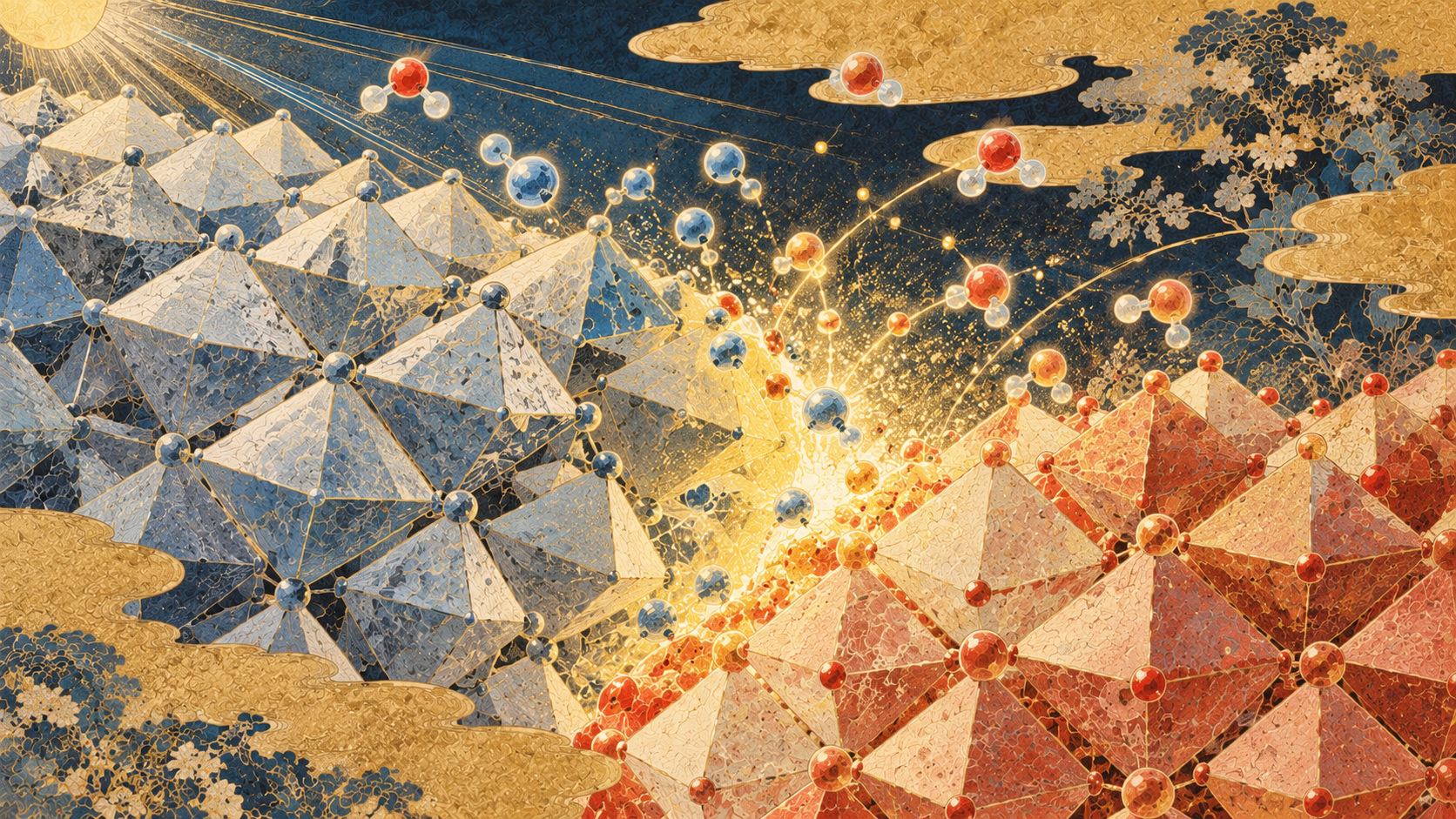
The surprising result was not simply that titanium dioxide reacts to light. It was where, on the same surface, the reaction was strongest.
A map of chemistry hiding on a white material
Titanium dioxide is familiar as the compound behind white pigments and as a workhorse of photocatalysis. Under appropriate light, it can drive chemical changes at a surface. Yet a coating is not a uniform plain of reactivity. Some microscopic neighborhoods are far more active than others. A research group working with Hiroshima University has now charted where an ultraviolet-driven reaction proceeds across a specially prepared boundary between two crystal forms of titanium dioxide. The achievement is not a new commercial coating or an image of atoms glowing. It is a spatial measurement of a chemical reaction, allowing researchers to ask whether a boundary genuinely does more catalytic work than the material on either side.
First separate the announcement from the paper
Hiroshima University released its Japanese research announcement on October 22, 2026. The underlying paper appeared online in Applied Surface Science on August 24, 2026, with the DOI 10.1016/j.apsusc.2026.168148. Its bibliographic listing includes volume 754, article 168148 and a 2027 volume year. That combination may look contradictory unless the online publication date and the later volume designation are separated. For an October 27 news edition the newly issued university explanation is timely, but the journal result itself must not be mislabeled as published in October. The authors describe imaging the spatial distribution of photocatalytic activity at an anatase–rutile interface using X-ray photoemission electron microscopy, abbreviated XPEEM.
One chemical formula; two different architectures
Anatase and rutile are both crystalline forms of TiO₂. Their titanium and oxygen atoms occupy different arrangements, and this influences electronic energy levels and charge behavior. Materials incorporating both phases have long interested researchers because their activity can differ from that of either phase alone. But in an ordinary powder or mixed coating, grains have irregular dimensions, contacts and defects. Changes in the amount of exposed surface can be confused with changes in intrinsic reaction rates. The difficult question is not merely whether a blended material works. It is whether the interface itself is where the reaction is fastest—and how far its influence extends into neighboring crystal regions.
How the laboratory made a reaction visible
The team used local laser melting on a titanium dioxide single-crystal surface to create a controlled boundary between anatase and rutile. They then adsorbed acetic acid molecules on the surface and exposed the material to ultraviolet light. XPEEM detects electrons emitted from the sample under X-ray irradiation, providing detailed information about the chemical state of the surface. The researchers followed changes in the carbon 1s signal: as the surface-bound acetic acid decomposed, that signal diminished. By analyzing its decrease across image pixels, they calculated local reaction-rate constants. The result was a map of how strongly the photocatalytic reaction proceeded in each measured location. This is an indirect but experimentally grounded chemical readout, not a photograph of molecular bonds visibly breaking.
The border was the most active part
The highest activity appeared close to the anatase–rutile interface. Moving away from that boundary into either crystal form, the measured reaction rate declined. Importantly, the researchers examined whether the pattern could simply reflect more acetic acid having accumulated near the interface. According to the university, the adsorption distribution did not match the activity map, supporting an interpretation based on local reactivity rather than unequal starting coverage alone. The result is striking because it gives a geographic dimension to a materials-science hypothesis: the most consequential part of a catalyst may be a narrow region where different crystal structures meet. But the specific result concerns the test surface, ultraviolet irradiation and acetic acid; it is not universal proof for all molecules or environmental conditions.
Electrons, holes and an extended zone of influence
When titanium dioxide absorbs sufficient light, electrons can be excited and leave behind positively charged holes. These carriers may participate in reactions on the surface—or recombine before they can do useful chemistry. A junction between two phases may alter electronic energy levels and influence the separation and migration of charges. The Hiroshima announcement reports that the enhanced activity extended beyond a simple Debye-length scale, lending experimental support to an interpretation involving charge diffusion and drift. These concepts matter because a catalyst designer might deliberately engineer interfaces rather than merely increase the total quantity of material. The paper does not, however, settle the contribution of every possible surface defect, carrier pathway or reaction intermediate in all contexts.
Japan helped put titanium dioxide on the research map
The modern story of titanium dioxide photocatalysis reaches back to the work of Akira Fujishima and Kenichi Honda. Their photoelectrochemical studies, involving titanium dioxide and another electrode, led to a landmark 1972 Nature report on light-assisted water splitting. Later known as the Honda–Fujishima effect, the finding attracted attention during the energy anxieties of the 1970s, when hydrogen from water appeared a potentially attractive prospect. Japanese universities and companies subsequently investigated applications including self-cleaning surfaces and materials that spread water into a thin film. Yet that early experiment was not the same chemical reaction examined in the new study. It involved an electrochemical system and water, whereas the Hiroshima team mapped the decomposition of adsorbed acetic acid.
From self-cleaning buildings to laboratory design
Titanium dioxide technology is associated with surfaces that can break down certain organic contaminants under suitable illumination. It is also studied for hydrophilic behavior, surface hygiene and environmental applications. These subjects are often marketed together, but they are not interchangeable properties and they do not guarantee performance without appropriate light, access to the active surface and real-world operating conditions. In practice, dust, humidity, wavelength, surface engineering and the target molecule may all matter. This new mapping method could help researchers decide where to place crystal boundaries and how to evaluate their effects. It does not establish a reduction in air pollution, a new building material certification or a timetable for a product launch.
An important earlier step in 2024
The group’s work builds on research reported by Hiroshima University in 2024 concerning electronic energy levels at a carefully made anatase–rutile interface. That investigation connected a sharply defined crystal boundary with electronic structure, offering a mechanistic explanation for why mixed phases might show enhanced photocatalysis. The newer experiment advances the question by mapping where a chemical transformation actually takes place. Showing a promising electronic arrangement and measuring a reaction rate are separate achievements. Their convergence strengthens the case that interface engineering is worth pursuing. The distinction also guards against a common error in science reporting: presenting a proposed mechanism as if it were already a directly measured performance outcome.
What “world first” does—and does not—mean
Hiroshima University describes the direct spatial visualization of active photocatalytic sites as a world-first achievement. The claim should be attributed to the university and understood within the scope of this XPEEM method and controlled interface experiment. It does not mean researchers had never observed photocatalysis, photographed titanium dioxide or studied anatase–rutile mixtures before. The published illustration associated with the announcement includes a conceptual representation, and the Japan.co.jp feature art is likewise an artistic interpretation inspired by Yashima Gakutei. Neither image should be represented as a raw laboratory measurement. Readers deserve to know whether they are seeing an actual experimental map, a diagram or a commissioned editorial artwork.
A more difficult second round of experiments
The scientists suggest extending their technique to other adsorbed molecules, including methanol, ethanol and sulfur-containing volatile species. Such studies would help establish whether the observed spatial advantage survives across different reactions. The path toward application would involve more questions: how reproducibly can useful interfaces be fabricated at industrial scale, do surface states change with aging, and do powder or film coatings behave like the controlled crystal surface? Economic questions about processing costs and durability would come later. There is no demonstrated commercial efficiency multiple, emissions reduction percentage or manufacturing timetable in the university’s announcement. Precision about what remains unknown is part of the finding’s value.
Why the boundary matters
This research makes a small but consequential idea tangible. A material’s nominal chemical formula does not tell engineers everything about how it works. Its microscopic geography—the placement of crystal domains and the borders between them—can control where chemistry is most active. The investigators did not simply confirm that titanium dioxide responds to light; they found a way to measure differences within the response across a defined interface. Fifty years after Japan helped establish the modern field of titanium dioxide photocatalysis, the question has become more exacting: not only what can light make a surface do, but precisely where does it happen, and how might that knowledge guide the next material?
Sources and verification
Checked against Hiroshima University’s October 22 announcement, the original paper’s bibliographic details, its earlier interface research and university histories. The tested ultraviolet/acetic-acid system is not evidence of a finished commercial coating. No independently conducted researcher interviews.
- Hiroshima University: Japanese announcement, October 22, 2026
- Applied Surface Science: original article, online August 24, 2026
- Hiroshima University: earlier 2024 interface research
- University of Tokyo: history of Honda–Fujishima research
- University of Tokyo: titanium dioxide research and applications
- Tokyo University of Science: Fujishima and photocatalysis