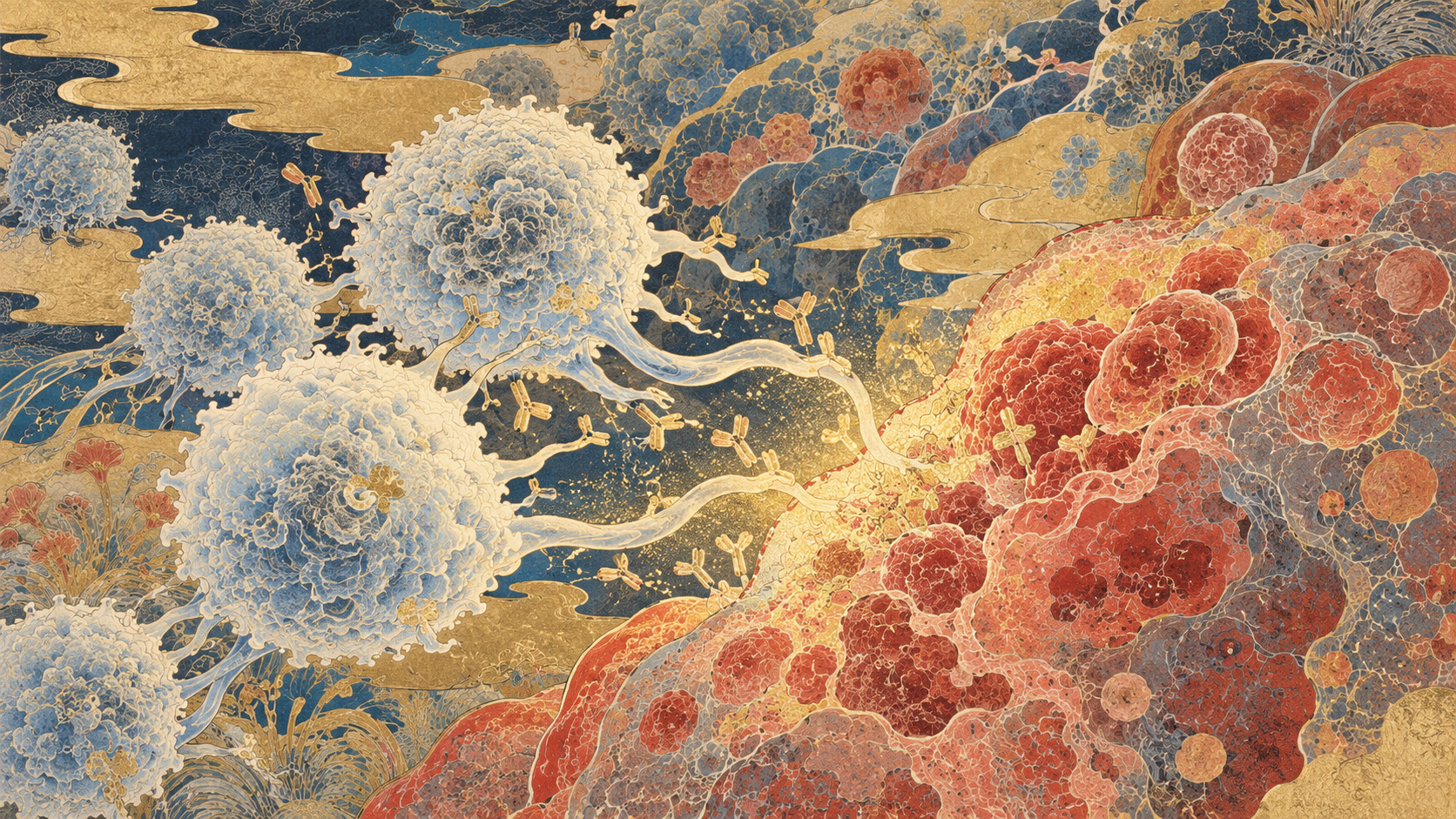
Making a tumor more visible to the immune system is a laboratory finding, not yet a clinical treatment.
The cancer cell that is hard to see
A tumor can survive not only by growing aggressively but by failing to attract the attention of immune cells equipped to kill it. That problem sits at the center of a Hiroshima University study drawing on a surprising source: a protein made by the Epstein–Barr virus, best known for its links to infection and certain cancers. The researchers did not discover a cure, nor propose infecting patients with a virus. They identified two regulators that may help tumor cells display signals recognizable to killer T cells. The result is a plausible research direction and a reminder of how much separates a clever mechanism from a usable therapy.
Three dates—and one necessary correction
The university announced the work on October 23, 2026. It was not, however, a paper first published that day. PubMed lists an advance online publication date of August 12; the article appears in the August 25 issue of Cell Reports, and the university laboratory reported it in August. That distinction matters when describing what is new. The October news is a public explanation of peer-reviewed research, not a newly released human clinical result.
How a killer T cell finds a target
CD8-positive cytotoxic T cells can recognize small protein fragments presented on the surface of cells by major histocompatibility complex class I molecules, or MHC-I. The display is one part of a larger system of immune signaling. If a tumor reduces its visibility—or if surrounding signals prevent a strong response—recognition and killing can falter. The Hiroshima work seeks to change the tumor’s own presentation machinery. Its scientists also report an increase in CD80, a co-stimulatory molecule involved in T-cell activation.
A virus with two faces
Epstein–Barr virus commonly infects B cells and has established associations with several malignancies. One of its proteins, latent membrane protein 1 (LMP1), can promote cellular proliferation and transformation. Yet in earlier work the group had also seen that LMP1 can intensify immune surveillance. This creates an intriguing but dangerous starting point: harness the immune-stimulating pathway without importing a protein whose cancer-promoting activity makes it unsuitable as a straightforward treatment. The answer they investigated lies downstream in gene regulation.
What the cells showed
The team introduced LMP1 into different solid-tumor cell lines, including melanoma and colorectal cancer models, and found greater expression of MHC-I and co-stimulatory signals, with stronger CD8 T-cell activation. They also describe presentation of antigens derived from endogenous retroviral elements embedded in the genome. That finding should not be misread as a fresh infection of the patients—or evidence that the team tested the approach in patients at all. These were experimental systems used to examine how tumors become more immunogenic.
The important pair: Spi-B and IRF1
By probing the molecular pathway, the researchers identified two transcription factors, Spi-B and IRF1, as important mediators of the LMP1 effect. Transcription factors regulate which genes a cell expresses. Expressing both factors in tumor cells produced stronger immune-related signaling and CD8-positive T-cell responses without requiring LMP1 itself. That is the study’s central conceptual advance: it offers a route to separate the immunological benefit being studied from the known growth-promoting properties of the viral protein.
The mouse result—and its limits
The investigators found suppression of tumor growth in experiments involving mice when the two transcription factors were expressed in tumor cells. That is a meaningful preclinical observation. It is not a demonstration of a medicine administered safely to people, a report of patient survival, or evidence of a treatment ready for use against drug-resistant cancer. No human trial results, dosing regimen, regulatory approval or validated delivery method are established by the paper and university release.
Where this fits into the history of immunotherapy
Cancer immunology has moved from observations about immune surveillance to approved treatments that adjust how the immune system responds. Immune checkpoint inhibitors can release inhibitory signals that hold back T cells; they have helped transform care for some cancers but do not work for everyone. One reason is that a tumor may fail to present sufficiently recognizable targets in the first place. The Hiroshima approach is different from simply releasing an immune brake: it tries to make the cancer cell more conspicuous. Whether it can complement established therapies remains untested.
Why Epstein–Barr biology belongs in this story
Since the discovery of Epstein–Barr virus in the 1960s, researchers have studied how infection changes cell growth, immune recognition and the risk of malignancy. The current research illustrates that a biological mechanism can have opposed consequences: a molecule associated with transformation may also illuminate pathways the immune system uses to identify abnormal cells. The goal is to extract mechanistic knowledge, not to rehabilitate an oncogenic protein as a harmless drug. That distinction belongs near the center of any public account.
Delivery is the next formidable problem
The university says it hopes to investigate ways to deliver Spi-B and IRF1 to tumors, potentially using mRNA-based approaches. Selectively delivering genetic instructions to a heterogeneous mass of cancer cells is difficult. Researchers would have to establish where the material goes, how much is expressed, whether normal tissue is affected, how long the response lasts and whether harmful immune effects emerge. The announcement does not specify a completed mRNA formulation, a trial protocol or a date for first-in-human testing.
A patent disclosure readers should know about
The article lists Keita Yamane as first author and Tomoharu Yasuda as corresponding author, with participation from Hiroshima University and collaborating institutions including the University of Shizuoka. Its PubMed disclosure states that Yamane, Yohei Kawano and Yasuda filed a patent application relating to the work. Intellectual-property filings do not independently validate or invalidate the findings; they do disclose a possible commercial interest in eventual applications. We have not interviewed the authors and do not attribute to them statements beyond the source materials.
The real breakthrough test comes later
The next steps are replication across tumor contexts, identification of safe delivery systems, assessment of unintended gene-regulatory effects and proof of benefit over clinically meaningful alternatives. None can be presumed from a mouse study. What Hiroshima has contributed is a more precise biological hypothesis: tumor visibility can potentially be raised by manipulating two transcription factors downstream of a viral protein. The possibility is scientifically interesting precisely because the proof of a patient-ready treatment remains to be earned.
Sources and verification
Based on the university release, original Cell Reports paper and PubMed record. No human efficacy, delivery product or clinical-trial result is documented. No independent author interviews were conducted.
- Hiroshima University: October 23 research announcement
- Hiroshima University immunology laboratory: August 25 report
- Cell Reports: original research article
- PubMed: publication chronology and competing interests
- US National Cancer Institute: immunotherapy background
- US National Cancer Institute: checkpoint inhibitors