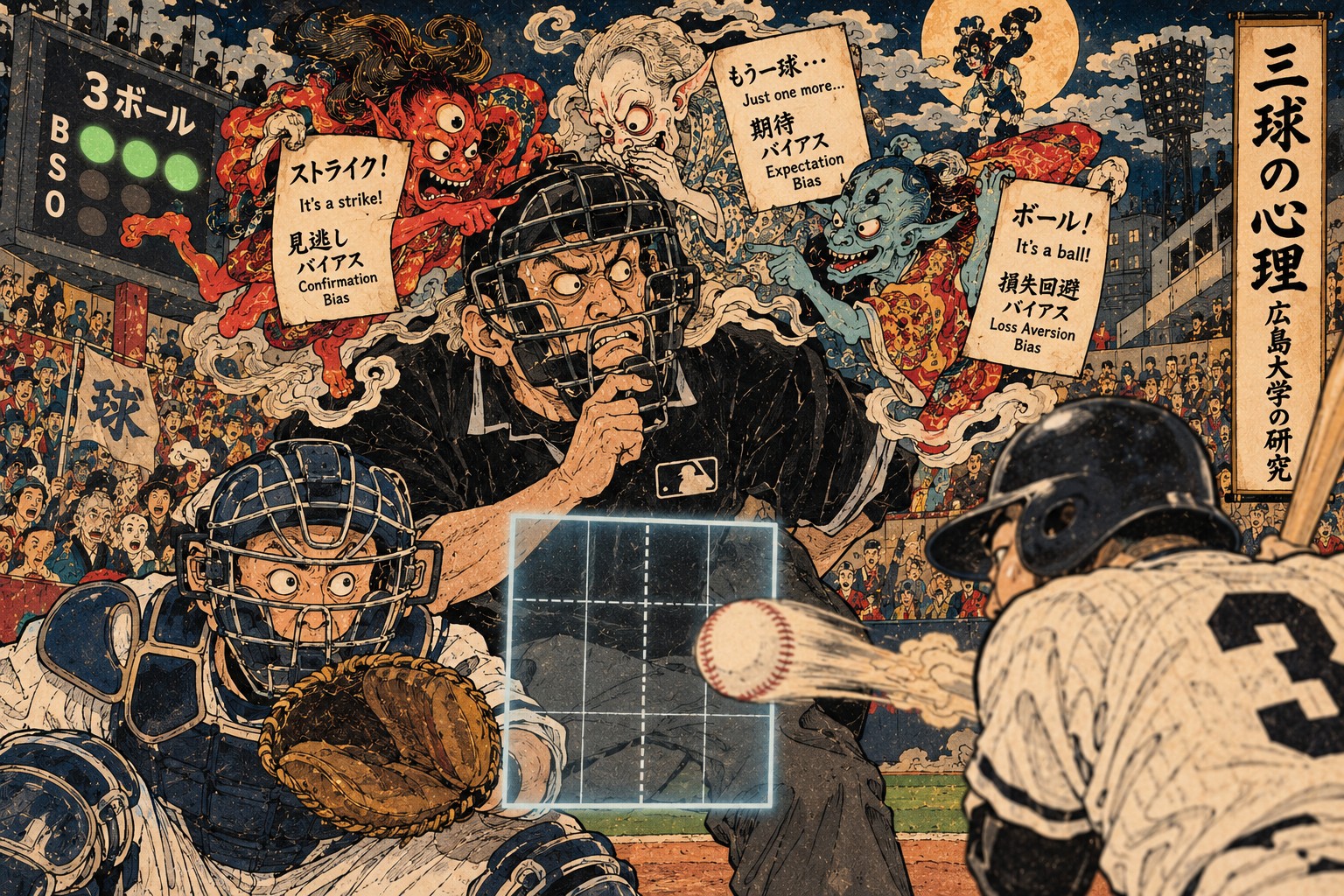
The rulebook does not change with the count. The human boundary can.
The pitch looks the same. The count may change the call.
A fastball reaches home plate in a fraction of a second. Behind the catcher, the umpire must transform a fleeting visual impression into one of baseball’s most consequential words: ball or strike. Yet the perceived edge of the strike zone appears to move as the count changes. In a new analysis, researchers at Hiroshima University found that an old baseball puzzle may have less to do with a conscious desire to avoid walks or strikeouts than with how the brain uses expectations when visual evidence is uncertain.
A decade of baseball, narrowed to a rigorous test
The paper by Mitsuto Tomomura and Masahiro Shinya was published in Communications Psychology on October 5, 2026; Hiroshima University announced it on October 26. The investigators examined 451,172 called pitches from the 2015–2024 Major League Baseball seasons. To reduce confounding factors, they restricted the sample to four-seam fastballs thrown by right-handed pitchers to right-handed batters and taken rather than swung at. The findings therefore do not automatically describe breaking balls, left-handed matchups, or every pitch in the game.
Not a change in the rulebook
The legal strike zone remains the same regardless of count. What changes is the observed boundary implied by umpire decisions. Researchers calculated where a pitch has approximately a fifty-fifty chance of being called a strike, a statistical point known as the point of subjective equality. Across 12 ball-strike counts, the effective zone expanded in hitter-favorable situations such as 3–0 and contracted in pitcher-favorable situations such as 0–2. The pattern appeared at the top, bottom, inside, and outside edges.
Why the pitches umpires see are not randomly distributed
At 3–0, the pitcher has a powerful reason to deliver a strike, so taken pitches tend to cluster nearer the heart of the zone. At 0–2, pitchers are free to seek the edge or miss beyond it, and hitters may swing defensively at borderline offerings. As a result, the subset of pitches requiring a ball-strike judgment differs systematically by count. The researchers proposed that repeated exposure to these patterns teaches the brain what to expect before the next pitch crosses the plate.
An explanation borrowed from perceptual science
Bayesian sensory integration describes how the nervous system combines noisy information from the senses with expectations learned from experience. Imagine trying to follow a familiar road in fog: when visibility is poor, what you already know about the road becomes more influential. Applied to baseball, the model treats perceived pitch location as a blend of visual evidence and count-dependent expectations. This is a model of perception, not a direct measurement of neural activity in umpires.
How strongly did the model fit?
The research model held two umpire characteristics constant across counts: a decision criterion and a measure of perceptual uncertainty. It varied the prior distribution of pitch locations according to the count. The fit was especially good for the top and outside boundaries, with reported coefficients of determination of 0.80 and 0.67 respectively. It outperformed a count-blind comparison model clearly in three of four directions. Those results support an explanation of population-level patterns; they should not be mistaken for a claim that the model can perfectly predict an individual call.
The 89-umpire comparison
Examining 89 umpires separately, the researchers found that those whose calls showed greater variability also tended to show greater count-related bias. That relationship is what a sensory integration account predicts: the less certain the observation, the more influential the prior expectation. But variability is not an accusation of dishonesty or evidence that any particular umpire intentionally favors a hitter or pitcher. The research studies systematic human perception under pressure, not motivation or misconduct.
How baseball arrived at this moment
For much of its history, baseball depended on the authority of human umpires to keep a contest moving. Television replays, digital tracking, and increasingly fine-grained pitch-location data made the gap between an objective measurement and a human call easier to examine. Earlier explanations of count bias often focused on the possibility that officials dislike making the terminal call that produces a walk or strikeout. This Japanese study adds a complementary mechanism rooted in learned statistical expectations, without proving that earlier explanations never matter.
The new ABS challenge era
Major League Baseball introduced the Automated Ball-Strike challenge system in its 2026 season. A human plate umpire still makes the initial call, but a batter, pitcher, or catcher can request an immediate technological review, subject to the league’s challenge rules. It is not a fully robot-called strike zone on every pitch. The arrangement makes baseball a living experiment in when a skilled professional should be trusted and when machine measurement should check the human eye.
Could the research change challenge strategy?
The Hiroshima team suggests a testable implication: a hitter might have stronger grounds to challenge a called strike in a hitter-favorable count, while the defense might find more promising ball calls to contest in a pitcher-favorable count. This is not an observed 2026 strategy advantage or a validated success-rate forecast. Challenge decisions also depend on pitch type, location, game stakes, remaining challenges, and who can request review. The hypothesis deserves new analysis using actual challenge data.
What the evidence cannot settle
The analyzed sample deliberately excludes left-handed combinations and non-four-seam pitches. It also cannot isolate every influence of fatigue, score, catcher presentation, and game context. A successful mathematical account does not establish that it is the only explanation, nor does it prove neural causation. The investigators also did not conduct a randomized intervention in which umpires were trained to alter their expectations. The most defensible conclusion is that Bayesian sensory integration provides a persuasive explanation for a large, measurable behavioral pattern.
A baseball story with implications beyond sport
Fast decisions under uncertainty occur throughout society: interpreting a medical scan, evaluating a security image, or deciding whether an apparent hazard is real. Expertise can be indispensable, yet expertise is partly built from expectations. Baseball’s newest challenge system provides a way to study the partnership between trained humans and objective measurement. Hiroshima University’s contribution is not to declare umpires obsolete. It is to show why a capable human observer may see a borderline pitch differently when the story of the at-bat changes.
Sources and verification
Based on Hiroshima University primary Japanese releases, the paper record, MLB explanations, and baseball research sources. No independent researcher interviews were conducted.