- An alarming start to the winter harvest
- What the prefecture actually counted
- A coastline of different outcomes
- Four centuries of skill beneath the rafts
- The 2025 warning: more than one environmental stress
- Why a better rainy season was not enough
- The experiments already under way
- A financial crisis with a biological cause
- Miyajima offers a useful counterpoint
- What the next report must answer
An alarming start to the winter harvest
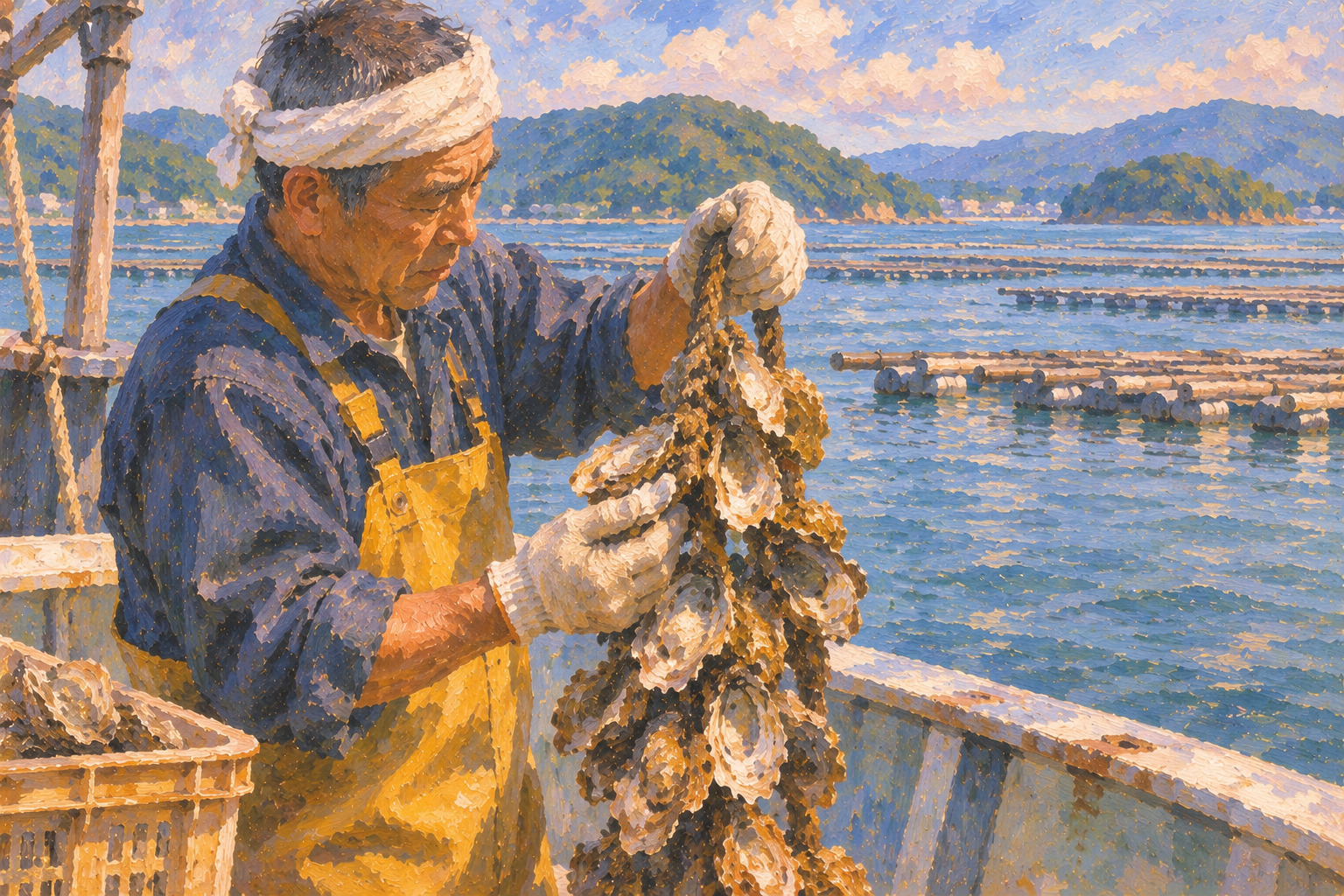
The most revealing sight in Hiroshima’s oyster crisis may be what cannot be seen from shore. Beneath the ordered lines of floating rafts in the Seto Inland Sea, oysters that farmers have tended for two or three years are dying before they can become a winter harvest. A November 19, 2026 report to the Hiroshima Prefectural Assembly found mortality of 50–90% in reported areas for three-year-grown oysters, and a much wider 10–90% range for two-year-grown stock. Districts in western and north-central Hiroshima Bay that had escaped some of last season’s worst losses now report mortality as high as 80–90%.
These numbers are alarming, but their denominators matter. They describe reported locations and age groups—not a scientific finding that 90% of every oyster throughout the prefecture is dead. Hiroshima’s own breakdown shows striking variation within coastal zones. A credible assessment must preserve that difference while recognizing the scale of the threat to one of Japan’s signature seafood industries.
What the prefecture actually counted
In its November 19 briefing, the prefectural Fisheries Division identified 259 growers in the relevant survey population. As of November 13, only 143 had begun shipping shucked oysters. Of those not yet shipping, 52 planned to start in mid-to-late November, 37 in December or later, and 27 had not replied. Grower interviews put individual shipments at about 20–80% of normal, with generally slow flesh development and smaller oysters in many districts.
The evidence comes from fisheries cooperative questionnaires and work-site observations, including measurements at 18 shucking locations between November 2 and 5. Seven of those sites were not yet shipping. This is an early-season operational assessment, not the final count of oysters produced in 2026–27 or a randomized census of every animal. The prefecture has promised recurring monitoring as more farms begin harvesting.
A coastline of different outcomes
In western Hiroshima Bay, three districts reported 80% mortality among three-year oysters while other districts reported around 60%. In north-central Hiroshima Bay, two districts reported 90%, one 80%, and the others 50–70%. Southern Hiroshima Bay and Kure Bay reported 70–90% for three-year oysters. Hiro Bay and Mitsu Bay reported 90%, but the prefecture explicitly noted that each figure came from only one reporting district. Two-year-old oysters showed different—and sometimes much lower—mortality rates in the same wider regions.
Farm revenue cannot be calculated by applying any one of those percentages to a regional output total. Surviving oysters differ in size and shucked-meat yield; farms harvest at different times and face different buyers, labor costs and fixed commitments. The report’s western and north-central sectors described shipment volumes of roughly 60–80% of typical levels, whereas Mitsu Bay reported about 20%. Those figures illustrate the economic differences the aggregate headlines conceal.
Four centuries of skill beneath the rafts
Hiroshima’s relationship with cultivated Pacific oysters, Magaki in Japanese, extends back roughly 450 years according to the prefectural government. Early cultivation used tidal flats near river mouths. Suspended-growing methods later spread, and postwar bamboo rafts helped the industry expand farther into sheltered water. The region’s broad bays and river-borne nutrients helped turn oysters into a winter staple and an engine for processors, shelling operations, restaurants, shipping and visitors.
The scale matters nationally. In Japan’s 2024 fishery production statistics, summarized in the agriculture ministry’s 2026 Hiroshima profile, the prefecture produced 94,290 metric tons of cultivated oysters, the largest volume of any prefecture and roughly 64% of Japan’s 148,149-ton national total. That is a historical full-production measure including shell weight, not the same unit as the shucked-oyster shipments now being reported. Comparing the two without adjustment would be misleading.
The 2025 warning: more than one environmental stress
Last season’s mass mortality prompted Hiroshima to establish an expert panel examining oyster physiology, seawater conditions and patterns across growing grounds. Its provisional interpretation describes prolonged high temperatures, unusually limited rain during the rainy season, changed food conditions and—depending on the bay—low dissolved oxygen or elevated salinity. Oyster reproductive condition and physiological stress may also have mattered. Japan’s Fisheries Agency similarly identified elevated water temperature as a common factor, potentially acting together with other local pressures.
The agencies have not reported a known pathogen as the established cause. Nor does the provisional analysis of the 2025 season prove the precise causes of the new 2026 wave. Water warmed by climate change may be part of the long-term context, but attributing every dead oyster to global warming—or to one contaminant, disease or isolated event—would outrun the evidence.
Why a better rainy season was not enough
In September 2026, Hiroshima’s expert panel reported that rainy-season precipitation had improved compared with the prior year. Large-scale new mortality had not yet been confirmed when those discussions took place. Later, as harvest preparations began, deaths spread through districts that growers had hoped would fare better. The contrast is a reminder that a single improved environmental indicator does not guarantee a healthy harvest.
In September, the prefecture had already issued its highest, Level 3 alert after low dissolved oxygen was recorded in north-central Hiroshima Bay and high-temperature thresholds were met in several sectors. The unanswered question is how temperature, oxygen, salinity, plankton availability and the oysters’ reproductive stage interacted over time and at different depths. That demands time-series data, not just a snapshot taken when the losses become visible.
The experiments already under way
An October 2026 Fisheries Agency summary lists Hiroshima measures ranging from real-time environmental monitoring to laboratory studies and changes in farming methods. They include adding oxygen and salinity readings, adjusting the depth of suspended oyster lines, evaluating lower stocking densities, testing water-circulation pumps, refining spat management and using AI-assisted monitoring of oyster larvae. Some interventions are being piloted by particular cooperatives rather than deployed everywhere.
Each proposal carries a trade-off. Moving stock through the water column may reduce one stress but worsen another; moving rafts costs money and depends on permitted grounds. Reducing density might leave more food for each oyster but also reduce possible harvest from the same area. A sensible policy will test survival gains against costs and publish the results, rather than presenting any early trial as a proven remedy.
A financial crisis with a biological cause
Oyster farming is not simply a matter of taking a boat out on harvest morning. Growers invest in spat, lines, rafts, vessel time, maintenance, shelling capacity and labor long before they sell the crop. Losing animals that have spent multiple seasons in the water erodes the capital needed to finance the next cycle. At the November 19 assembly committee meeting, members urged the prefecture to prepare bridge financing and other support. A Fisheries Division official said authorities were surveying working-capital needs and could consider measures similar to last year’s if necessary.
No credible prefecture-wide financial loss estimate was established in the sources reviewed by the November 19 research cutoff. Nor can the effect on supermarket prices be confidently predicted while harvest volumes and product grades remain uncertain. Assistance to growers, clarity for buyers and keeping processing businesses operating are related but distinct public-policy challenges.
Miyajima offers a useful counterpoint
On November 6, Hatsukaichi City published a more encouraging early report from its own oyster-growing area. It said interviewed growers described mortality as normal or somewhat above normal, but not a repeat of the previous year’s catastrophic damage at that point. The city expected fuller shipments later in November and planned a consumer tasting event at Miyajimaguchi. That local statement predates the more recent prefectural assessment; it should not be used to deny reports from harder-hit waters.
Instead, differences among coves and years may help scientists investigate what is happening. Farms with better results can be compared for current patterns, oyster age and maturity, depth, seeding method and other conditions. It is possible to recognize severe damage while also resisting the misleading impression that every oyster produced in Hiroshima has been lost.
What the next report must answer
Hiroshima plans weekly fisheries-cooperative surveys and monthly measurements at 18 oyster-processing work sites. The next crucial evidence will include survival by location and growing cohort, environmental measurements at the relevant depth, harvest and revenue totals, and the scope and effectiveness of financial assistance. Experimental interventions will need comparisons against ordinary practice before they can be judged successful.
For centuries Hiroshima’s oyster growers have adjusted their craft to the rhythm of the Inland Sea. Today, a second devastating season is emerging before the causes of the first have been fully resolved. The future of the rafts depends on more than protecting a celebrated culinary identity: it depends on giving families scientific answers, practical choices and the economic ability to plant the next harvest.
Source documentation and reporting limits
Based on Hiroshima Prefecture’s November 19 fisheries briefing, Fisheries Agency and expert-panel records, local government reporting and contemporary news coverage. JAPAN.co.jp did not directly interview growers, resample mortality or independently calculate financial losses. Research cutoff: November 19, 2026; later developments through publication day are not verified here.
- 広島県水産課「広島かきの生産出荷状況について」(2026年11月19日、県議会資料)
- 広島県「広島県かきへい死に関する有識者会議について」
- 広島県・2026年度養殖カキへい死対策に関する説明(2026年9月)
- 水産庁「カキ養殖に関する情報/へい死の推定要因と対策」
- 水産庁:各府県のへい死軽減等に向けた取組計画(2026年10月)
- 農林水産省「令和8年版・広島県の農林水産業の概要」
- 広島県「ひろしまの旬のさかな:カキ」
- 廿日市市:市産かきの生産状況(2026年11月6日)
- 広島ホームテレビ:県議会でのへい死状況報告(2026年11月19日)
- テレビ新広島:県議会の議論と生産者支援(2026年11月19日)
- 広島テレビ:運転資金支援の検討(2026年11月19日)