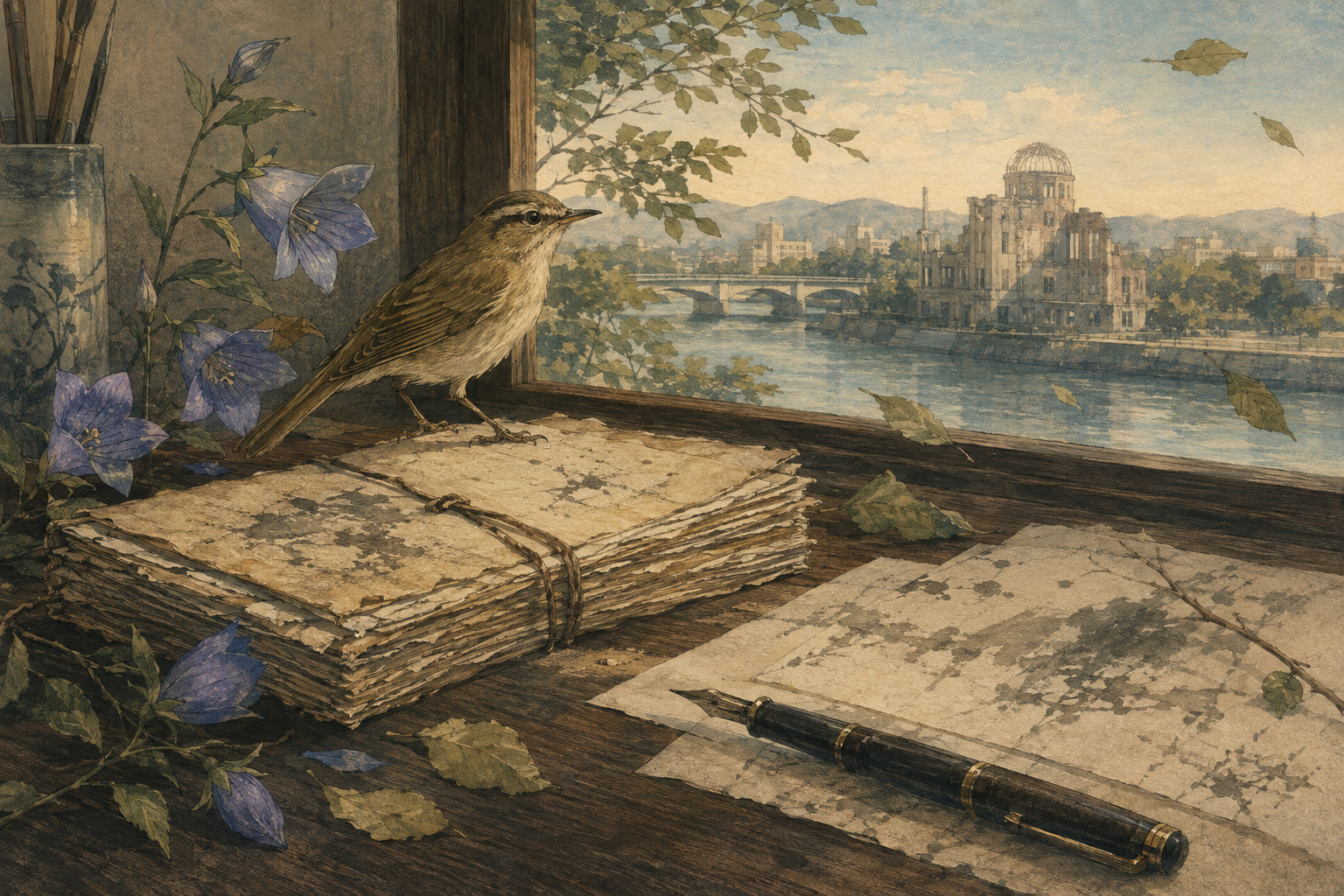
For decades, a Japanese voice sat inside an American writer’s archive. The pages were typed in English, stacked among the papers of John Hersey at Yale University’s Beinecke Rare Book and Manuscript Library. They belonged to Kiyoshi Tanimoto, the Methodist minister whom millions of readers already knew as one of the six survivors in Hersey’s Hiroshima. Yet the familiar arrangement of authorship had concealed something: the man being described had written his own book.
Hiroshima, 8:15: The Lost Memoir now brings that book into public circulation on the 81st anniversary of the atomic bombing. Random House released the 224-page U.S. hardcover on August 4; Penguin’s British edition followed on August 6. The published volume includes an introduction by Tanimoto’s daughter, Koko Tanimoto Kondo, who was eight months old when the parsonage collapsed around her and her mother.
The discovery is important not because the broad outline of Tanimoto’s life was unknown. Hersey made him internationally famous in 1946, returned to his story in 1985, and archives at Emory University preserve his speeches and career papers. It matters because testimony changes when the witness controls sequence, moral emphasis and voice. Hersey observed Tanimoto with extraordinary restraint. Tanimoto wrote from inside the event, in a second language, while the ruins and the people he failed to save were still present.
The Minister Between Two Countries
Kiyoshi Tanimoto was born in 1909 in Sakaide, Kagawa Prefecture. He converted from Buddhism to Christianity and studied theology at Kwansei Gakuin before traveling to the United States. At Emory University’s Candler School of Theology in Atlanta, he earned a bachelor of theology degree in 1940. He then served a Japanese American congregation in Los Angeles before returning to Japan shortly before Pearl Harbor.
That biography gave him an unusual position during a war defined by racialized propaganda on both sides. He knew American language, churches and habits; by 1945, those connections could invite suspicion in Japan. After serving in Okinawa and marrying Chisa, he moved to Hiroshima in 1943 to lead the Nagarekawa Methodist Church. His congregation occupied a small place within a nation mobilized for total war.
English was more than an acquired skill. It became the bridge by which Tanimoto tried to carry Hiroshima outward. The memoir’s language means that it did not need a translator before reaching Hersey, yet it also raises literary questions. How did Tanimoto’s American theological education shape his sentences? Which Japanese concepts did he compress into English? How much revision occurred between diary, speech, manuscript and the edition now published? A firsthand account is still a made document.
At 8:15, Granite Stones Became Shelter
On the morning of August 6, 1945, Tanimoto was about two miles from the hypocenter in Koi, west of the center. Hiroshima expected a conventional B-29 raid, and he had been helping move household goods away from town. At the entrance to an estate, a sudden flash crossed the sky. Tanimoto dropped between large ornamental stones. The rocks shielded him from heat and flying debris; the building into which his companion ran collapsed, but the companion also survived.
Tanimoto was physically able to move. That accident of survival immediately became obligation. He headed toward the center in search of Chisa and their infant daughter. The roads dissolved into wreckage and fire. Injured people moved outward as he moved in. Near a shrine, he encountered his wife, bloodied, with Koko alive. The family did not stop for a long reunion. Once he knew they had escaped, he continued toward his congregation.
At Asano Park on the Kyobashi River, Tanimoto found burned, thirsty and dying people. He carried water, fought fires and used a small boat to ferry victims. He removed bodies from the boat, prayed, and returned to the living. The labor required choices no minister had been trained to make: whom to move, whom to leave, when to touch skin that might come away, whether contaminated food was better than no food.
His escape from the most intense initial radiation did not mean escape from radiation. By returning quickly to the ruins and handling bodies and victims, he was exposed to residual contamination. He later developed severe fever and intestinal illness and spent weeks in bed. Then, still weak, he resumed distributing rations and trying to rebuild a congregation whose church, parsonage and membership had been shattered.
John Hersey Arrives Eight Months Later
In 1946, The New Yorker sent John Hersey to Japan. Hersey, 31, had reported from the Pacific and won the Pulitzer Prize for his novel A Bell for Adano. Deputy editor William Shawn wanted an account centered on victims rather than bomb design, military strategy or official celebration. Hersey chose six people and reconstructed the morning through their intersecting lives.
Tanimoto could not meet the reporter immediately, so he prepared a nine-page English account. Researchers say Hersey read it before their first conversation and drew on it in his reporting. When “Hiroshima” appeared in the August 31, 1946 issue, it occupied nearly the entire magazine. The spare 30,000-word narrative sold out quickly, was read on radio and reprinted internationally. Its restraint made the physical detail more difficult to dismiss.
The six subjects were clerk Toshiko Sasaki, tailor’s widow Hatsuyo Nakamura, physician Masakazu Fujii, surgeon Terufumi Sasaki, German Jesuit Wilhelm Kleinsorge and Tanimoto. The structure created equality at the instant of the flash: different lives fixed to one minute. Yet it also placed a powerful American narrative intelligence between Japanese speakers and American readers.
Tanimoto admired the book. He translated it into Japanese in 1949 and believed it had made another nuclear attack less likely. Hersey and Tanimoto remained connected for decades. In 1985, Hersey published a long follow-up tracing what had happened to the six. That continuing friendship makes the manuscript’s silence more puzzling, not less.
The Folder at Yale
The John Hersey Papers at Beinecke contain writings, correspondence, reporting material, photographs and personal records. In that large collection, the Tanimoto typescript acquired the archival title “My Diary Since The Atomic Catastrophe Up To Today.” Yale’s online finding aid dates it to 1946. Contemporary reporting describes a perfectly typed, roughly 230-page English text beginning on August 6, 1945 and continuing into November 1947.
Filmmaker Taku Nishimae and Hersey’s grandson Cannon Hersey encountered the document while researching the writer. Their memories of discovery differ: Nishimae has said 2022; Cannon Hersey has said they first found it in 2014 during an earlier documentary project. Publisher descriptions use 2022. This is not a trivial discrepancy, but neither does it undermine the manuscript itself. It shows how quickly a complicated chain of custody becomes a polished publication story.
No known letter records the handoff. Nishimae has proposed that Tanimoto brought the manuscript during his 1948–49 American visit; Cannon Hersey allows that it may have arrived later. No evidence establishes why Hersey did not promote it. Rivalry is possible to imagine but not demonstrated. Neglect, publishing prejudice, a failed proposal, an assumption that the manuscript was private, or simple archival drift are also possible.
- The archival typescript is described as about 230 pages in English.
- It begins with the bombing and continues through November 1947.
- The 2026 publication condenses the narrative to roughly the first year after the attack.
- The U.S. hardcover is 224 pages; editions in other markets vary.
- Koko Tanimoto Kondo contributes a substantial introduction.
- Readers should distinguish Tanimoto’s surviving text from editorial selection, sequencing and packaging in the new edition.
Why “Lost” Is Both True and Incomplete
The adjective “lost” sells the drama of recovery: a forgotten box, an overlooked witness, history suddenly speaking. The manuscript was indeed unknown to Tanimoto’s and Hersey’s families and unavailable to ordinary readers. But it was not physically absent. It had reached one of the world’s major research libraries, received a catalog record and could, at least in principle, be consulted.
Archives are full of this kind of partial invisibility. A document can be preserved yet intellectually lost because the description is vague, handwriting is difficult, a name is romanized differently, copyright is uncertain, or no researcher asks the right question. Digitization helps discovery but does not replace cataloging, translation and human curiosity. Search engines retrieve words; historians recognize relationships.
The date disagreement is also revealing. Publishers often need one clean origin story. Archives preserve messier evidence: item-level dates, later annotations, uncertain creators and boxes assembled across decades. The responsible response is not to abandon the story but to state the limits. Tanimoto’s book is newly public. Exactly when its modern rediscovery began remains contested.
| Question | Best-supported answer | Remaining uncertainty |
|---|---|---|
| Who wrote it? | Kiyoshi Tanimoto, in English | Degree of later editing across diary and typescript stages |
| When? | Immediate postwar years | Yale dates it 1946; publisher material says 1947 |
| Where was it? | John Hersey Papers, Beinecke Library at Yale | When and how Hersey received it |
| When rediscovered? | During research by Cannon Hersey and Taku Nishimae | The researchers cite 2014 and 2022 |
| What was published? | An edited book with Koko Kondo’s introduction | Full editorial history has not been publicly detailed |
From Witness to Public Figure
Hersey’s success transformed Tanimoto. He traveled through the United States, speaking hundreds of times and raising money to rebuild his church and create a peace center. He helped establish the Moral Adoption Project, through which Americans supported children orphaned by the war. His fluency, Christianity and lack of expressed hatred made him an effective interpreter of Hiroshima to American audiences.
That role was never simple. Some Japanese critics saw him as too accommodating to the country that had dropped the bomb; American officials could view antinuclear organizing with suspicion. Others accused him of seeking publicity or questioned his fundraising. A bright American car he briefly drove became an easy symbol for detractors. The unease matters because public memory often demands a witness who is morally pure, self-effacing and politically convenient. Real organizers need money, networks, attention and compromise.
His most visible project concerned women with severe facial and bodily burns. With writer and editor Norman Cousins and other supporters, Tanimoto helped bring 25 “Hiroshima Maidens” to New York in 1955 for reconstructive operations at Mount Sinai Hospital. The program provided treatment otherwise unavailable to them and exposed Americans to consequences of the bomb. It also placed young women’s bodies inside a publicity and medical system they did not fully control. Later scholars and participants have asked whether compassion, spectacle, gender expectations and experimentation became entangled.
In May 1955, American television concentrated all those tensions into one broadcast. This Is Your Life surprised Tanimoto on air and brought out Robert Lewis, co-pilot of the Enola Gay, without warning. The encounter raised funds for the women but turned trauma and reconciliation into entertainment between commercial breaks. Tanimoto’s composure was praised; the production’s coercion remains disturbing.
Koko Kondo’s Inheritance
At 8:15, eight-month-old Koko was in the parsonage with her mother, Chisa. The building collapsed. Chisa, nearly losing consciousness, heard her baby cry and dug through the wreckage, pushing Koko through an opening before crawling out herself. The salmon-pink dress the baby wore survived and later became one of Kondo’s most intimate teaching objects.
For years she resisted her father’s expectation that she devote herself to Hiroshima. Her mother took roughly four decades to describe their escape in her own words. Kondo experienced the humiliations attached to being medically examined and socially labeled a hibakusha. While studying in the United States, prejudice about possible radiation effects contributed to the end of an engagement.
She eventually accepted public work on her own terms. Kondo became a peace educator and advocate, bringing the perspectives of a child survivor and a daughter who had once rejected inherited trauma. Her introduction to the 2026 book is therefore more than a celebrity foreword. It explains what the manuscript’s long silence cost a family and why recovery belongs to descendants as well as historians.
A Memoir Is Not Raw Memory
The time gap between August 1945 and the typescript matters. Tanimoto wrote close enough to the event for ruined Hiroshima to shape daily life, yet after surrender, early relief work and Hersey’s visit. His account had already been told in letters, sermons and interviews. Memory and purpose had begun to organize experience.
That does not make it less authentic. It makes it a memoir. Eyewitnesses select scenes, join fragments, interpret motives and write toward an audience. Tanimoto’s Christian faith frames suffering, duty and reconciliation. His American education helps him anticipate foreign readers. His wish to abolish war gives the narrative a destination.
Hersey’s work and Tanimoto’s memoir should not be staged as competitors. Hersey’s controlled third-person reconstruction made six Japanese civilians legible to a vast 1946 American public. Tanimoto’s first-person account supplies urgency, theology, self-judgment and details of sustained relief. Where the two converge, they can reinforce evidence. Where they differ, the difference can reveal memory, translation and editorial choice.
The Film and the Risk of Another Transformation
The recovered memoir is also being developed for cinema. Producers have announced Hiroshima, 8:15, written and directed by Phil Joanou, with Takehiro Hira set to portray Tanimoto. Pre-production was reported for late 2026 and filming for early 2027, with a hoped-for Cannes premiere in 2028. These remain production plans, not completed facts.
Film can carry Tanimoto’s story to people who will never open an archival finding aid. It can also reward spectacle—the fire, ruined bodies and heroic rescue—at the expense of the slower story of hunger, burial, bureaucracy, fundraising and reconstruction. The challenge is especially sharp when adapting a text whose value lies in a survivor reclaiming authorship from representations made by others.
Kondo’s involvement, introducing filmmakers to survivors and families, offers a line of accountability. It does not eliminate artistic choices. The strongest adaptation will not merely reproduce the horror of August 6. It will show the decades during which Hiroshima was repeatedly translated for American needs: journalism, charity, television, medicine, Cold War politics and now cinema.
Eighty Years to Cross the Last Distance
Tanimoto died in Hiroshima in 1986 at 77, shortly before Emory posthumously conferred an honorary Doctor of Divinity. He had spent four decades explaining the same morning. His sermons were preserved. Hersey’s chapters remained in print. A peace prize took his name. Still, his longest account waited.
The passage from witness to archive is never automatic. Someone must keep the pages, describe the box, recognize the name, negotiate rights, edit the text and persuade a publisher that an old voice is not obsolete. Each step can preserve meaning or reshape it. The Lost Memoir carries all those layers.
Its appearance in 2026 arrives as the generation of direct witnesses diminishes and nuclear powers modernize their arsenals. The timing gives the book political force, but its deepest value is smaller. Tanimoto becomes again a man moving through a ruined city, not yet certain whether his family is alive, deciding that the next suffering person is the task immediately before him.
For eighty years, readers encountered him through Hersey’s sentence. Now they can encounter the sentences he chose. The archive has not changed what happened at 8:15. It has changed who is permitted to tell it.
1940 Tanimoto graduates from Emory’s Candler School of Theology.
1943 He becomes pastor of Nagarekawa Methodist Church in Hiroshima.
August 6, 1945 He survives in Koi and returns to help victims.
1946 John Hersey publishes “Hiroshima”; Yale catalogs the memoir typescript to this year.
1947 Publisher material says Tanimoto completes the memoir.
1948–50 He tours the United States and builds support for relief and reconstruction.
1949 He translates Hersey’s Hiroshima into Japanese and speaks at Emory.
1955 Hiroshima Maidens travel for surgery; Tanimoto appears on This Is Your Life.
1985–86 Hersey revisits the six survivors; Tanimoto dies the following year.
2014 or 2022 Researchers give different dates for encountering the typescript.
August 2026 The memoir is published in the United States and Britain.
Reporting notes and principal sources
This article paraphrases published descriptions and archival metadata; it does not reproduce extended passages from the copyrighted memoir. Discovery dates and the document’s chronology are presented as disputed where sources conflict.
- Random House: U.S. edition, format and publication details
- Penguin: British edition and Koko Kondo introduction
- Yale Archives: John Hersey Papers and Tanimoto typescript catalog entry
- Beinecke Library: John Hersey Papers overview
- The Guardian: Koko Kondo, manuscript provenance and researcher accounts
- The Guardian: publication and film announcement
- The New Yorker: John Hersey’s “Hiroshima” (1946)
- The New Yorker: “Hiroshima: The Aftermath” (1985)
- Beinecke Library: Hersey’s reporting and archival legacy
- Emory University: Kiyoshi Tanimoto biography and relief work
- Emory Pitts Theology Library: Kiyoshi Tanimoto Collection
- Emory digital collection: Tanimoto’s 1949 eyewitness address