- A million seeds and a question that cannot be answered overnight
- The underwater nursery that is not seaweed
- The loss behind a seemingly simple project
- A fisheries cooperative builds a conservation network
- A city workshop, then a return to the island
- What the oyster shells are supposed to do
- Why the sea can defeat a seedling
- Blue carbon is an opportunity, not a credit for every seed
- Separate from Hiroshima’s oyster mortality emergency
- The next chapter will be written underwater
A million seeds and a question that cannot be answered overnight
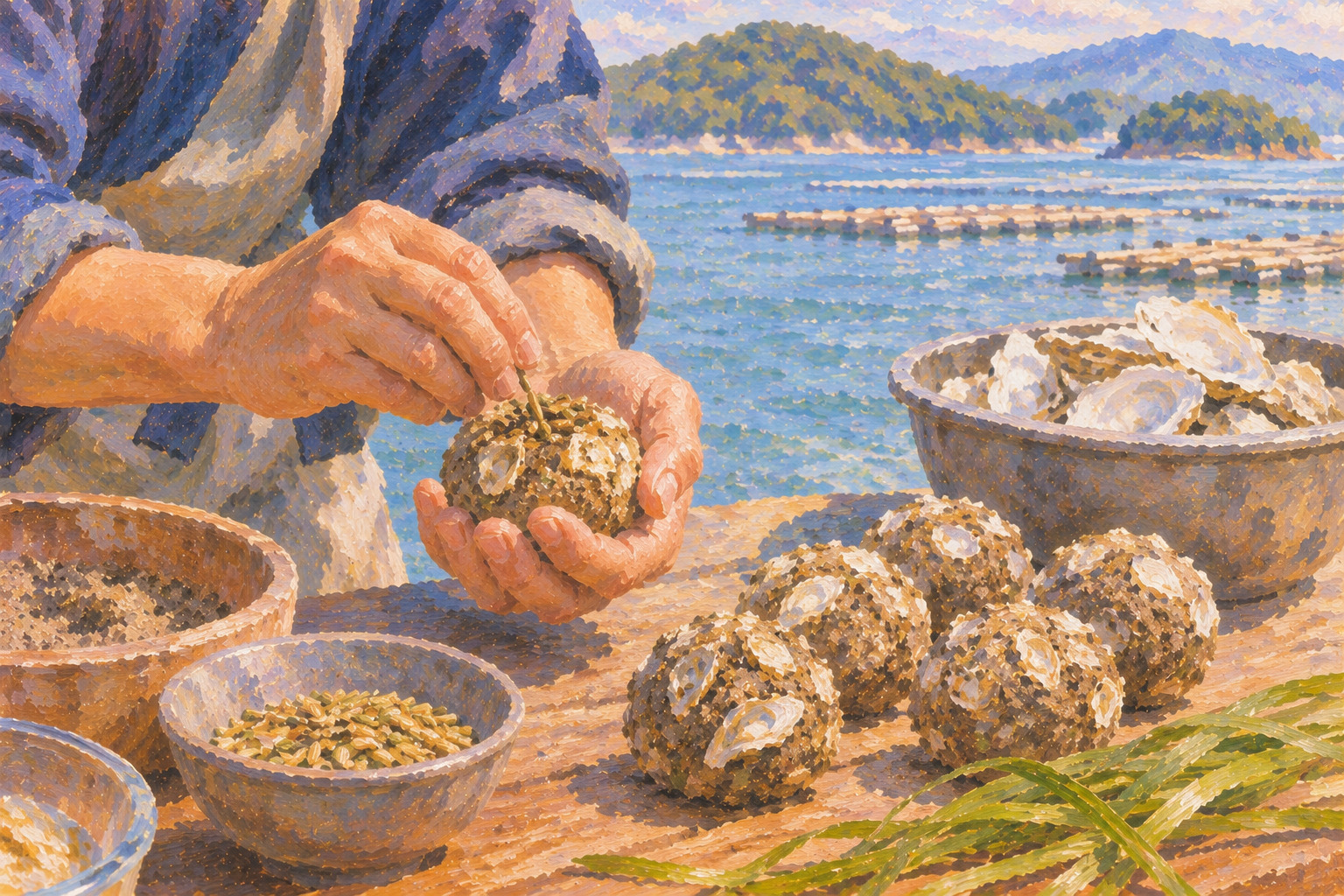
On an island in Japan’s sheltered Seto Inland Sea, the act of restoration begins with something small enough to fit in a child’s palm. Families pressed eelgrass seeds and crushed oyster shells into compact balls and helped deliver them to the water around Osakikamijima, Hiroshima Prefecture, on November 14–15. On November 18, the Osaki Uchiura Fisheries Cooperative reported that participants had sorted and sown approximately 1.19 million eelgrass seeds. It is an impressive figure, but not a measure of success. The number that will matter in the years ahead is how many plants take root, endure the seasons and establish a living meadow on the seabed.
The underwater nursery that is not seaweed
Eelgrass is a flowering marine plant, not a seaweed like kelp or wakame. It produces seeds and grows roots and underground stems in shallow sand or mud. Its slender leaves create hiding and feeding space for young fish, crustaceans and other organisms; hence the familiar description of seagrass beds as nurseries of the sea. In productive coastal waters, meadows can also change local sediment and water movement. Those services, however, depend on thriving plants. Dropping seeds overboard does not by itself guarantee clearer water, greater fish catches or a lasting ecosystem.
The loss behind a seemingly simple project
Japanese authorities have documented major historical losses of seagrass habitat in the Seto Inland Sea. The Ministry of the Environment says roughly 70% of eelgrass habitat disappeared between fiscal 1960 and the 1989–90 survey period. That specific historical comparison should not be misreported as a loss during the most recent three decades. Shoreline modification, development and changing water conditions have transformed portions of the inland sea, but local trends differ. Hiroshima Prefecture’s habitat strategy therefore combines restoration measures with protection of existing eelgrass and other marine vegetation. Maintaining the meadows that remain can be as important as starting a new one.
A fisheries cooperative builds a conservation network
The Osakikamijima seashore conservation group began in fiscal 2021. According to the Osaki Uchiura Fisheries Cooperative, it brings together fishers, residents, businesses and schools to collect and sort seeds, sow them in suitable coastal areas and teach children why the plants matter. Participants gather drifting flowering shoots in early summer, hold the material in nets suspended from rafts and extract the seeds in autumn. The cooperative reported handling about 860,000 seeds in 2023 and roughly 1.19 million this November. The difference is not evidence that the resulting meadow grew by the same proportion. Seed supply and plant survival are fundamentally different metrics.
A city workshop, then a return to the island
The latest effort reached beyond the fishing village. On November 14, families gathered at Aeon Mall Hiroshima Gion in Hiroshima City for an event under the Hiroshima Sea Forest initiative. They formed seed balls containing oyster shells, while students from Hiroshima National College of Maritime Technology helped explain the local marine environment. The prepared material was deployed around Osakikamijima on November 15. Television Shin-Hiroshima documented the activities and the participation of local fishers. Such events draw urban families into an ecological task they might otherwise never see. But attendance figures, smiles and well-made seed balls are not a substitute for surveys showing the return of a functioning seagrass bed.
What the oyster shells are supposed to do
This year’s modification follows a sobering result from the previous attempt. Seeded eelgrass was visible in May 2026 but did not persist, according to local reporting. Organizers have now mixed oyster-shell material into the seed balls. Shohei Urabe, president of Urabe Sangyo, told Television Shin-Hiroshima that shells might help suppress hydrogen sulfide in sediment and promote root growth, potentially improving retention. Those are the company's proposed mechanisms, not independently demonstrated outcomes at this site. The shell mixture’s effect will depend on conditions such as sediment chemistry and grain size; comparative monitoring is needed to determine whether it improves establishment over conventional sowing.
Why the sea can defeat a seedling
The Japan Fisheries Agency describes how eelgrass seeds can be washed away before they settle and therefore recommends techniques including gauze, mats and other seed-retention methods. Ecological research also points to the importance of light reaching the seabed, water movement, unstable sediment and the accumulation of suspended mud or drifting algae. Even a successful spring germination may be followed by summer or autumn loss. The new oyster-shell seed balls are an experiment in solving part of that problem. Credible evaluation would compare test and control areas, track seedling emergence and survival and measure bottom conditions through more than one season. No such comparison results for the November 2026 activity have yet been published.
Blue carbon is an opportunity, not a credit for every seed
Seagrass beds can take up carbon through photosynthesis and may contribute to long-term carbon storage in sediments. This has brought them into Japan’s “blue carbon” conversation and wider efforts to fund coastal restoration. But the quantity of seed spread is not a proxy for carbon permanently removed from the atmosphere. Credible carbon accounting needs measurements of plant growth, sediment carbon, persistence and the applicable accounting boundary. Hiroshima has other projects exploring science-based marine restoration, including an initiative on Etajima that couples eelgrass recovery with monitoring and community participation. The lesson is that lasting restoration requires institutions and evidence as much as enthusiasm.
Separate from Hiroshima’s oyster mortality emergency
The choice of oyster shells makes this story resonate especially strongly in Hiroshima, where oyster aquaculture faces another season of serious mortality. Yet the two developments should not be merged into an unsupported claim. Seeding eelgrass with shell material is not an established remedy for oyster deaths, and this local conservation exercise cannot determine the causes of the aquaculture crisis. Coastal biodiversity, shell recycling and oyster production are connected in the broader life of the Seto Inland Sea, but the specific scientific relationships still require investigation. The distinction matters to fishers whose livelihoods depend on practical, tested solutions.
The next chapter will be written underwater
The fisheries cooperative says it conducts diving surveys around January and May to check whether eelgrass is establishing and growing. Those observations will help answer questions that the November ceremony could not: How many seedlings emerged? Which sites supported root growth? Did shell-filled balls outperform the earlier method? And did plants survive long enough to reproduce? For a community confronting long-term environmental change, such measurements matter more than a single spectacular seed count. The story of the million-plus seeds is promising precisely because the outcome is unfinished—and because the people of Osakikamijima intend to keep watching.
Sources, methods and what remains unknown
This report independently synthesizes the fisheries cooperative’s November 18 primary announcement, local November 14 and 19 reporting, government guidance and ecological research. JAPAN.co.jp did not visit the site, interview participants or independently survey seedlings. The performance of oyster-shell seed balls has not yet been established.
- Osaki Uchiura Fisheries Cooperative: 2026 seed collection and sowing report (Nov. 18)
- Osaki Uchiura Fisheries Cooperative: local seashore conservation group
- Television Shin-Hiroshima: eelgrass seed balls and oyster shells (Nov. 19)
- Television Shin-Hiroshima: Nov. 14 family workshop
- Japan Fisheries Agency: seagrass restoration techniques
- Ministry of the Environment: Seto Inland Sea seagrass and tidal flats
- Hiroshima Prefecture: seagrass and seaweed habitat vision
- Ministry of the Environment: 2026 Etajima coastal restoration project
- Osaki Uchiura Fisheries Cooperative: 860,000 seeds in 2023
- Peer-reviewed study: physical constraints on eelgrass beds (2015)