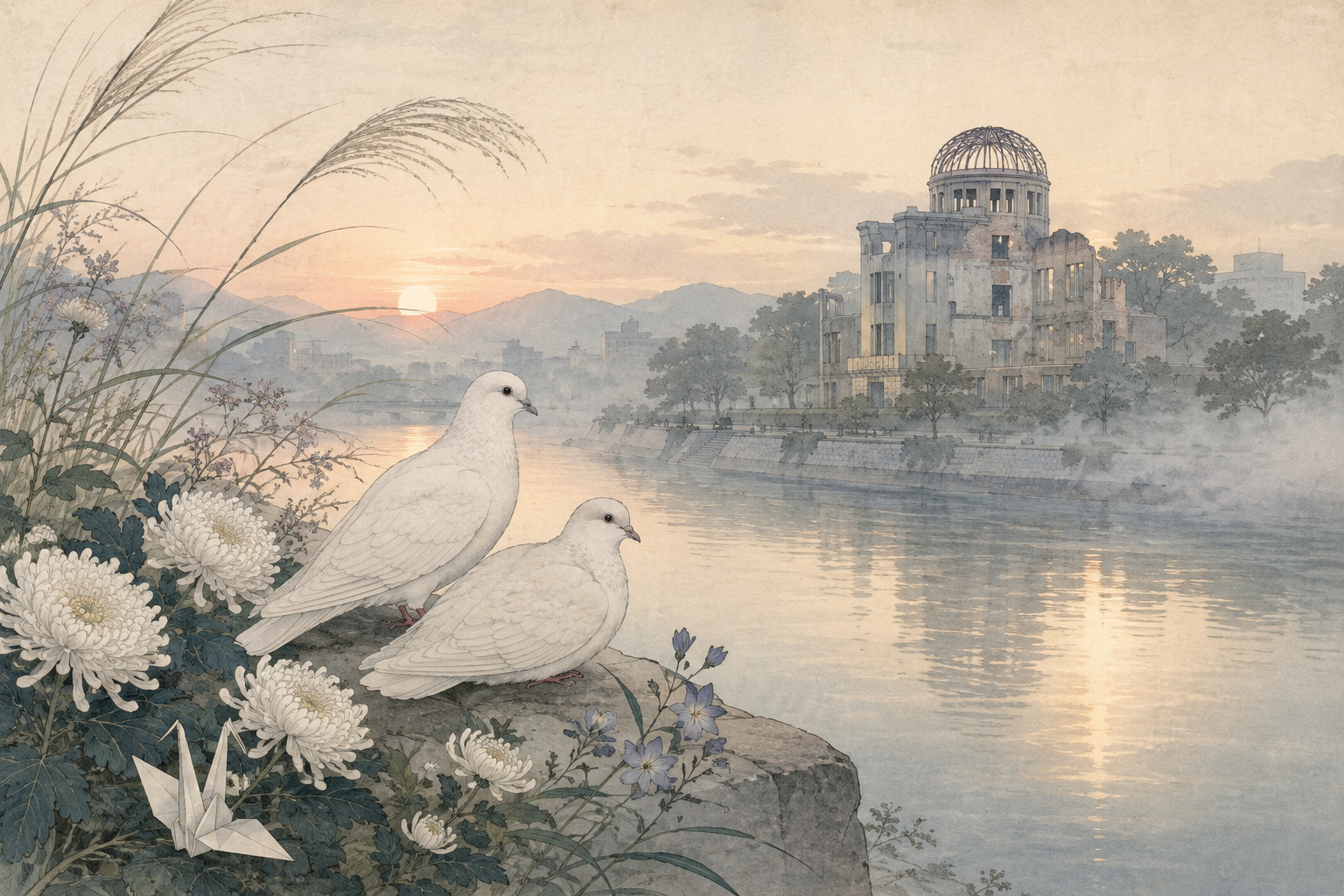
At 8:15 on Thursday morning, the city stopped. The Peace Bell sounded from a park built over what had once been a crowded district of homes, shops, temples and offices. Cicadas filled the pause around the bell. People bowed beneath the August sun. Then, at 8:16, Mayor Kazumi Matsui began the 2026 Peace Declaration: remembrance made public, grief converted again into an argument with the living.
The ceremony lasted fifty minutes. The city dedicated its register of the dead, laid flowers, released doves and heard children make a commitment to peace. It was a familiar order, but familiarity is part of the purpose. The same minute, the same bell and the same place prevent August 6 from drifting into an abstract anniversary. Hiroshima does not remember only that a weapon exploded. It remembers that people were eating breakfast, lining up for work, opening windows and walking to school.
That distinction matters in 2026. The people who can say “I was there” are disappearing. Japan’s health ministry counted 91,105 holders of an Atomic Bomb Survivor’s Health Handbook at the end of March, with an average age of 86.66. The generation that carried the event in scars, illnesses and recurring dreams is passing its testimony to people who know the mushroom cloud first as an image.
A Military City, and a City of Ordinary Mornings
Hiroshima in 1945 was both a military center and a civilian city. The headquarters of Japan’s Second General Army stood there; the port, railways and warehouses served troops and supplies. Those facts helped place it on an American target list. They did not turn its neighborhoods into an empty battlefield. Tens of thousands of children, older people, Korean and Chinese residents, forced laborers and other civilians lived within the target.
By early August, Japan had been at war in China for eight years and at war with the United States and its allies for almost four. Japanese forces had committed aggression and atrocities across Asia. American conventional bombing had already burned large parts of Tokyo and scores of other cities. The Allied demand for unconditional surrender had gone unanswered. Hiroshima, spared the mass raids that devastated other urban centers, remained unusually intact—one reason the effects of a new weapon could be observed.
On the morning of August 6, the B-29 Enola Gay approached at high altitude. At 8:15, it released “Little Boy,” a uranium-235 gun-type bomb. The weapon detonated roughly 600 meters above the city, near the center of a densely occupied urban plain. Its yield was equivalent to about 15,000 tons of TNT. In less time than a person could recognize the flash, the city entered the nuclear age.
Thousands of students had been mobilized outdoors to clear firebreaks by demolishing buildings. Many were close to the hypocenter. Office workers had begun the day. Streetcars were moving. Patients waited in clinics. The bomb did not select among military headquarters, school groups and kitchens. Its effects spread according to distance, shielding, building material and chance.
Heat, Blast and Radiation
The first violence was light and heat. A fireball released thermal energy intense enough to burn exposed skin and ignite combustible material across a wide area. Dark clothing absorbed more heat than light cloth. Roof tiles bubbled. Human silhouettes were left as changes on stone where bodies or objects had interrupted the flash—not bodies vaporized into shadows, as the story is sometimes simplified, but surfaces altered by heat and shielding.
The second violence was pressure. The blast crushed wooden houses, hurled glass and debris, and trapped people beneath structures that then burned. Hospitals and clinics were destroyed or disabled; medical workers were killed or injured. Broken water mains and blocked roads made rescue almost impossible. The city’s rivers became places of refuge for people with burns, and places where many died.
The third violence could not be seen. Prompt radiation struck at detonation. Radioactive material and dust returned in contaminated rain in some areas. People who appeared to have escaped the blast developed fever, bleeding, hair loss and profound weakness in the following days and weeks. Later came elevated risks of leukemia and solid cancers. Radiation Effects Research Foundation studies have shown that risk varies with dose, age and other factors; exposure was neither a universal death sentence nor a harmless event.
By the end of 1945, an estimated 140,000 people had died in Hiroshima, with a commonly stated uncertainty of tens of thousands. The figure includes immediate deaths and later deaths from burns, injuries and radiation illness. It remains an estimate because municipal records burned, populations shifted during wartime mobilization, bodies were never recovered, and some residents—especially marginalized or colonial subjects—were poorly documented.
- People directly exposed in Hiroshima or Nagasaki.
- People who entered designated areas soon afterward, including for rescue or searching for family.
- People exposed under other specified circumstances, including assistance to victims and certain “black rain” cases.
- People who were in utero when their mothers were exposed.
Did the Bomb End the War?
The neat textbook sentence—Hiroshima happened, therefore the war ended—compresses a contested sequence. On August 8, the Soviet Union declared war on Japan and attacked Japanese forces in Manchuria. On August 9, the United States dropped a plutonium bomb on Nagasaki. Japan announced acceptance of surrender terms on August 15, and the formal surrender was signed on September 2.
Historians continue to debate the relative weight of the atomic bombings, Soviet entry, the prospect of invasion, domestic politics and the status of the emperor. American decision-makers cited ending the war and avoiding an invasion expected to cause enormous casualties. Critics argue that alternatives were available or insufficiently tested, and that demonstrating the bomb’s power and constraining Soviet influence also shaped the decision. The archival record supports serious argument; it does not support a painless moral formula.
Two truths can stand together. Imperial Japan waged a brutal war for which it bore responsibility. The civilians burned and irradiated at Hiroshima did not cease to be civilians because their government had committed aggression. Remembering them does not erase Nanjing, forced labor, colonial rule or Pearl Harbor. Remembering Japan’s victims across Asia does not make the nuclear destruction of a city ethically simple.
From Censorship to Testimony
After surrender, occupation authorities restricted reporting and images about the bomb’s effects. Survivors lived with scarce medical care, homelessness and stigma. Some were treated as contagious, genetically damaged or unsuitable for marriage and employment. The Japanese word hibakusha—bomb-affected person—became both an identity of witness and a label people sometimes hid.
John Hersey’s 1946 New Yorker article “Hiroshima” followed six survivors through the morning and its aftermath. Its power came from scale: not strategy maps but thirst, wounds, separated families and hours without help. Methodist minister Kiyoshi Tanimoto was among those six. Such accounts helped an American and global public encounter the bomb as an experience endured by individual bodies.
Survivors organized. The 1957 Atomic Bomb Survivors Medical Care Law established health examinations and medical benefits; later legislation expanded support. Nihon Hidankyo, founded in 1956, linked demands for survivor welfare with abolition of nuclear weapons. In 2024, the Norwegian Nobel Committee awarded the organization the Nobel Peace Prize for its work toward a world without nuclear weapons and for showing through testimony why such weapons must never be used again.
Testimony is not a transparent recording. Trauma disturbs sequence; memories differ; translators and editors make choices. Yet those limits are reasons to compare testimony with documents and physical evidence, not reasons to discard it. A military history can tell us altitude and yield. A survivor can tell us what it meant to step over a person calling for water when there was no safe water to give.
A City Rebuilt Around an Axis of Memory
Hiroshima’s postwar identity was not inevitable. Survivors needed housing, food, jobs and infrastructure. Many residents wanted normal urban life, not permanent existence as victims. In 1947 the city held its first Peace Festival and Mayor Shinzo Hamai issued a Peace Declaration. In 1949 the Diet unanimously passed the Hiroshima Peace Memorial City Construction Law; local voters approved it in a referendum, giving reconstruction a national purpose and access to state land.
Architect Kenzō Tange’s plan made memory spatial. The Peace Memorial Museum, the arched cenotaph and the ruined former Industrial Promotion Hall—now the Atomic Bomb Dome—share a visual axis. A visitor can stand beneath the museum, look through the cenotaph and see the skeletal dome beyond. The composition turns a walk into an argument: evidence, mourning and warning aligned across an open field.
The museum opened in 1955. Its burned clothing, fused roof tiles, watches stopped at 8:15 and children’s possessions resist the grand scale of military language. UNESCO inscribed the dome as a World Heritage Site in 1996. The surviving structure has become globally recognizable, but it was preserved through local disagreement and effort. Ruins do not automatically become memorials; people decide that discomfort must remain visible.
August 6, 1945 “Little Boy” detonates over Hiroshima at 8:15 a.m.
August 8–9, 1945 The Soviet Union enters the war; Nagasaki is bombed.
August 15, 1945 Japan announces its surrender.
August 1946 John Hersey’s “Hiroshima” gives six survivors’ experiences a global audience.
August 6, 1947 Hiroshima holds its first Peace Festival.
1949 The Peace Memorial City Construction Law is enacted.
1955–1957 The museum opens; national medical-support legislation follows.
1996 UNESCO lists the Atomic Bomb Dome as World Heritage.
2024 Nihon Hidankyo receives the Nobel Peace Prize.
2026 Hiroshima marks 81 years as the global nuclear order weakens.
The Arithmetic of a Vanishing Generation
At the end of March 2026, 91,105 people held survivor health handbooks. Of them, 52,828 were classified as directly exposed; 15,822 had entered the cities after the bombings; 16,204 qualified through other radiation-related circumstances; and 6,251 had been exposed in utero. Their average age, 86.66, is the clearest measure of urgency. The number of recognized survivors peaked at 372,264 in fiscal 1980.
The cenotaph register tells a different story. As of the 2025 ceremony, its 130 volumes contained 349,246 names, including people who died decades after the attack. Ahead of the 2026 ceremony, scribes began adding thousands more names confirmed during the year. A name may arrive late because a family hesitated, records emerged or relatives finally judged a death connected to exposure.
Neither ledger can contain everyone. Korean survivors fought for decades for recognition and equal treatment. Some people exposed to radioactive “black rain” had to litigate over the boundaries used for assistance. Others emigrated. The bureaucratic categories provide medical support, but they also reveal how difficult it is to draw a legal line around radiation that moved with weather, water, rescue work and human bodies.
| Measure | 2026 reference | What it means |
|---|---|---|
| Detonation | 8:15 a.m., August 6, 1945 | Airburst roughly 600 meters above Hiroshima |
| Weapon | Uranium-235, about 15 kilotons | First nuclear weapon used against a city in war |
| Deaths by end of 1945 | About 140,000 | Estimated, not a complete named list |
| Survivor handbooks | 91,105 | Living recognized survivors at end-March 2026 |
| Average survivor age | 86.66 years | Shows the closing window for first-person testimony |
| Global nuclear inventory | About 12,187 warheads | SIPRI estimate for nine nuclear-armed states in January 2026 |
The 2026 Declaration Meets a Harder World
Mayor Matsui’s declaration spoke from a city ceremony into a deteriorating arms-control environment. The 2026 Nuclear Non-Proliferation Treaty Review Conference ended in May without a consensus outcome—the third consecutive review cycle to fail to agree on a final document. The failure does not abolish the treaty, but it exposes distrust among nuclear powers and frustration among non-nuclear states.
SIPRI estimated that nine states possessed about 12,187 nuclear warheads at the start of 2026. Roughly 9,745 were in military stockpiles and about 4,012 were deployed with missiles or aircraft. The total is far below Cold War peaks, yet modernization, weakening arms-control agreements and a renewed reliance on nuclear threats point in the wrong direction.
Matsui warned that repeated disregard for international law and a chain of distrust could produce a “third Hiroshima and Nagasaki.” He urged leaders to visit the two cities, asked Japan to attend the November 2026 review conference of the Treaty on the Prohibition of Nuclear Weapons as an observer, and pressed the government to join the treaty as soon as possible. He also called for stronger support for aging survivors, including those overseas.
Japan’s position contains a central contradiction. It is the only country attacked with nuclear weapons in war and presents survivor testimony as a national moral resource. At the same time, it relies on the United States’ extended nuclear deterrent and has not joined the prohibition treaty. Supporters call the alliance necessary in a region containing nuclear-armed China, Russia and North Korea. Critics say the policy asks other countries to abandon weapons Japan still wants available for its own defense.
The declaration’s appeal to young people is therefore more than ceremonial succession. Mayors for Peace counted 8,589 member cities in 166 countries and regions by mid-2026. The project assumes that municipal networks, education, art and exchange can build what Matsui calls a culture of peace from below—even when national governments remain locked in deterrence.
What Remembrance Requires
An anniversary can flatten a catastrophe into ritual: a bell, a bow, a photograph of doves. Hiroshima’s ceremony works against that flattening when it returns listeners to specific people and specific decisions. It asks who designed the weapon, who authorized it, who suffered, who helped, who was excluded from later support and who now speaks about using such weapons again.
It also asks that memory be historically adult. Japan’s wartime aggression belongs in the story. So do American choices, Soviet strategy, racism, technology and the experiences of colonial subjects in Hiroshima. Complexity is not an excuse to avoid judgment. It is the condition for making judgment honestly.
At eighty-one years, the most fragile part of Hiroshima’s archive is the human voice. Objects remain in museum cases. Buildings can be stabilized. Documents can be digitized. A witness can answer an unexpected question, correct a misunderstanding, pause, become angry or decide that a detail is too painful to say. No recording fully replaces that encounter.
But the disappearance of the hibakusha does not end responsibility. It transfers it. The children who read the Commitment to Peace in 2026 inherited no memory of the flash. They inherited evidence, names and a choice about what to do with them.
After the bell, traffic resumed across Hiroshima. Streetcars moved beside the park; workers crossed bridges; the city returned to an ordinary Thursday. That ordinariness is not a betrayal of the dead. It is what was taken from them, what survivors rebuilt, and what the ceremony asks the world to protect.
Reporting notes and principal sources
Reporting was checked through August 6, 2026 at 9:40 a.m. JST. Casualty estimates, named-death registers and living-survivor statistics answer different questions and are not treated as interchangeable.
- City of Hiroshima: 2026 Peace Memorial Ceremony program and scale
- City of Hiroshima: 2026 Peace Declaration
- Ministry of Health, Labour and Welfare: 2026 hibakusha statistics
- MHLW: legal categories of atomic-bomb survivors
- City of Hiroshima: Register of the Names of the Fallen Atomic Bomb Victims
- Mainichi Shimbun: names prepared for the 2026 register
- ICAN: Hiroshima and Nagasaki bombing figures and effects
- U.S. National Archives: the atomic bombings
- Radiation Effects Research Foundation: health effects research
- City of Hiroshima: the Peace Memorial City Construction Law
- UNESCO: Hiroshima Peace Memorial (Genbaku Dome)
- The New Yorker: John Hersey’s “Hiroshima” (1946)
- Norwegian Nobel Committee: 2024 Peace Prize to Nihon Hidankyo
- United Nations: 2026 NPT Review Conference closes without consensus
- SIPRI Yearbook 2026: world nuclear forces