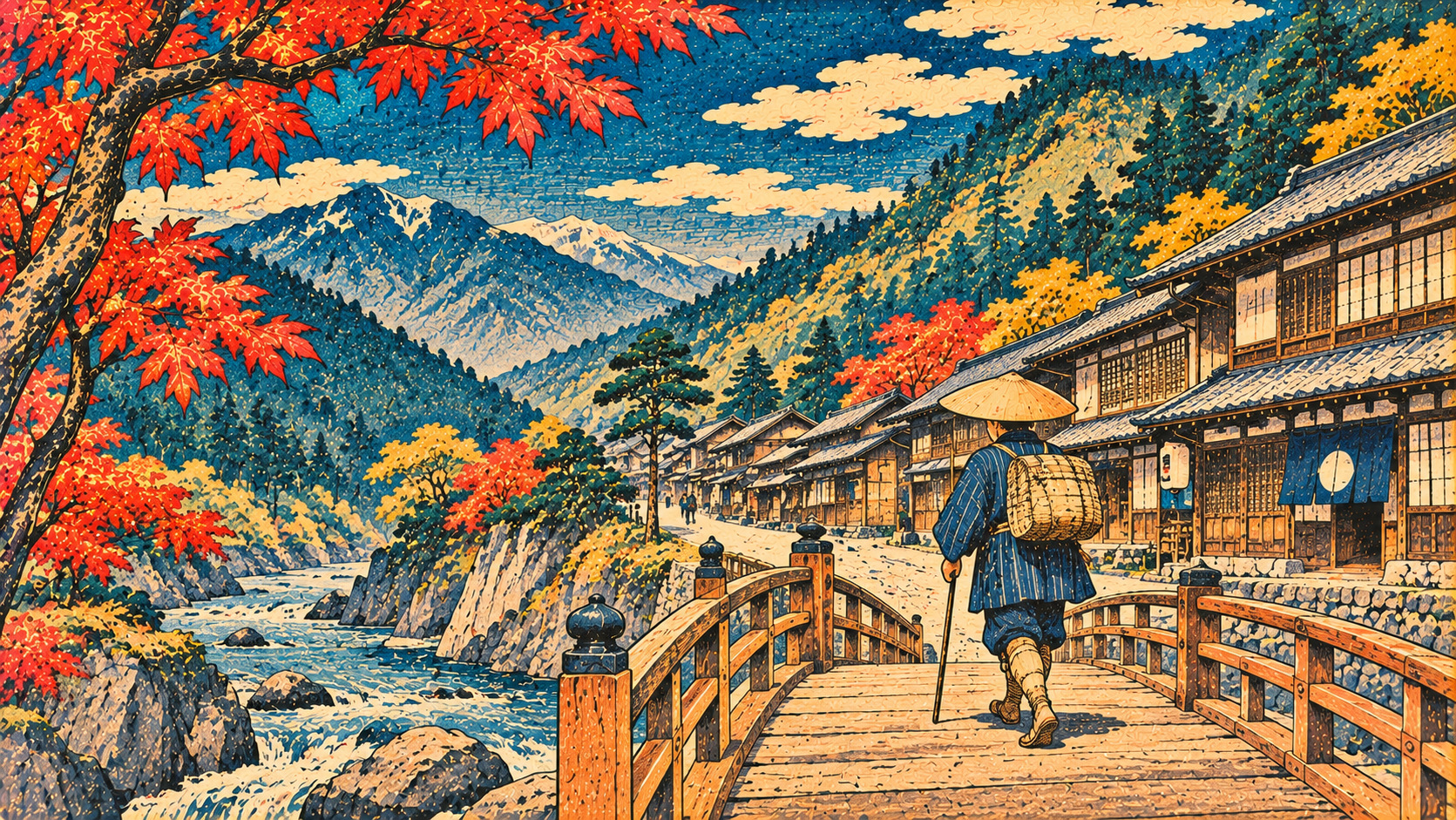
- The last day of a journey through mountain Japan
- An inland highway through the Edo world
- Two artists, two approaches—and a changing publisher
- Seba: finding an evening in a woodblock
- How a printed landscape made weather visible
- The collector behind a gift of 1,025 prints
- Three complete series, three different ways of looking
- Practical information for a Monday holiday visit
- The longer journey is learning to see a landscape
The last day of a journey through mountain Japan
At the edge of a river, the evening light appears to hesitate. A willow bends over the water, and a figure moves through a landscape that is both recognizable and dreamlike. Utagawa Hiroshige understood that a journey could be communicated without a map: a bend of the road, the weight of cloud, a few spare marks for people far from home.
On Monday, November 23, 2026, visitors to the Tokyo National Museum have their final scheduled chance to see the second phase of its exhibition, Hiroshige: New Perspectives on Edo Japan. The center of this phase is The Sixty-nine Stations of the Kisokaidō, a celebrated series devoted to Japan’s inland highway. The museum will replace every work on display before opening the third and final phase on November 25.
The date is easily misunderstood. November 23 is not the last day of the entire exhibition, which continues through December 20. It is the last day of this particular Kiso Road presentation. For anyone who wants to follow the route as a complete sequence of prints, that distinction is the news.
An inland highway through the Edo world
The Nakasendō was one of the five official highways of Tokugawa Japan, linking Edo with Kyoto by an inland route through mountain settlements and river valleys. Its 69 post stations supplied the infrastructure of travel: places to rest, change horses, exchange news, lodge for the night and move goods between regions.
The print series titled The Sixty-nine Stations of the Kisokaidō includes more images than the 69 in its name. The route comprises the starting point at Nihonbashi as well as the 69 stations, producing a standard sequence of 70 designs. A second version of the Nakatsugawa view raises the number of distinct designs known to 71. This is not a trivial bibliographic puzzle: individual impressions, variants and publishing sequences help scholars reconstruct how the project was made.
Neither artist offered a photographic survey. A woodblock landscape compresses distance, amplifies a winding road or arranges travelers beneath a dramatic bank of cloud. The visual choices reveal what editors and publishers of Edo Japan believed would move purchasers who might never have undertaken the trip themselves.
Two artists, two approaches—and a changing publisher
Although the Tokyo exhibition is organized around Hiroshige, the Kiso Road series was not his work alone. Keisai Eisen, a successful ukiyo-e artist older than Hiroshige, began the series for publisher Hōeidō, associated with Takeuchi Magohachi, in 1835. Hiroshige subsequently joined and took over much of the undertaking as publication shifted toward Kinjudō.
The Hiroshige Museum of Art in Ena counts 24 standard designs by Eisen and 46 by Hiroshige, yielding the conventional total of 70. When the alternate Nakatsugawa design is counted, other Japanese scholarship records 47 Hiroshige designs and 24 Eisen designs, or 71. The two totals describe different counting conventions, not a disagreement over whether Eisen participated.
Looking at an entire series makes it possible to recognize different temperaments in the same journey. Eisen often draws attention to people and the structures of a post town; Hiroshige can make a nearly empty stretch of sky or the angle of a branch the principal drama. The series also reminds us that ukiyo-e was collaborative: publisher, artist, block carver and printer all shaped the result.
Seba: finding an evening in a woodblock
The Tokyo National Museum highlights Seba, a station in what is now Shiojiri, Nagano Prefecture, as a representative work from the second phase. The museum dates the Hiroshige design to approximately 1836–37. Its importance is not the number of landmarks that can be identified. Rather, it invites the viewer to linger in a particular atmosphere.
The water takes up space; slight forms and human activity register at the margins; changing light becomes the subject. A picture that seems sparse is painstakingly arranged. Hiroshige allows the traveler to inhabit the interval between movement and rest, the hour when the journey’s practical demands meet the imagination.
Other works on view in this phase range across mountain terrain and weather. Taken together, the prints are not merely a checklist of inns and villages. They are an atlas of conditions: the cold of snow, the suddenness of rain, the silence of night and the sheer scale of land beyond the city.
How a printed landscape made weather visible
A nineteenth-century color woodblock print was a technically demanding publication. A carved key block established the outlines, separate blocks supplied colors, and the printer had to align successive impressions precisely. Controlled gradations, known as bokashi, allowed sky and water to recede without the continuous tones of modern photography.
This printing process helped Hiroshige turn meteorological moments into visual structure. Diagonal rain can become the rhythm of an entire view. A darker band near a horizon can make an otherwise ordinary riverbank feel like a place at dusk. Differences between impressions can also tell scholars about changes in production and the history of individual blocks.
A paper presented to the Art History Society of Japan in 2023 by Miho Tsunekane specifically examined printing methods and expressive choices in the Eisen–Hiroshige Kisokaidō series. It is a useful reminder not to treat every surviving impression as identical. Exhibition visitors should look for the physical craftsmanship as carefully as the depicted scenery.
The collector behind a gift of 1,025 prints
The exhibition exists because the Tokyo National Museum received 1,025 ukiyo-e works formerly owned by Uchiyama Susumu (1893–1980). Born in Shizuoka, Uchiyama ran a trading business while assembling a substantial collection focused on Hiroshige. The museum traces his collecting interest to a print showing the Ejiri-Shimizu harbor area of his home region.
Visits to the Museum of Fine Arts, Boston, and the British Museum later strengthened his dedication to collecting. His particular enthusiasm was not for the celebrity actors or beautiful women of the print market but for the quieter poetry of landscape. In 1958 he documented the collection in a privately published volume, and he helped spread knowledge of ukiyo-e through exhibitions and publishing.
A transfer from private collector to public museum matters beyond the number. Researchers can compare impressions and variants, conservators can monitor condition, and future generations may gain access under institutional stewardship. The museum is not, however, displaying all 1,025 newly received works simultaneously; it is presenting selected major bodies of work across three phases.
Three complete series, three different ways of looking
The exhibition opened on September 29 with Hiroshige’s Fifty-three Stations of the Tōkaidō as the focus of its first phase, which ended October 25. The second phase began October 27 and centers on the Kisokaidō journey. After a full changeover, the final phase from November 25 to December 20 features One Hundred Famous Views of Edo.
These are different artistic enterprises. The Tōkaidō evokes the rhythm of travel on Japan’s famous coastal highway. The Kisokaidō concentrates attention on inland routes, mountain settlements and changing conditions. One Hundred Famous Views of Edo turns the viewer toward the city itself, often presenting familiar locations from startlingly intimate angles.
The museum says all prints belonging to each of the three great series are presented within the corresponding phase. That is an unusually concentrated opportunity, but it means no single visit offers all three series together. November 23 visitors will encounter different works from people who return on November 25.
Practical information for a Monday holiday visit
The venue is Room A of the Honkan, the Tokyo National Museum’s main building in Ueno Park. The museum explicitly lists November 23, a national holiday, as an open Monday. Exhibition hours that day are 9:30 a.m. to 5 p.m., with last admission 30 minutes before closing. The special 8 p.m. opening advertised for November 22 does not automatically extend to November 23.
Adult admission is ¥1,500 and university admission ¥500, with exemptions for specified younger and older visitors and qualifying visitors with disabilities. Reservations are not mandatory, though the museum warns that entry may be delayed when galleries are crowded. November 24 is a closed day before the new installation opens on November 25.
The museum publishes its exhibition checklist online rather than distributing a printed list in the galleries. Readers who are hoping to see a particular station should review that checklist in advance. Hours, ticket provisions and photography rules should always be checked against the museum’s latest notices before visiting.
The longer journey is learning to see a landscape
Why does a route imagined almost two centuries ago still have the power to stop a traveler in a museum? The answer is partly in the apparently modest decisions Hiroshige made: how much of the sky to leave empty, how small to make the human presence, how sharply to angle the bridge toward the hills.
The prints can inform historical research, but they should not be mistaken for strictly factual photographs of the nineteenth-century countryside. Their angles and proportions serve a visual story. The attribution of each view, the publishing history and the differences between impressions all matter when moving from aesthetic appreciation to historical evidence.
When the Kiso Road installation closes on November 23, Hiroshige’s larger journey does not end. Two days later the museum’s walls will become an imaginative tour of old Edo. The act of changing the exhibition is almost a Hiroshige subject in itself: the same place seen again through an entirely different arrangement of time, distance and light.
Primary sources, methodology and limits
Based on the Tokyo National Museum exhibition page, the National Art Center exhibition record, Hiroshige Museum of Art in Ena, Nakatsugawa City and Art History Society research material. We did not inspect the original impressions or interview curators. Exhibition details may change.