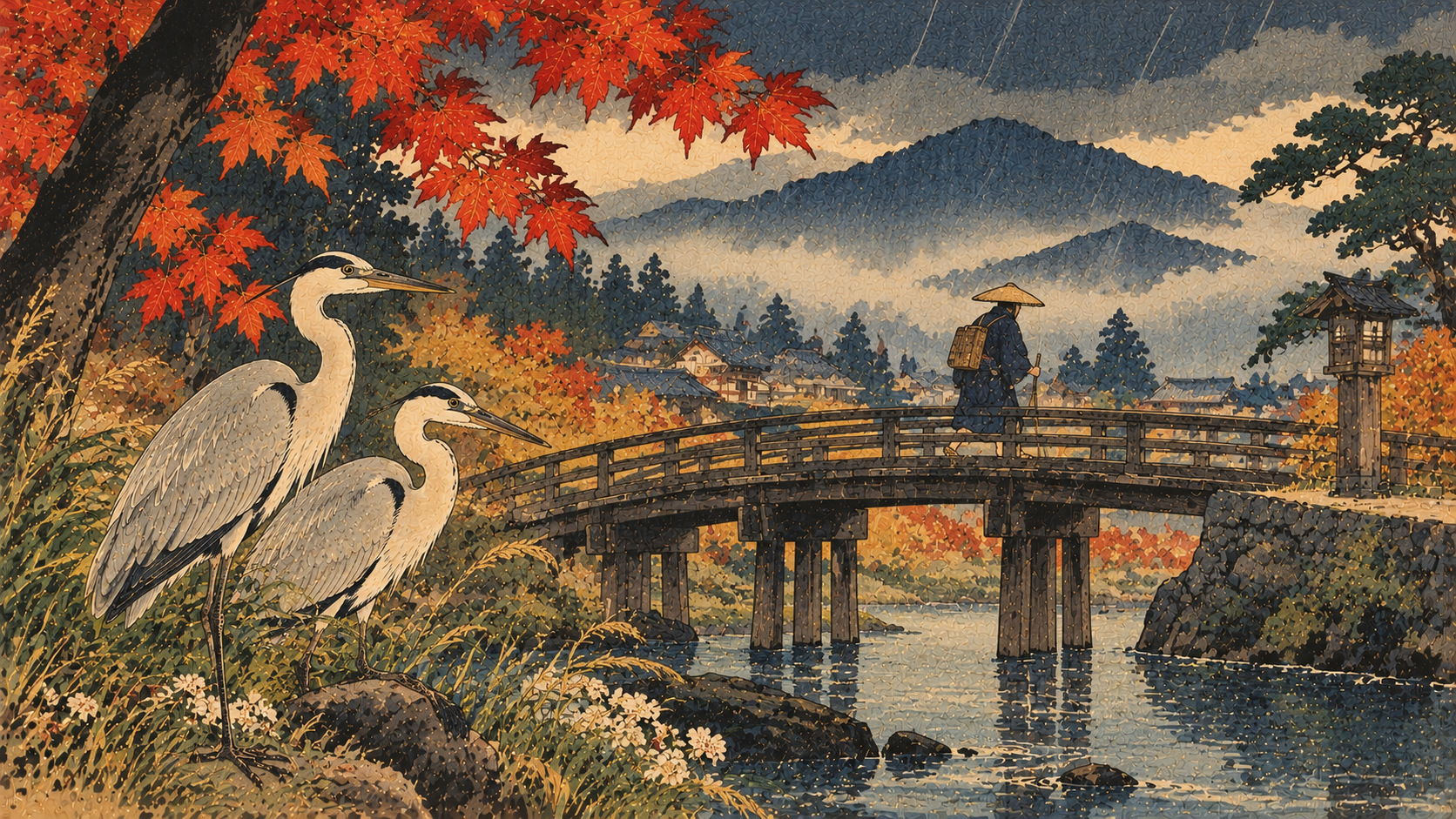
The road is not just scenery: weather, labor and the traveler’s time give Hiroshige’s landscapes their life.
A highway becomes a work of art
Imagine approaching a mountain pass without a weather forecast, a train timetable or the reassurance of a paved road. The traveler might be a merchant, a pilgrim, a servant accompanying an official procession or a person making a rare journey away from home. For each, the road was shaped as much by weather and labor as by the destination.
Utagawa Hiroshige understood that a landscape can tell a human story without placing its people at the center. At the Tokyo National Museum, a major exhibition built around a newly donated collection asks visitors to follow his roads—and to notice how his framing of rain, mountains, bridges and ordinary travelers made distance feel tangible.
The October 25 deadline
The exhibition is officially titled “Utagawa Hiroshige: The Best Angles of Edo,” commemorating the donation of the Uchiyama Susumu collection. It runs from September 29 through December 20, 2026, but this is not a single unchanging show. Its first installment, devoted to the Tōkaidō, ends on Sunday, October 25. A completely changed display opens October 27.
That makes the October 22 news peg precise: this is the last week to see the first installment, not the launch of the entire exhibition. A visitor arriving in November expecting the Tōkaidō prints from October will instead find a different great highway. The museum says all displayed works change between installments.
A thousand prints and one committed collector
The museum has received 1,025 ukiyo-e prints formerly owned by Uchiyama Susumu (1893–1980). Uchiyama assembled a high-quality collection with a particular emphasis on Hiroshige and supported the study and public appreciation of woodblock printing through publications and exhibitions. The donation places a private collector’s lifetime of selection within a national institution.
The museum describes this as its first full-scale Hiroshige exhibition. Its three segments are built around the artist’s three major landscape series: the Tōkaidō road in the first period, the Kiso road in the second and the landmarks of Edo in the third. The distinction is more than curatorial housekeeping: the subject changes from a coastal highway to an interior mountain route and finally to urban life.
The road that linked the shogun’s capital to Kyoto
In Tokugawa Japan, the Tōkaidō connected Edo, today’s Tokyo, to Kyoto through a chain of post stations. Travelers relied on lodgings, ferries, porters, horses and bridges. The road also carried the economic traffic and official journeys that supported the shogunate’s political geography.
Hiroshige’s celebrated “Fifty-three Stations of the Tōkaidō” series turns that infrastructure into a series of visual episodes. The National Diet Library preserves individual prints including the Rokugō ferry crossing at Kawasaki and the imposing topography at Hakone. Each scene works at two scales: it identifies a location, but it also reveals what movement might have felt like there.
Weather, rather than monuments, is the protagonist
A Hiroshige landscape often gains its force from the thing that interrupts a journey: rain, snow, a steep slope or a river. His prints can be read as an archive of gestures—figures bent against the elements, travelers pausing or pressing forward, tiny human forms measured against an expansive horizon.
The National Diet Library’s record of the Yui/Satta Pass image is a useful example. The composition draws power from land falling steeply toward the sea. It should not be treated as a neutral topographical survey: woodblock artists selected viewpoints, manipulated scale and worked within the conventions and commercial demands of printed images. That is precisely what makes Hiroshige an artist rather than a camera before cameras.
How a popular print became a global visual language
Hiroshige, who lived from 1797 to 1858, worked within a collaborative printing industry. An artist supplied designs, but carvers, printers and publishers helped bring the finished color image to market. Ukiyo-e could reach customers who would never own a unique painting or travel to every place depicted.
Japanese prints later circulated internationally and became important to the visual conversations associated with Japonisme. Yet sweeping claims that one particular print transformed a named European painter require evidence from that painter’s collection, copies or writings. The more secure point is that Hiroshige developed compositional methods—unexpected cropping, flattened areas of color and striking vantage points—that readers can see directly in the work.
The Kiso road is not the Tōkaidō
From October 27 to November 23 the show turns to “Sixty-nine Stations of the Kiso Road,” a series also associated with the artist Keisai Eisen. Unlike the coastal Tōkaidō, the route traversed inland mountain regions. The shift invites viewers to consider how geography shaped the rhythm of transport, the visual character of towns and the expectations of travelers.
The final segment, November 25 to December 20, presents “One Hundred Famous Views of Edo.” Here Hiroshige’s attention turns toward a metropolis: rivers, canals, bridges, seasonal customs and temples. Seen in succession, the three displays describe not one generic “old Japan” but three different relationships between space and human activity.
Why these pictures still matter
A contemporary journey can be measured almost entirely in minutes, fares and coordinates. Hiroshige reminds the viewer that movement also contains waiting, discomfort, exposure and chance encounters. A landscape print is therefore both an aesthetic object and an invitation to ask historical questions: Who maintained these roads? Who could afford the trip? Whose work made travel possible?
A donated collection of 1,025 prints opens opportunities for research, preservation and comparison over time. It does not mean every print is on view simultaneously, nor that every Hiroshige landscape is a literal eyewitness record. The exhibition is most rewarding when its images are taken seriously as both crafted compositions and evidence of how people imagined the world beyond their neighborhood.
Visiting the exhibition
The venue is Gallery A of the Tokyo National Museum’s Honkan. The three segments run September 29–October 25, October 27–November 23 and November 25–December 20. The museum lists general admission at ¥1,500 and university admission at ¥500, with no advance reservation required. Standard opening hours are 9:30 a.m. to 5 p.m.; on Fridays, Saturdays and specified additional dates the museum stays open until 8 p.m. Last admission is 30 minutes before closing.
Dates, individual works and visitor arrangements may change. Those intent on the Tōkaidō installment should pay special attention to its October 25 end date. This feature is based on the museum’s published exhibition information and National Diet Library records, not a claimed on-site visit or curator interview.
Sources and further reading
Based on the museum’s published material and National Diet Library records; not a claimed site visit or curator interview.
- Tokyo National Museum — exhibition announcement
- National Diet Library / official record — 展覧会日程(2026年)
- National Diet Library / official record — 歌川広重「東海道五拾三次之内」
- National Diet Library / official record — 「東海道五十三次」
- National Diet Library / official record — 「川崎 六郷渡舟」
- National Diet Library / official record — 「箱根 湖水図」
- National Diet Library / official record — 「由井 薩埵嶺」