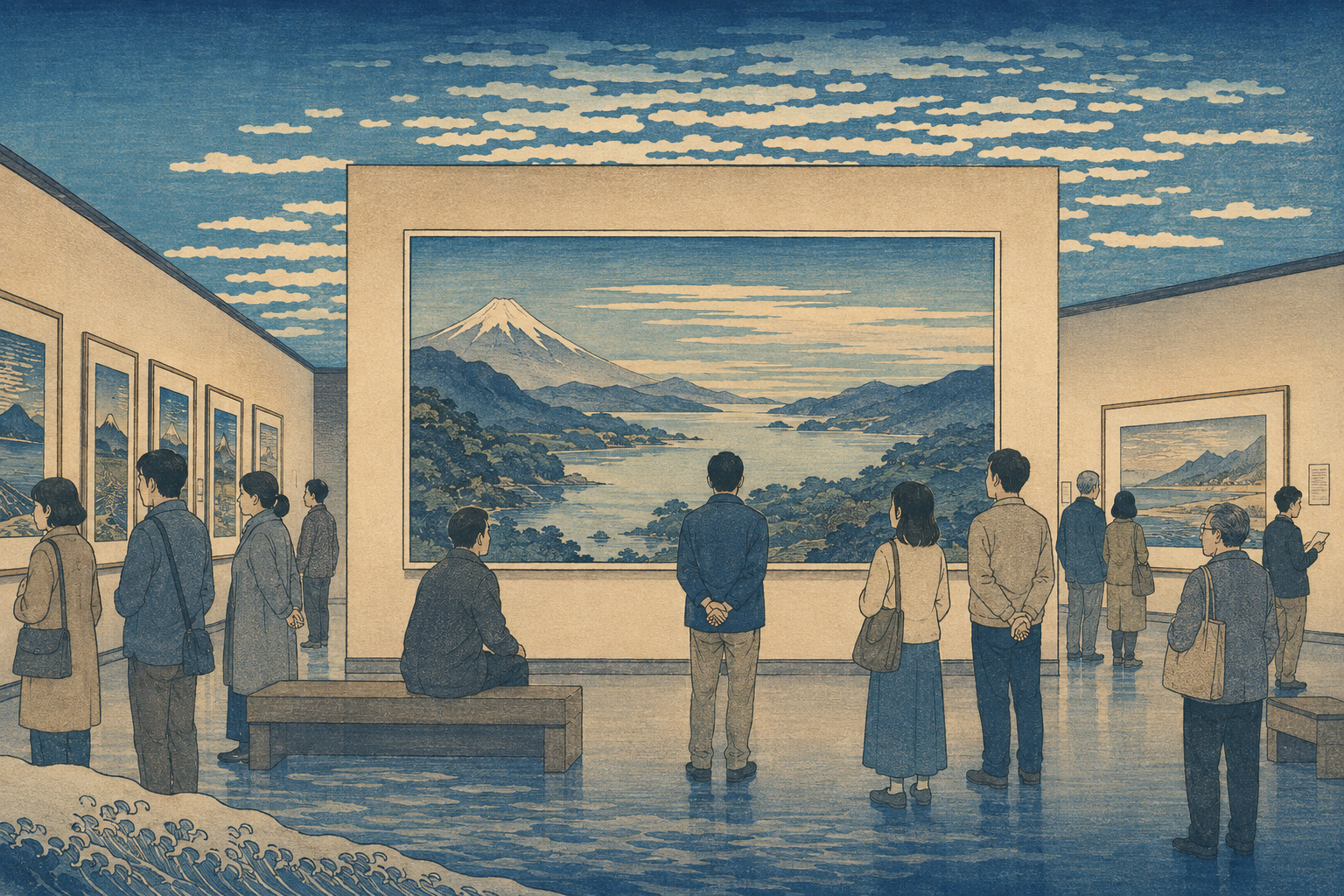
On September 3, MOA Museum of Art is closed. The anniversary exhibition opens the following morning. That one-day distinction matters: this is an advance report, not a review written after seeing the installation. It reconstructs the museum’s announced argument—and tests it against institutional records of Hiroshi Yoshida’s longer career.
A rediscovered watercolor changes the opening argument
The exhibition’s lead work is Highway and Horse, a large watercolor recently rediscovered in the United States and returned to Japan. MOA dates it to around 1908, identifies it as privately owned and says this will be its first public exhibition in Japan.
The museum places the work in the period after Yoshida’s second tour of Europe and America, when he produced a concentration of pictures involving people and animals. That is a curatorial attribution, not a fully published provenance. The museum has not publicly detailed the former owner, the route by which the watercolor reached the United States, or the conservation and technical work that followed its rediscovery.
Its importance is nevertheless immediate. The familiar shorthand begins with immaculate mountain prints from the 1920s and 1930s. Highway and Horse begins elsewhere—with movement, figures, animals and watercolor. It makes the late prints look less like a sudden invention and more like the outcome of a long argument Yoshida conducted across materials.
Before the woodblocks, watercolors paid for the world
Yoshida was born in Kurume, Fukuoka Prefecture, in 1876. An archival obituary published through the Tokyo National Research Institute for Cultural Properties records his schooling at Shuyukan, adoption by the Western-style painter Yoshida Kasaburo, study with Tamura Soryu in Kyoto and training at Koyama Shotaro’s Fudosha academy after moving to Tokyo in 1894.
At seventeen, according to MOA, he encountered the work of pioneering watercolorist Miyake Kokki. The contact helped establish a medium Yoshida pursued intensively into his early thirties. Fudosha supplied exact observation; travel helped turn that precision toward soft edges, atmospheric blur and the humid air of Japanese scenery. The exhibition lists works including Evening Primrose and Woman in Yukata Robe, Morning and Carps in a Pond.
In 1899, Yoshida and Nakagawa Hachiro sailed for the United States carrying watercolors. He mounted exhibitions, then traveled through Britain, France, Germany and Italy before returning in 1901. His Mountain Stream received an honorable mention at the 1900 Paris Exposition; Last Night’s Rain received a bronze medal at the 1904 St. Louis exposition. In 1907, the first Bunten awarded second prize to his watercolor New Moon. By 1910 he was serving as a juror.
Landscape was fieldwork, not scenery supplied at a distance
Oil painting occupies the middle gallery in MOA’s structure, but not a secondary place in Yoshida’s practice. The museum says he painted in oil throughout his life, with especially concentrated activity from his thirties into his early fifties. During the Taisho era he repeatedly spent summers camping in the Japanese Alps and other mountain ranges to sketch on site.
The Grand Canyon from 1924, Mont Blanc from 1925 and Early Autumn from 1947 make the span visible. The sites differ, but the working premise holds: distance, slope, weather and scale had to be experienced before they could be organized. MOA frames the exhibition with Yoshida’s statement that “Nothing compares to nature in terms of diversity and power.”
Accuracy alone does not explain the effect. A map can record a ridge; a photograph can freeze cloud. Yoshida’s problem was how to retain the pressure of standing before a place. Watercolor let air remain thin. Oil gave rock and snow weight. Woodblock would later force light to arrive in a predetermined order.
The earthquake did not create the printmaker—but it changed the route
Yoshida was already forty-four when publisher Watanabe Shozaburo encouraged him to issue his first woodblock, The Sacred Garden in Meiji Shrine, in 1920. MOA says his early role was largely to provide the design. The organization of production still belonged to the publisher-led system.
The Great Kanto Earthquake of 1923 altered the circumstances. Yoshida returned to the United States to sell works and raise funds for members of the Taiheiyo Gakai whose losses followed the disaster. There he saw the strong American market for Japanese prints. When he returned in 1925, at forty-nine, he issued woodblocks for which he supervised every stage of production.
That shift is often compressed into the phrase “self-published.” It did not mean solitary manufacture. Shizuoka City Museum records that Yoshida employed carvers and printers while acquiring substantial technical knowledge himself. The difference lay in authority: the artist’s studio took over decisions normally coordinated by a commercial publisher.
A print was a workshop of controlled repetition
Yoshida’s color was not applied in one conclusive gesture. Shizuoka City Museum explains that many works used roughly twelve to twenty blocks and thirty or more printing passes. Yomeimon, made in 1937, reached ninety-six passes—the highest figure cited for his prints by the museum. That exceptional example should not be mistaken for a standard count, or as confirmation that Yomeimon is in the current exhibition.
Each pass separated a decision: a pale atmosphere, a shadow beneath an eave, a reflected color on water, a colder band of snow. Moisture in the paper, pigment, registration and pressure from the baren all affected the result. Yoshida did not simply add detail. He engineered the sequence by which the image became visible.
What “artist-supervised” means
- Design: Yoshida determined composition, tonal structure and the intended final color.
- Carving: Specialist carvers translated key and color separations into woodblocks.
- Printing: Specialist printers managed pigment, water, registration, paper and baren pressure.
- Direction: In the private-edition system, Yoshida’s studio—not an outside publisher—controlled the production standard and release.
The same blocks could hold morning and night
The Sailing Boats sequence demonstrates the creative use of repetition. Shizuoka City Museum says Yoshida used the same blocks to produce six different scenes through changes of color. MOA’s anniversary exhibition highlights Sailing Boats: Morning and Sailing Boats: Night, both from the Inland Sea series of 1926.
The outlines remain stable while visibility changes. Morning opens the horizon. Night gathers distance around lamps and dark water. The Europe series similarly turns the Sphinx from day to night. The blocks remember geography; the printing schedule changes time.
This is why the woodblocks cannot be separated from Yoshida’s earlier media. Watercolor taught him to see atmosphere as layers. Oil taught him to organize mass. Woodblock converted those perceptions into production—a sequence that other hands could execute under exacting direction.
“East meets West” is true—and still too small
MOA describes Yoshida’s prints as a new form created from traditional Japanese technique and Western realism. That is accurate, but the familiar formula can hide the risk in what he actually did. He did not merely place a European-looking mountain inside a Japanese medium.
He chose unusually ambitious formats, multiple blocks, repeated pale impressions, alternate states of the same subject and an artist-controlled workshop. Every additional pass created another opportunity for misregistration or failure. His international experience changed not only what he depicted but how the object was manufactured.
Institutional records preserve the dual identity. The 1950 Japanese obituary introduced Yoshida first as an elder of Western-style painting and president of the Taiheiyo Gakai, then noted the many woodblocks he left. The Metropolitan Museum of Art holds his 1926 Ten Views of Fuji. On the Smithsonian National Museum of Asian Art’s impression of Sailing Boats: Morning, the margin carries the jizuri seal, date and title, along with a penciled English title and signature. The sheet records both studio control and international circulation. Neither the painter nor the printmaker is an appendix to the other.
Travel also passed through empire and war
The career’s geography cannot be narrated only as private travel and cultural exchange. MOA’s 2020 institutional biography records a five-print group labeled “Korea and Manchuria” in 1937, followed by three years from 1938 when Yoshida was dispatched to China as a war artist. The quoted label reflects imperial-period source terminology, not the political geography or sovereign relationships of the present.
Hyogo Prefectural Museum of Art has also documented paintings made around 1944 at the Harima shipyard and nearby sites. They show home-front ship construction and, in particular, mobilized students working inside Japan’s wartime production system. These works are not among the highlights named on the current MOA exhibition page, and this report does not imply that they will be displayed.
The available records do not establish every commission, the exact conditions of each dispatch or Yoshida’s personal politics. They do establish that observation, travel and workshop skill also operated inside imperial and wartime institutions. A 150th-anniversary account becomes more useful when it distinguishes the exhibition’s selection from the full career—without turning either commemoration or retrospective judgment into a substitute for evidence.
The present-day photographs are not a realism test
MOA has photographed selected places Yoshida depicted and will show those contemporary views beside the works. Its official examples include a 2025 setting related to Sailing Boats: Morning, a 2024 view of Gion connected to Night in Kyoto, and the present Hirakawabashi bridge. High-definition images of works will also be projected at large scale.
The comparison should do more than ask whether Yoshida “got it right.” A century changes coastlines, buildings, vegetation, traffic, tourism and artificial light. An artist also edits. The photographs can expose what Yoshida removed, compressed, enlarged or assigned to a particular hour.
Projection creates a second form of comparison. Magnification can reveal fine carving and accumulated color that are difficult to follow at normal viewing distance. It cannot reproduce paper fiber, pigment sitting in or above that paper, pressure from the baren, or the bodily scale of the original sheet. The screen is an instrument for looking, not a substitute object.
Three media, one continuing problem
| Medium | Role in the exhibition | Named examples | What to examine |
|---|---|---|---|
| Watercolor | From exact early observation toward color, blur and humid atmosphere | Highway and Horse; Morning; Carps in a Pond | Reserved paper, softened distance, the relation of figures to weather |
| Oil | Sustained study of mountains, volume and spatial weight | The Grand Canyon; Mont Blanc; Early Autumn | Mass, recession and the transformation of field sketches |
| Private-edition woodblock | Artist-directed decomposition of color and reconstruction of time | Sailing Boats: Morning/Night; Night in Kyoto; Tsurugizan: Morning | Color separations, printing layers and alternate times from shared blocks |
What the anniversary restores
Yoshida’s prints are unusually effective in reproduction. Fuji, the Alps, the Taj Mahal, the Grand Canyon and Venice remain legible at the scale of a screen. That clarity has helped the later works travel, but it can also flatten the career into a portfolio of beautiful destinations.
The exhibition restores chronology. First came the watercolorist who crossed the Pacific. Then the oil painter who camped in mountains. The print studio arrived after decades of looking, travel, exhibition politics and the institutional rupture of the 1923 earthquake. Its refined surfaces are compressed records of that experience.
The useful question at 150 is therefore not whether Yoshida was more Japanese or more Western. It is what he retained each time he changed medium—and what the new medium forced him to rebuild. The rediscovered watercolor brings that question back before the celebrated prints, where it belongs.
Before visiting
Dates: September 4–October 20, 2026
Venue: MOA Museum of Art, 26-2 Momoyama-cho, Atami, Shizuoka
Hours: 9:30 a.m.–4:30 p.m.; last admission at 4:00 p.m.
Closures: Normally Thursdays except national holidays, plus installation days; check the official calendar before travel
Admission: Adults ¥2,000; high-school and university students ¥1,400; junior-high students and younger free
Access: About seven minutes by the MOA Museum bus from stop 8 at JR Atami Station
The museum has not published a complete checklist or total object count on the exhibition page reviewed for this report. Loaned works may not be photographed. Rotation schedules, individual display periods and crowd conditions should be checked directly with the museum.
An anniversary can turn an artist into a monument. Yoshida’s career resists that treatment. He changed material, traveled, rebuilt his production system and used repetition to make difference visible. The exhibition opening in Atami asks viewers to see not only a man who pictured the world, but one who kept redesigning the process by which a landscape becomes an image.
Sources and documentation
- MOA Museum of Art, “Yoshida Hiroshi—the 150th anniversary of his birth” (dates, English titles, galleries, rediscovered watercolor and production overview)
- MOA Museum of Art, 「生誕150年 吉田博展」 (Japanese names, terminology, quotation and exhibition structure)
- MOA Museum of Art visitor guide (hours, admission, access and photography rules)
- MOA Museum of Art FAQ (closures, admission and visitor services)
- Tokyo National Research Institute for Cultural Properties, archival obituary for Yoshida Hiroshi (education, travel, awards, exhibitions and institutional career)
- Shizuoka City Museum, “About Hiroshi Yoshida” (approximately 250 woodblock designs and repeated printing)
- Shizuoka City Museum, “Hiroshi Yoshida and woodblock printing” (artist-run workshop, carvers, printers and the Sailing Boats variants)
- Shizuoka City Museum, introduction to Yomeimon (blocks, typical passes and the exceptional 96-pass example)
- National Diet Library Authorities, Miyake Kokki (authoritative reading and romanization)
- The Metropolitan Museum of Art, Ten Views of Fuji (international museum holding, 1926)
- MOA Museum of Art, 2020 Yoshida Hiroshi woodblock exhibition and biography
- Hyogo Prefectural Museum of Art, Yoshida Hiroshi’s Harima shipyard paintings
- Smithsonian National Museum of Asian Art, Sailing Boats: Morning object record
This report was checked against material available by 3:30 a.m. JST on September 2, 2026. Japanese primary and institutional sources were used for Japanese names, titles, terminology and the original quotation. MOA’s Japanese page gives an internally inconsistent era/Western-year pairing for Highway and Horse; this article follows the Gregorian date “circa 1908,” which also appears on the museum’s English page. Wartime history is drawn from earlier institutional records and does not imply that those works are included in the 2026 exhibition. The exhibition had not opened at the reporting cutoff, so no claims are made about attendance, the completed installation or firsthand evaluation.
Image rights: © 2026 Japan.co.jp. This AI-assisted editorial illustration may not be reproduced or reused without permission. For licensing, use the contact page.