- A mentor’s name returns at the Port of Los Angeles
- An ocean changed by what happened at sixteen
- Shinjiro Matsui and an older Japanese idea of possibility
- A boat lost in 2013, and a fear that remains
- What the 55-day crossing changed
- His most important navigation breakthrough was an iPhone
- Alone on board does not mean without other people
- Why Amakusa, and why the word arigato
- The next passage is still unwritten
A mentor’s name returns at the Port of Los Angeles
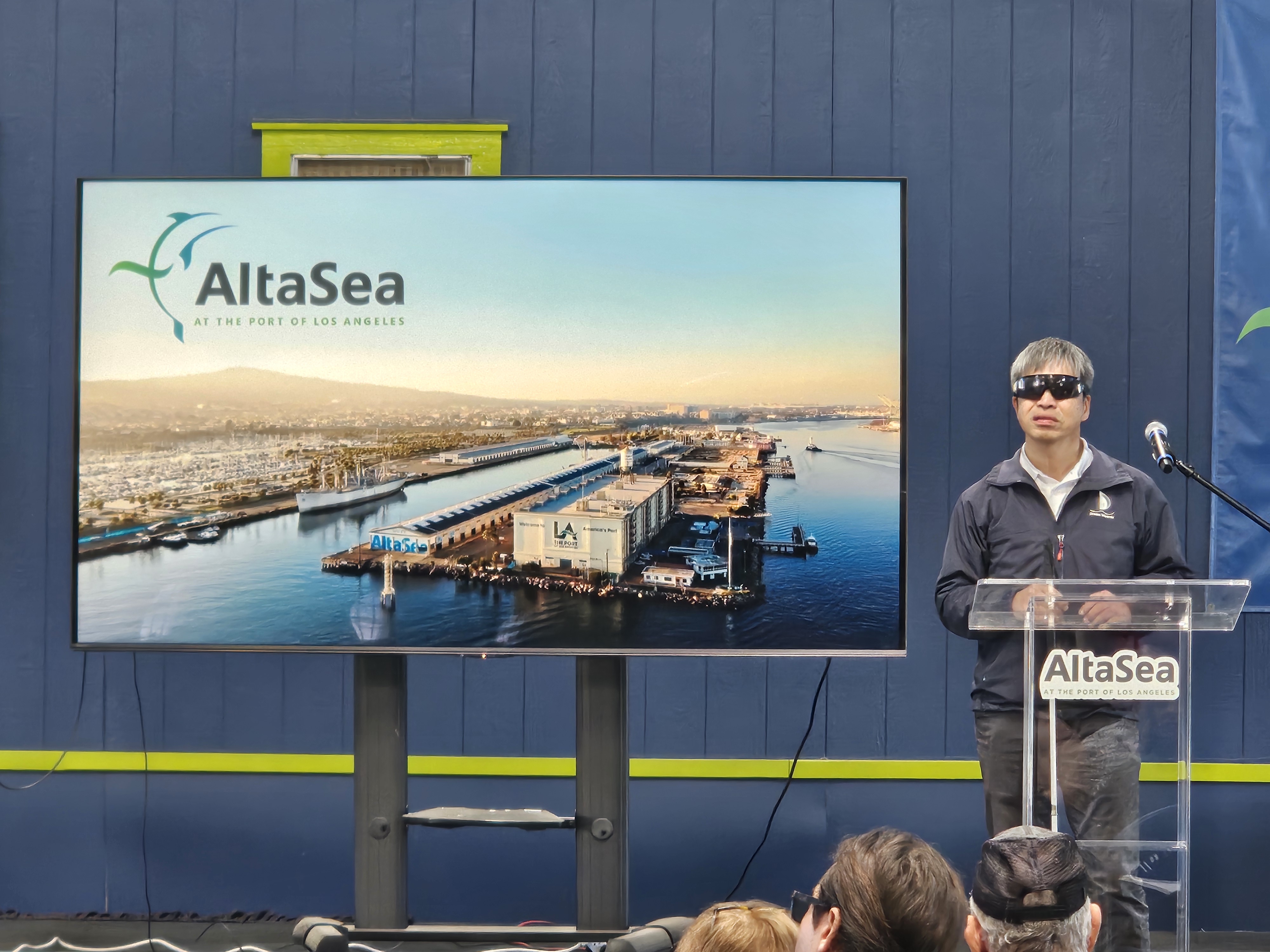
On November 14, 2026, Mitsuhiro “Hiro” Iwamoto spoke at AltaSea in the Port of Los Angeles about an extraordinary ambition: to sail across the Pacific alone, without stopping, and return to the sea he remembers from childhood. After the presentation, a brief conversation brought up the name of Shinjiro Matsui, the Japanese advocate who had helped open new careers to blind people. For Iwamoto, Matsui was more than a familiar name; he was a model of what it means to believe in another person’s possibilities.
In exclusive written answers supplied to JAPAN.co.jp on November 19, Iwamoto recalled meeting Matsui in the 1990s while teaching acupuncture and moxibustion at the school for blind students affiliated with the University of Tsukuba. Their paths crossed through international efforts to help blind people in Southeast Asia gain independence. Matsui was not merely a contact: for Iwamoto, his example came to define leadership as service to other people.
Now Iwamoto is aiming for a solo, nonstop Pacific voyage from San Diego to his childhood home in Amakusa, Kumamoto Prefecture. In a direct email to this publication he confirmed that the target year has moved from 2027 to **2028**. Some existing event and project pages still advertise the older date. The new target, independently supplied by the subject of the story, is the one used here.
An ocean changed by what happened at sixteen
As a child in Ushibuka, the sea was a place of vivid blue water and possibility. When Iwamoto became completely blind at sixteen, the same coast became associated with a profound personal crisis. In his interview he described reaching a bridge, contemplating suicide, and walking away. This is a difficult part of his history, shared by Iwamoto himself; it should not be turned into a dramatic shorthand for his entire life.
He fell asleep on a park bench and dreamed of an uncle who had died. In that dream, he recalled receiving a message that a life with blindness could still help others find hope. The account is a personal memory and interpretation, not a claim that an outside observer could verify the contents of the dream. What matters in the interview is the way Iwamoto describes returning to that message as he built a life beyond his earlier despair.
Years later, after climbing Mount Fuji, Iwamoto heard strangers tell him that his accomplishment gave them courage. When he first stepped onto a sailboat he discovered an experience unlike the powerboats he knew: almost no engine sound, only wind, birds and the life of the water. He began to imagine crossing the Pacific, inspired in part by the pioneering Japanese solo sailor Kenichi Horie. The goal emerged not from forgetting blindness but from learning a different way to experience distance and direction.
Shinjiro Matsui and an older Japanese idea of possibility
Matsui lost his sight after being wounded during the war and became a leading advocate for expanding the kinds of jobs available to blind people. His organization’s history dates the founding of the Japanese Blind Kanatype Association to 1963. A later nonprofit vocational-development center was formally established in 1976; a workshop opened in Yotsuya Honshiocho, Tokyo, in 1980. Its work included transcription, typing and later computer-related training.
This was more than welfare in a narrow sense. Matsui’s projects asked whether technology and education could make employment possible in occupations from which blind people had been excluded. He rose to become the vocational center’s second chairman in 1993 and died on March 31, 1995. An industry council history also records his leadership of Japan’s national association of welfare facilities for the blind beginning in 1986.
Iwamoto remembers decisiveness, action and an unshakable belief in people. He describes the lesson not as a lecture on management, but as leadership visible in a person’s conduct. His answers confirm their shared work in Southeast Asian independence initiatives, but do not name the countries, dates, or specific speaking events. Those details remain opportunities for a future follow-up rather than claims to fill with assumption.
A personal connection surfaced at AltaSea: JAPAN.co.jp publisher Bradley L. Bartz, who established a nonprofit in 1986 to train blind people for telephone-based employment using speech-enabled technology, recalled volunteering at a vocational center associated with Matsui in Tokyo in 1990. The encounter brought together two separate histories of disability advocacy. It is Iwamoto’s own account of Matsui’s influence, however, that explains why the name matters to this voyage.
A boat lost in 2013, and a fear that remains
In 2013 Iwamoto set out from Fukushima with Japanese television presenter Jiro Shinbo. Six days into the attempted Pacific crossing, their yacht, Aeolus, was damaged in a collision described by the sailors as involving a whale. Water entered the boat; they abandoned it and drifted in a life raft for roughly eleven hours before being rescued by Japan’s Maritime Self-Defense Force. Japanese contemporary reporting and later sailing coverage document the essential sequence.
Iwamoto’s new answers do not turn this episode into a tidy lesson in perseverance. He says the collision still appears in his dreams and describes lingering psychological effects in his own terms. His most persistent worry for the next voyage is another whale strike. This is an account of his feelings, not a clinical diagnosis made by this publication.
In a striking decision, he has chosen a 28-foot Bristol Channel Cutter of the same design as the boat lost in 2013. The choice carries emotional meaning, but a seaworthy vessel and careful engineering must do far more than symbolize recovery. Collision awareness, emergency systems, power reserves and the ability to respond to equipment failures are practical necessities. Courage does not make those constraints disappear.
What the 55-day crossing changed
In February 2019, Iwamoto and American sailing partner Douglas “Doug” Smith departed San Diego aboard Dream Weaver, an Island Packet 40. They reached Fukushima after 55 days at sea without stopping. Their achievement was widely described as the first nonstop Pacific crossing completed by a totally blind sailor. It was a two-person voyage: Smith supplied visual navigation support, and that partnership was central to the undertaking.
In the interview, Iwamoto identifies a change more significant than the difference between a failed trip and a successful one. In 2013 he wanted to show what he personally could do. By 2019, he wanted the crossing to help other people believe in their own capabilities. The ocean had not changed, he writes, but the purpose of crossing it had.
He also explains why Fukushima mattered. Following the 2011 earthquake and tsunami, some children in the region had come to fear the sea that had taken family members. The 2013 failure left him worried that he had reinforced that fear. By returning to Fukushima in 2019 and later sailing with young local sailors, he felt able to complete a promise that had remained unfinished. His next voyage has another emotional destination.
His most important navigation breakthrough was an iPhone
Ask Iwamoto which innovation made the greatest difference to his independence at sea and he does not begin with a radar array or satellite network. He begins with the iPhone. Apple’s VoiceOver accessibility feature let him hear compass direction using an ordinary smartphone, replacing a large specialized talking compass he once carried. The principle is deceptively simple: information about heading becomes useful when it can be heard in real time.
For the planned 2028 crossing, Furuno Electric and its group companies are developing Leena, an audio navigation app named for Iwamoto’s daughter. Furuno’s January 2026 Japanese announcement describes voice delivery of wind direction, wind speed, position and heading, supported by marine instruments and onboard networking. Radar, GNSS-related equipment and TimeZero navigation software are also part of the announced support. Iwamoto says the app can warn him about collision threats involving other vessels.
The project also proposes Starlink connectivity, onboard cameras and a shore team able to review information and give technical or weather advice. None of those plans eliminates the possibility of failure. Power may run low, communications may stop, and sensors or software may behave unexpectedly. This article distinguishes announced and developing capabilities from systems independently proven to work throughout a long solo passage.
Alone on board does not mean without other people
The word “solo” is easy to misunderstand. The intended voyage has one person on the boat and no port calls, but Iwamoto expects a network of people ashore to assist with weather interpretation, remote monitoring and technical questions. He emphasizes that he must make final decisions and act by himself at sea. The exact limits of outside help for any proposed record have not been independently established; those rules should be reviewed before a world-first claim is treated as a verified record category.
For the sailor, outside assistance is not evidence of weakness. It is the structure that lets him retain responsibility while gaining access to information others normally see. Yet it raises demanding questions about backups, power budgets, bridge watches, collision alerts and the response when shore communication drops for hours or days. A vessel can be connected in ordinary conditions and still be unprepared for the moment connection fails.
Iwamoto confirmed the shift to 2028 in writing, explaining that more preparation time would improve safety. In conversation at AltaSea, he also mentioned concerns about El Niño, according to Bartz; the subsequently delivered written interview did not make an independent weather attribution. This report therefore does not treat El Niño as the sole documented reason. Iwamoto puts safe return ahead of the temptation to meet an ambitious deadline.
Why Amakusa, and why the word arigato
The destination for 2028 is Ushibuka, in Amakusa City, where Iwamoto grew up. He writes that arriving there would help him recover the beautiful blue sea he remembers from childhood—a sea transformed in his imagination during his crisis at sixteen. This is not a literal promise to see again. It is the desire to come home with a changed relationship to the place where his future once seemed closed.
His uncle, he recalls, had owned a successful ready-mixed concrete business and once considered purchasing property that would provide long-term income for his nephew if employment proved impossible. The plan was never completed before the uncle’s death. Iwamoto now sees a different inheritance: encouragement to build a life with value to others. He imagines arriving in Amakusa and expressing thanks to the uncle whose words shaped him.
That impulse is part of the Global Arigato Project, the nonprofit he founded in the United States in 2023. His message to young people avoids the easy promise that determination makes everything possible. Some things are beyond any one person, he says; there are things people can achieve only with help. Disability does not erase the capacity to contribute, and the person receiving help may also give another person something precious in return.
The next passage is still unwritten
Iwamoto hopes people around the world will watch and help support him while he navigates the Pacific. He links the idea of shared vision to international understanding: oceans do not merely divide nations, they connect them. That aspiration is best understood as his personal purpose, not as proof that a technical support system can guarantee safety or produce any larger social outcome.
Before departure there will be measurable work: sea trials, reliability testing, emergency plans, training, satellite outages, onboard energy management and clarity about the kind of outside assistance permitted. The project has described the plan as unprecedented, but the voyage is not yet completed and no independent governing record ruling has been established in the materials reviewed here.
The photograph taken at AltaSea shows a person preparing to set out. The account he gave JAPAN.co.jp reaches backward, from a lost sailboat and a mentor in Yotsuya to a childhood coastline in Kumamoto. The 2028 voyage, if it goes ahead, will have an ending no one can write today. The important question is not only whether Iwamoto reaches Japan, but what his attempt reveals about technology, shared responsibility and the freedom to choose a life.
Sources, reporting method and limitations
Primary reporting derives from Iwamoto’s original Japanese written answers received November 19, 2026; the subject disclosed that AI assisted proofreading and prepared the English translation. We use his Japanese original as authoritative, while editing this English report independently. His direct correspondence and an original photo from AltaSea provide additional firsthand evidence. Institutional histories, sailing accounts and Furuno documents were cross-checked. We did not audit the vessel’s equipment, emergency plans or prospective record eligibility.
- Exclusive written interview: Mitsuhiro Iwamoto’s original Japanese answers to JAPAN.co.jp, received November 19, 2026 (direct reporting material)
- Hiro Iwamoto’s correspondence with Bradley L. Bartz, November 14 and 19, 2026, confirming the 2028 target (direct reporting material)
- AltaSea: November 14 open-house event listing
- Japan Vocational Development Center for the Blind and Low Vision: institutional history of Shinjiro Matsui
- National Council of Social Welfare Facilities for the Blind: 70-year history
- Furuno Electric: official technology sponsorship and Leena app details
- HIRO’s CHOICE: technology and shore-based assistance (some pages retain outdated 2027 schedule)
- KAZI online: historical account of 2013 and 2019 voyages
- Latitude 38: April 2019 report on the voyage with Doug Smith
- Global Arigato Project: mission and organizational background
- Bradley L. Bartz, JAPAN.co.jp — Hardhat Required: author’s complete memoir and first-person account of Telemarketing Visions Institute and his experience in Japan (publisher testimony, not independent verification of Iwamoto’s biography)