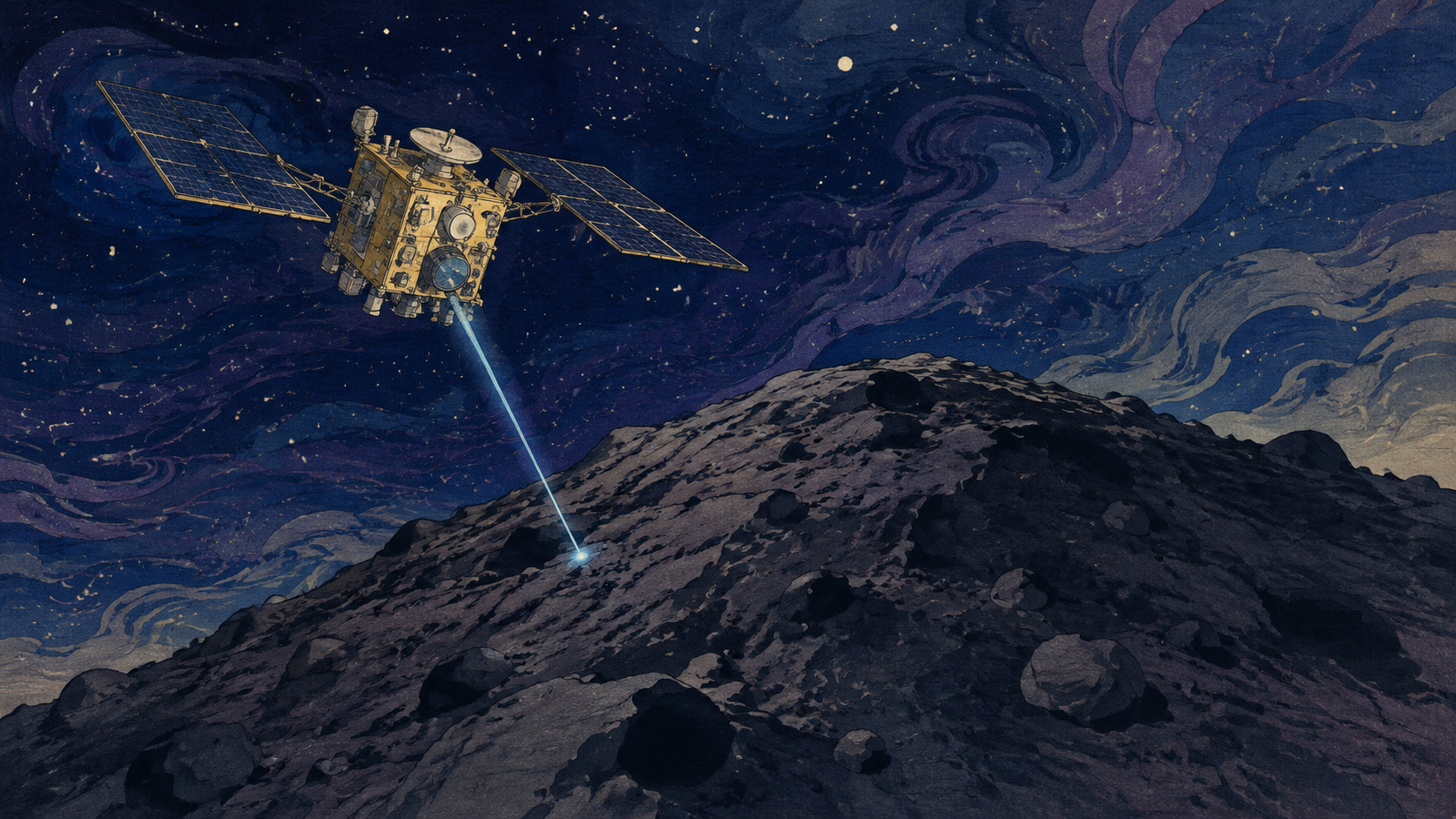
The asteroid did not arrive on the monitor as a world. It arrived as less than a pixel.
On June 20, 2026, Hayabusa2’s optical navigation camera found a faint point of light roughly seven million kilometers away. The exposures lasted 178 seconds. Torifune was around magnitude 12.5—far too dim for the unaided eye—and not yet large enough in the image to reveal a contour. Engineers could confirm that their spacecraft was aimed toward the right darkness. They still could not see the shape of the thing they intended to miss by only hundreds of meters.
Fifteen days later, the point expanded into a paired, irregular body as Hayabusa2 crossed its path. The useful close-up interval lasted less than ten seconds. The narrow-angle camera made one frame per second. Its final pre-encounter image began at 6:29:59 PM JST, about one second before closest approach, with an exposure of just eight milliseconds. At flyby speed, the probe moved more than five kilometers while a clock advanced one second.
The arithmetic is almost rude in its simplicity. Four hundred meters—the estimated clearance between spacecraft and rock—is a distance Hayabusa2 traveled in about eight hundredths of a second. There was no orbiting afterward and no second approach. Torifune entered, filled and left the instruments’ fields of view. The navigation had to be right before the asteroid finally looked like an asteroid.
What the world record is—and is not
The phrase “closest asteroid encounter” would be dramatic and wrong. Japan’s first Hayabusa touched Itokawa. Hayabusa2 itself descended to Ryugu twice. NASA’s DART mission ended by striking Dimorphos at high speed. Landers and sample collectors, by definition, have reached zero altitude.
JAXA’s record is narrower and technically revealing: the smallest separation achieved during a flyby exploration of a solar-system body. A flyby vehicle retains enough speed to continue past its target rather than matching the target’s orbit and remaining nearby. That speed creates scientific opportunity and unforgiving geometry at the same time. A camera can sweep across terrain quickly; a navigation error can become an impact before a command from Earth could matter.
The center and surface figures also answer different questions. The spacecraft passed about 744 meters from Torifune’s estimated center. Because the asteroid is elongated and uneven, that does not mean it flew 744 meters above rock. JAXA’s preliminary three-dimensional interpretation put the local surface roughly 400 meters below the flight path.
A rendezvous spacecraft forced to sprint
Hayabusa2 was designed for a different rhythm. At Ryugu, the probe arrived in June 2018, matched the asteroid’s solar orbit and spent about a year and a half conducting operations. Relative velocities during final surface work could be measured in centimeters per second. The team could image the terrain, retreat, debate, rehearse and return.
Torifune rushed past at 5.3 kilometers per second. Hayabusa2 did not carry the large, long-focal-length telescope that a purpose-built flyby mission might use from a comfortable distance. To obtain useful resolution with its existing optical camera, thermal imager and near-infrared spectrometer, the team had to bring the entire spacecraft close. Before the encounter, mission planners discussed a pass at roughly one kilometer above the surface—a compromise among resolution, instrument pointing and collision risk. The actual reconstructed clearance was smaller.
This was the extended mission’s ingenuity: not a new spacecraft built for a new task, but a surviving spacecraft taught a new kind of motion. The hardware that had once hovered over a rubble-pile asteroid would now cross another asteroid’s neighborhood faster than a rifle bullet.
How to aim at something too faint to see
Ground teams first combined radio tracking of Hayabusa2 with optical measurements of Torifune. The asteroid’s location was uncertain enough that before the encounter its predicted position carried a 49.5-kilometer three-sigma error at flyby time. That uncertainty was far larger than the intended clearance.
The spacecraft’s own camera changed the problem. Repeated observations measured the target against the star field. Engineers used those angles with radio data to refine the relative geometry, then executed trajectory-correction maneuvers on July 1 at 2:50 PM, July 4 at 5:50 PM and July 5 at 3:27 PM JST. Roughly three hours before closest approach, the last practical ground-directed correction was complete. New onboard guidance software took responsibility for the terminal phase.
JAXA had defined a target point 800 meters from Torifune’s estimated center. The reconstructed path passed about 120 meters from that aim point. In the direction connecting spacecraft and asteroid center, the error was only 54 meters closer than planned. Closest approach occurred about three-tenths of a second from the scheduled instant, with a timing uncertainty of 0.03 second.
| Stage | What the team knew | What changed |
|---|---|---|
| June 20–21 | Torifune was a sub-pixel point about 7 million km away. | Onboard images confirmed the target and began optical-radio navigation. |
| July 1 | The relative path had been refined from repeated observations. | Trajectory correction TCM-B adjusted the approach. |
| July 4 | The target was closer but still not a resolved world. | TCM-C made the penultimate ground-planned correction. |
| July 5, 3:27 PM | About three hours remained before encounter. | TCM-D handed the terminal approach to onboard guidance. |
| July 5, 6:30 PM | The shape finally filled the instruments. | Hayabusa2 passed ~400 m above the surface, 120 m from its aim point. |
After the flyby, navigation data reduced Torifune’s positional uncertainty at encounter from 49.5 kilometers to 0.78 kilometer at the same three-sigma confidence level. The visitor did not merely photograph the asteroid; it made the asteroid’s future path better known.
The laser that heard two echoes
Hayabusa2’s LIDAR measures distance by firing laser pulses and timing their return. It had been indispensable during the slow work at Ryugu. At Torifune, the team attempted something no asteroid flyby mission had previously achieved: active laser ranging during the high-speed encounter.
The instrument fired once per second from four minutes before closest approach until one minute after. Two pulses returned usable distances, at 6:29:56.5 and 6:29:57.5 PM—about four and three seconds before closest approach—when the range was approximately 20 and 15 kilometers. Those sparse echoes mattered. They supplied direct geometric measurements independent of the camera and demonstrated that a rendezvous-era laser altimeter could interrogate a body flashing through its beam.
A successful flyby does not require every pulse to return. The asteroid’s irregular surface, the narrow beam, rapidly changing geometry and receiver sensitivity determine whether reflected light reaches the instrument. The “world first” belongs to those two measurements, not to a continuous laser trace down to 400 meters.
Ten seconds of geology
The images overturned the simplest pre-encounter picture. Torifune is a contact binary: two lobes joined into one object, the fossil form of bodies that likely came together gently rather than shattering one another. Preliminary dimensions are about 840 meters along the long axis and 340 meters along the short axis, with a mean diameter near 540 meters. Its rotation period is roughly five hours.
Four instruments worked through the pass. The Optical Navigation Camera–Telescopic recorded visible morphology and color. The Thermal Infrared Imager mapped emitted heat, which can help researchers infer how quickly different materials warm and cool and therefore constrain surface texture and thermal inertia. The Near-Infrared Spectrometer measured wavelengths associated with mineral composition and hydration. LIDAR supplied direct range.
The data volume is finite; the interpretation will not be quick. Researchers must reconstruct where each pixel fell on a rapidly rotating, newly modeled shape while accounting for spacecraft position, pointing and illumination. The published dimensions and even the headline clearance may be revised as the shape model becomes more exact. “Four hundred meters” is the best post-flight estimate available by this edition’s cutoff, not a laser measurement of the final gap.
- Its two-lobed shape records an assembly history shared by many small bodies.
- Visible, thermal and near-infrared data can distinguish boulders, fine material and compositional differences.
- Close imaging tests what useful characterization is possible during a rapid reconnaissance pass.
- Better size, shape and orbit estimates are exactly the information required to assess a newly discovered near-Earth object.
A ship of heaven, named by children
For most of its catalog life the object was 2001 CC21, a designation built from discovery year and sequence. The LINEAR survey discovered it on February 3, 2001—the same program that found Itokawa and Ryugu, an accidental thread tying together Japan’s three asteroid destinations.
Hayabusa2’s team opened a public naming campaign in December 2023. By May 2024, 3,082 suggestions had arrived. A committee of nine children and mission members reviewed 60 candidate names; ten entrants had independently proposed Torifune or Ame-no-Torifune. With the discoverers’ cooperation and approval by the International Astronomical Union, “Torifune” became official in September 2024.
Ame-no-Torifune appears in Japanese mythology as a deity—and in some readings a celestial ship—associated with swift, steady and safe travel. It was an unusually exact wish for a target that would allow no loitering. The spacecraft crossed the closest point in a fraction of a heartbeat and continued safely into the dark.
From Itokawa to Ryugu to a fleeting third asteroid
The flyby belongs to a history that began with a much more fragile success. The original Hayabusa launched on May 9, 2003, reached the S-type asteroid Itokawa on September 12, 2005, and made two touchdowns that November. Its sampling mechanism did not operate exactly as intended. The spacecraft suffered serious propulsion and communications problems. Yet its capsule returned to Australia on June 13, 2010 carrying microscopic grains—the first samples ever returned from an asteroid.
Hayabusa2 was built from those hard lessons. It launched on December 3, 2014 and reached carbon-rich Ryugu on June 27, 2018. The mission deployed small surface robots, made a first touchdown in February 2019, fired an impactor to excavate a crater in April, and completed a second touchdown in July near material exposed by the impact. The return capsule landed in Australia on December 6, 2020. Laboratory analysis has since identified water-bearing minerals, a wide variety of organic compounds and amino acids in the pristine sample.
The capsule came home, but the main spacecraft did not. Hayabusa2 released it on a carefully aimed Earth approach and flew onward. About half its xenon propellant remained, its instruments were working and its solar-electric engines could still reshape the orbit. A mission designed to end in 2020 became a decade-long laboratory in reuse.
2003 — The first Hayabusa launches for Itokawa.
2005 — Hayabusa reaches Itokawa and makes two touchdowns.
2010 — Its capsule returns the first asteroid samples to Earth.
2014 — Hayabusa2 launches for Ryugu.
2018–2019 — Rendezvous, rovers, two touchdowns and an artificial crater at Ryugu.
2020 — The Ryugu sample capsule returns; the spacecraft begins its extended mission.
2026 — Hayabusa2 sets the closest solar-system-body flyby record at Torifune.
2031 — Current plan: rendezvous with the fast-spinning asteroid 1998 KY26.
An aging engine and the value of a second life
Extended missions are often described as bargains because launch costs have already been paid. That does not make them easy. Every component accumulates radiation exposure, thermal cycles and operating hours. Engineers must discover how old hardware fails while it is millions of kilometers away.
Hayabusa2’s ion-engine system illustrates the trade. Engines A, C and D showed degradation in neutralizer voltage during the cruise toward Torifune. The team ultimately relied on engine B alone for the final propulsion phase. By June 9, 2026, that unit had accumulated 8,143 operating hours. Across the system, the mission had achieved more than two kilometers per second of velocity change and 155% of the original mission requirement. The final pre-Torifune ion operation ended June 6.
This quiet endurance is part of the record. A probe launched nearly twelve years earlier, after completing the mission for which it was funded and returning its precious cargo, still had enough precision, power and institutional care to attempt a new kind of encounter. JAXA also treats the extension as a bridge between generations: veterans pass operational judgment to younger engineers before knowledge hardens into archived documents.
Planetary defense without the Hollywood ending
Planetary defense begins long before anyone tries to deflect an asteroid. A threatening object must be discovered, its orbit refined, its size and rotation measured, and its surface and internal structure constrained. A kinetic impactor needs to strike the correct body at the correct place and time. An observer may need to arrive quickly to determine what telescopes cannot.
NASA’s DART mission demonstrated the impact half of that problem in 2022 by deliberately colliding with the 160-meter moonlet Dimorphos at about 6.6 kilometers per second and measurably changing its orbit. Hayabusa2 did not attempt a deflection, and its Torifune result should not be confused with one. It demonstrated parts of the approach and reconnaissance problem: acquire a faint small body, refine a high-speed trajectory, allow onboard software to control the terminal encounter, pass with roughly hundred-meter accuracy and return close scientific observations.
JAXA highlights two possible uses. One is precision guidance for a future kinetic impactor. The other is “fast reconnaissance”: redirecting a spacecraft already in deep space to inspect a newly identified object sooner than a purpose-built mission could be designed, launched and cruised to it. Hayabusa2’s own extended mission is evidence for the premise. A spacecraft with a second life can become strategic capacity.
The road to a smaller, stranger target
Four days after the flyby, Hayabusa2 restarted its ion engines. Its next major waypoint is an Earth swingby planned for December 2027, part of the gravity-assisted route toward 1998 KY26. The final destination is far smaller than Torifune: JAXA currently estimates a diameter of about 11 meters and a rotation period of roughly five minutes.
At a five-minute spin, material near the surface can experience centrifugal acceleration greater than the body’s weak gravity. A spacecraft cannot treat such an object as a miniature Ryugu. Navigation, observation and any close operation must confront a rapidly changing surface and a gravitational environment at the edge of ordinary intuition. Rendezvous is planned for 2031.
Torifune was therefore both destination and examination. It tested whether the spacecraft and team could navigate close to a small, poorly resolved asteroid at flyby speed. KY26 will ask whether they can remain with an even smaller, faster-spinning one after another five years of aging.
The meaning of 400 meters
Records tempt us to remember a number and forget the system that produced it. The enduring achievement at Torifune is not a tape measure stretched from gold foil to black rock. It is the chain behind the number: a faint detection made with a camera never designed as a great flyby telescope; radio and optical observations fused into a relative path; three ground-planned corrections; autonomous terminal guidance; two laser echoes; four instruments collecting what they could in a window shorter than a traffic light.
It is also a chain across time. Itokawa taught Japan how much a damaged spacecraft could still accomplish. Ryugu turned those lessons into a disciplined sample-return system. Torifune took the same machine and asked it to abandon the luxury of waiting. KY26 will ask for something different again.
At 6:30 PM on July 5, the closest point passed almost exactly when predicted. The asteroid’s two lobes rolled beneath the instruments; the spacecraft crossed a line no previous flyby explorer had crossed and kept going. The image lasted milliseconds. The engineering history behind it took more than twenty years.
Reporting notes and principal sources
This article reviews public information available through August 16, 2026 at 6:00 AM JST. The flyby geometry, asteroid dimensions and record designation are JAXA’s preliminary post-flight results. JAXA says the center distance, surface clearance and size may be revised as scientific analysis produces a better Torifune shape model. The 400-meter figure is a reconstructed surface clearance, not the final successful LIDAR range.
- Hayabusa2 Project: consolidated Torifune flyby results, images, trajectory, science and next operations
- JAXA: closest-distance record and navigation, guidance and control results
- JAXA: world-first LIDAR ranging during an asteroid flyby
- ISAS/JAXA: Hayabusa2 mission and extended-mission overview
- ISAS/JAXA: why Torifune required an unusually close flyby
- Hayabusa2 Project: first onboard detection of Torifune and optical-radio navigation
- Hayabusa2 Project: final pre-Torifune ion-engine operation and engine history
- Hayabusa2 Project: public naming campaign and the official name Torifune
- ISAS Astromaterials Science Research Group: Hayabusa and Itokawa mission history
- Hayabusa2 Project: Ryugu mission objectives, operations and 2019 departure briefing
- NASA: Double Asteroid Redirection Test mission overview
- The Planetary Society: pre-encounter context for the Torifune flyby