- A city seen from above, but experienced from the street
- The book took three generations to make
- An atlas that extended beyond Edo
- What a bird’s-eye view can reveal—and conceal
- The sketchbook that takes Settan far beyond Tokyo
- Three historic images, three ways of understanding Edo
- The woodblock book as an information technology
- From places to seasons: the 1838 sequel in spirit
- Why “forgotten” needs a qualification
- The artist behind a contemporary editorial experiment
A city seen from above, but experienced from the street
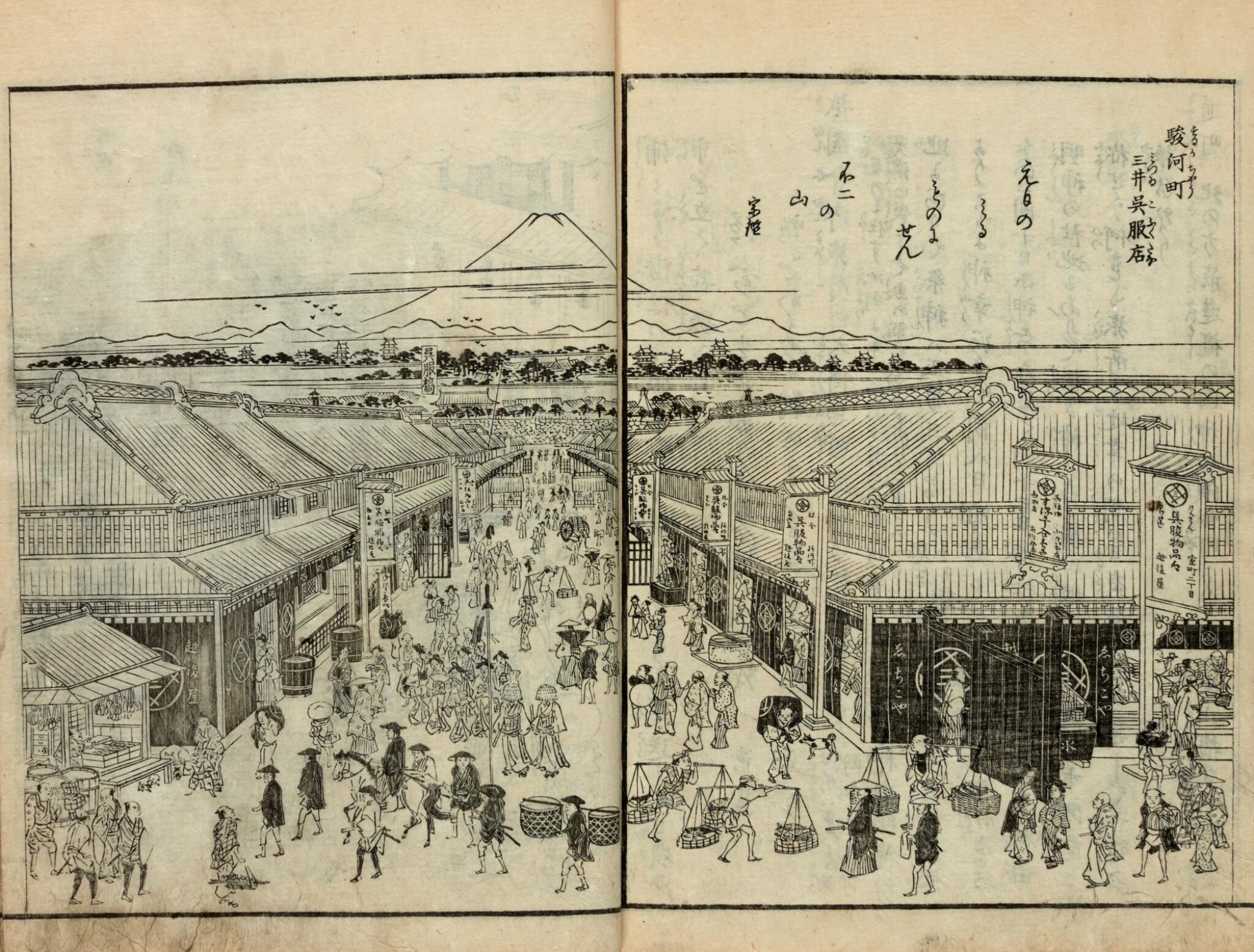
On a two-page spread, a road cuts between tiled roofs toward a distant mountain. The foreground is busy with passersby, shopkeepers and porters; the back of the scene opens into a sweeping view of the city. There is no solitary hero. The place itself—and the people who give it life—is the subject. This is the remarkable achievement of Hasegawa Settan (1778–1843), an illustrator whose work made late-Edo urban life legible at a scale few individual prints could match.
Settan is hardly absent from Japanese scholarship or museum collections. But his international reputation is far smaller than that of the most familiar ukiyo-e printmakers. His lasting contribution was embedded in books, above all the monumental Edo Meisho Zue, an illustrated account of Edo and its surroundings. To see why his work matters, we have to look beyond the idea of a single celebrated picture to the thousands of connections between streets, rivers, shrines, industries and people.
The book took three generations to make
The volumes were the culmination of a family enterprise, not an artist’s independent travel journal. The Saitō family served as town headmen in Kijichō, Kanda. The earliest compiler, Saitō Yukio, also known as Chōshū, obtained publication permission in 1798 and died the following year. His son Yukitaka continued the work, and the grandson Yukinari—widely known as Saitō Gesshin—eventually saw it through while maintaining public duties.
Published in 1834–1836, the completed Edo Meisho Zue comprised seven volumes issued in 20 bound books. Waseda University Library lists Settan as illustrator and the Saitō family as compilers; the National Diet Library preserves both the printed work and evidence of the family’s research. The story is therefore about the labor of collecting, checking, drawing, carving, printing and selling historical knowledge, as much as it is about one extraordinary hand.
An atlas that extended beyond Edo
The Edo-Tokyo Museum says the undertaking encompassed more than 1,000 notable locations—ranging south to Kanazawa in what is now Yokohama, west to Fuchū, north to Ōmiya and east to Funabashi. Its account credits Settan with visiting and depicting 742 sites. That figure describes the work documented by the museum; it should not be taken to imply that every figure or roofline in the published drawings is an exact field measurement.
The word meisho can tempt readers to think only of famous temples or scenic views. Settan’s pages insist on something broader. A shrine has a path leading to it; a path serves shops, crowds and the people who make a living there. A landscape is never only landscape. Such compositions offer evidence of the social geography of Edo, even when individual details require comparison with other historical sources.
What a bird’s-eye view can reveal—and conceal
Settan repeatedly elevated his viewpoint, creating expansive compositions that unfold almost like maps. Buildings are made readable, pathways join distant scenes, and clusters of people indicate how places were used. The result is an image a reader can explore in sequence rather than absorb in one glance.
Yet these are composed illustrations, not photographic surveys. A roof can be partly opened to show a courtyard; perspective can be adjusted for clarity; the density of human activity can be arranged as narrative. For historians, that is both a strength and a warning. These pictures are evidence of what the illustrators and editors considered important to show, not an automatic guarantee of precise dimensions or daily traffic counts.
The sketchbook that takes Settan far beyond Tokyo
The National Diet Library offers a rare window into Settan’s working practice through Saigoku Shasei, sketches made during a journey west in 1818. Settan traveled with Ogasawara Nagamasa, lord of the Karatsu domain. His route produced studies of distant landscapes and the Dutch trading establishment at Dejima in Nagasaki.
The library singles out an extraordinary detail: the Dutch visitors playing billiards are represented not merely as figures around a table, but with attention to the pockets hanging beneath it. Such small observations reveal a desire to record how a setting actually worked. That instinct helps explain the intimate credibility of his larger urban panoramas.
Three historic images, three ways of understanding Edo
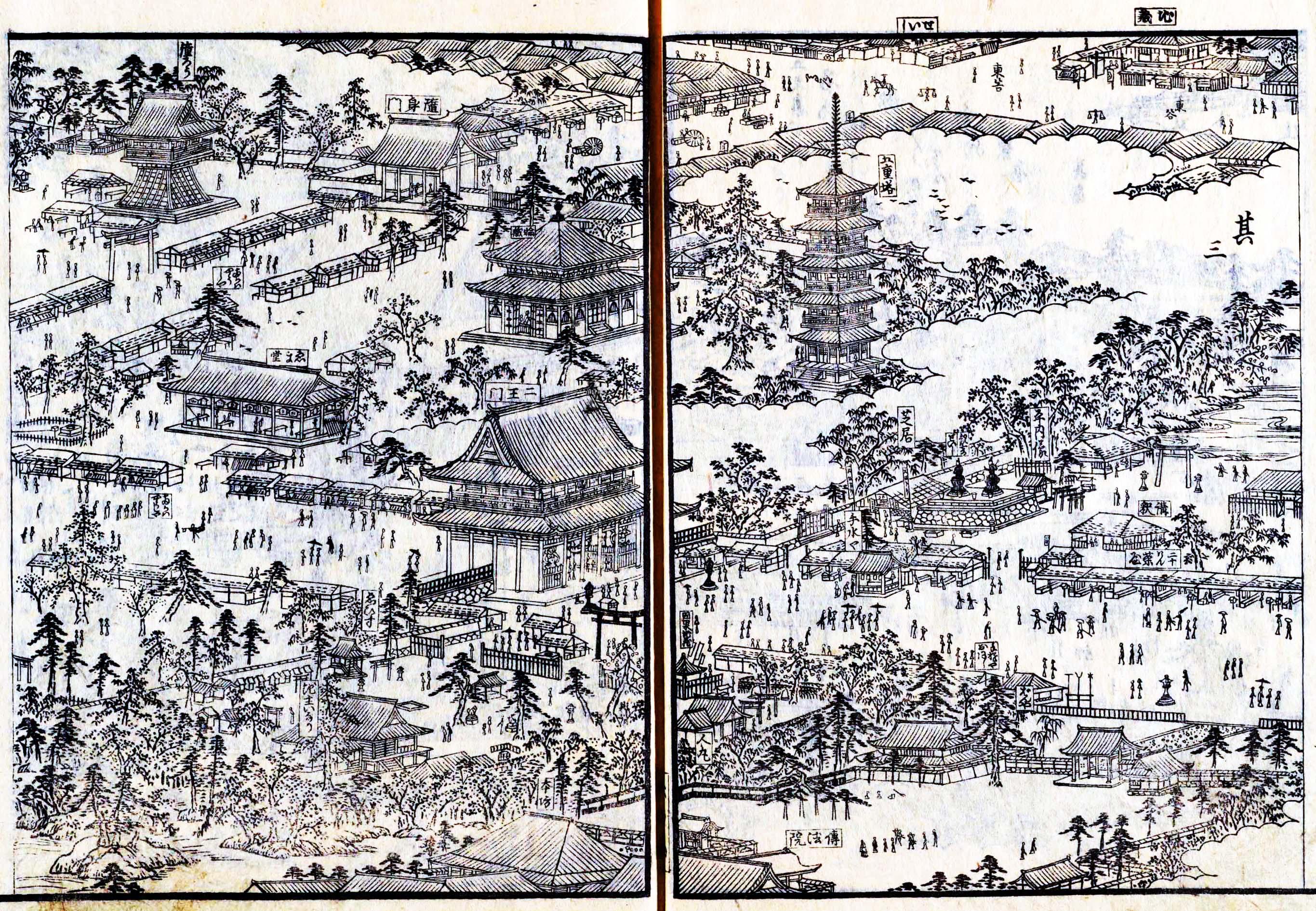
The Surugachō merchant-street spread draws the viewer toward Mount Fuji above commercial rooftops, making perspective itself the story. In the supplied Asakusa temple panorama, religious buildings form an interconnected precinct, with lanes and visitors making visible the relationship between spiritual place and urban commerce.
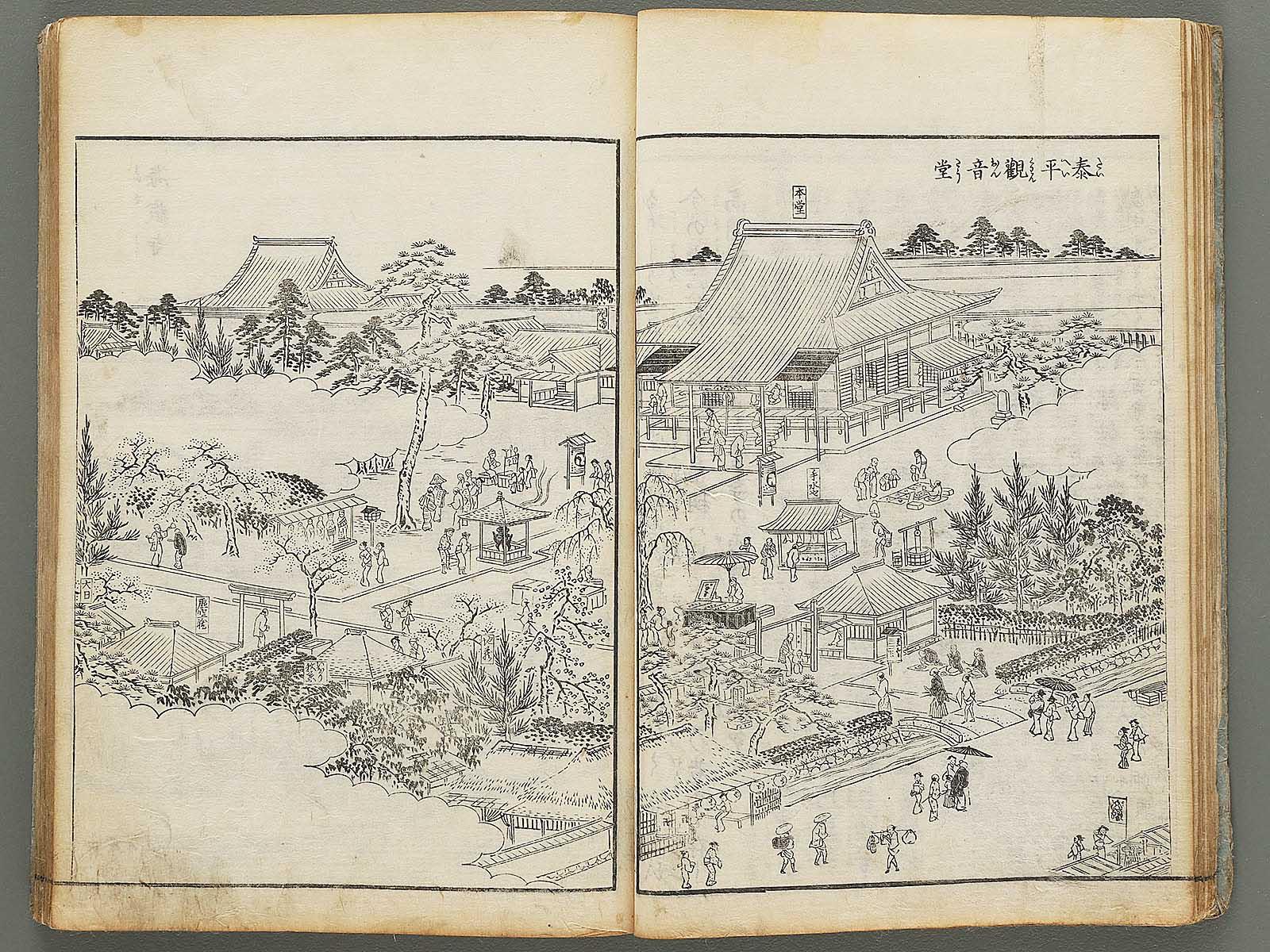
The third historic spread combines a temple building, pathways, trees and strolling figures. Its precise temple identification and edition have not yet been independently matched to a catalogue record, so this article retains a descriptive caption rather than applying an unverified site name. With historic images, a compelling visual interpretation is never a substitute for an exact source identification.
Three historic book illustrations
The woodblock book as an information technology
A guide to historic Edo was not merely a souvenir of fine scenery. The printed image worked with prose to make connections a distant reader could not readily see. The seven-volume geography could be consulted, revisited and compared, while the woodblock process allowed multiple readers to encounter its scenes.
An analogy to a modern digital city guide is illuminating but incomplete. Settan’s pictures were shaped by the conventions of illustrated topography, local histories and the commercial book trade of his time. Their strength lies less in being perfectly transparent windows than in condensing an enormous quantity of knowledge into navigable printed pages.
From places to seasons: the 1838 sequel in spirit
The collaboration continued in another form. In 1838, Saitō Gesshin and Settan produced Tōto Saijiki, a richly illustrated account of annual events and seasonal customs, with supplementary drawings attributed to Hasegawa Settei. Collections at the Tokyo National Museum and Edo-Tokyo Museum document the publication.
Where Edo Meisho Zue arranges the world geographically, Tōto Saijiki follows the calendar. Temple observances, blossoms and seasonal festivities give motion and rhythm to the city. Seen together, the books describe a metropolis that changed not only from one neighborhood to the next, but from one month to the next.
Why “forgotten” needs a qualification
The headline calls Settan forgotten to suggest the gap between his achievements and general recognition outside specialist circles. It is not a claim that curators and historians lost track of his name. The National Diet Library maintains an authority record identifying his reading, Hasegawa Settan, his years of life and his personal name Sōshū. Public institutions have catalogued his works for decades.
In fact, the survival of his books challenges a modern preference for the unique masterpiece over collaborative visual scholarship. A sweeping panorama of shops and buildings may be less instantly iconic than a single theatrical print, but it can hold a richer account of how a community functioned.
The artist behind a contemporary editorial experiment
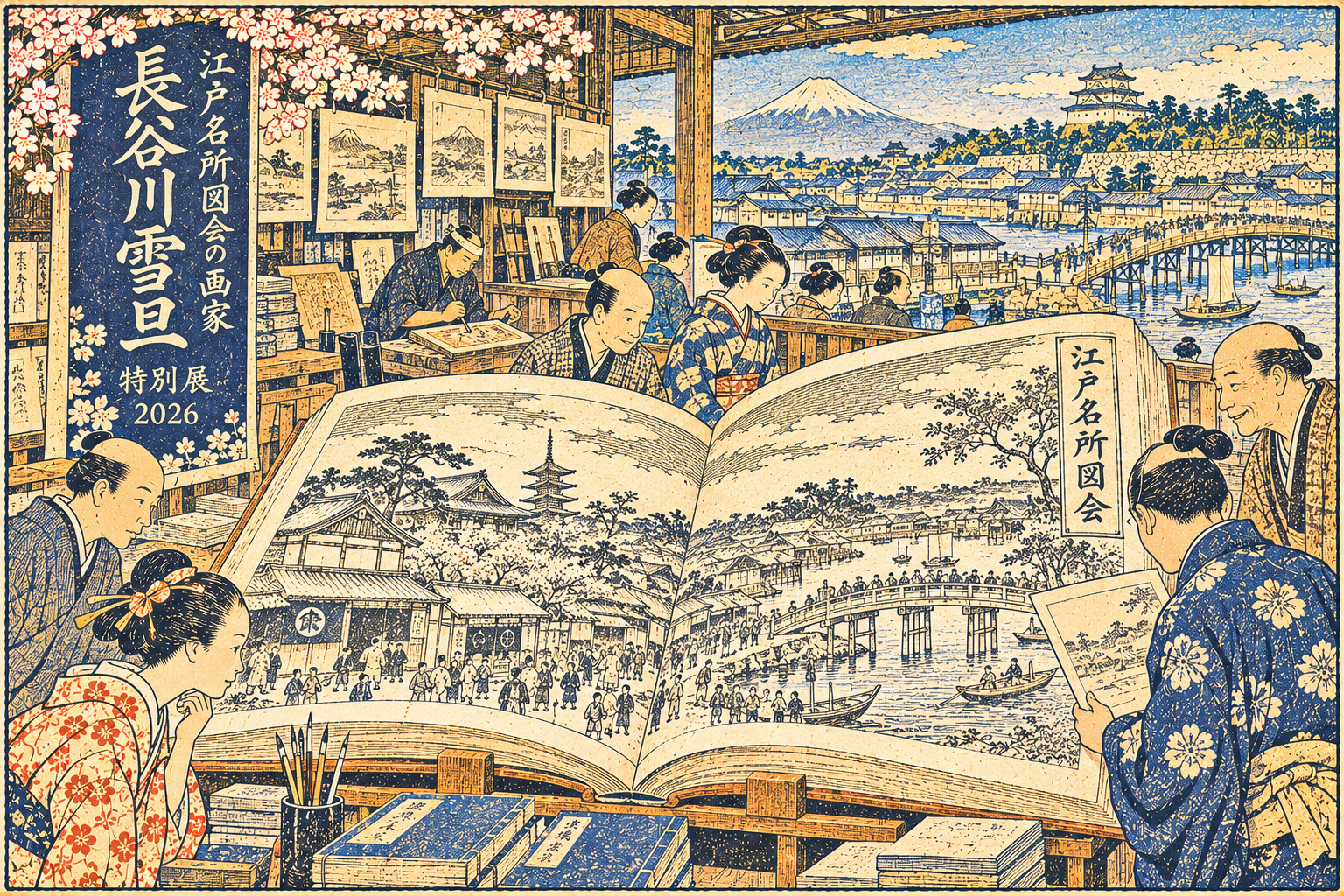
For its November 7, 2026 edition, JAPAN.co.jp has drawn on Settan’s high viewpoints, intricate architectural linework and miniature human narratives to develop contemporary editorial illustrations of factories, laboratories, infrastructure and sport. Those images are AI-generated interpretations. They are not archival views by Settan, nor documentary photographs of current sites.
The three reproduced historic illustrations serve a different function. They invite a reader to inspect the artist’s original visual language, with all its density and precision. Settan’s most relevant lesson to contemporary journalism may be deceptively simple: show what surrounds the subject, because context is often where the story lives.
Sources and reporting method
Documentary research based principally on institutional collections and original bibliographies. No claims of first-hand interviews or newly discovered manuscripts are made.
- National Diet Library: Hasegawa Settan and his sketches
- National Diet Library: the Saitō family and Edo Meisho Zue
- Edo-Tokyo Museum collection: Edo Meisho Zue
- National Diet Library authority record: Hasegawa Settan
- Waseda University Library: digitized Edo Meisho Zue
- Tokyo National Museum: Seasonal Events of Edo, 1838
- National Archives: seasonal life in Edo and the illustrated almanac
- Edo-Tokyo Museum: Toto Saijiki catalogue
- NDL catalogue: publication and bibliographic details