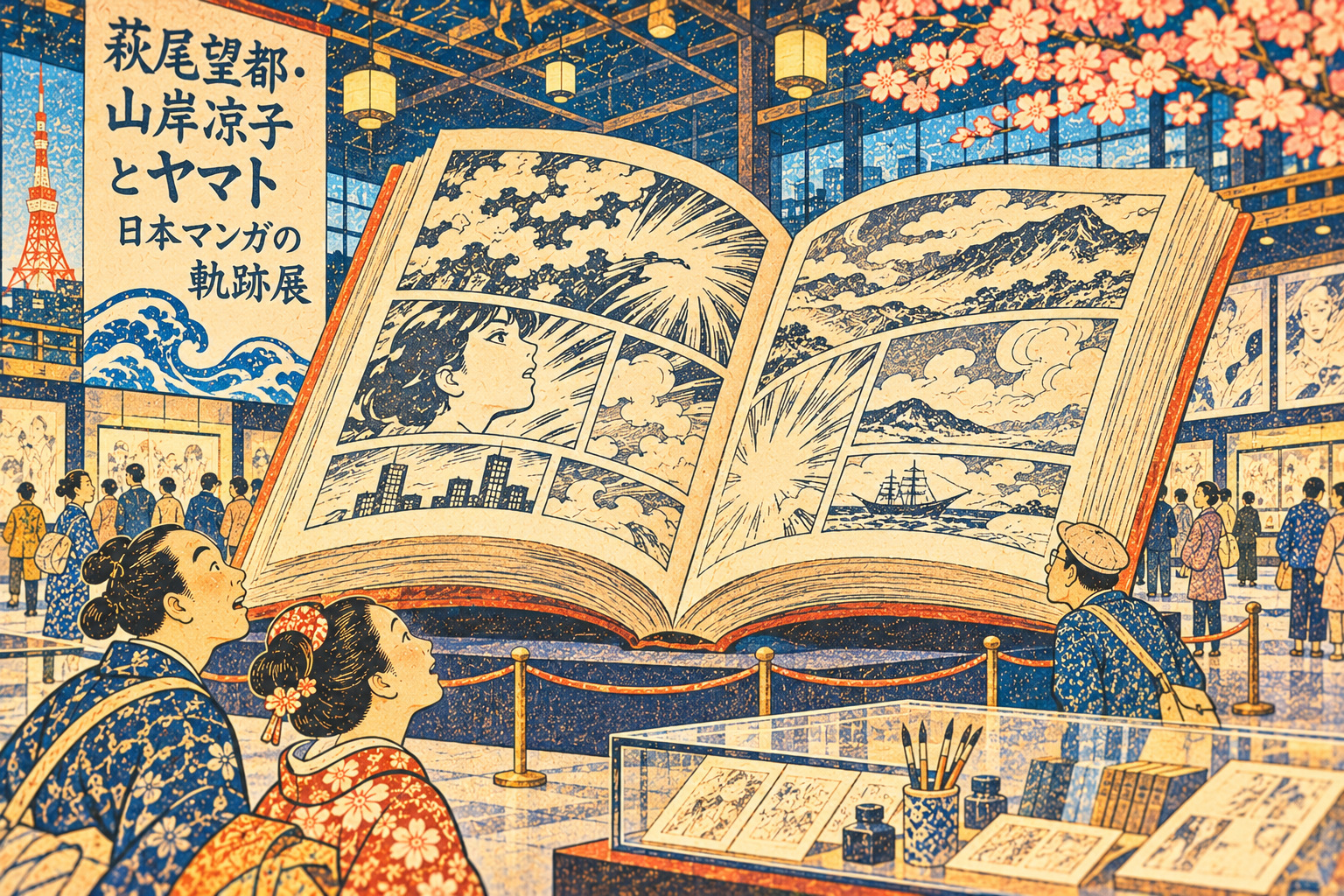
A museum confronts the art of a page turn
A reader can spend seconds crossing a manga page and years remembering it. A face appears in one panel; the next is almost empty. Space opens between two characters and the silence becomes the point. That kind of visual storytelling is now the subject of a major exhibition in Tokyo. Shojo Manga Infinity, which opened October 28 at the National Art Center, Tokyo, brings together original drawings by Moto Hagio, Ryoko Yamagishi and Waki Yamato. The museum plans to show more than 800 monochrome and color originals over the run. It describes the project as the first large-scale shojo manga exhibition held by a national art museum in Japan—a carefully bounded institutional claim, not an assertion that manga has never appeared in a museum before.
The genre label that became too small
The word shojo identifies a publishing tradition historically addressed to girls and young women. It does not meaningfully delimit what these three artists have written about. Their stories move through death, power, sexuality, history, inherited social roles, artistic ambition and unfamiliar worlds. In the late 1960s and 1970s, the magazine ecosystem gave artists new chances to experiment with the sequence and scale of panels, with quiet interiors and elaborate historical settings, and with the time a reader spends inside a thought. Rather than presenting the 1970s as the work of one unified movement, the exhibition sets three contrasting careers beside one another. Each demonstrates a different answer to the question of what a printed narrative can make readers feel and understand.
Moto Hagio and the cost of never growing older
Born in Fukuoka Prefecture in 1949, Moto Hagio debuted in 1969 with Lulu to Mimi. Her sequence The Poe Clan, published between 1972 and 1976, uses the idea of a family of eternally youthful vampires to ask what it means to live outside ordinary human time. The Heart of Thomas, from 1974, probes the charged emotional relationships of adolescent boys with unusual formal control. Their force is not simply in plot. Faces, empty panels, delicate shifts in viewpoint and images that extend across ordinary boundaries make consciousness part of the architecture of the page. In Hagio, melancholy is not merely described. The reader inhabits its duration.
Science fiction was never a detour
Hagio also expanded the possibilities of Japanese science-fiction comics. They Were Eleven!, published in 1975, makes a confined test environment an engine of mistrust, identity and cooperation. The Silver Triangle, from 1980–82, explores further imaginative territory. Her later recognition extends beyond the Japanese manga industry: she received the Japan SF Grand Prize in 2006 for Barbara Ikai, was named a Person of Cultural Merit in 2019 and entered the Eisner Awards Hall of Fame in 2022. That international visibility is important but not the sole reason to revisit her work. For readers attending the exhibition now, the display schedule matters: The Poe Clan: Spring's Dream cover and Mesh materials are designated for the first period, while other familiar Poe Clan and They Were Eleven! images belong to the second.
Ryoko Yamagishi: the body is never just beautiful
Ryoko Yamagishi was born in Hokkaido in 1947 and made her debut in 1969. Her ballet manga Arabesque (1971–75) drew attention by treating the dancer's body as a site of strenuous work rather than a simple ideal of grace. Training and competition expose the difference between what an audience sees and what an artist endures. Decades later she returned to the subject with Telepsychora / Maihime (2000–10), a work recognized with the Tezuka Osamu Cultural Prize's Manga Grand Prize for 2007. Across these stories, movement is a means of presenting ambition, fear and dependence. The relationship between bodily discipline and psychological pressure gives Yamagishi's work particular resonance in a museum where original linework can be examined up close.
A prince, a historical record and an unsettling imagination
Yamagishi's The Prince of the Land of the Rising Sun (Hi Izuru Tokoro no Tenshi, 1980–84) reimagines the young figure traditionally known as Prince Shotoku. The work received the Kodansha Manga Award for 1983 and became known for its bold treatment of power, spirituality and personal relationships. Its inventions must not be mistaken for documentary accounts of the ancient Japanese court. What matters is the freedom with which it subjects a familiar historical figure to questions about longing and alienation. Yamagishi's wider output includes mythology, supernatural stories, horror and psychological suspense. The museum lists some representative images from the Prince series for the later exhibition period, so visitors arriving in early November should not assume every celebrated image is already hanging.
Waki Yamato and the modern woman in a changing society
Waki Yamato, born in Hokkaido in 1948, began her manga career in 1966. Her Haikara-san ga Toru (1975–77) places the spirited Benio Hanamura in Taisho-era Japan, where romantic obligations, new professions and shifts in women's roles collide. Humor makes the story inviting, but the contradictions of the period sustain it: individual independence does not appear simply because a heroine wants it. Yamato won the first Kodansha Manga Award in the shojo category, and the work has been adapted in other media. Her historical settings are neither museum dioramas nor detachable decoration. They supply the institutions and expectations against which characters discover who they can become.
The Tale of Genji finds another set of readers
Yamato's Asaki Yumemishi (1979–93) brought Murasaki Shikibu's Tale of Genji to manga readers through sustained visual interpretation. The robes, architecture and shifting seasons help situate court life, but the deeper achievement lies in managing a large cast and a narrative in which affection, ambition and social rank continually change their significance. It has also found a place in educational reading, though a manga adaptation is not a substitute for the eleventh-century literary work or its scholarly editions. Yamato's drawings were included in the Metropolitan Museum of Art's 2019 exhibition The Tale of Genji: A Japanese Classic Illuminated. A 1983 illustrated magazine page from Asaki Yumemishi is among the works designated for the exhibition's first phase in Tokyo.
What can an original drawing show?
The exhibition promises a chance to examine the materials of image-making: the density and direction of inked lines, tonal work and color, the spacing of panels and the decisions that turn a sequence into a psychological event. Reproduction makes manga portable, but printing processes and book dimensions can obscure aspects of an original sheet. Conversely, a museum frame inevitably changes the art. A visitor can scrutinize an image without reading the pages that surround it, even though a plot twist or gesture may depend on what came before. The curatorial question is not whether manga deserves the status of a painting. It is how a museum can display an art whose fundamental unit is often the turn from one page to the next.
Magazines, publishers and generations of readers
Shojo manga's formal expansion belongs partly to the history of Japanese publishing. Serialized pages circulated in magazines before being collected, rediscovered and reinterpreted across decades. Hagio and Yamagishi both debuted in 1969, Yamato in 1966; their creative formation overlaps but is not identical. Discussions of the so-called Year 24 Group can illuminate some aspects of the era, yet folding every woman artist of the period into that convenient label would erase differences in approach, professional trajectory and subject matter. The magazine page was simultaneously a commercial deadline, an artistic laboratory and a place where readers developed deep, ongoing relationships with fictional people.
Why the national museum setting matters
The National Art Center, Tokyo, is presenting the exhibition as part of its twentieth-anniversary program. It says this is the first large-scale shojo manga exhibition in a national art museum, a claim about institution and scope rather than an assertion that manga only recently entered visual culture. The event is organized by the museum and co-presented with the Mainichi Newspapers, with support from Kodansha, Shogakukan and others. That institutional alignment points to both opportunities and questions: how original drawings are conserved, how rights are respected, how people unfamiliar with the books encounter an incomplete page, and whether the canon gains complexity or simply a set of new celebrities.
Do not expect every famous drawing on November 6
The exhibition runs from October 28, 2026, until February 8, 2027, at Special Exhibition Gallery 2E in Roppongi. Its first display period ends December 14 and its second begins December 16, with color works rotated. The official selection places several famous Poe Clan and The Heart of Thomas images, as well as examples from The Prince of the Land of the Rising Sun, in the later period. Works identified for the first include Arabesque, Haikara-san ga Toru and Asaki Yumemishi selections. Readers should check the specific exhibit list rather than assume all 800-plus planned works will be displayed simultaneously. The museum is closed on Tuesdays, on November 4 and during its late-December/early-January holiday period, with stated exceptions.
The long afterlife of the illustrated page
Regular same-day admission costs ¥2,200 for adults, ¥1,000 for university students and ¥500 for high-school students; younger visitors and other qualifying groups receive free entry under the museum's rules. Friday and Saturday closing time is 8 p.m., with last entry 30 minutes beforehand. The museum stands at 7-22-2 Roppongi, Minato-ku, with a direct connection to Nogizaka Station. These practical details are worth checking with the organizer before a visit. The larger question survives the exhibition's closing date. Hagio turned loss and unfamiliar worlds into a way of contemplating identity. Yamagishi made physical discipline inseparable from psychological force. Yamato gave familiar historical periods new protagonists and new stakes. Their legacy is not simply that shojo manga became respectable. It is that their pages enlarged the expressive range of comics themselves.
Sources and reporting method
The National Art Center and exhibition organizers provide the artist biographies, work lists, exhibition schedule and prices. The institutional first is attributed to the museum; individual display periods are distinguished.
- National Art Center, Tokyo: exhibition and verified artist biographies
- National Art Center, Tokyo: English exhibition information
- Official exhibition: highlights and work rotations
- Official exhibition: work guides and selection of manga
- Official exhibition: detailed artists’ profiles
- Official exhibition: visitor information and dates
- Official exhibition: admission prices and concessions
- National Art Center Art Commons: exhibition identity and title
- Official exhibition: Waki Yamato bibliography
- Minato City Tourism Association: local exhibition listing