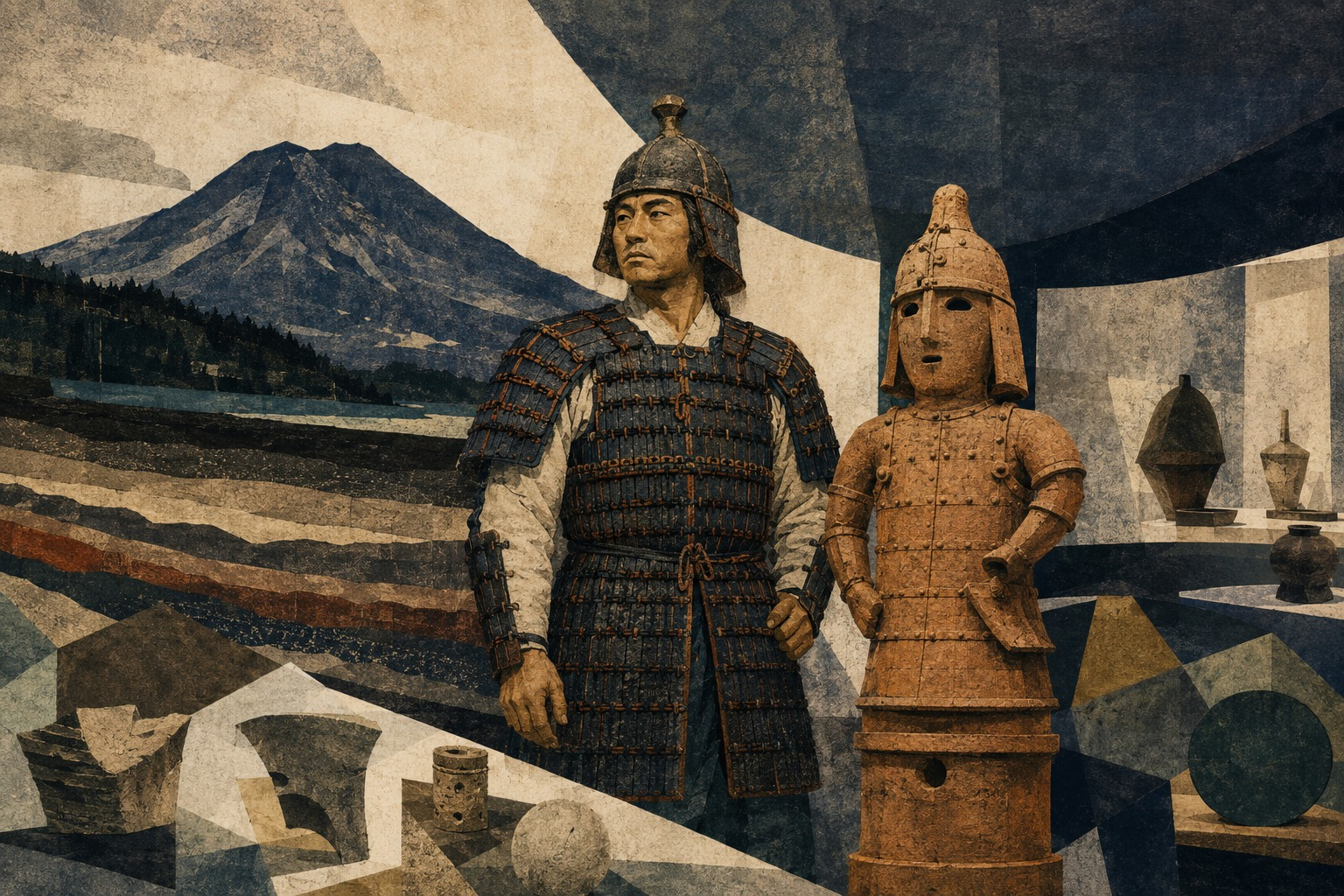
Two warriors occupy the gallery. One is a 130.5-centimeter figure made of clay. He wears a ridged helmet with guards for his cheeks and neck. Armor covers his shoulders, arms, knees, shins and feet. His right hand rests by a sword; his left held a bow. Even ten tied bows are modeled, preserving clues to the way the armor was fastened and carried on the body.
The other was never a statue. He was a man in his forties, approximately 164 centimeters tall. In the early sixth century, when an eruption of Mount Haruna’s Futatsudake devastated the settlement at Kanai Higashiura, he appears to have been equipped with armor made from iron scales laced in silk, a helmet, decorated spear, bow and arrows, knife and portable whetstone. He was found in 2012, face down, knees on the ground and head pointing west.
They are not one person reunited. They came from different places and are different kinds of evidence. The haniwa, unearthed at Iizuka in Ota, is a sixth-century tomb sculpture. The man at Kanai in Shibukawa was a human body preserved at a disaster scene. Yet both wear the same family of armor, lamellar keikō made from small iron plates. One tells us how a warrior was meant to appear. The other tells us what happened when armor was placed on a living body.
A Road Project Opens One Day From 1,500 Years Ago
The discovery did not begin as a hunt for a famous tomb. It was rescue archaeology conducted before construction of the National Route 353 Kanai Bypass, now part of the Joshin Expressway. The Gunma Archaeological Research Foundation began excavating Kanai Higashiura in September 2012. Two months later, inside a ditch roughly two meters wide and one meter deep, the skeleton and armor emerged from pyroclastic material.
Armor from the Kofun period usually comes from a grave. It was arranged for a dead person, and centuries commonly erased organic materials such as cloth, leather, wood and lacing. Kanai reversed that order. The man had not been buried. He fell inside a living landscape while equipped. Ash and pyroclastic flows destroyed lives and settlement, yet an accidental combination of pressure, moisture and burial preserved relationships between bone, armor and soil.
Excavation could no longer mean simply lifting an object. The helmet lay beneath the man’s face. Iron scales had corroded into masses holding information about the silk inside. Archaeologists removed sections with surrounding earth, used CT imaging and continued detailed work indoors. A site that would be lost to a road became a long investigation capable of reading the layering of equipment and the posture of death.
Early sixth century — The first major Futatsudake eruption buries the Kanai settlement in ash and pyroclastic flows.
Mid-sixth century — A second major eruption covers other settlements, including Kuroimine, in thick pumice.
1974 — The Ota warrior becomes the first haniwa designated a National Treasure.
Nov. 19, 2012 — Excavators discover the armored man at Kanai Higashiura.
2012–2014 — Work reveals an adult woman, two children, human and horse tracks, ritual areas and production remains.
Sept. 26, 2025 — Artifacts from the Kanai sites are designated Important Cultural Property.
July 10, 2026 — The commemorative exhibition opens; the National Treasure returns to Gunma after 17 years.
Warrior, Ritual Leader—or Both?
The equipment is exceptional. According to the Agency for Cultural Affairs, the armor was assembled from an estimated 1,800 iron scales using braided silk cords. No other find preserves the scale-made neck guard of a ridged helmet still in worn position. A spear decorated with silver and antler, an antler-handled knife and arrowheads, and a portable whetstone accompanied him. They compare with the finest grave goods and support the conclusion that he held a central place in the settlement.
His bones record work. An anthropological study published by the Gunma Archaeological Research Foundation identified him as a man in his forties and estimated his height at 164 centimeters. Developed muscle attachments on the femur and left upper arm suggest repeated riding and archery movements, possibly by a left-handed person. The report described his tall, narrow face as showing morphological traits associated with migrant ancestry.
Those observations should not be compressed into a single heroic identity. Muscle attachments suggest repeated movement, not a job title. Skeletal form does not directly assign a modern nationality or ethnicity. Nor did possessing weapons necessarily make a sixth-century elite man a full-time soldier. Regional leadership may have combined horses and force with ritual, exchange and control of production.
The idea that he was conducting a rite toward the erupting mountain is compelling but unproven. The cultural-property explanation itself poses it as a question. Another excavation interpretation suggests that armor and weapons nearby may have been moved to safety rather than offered. Was he praying, carrying equipment or trying to escape? A responsible exhibition leaves that space open.
- Established: A man in his forties, about 164 centimeters tall, was wearing armor; extraordinary weapons and tools lay with him.
- Strong indications: Repeated riding or archery activity, high status inside the settlement and equipment linked to wide networks.
- Still hypotheses: His precise title, what he was doing during the eruption, why the armor was worn and his social relationship to other victims.
- Claims to avoid: Treating the reconstruction as a photograph or translating skeletal morphology into a modern national identity.
1,800 Pieces of Iron Become “Mobile Power”
Lamellar armor is made by perforating small iron plates, overlapping them and lacing them into a flexible shell. It moves more readily with the body than tankō, an earlier cuirass assembled from larger horizontal plates. Production began in the later fifth century, and keikō became the dominant armor in the sixth. Its flexibility suited riding and shooting a bow.
The figure 1,800 measures more than weight. Each scale had to be cut, pierced, regularized and supplied from an iron economy vulnerable to corrosion. The scales had to be laced in order with silk. A helmet, neck guard, shoulder and waist protection, weapons and horse gear required minerals, fuel, smiths, textiles, ornament and the authority to coordinate them. Armor was protection, but it was also a region’s production and exchange system worn on the body.
Kanai yielded tuyères and anvil stones used in smithing, balls thought to be raw material for red pigment, and worked antler. Nearby tombs contained swords and whetstones with strong Korean Peninsula affinities. The man’s spear combined silver decoration paralleled in the southern peninsula with a curved rectilinear motif native to the Japanese archipelago. Kofun Gunma was not a remote recipient. It selected outside technology and remade it in a local visual language.
The National Treasure Is Not an Ancient Photograph
The National Treasure Haniwa Warrior in Keikō Armor shows equipment with astonishing precision. Clay pellets mark rivets on the helmet. There are cheek pieces, a neck guard, shoulder protection, knee guards, arm guards, shin guards and shoes. The lamellar body armor closes right-over-left. A wrist guard protected the bow hand, and a quiver carried arrows on the back. Ten modeled knots imply that the maker understood how the parts were tied.
Its archaeological and sculptural quality made it the first haniwa designated a National Treasure, in 1974. The Tokyo National Museum describes it as the only figural haniwa among Japan’s National Treasures. From 2017 to 2019, it underwent approximately 28 months of dismantling and repair. A 2024 exhibition marking the designation’s 50th anniversary brought it together for the first time with four remarkably similar “sibling” warriors possibly produced by the same workshop tradition.
Precision is not the same as portraiture. Haniwa were arranged on and around mounds, turning funerary order, authority, social roles and ritual scenes into visible form. The equipment may be grounded in actual practice, but the posture is a selected self-image. Injury, fatigue, age and fear disappear into clay; force and order remain.
That is why the encounter with the Kanai man matters. The haniwa is the warrior as power wanted him seen. The skeleton is a human being carrying that equipment. The National Treasure explains structure; armor and bone explain material, motion and catastrophe. One does not prove the other. Their difference makes the sixth century deeper.
| Two witnesses face to face | National Treasure warrior haniwa | Kanai Higashiura Individual No. 1 |
|---|---|---|
| Nature | A clay human figure made for a tomb | A real man killed by a pyroclastic flow |
| Provenance | Iizuka, Ota, Gunma | Kanai Higashiura, Shibukawa, Gunma |
| Shared element | Lamellar keikō armor made from small iron plates and a ridged helmet system | |
| Best evidence | Appearance, components, knots and idealized martial authority | Material, placement on the body, physical activity and a disaster context |
| Cannot reveal | A specific person’s face, the felt weight of equipment or daily behavior | His exact office, intention during the eruption, name or spoken words |
Why Gunma Became a “Haniwa Kingdom”
The Kofun period, conventionally spanning roughly the mid-third through seventh centuries, takes its name from the great mounded tombs through which a new political order spread across the archipelago. Keyhole-shaped plans, mirrors, weapons and haniwa arrangements signal relationships between the Yamato polity and regional rulers. But the regions were not merely receivers of central copies.
Present-day Gunma formed the heart of a powerful eastern region later associated with Keno and Kōzuke. Plains, rivers and mountain resources supported generations of major tomb building. Ota Tenjinyama is eastern Japan’s largest keyhole tomb. The Hodota group in Takasaki, Nanakoshiyama in Fujioka and the Ōmuro mounds in Maebashi reveal a deep stratum of rulers across time.
Horses transformed that power. Animals and tack spreading from the Korean Peninsula brought new capacities in movement, warfare, display and farming. Gunma has produced many horse haniwa and pieces of harness, as well as evidence of managed animals. At Kanai, barefoot human prints and hoofprints occupy the same eruption sequence. The skeletal indication that the armored man rode fits a wider archaeological landscape.
Haniwa production was highly developed too. Several accomplished warrior figures with traits resembling the National Treasure were found around Ota, implying specialist workshops. Gunma’s own cultural materials note that a large share of Japan’s designated National Treasure and Important Cultural Property haniwa came from the prefecture. “Haniwa Kingdom” is not merely a tourist slogan; it describes the result of tomb construction, horses, iron, skilled artisans and exchange operating together.
The Village Disappears If We Keep Only the Hero
“The armored Kofun man” is an irresistible name. But reducing the Kanai sites to one warrior discards half the discovery. The same pyroclastic flow preserved a woman in her thirties wearing a necklace, a young child and an infant. DNA analysis found no blood relationship between the man and woman. This is not a family portrait but a disaster site holding several lives from one community.
The woman was estimated at 143.8 centimeters. Her necklace combined tubular stone and glass beads. The way her body rotated over the left foot and fell face down with the head toward the east suggests she tried to escape a flow approaching from the west, the direction of Mount Haruna. Adult and child footprints survived, sometimes with the depressions of bare toes, alongside hoof marks. People and horses were still using paths after the first ash had fallen.
The settlement contained ritual life as well. Great concentrations of Sue and Haji pottery, miniature vessels, stone and glass beads, and imitations of swords, mirrors and farm tools point to offerings of food and symbolic power. Such a large and varied ritual deposit is rare in Japan. Read with an elite residence, fields, buildings, smithing and pigment production, it reveals authority broader than weapons.
The distinction is between history from tombs and history from life. A mound is rich in things a ruler selected to survive. The Kanai disaster layer preserves arrangements nobody intended to show posterity. A costly cuirass lies beside a road; ritual vessels stand near a child’s footprint. Hierarchy and daily experience meet in one layer.
The Power—and Limit—of “Japan’s Pompeii”
Buried settlements around Mount Haruna are often called “Japan’s Pompeii.” The phrase efficiently communicates a volcanic catastrophe, preserved living space and human remains. Nearby Kuroimine retained the outline of a settlement beneath thick pumice from the second major Futatsudake eruption in the middle of the sixth century.
But the metaphor should be an entrance, not a conclusion. At least two major Haruna eruptions struck different sectors with different deposits, and communities rebuilt between disasters. At Kanai, researchers can separate ashfall, repeated pyroclastic flows and movements recorded in tracks. The event was not a single frozen instant but a sequence in which people recognized ash, moved, decided and then met another surge.
The victims were people before they became exhibition subjects. Facial reconstruction makes them approachable, but skin, hair, eyes and expression require inference. If catastrophe becomes only heroic narrative or spectacle, the deaths of four people—including two children—and the fear of those who escaped disappear. Museums must distinguish what science reconstructs from what interpretation supplies.
The Important Cultural Property Is Not Just “The Man”
On September 26, 2025, the national designation was given to the “Artifacts Excavated From the Kanai Sites, Gunma,” not simply to the armored man. The protected ensemble from Kanai Higashiura and Kanai Shimonitta includes four pieces of armor, metalwork, stone objects, glass beads, pottery and clay objects that collectively explain an early-sixth-century settlement.
Keeping the group intact is an argument about history. Isolate the decorated spear and the story becomes decorative art. Isolate the armor and it becomes military history. Isolate the skeleton and it becomes anthropology or natural disaster. Reconnect ritual objects, smithing tools, pigment, tombs, homes, fields and tracks, and we can ask how elites sustained authority, what a community produced, what it offered and how it absorbed long-distance exchange.
The exhibition makes the same move by adding reconstructed armor from the Imashirozuka tomb in Osaka, a helmet from Ōsu Futagoyama in Aichi, a house haniwa and wooden sword fitting from sites in Nara, and Sue ware and a chicken haniwa from Iwate. Kanai is not left as an isolated miracle. It is positioned in an archipelago stretching from the Kinai heartland toward the northeast. Comparison does not dilute Gunma’s distinctiveness; it gives it an outline.
After the Gallery, the Map Changes
There is no required route through the exhibition. One rewarding sequence is to circle the National Treasure first, studying the knots, helmet, archery equipment and feet. Then look at the real scales, helmet and possessions from Kanai. End with the face and full-body reconstruction. Clay symbols become material and body. Reverse the sequence and an anonymous ancient face gradually acquires equipment, rank and social ties.
The history continues outside the museum. Around Takasaki lie Watanuki Kannonyama and the Hodota mounds. Maebashi has the Ōmuro group; Shibukawa has Kanai and Kuroimine; Ota holds the tomb landscape that produced the National Treasure. Connecting the display case to terrain, river, volcano and mound turns “a powerful eastern center” from a label into physical experience.
We do not know the Kanai man’s name. We may never determine what occupied his final thoughts, why he wore armor or what he intended in the last moments. Uncertainty is not failure. His bones, armor, tools and tracks, the woman and children in the same community, and the clay warrior each hold a different radius of truth.
In their encounter after 1,500 years, the National Treasure gains a human body, and the excavated man gains a society. The clay warrior protects the eternal stance authority wanted. The man under the ash answers that eternity was made of heavy iron, working muscles, an instant of choice and a fragile life. Gunma’s summer exhibition returns the Kofun period from an age of old objects to a time in which people built, rode, prayed, decided and ran.
Reporting Notes and Principal Sources
This article is based on public information available as of July 29, 2026, 11:30 a.m. JST. Exhibition details and loan objects come from Gunma Prefectural Museum of History; designation data come from the Agency for Cultural Affairs; human, excavation and armor findings prioritize reports from the Gunma Archaeological Research Foundation. The armored man’s actions and office remain disputed and are not presented as settled. Facial reconstruction begins with the skull but cannot determine every feature of appearance.
- Gunma Prefectural Museum of History: Exhibition overview, objects and visitor information
- Gunma Prefecture: Exhibition announcement and three principal highlights
- Agency for Cultural Affairs: Artifacts Excavated From the Kanai Sites
- Gunma Prefecture: Kanai Higashiura excavation and information display
- Gunma Archaeological Research Foundation: Circumstances of discovery (PDF, Japanese)
- Gunma Archaeological Research Foundation: Human remains, DNA and musculoskeletal study (PDF, Japanese)
- Gunma Archaeological Research Foundation: Lamellar armor structure and history (PDF, Japanese)
- Gunma Archaeological Research Foundation: Kanai research and peninsula-linked decoration (PDF, Japanese)
- e-Museum: Detailed record for the National Treasure warrior haniwa
- Tokyo National Museum: Collection record for Haniwa Warrior in Keikō Armor
- Tokyo National Museum: 50th-anniversary “Haniwa” exhibition
- Gunma Prefecture: Cultural-property plan and Haruna eruption sites (PDF, Japanese)
- Gunma Prefecture: Kofun-period Gunma and major mounds
- Gunma Prefecture: Facial reconstruction and digital interpretation