- The news is access, not a newly unearthed treasure
- Why a catalog entry can change history
- The Ozu collection: the workings of an administration
- Rubbings, wartime memory and the limits of a finding aid
- When a castle became the prefectural office
- Kawarayu: records of a community that ran its own hot spring
- The value of counting visitors in 1897
- A valley changed by the Yamba Dam
- How Gunma built an archive for its people
- How to visit—and what remains to be investigated
The news is access, not a newly unearthed treasure
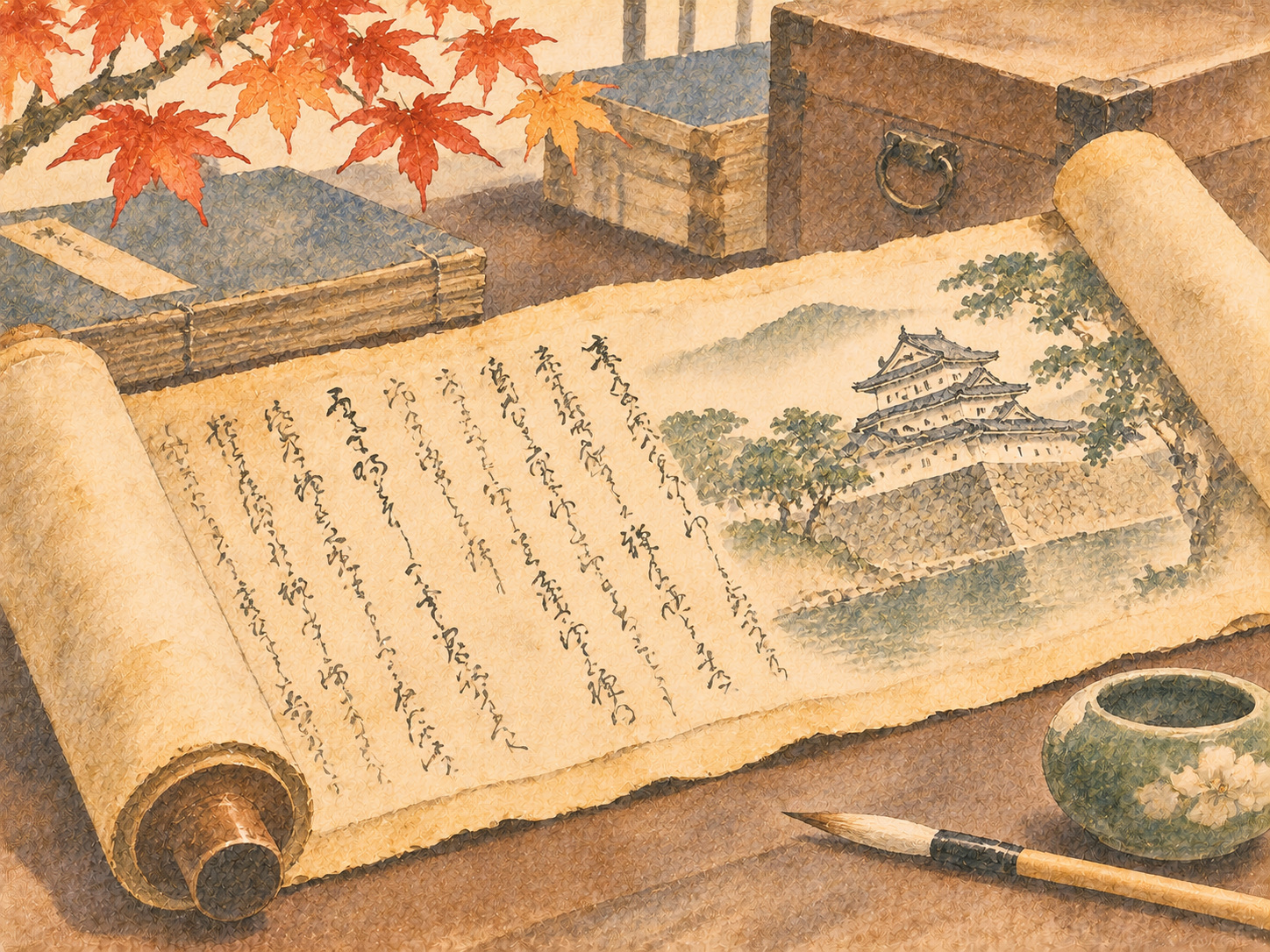
An old photograph of Maebashi Castle after its conversion into a prefectural office. Letters concerning the recording of ancient burial mounds. Day-by-day counts of the people using a mountain hot spring. These are not necessarily spectacular artifacts, but together they expose the practical decisions through which a region remembered itself and kept going.
On November 10, 2026, the Gunma Prefectural Archives announced that 2,318 additional historical records and illustrated materials were available for consultation. They belong to two distinct collections: 626 items assembled by former public official Ozu (大図軍之丞) and 1,692 records from the Kawarayu community in Naganohara. The larger group is available as reproductions derived from microfilm, not as 1,692 newly presented physical originals.
Why a catalog entry can change history
The archives’ website says both collections were added to its searchable catalog on November 5, before the November 10 announcement. That timing matters. Documents held in storage may be physically preserved yet remain functionally inaccessible until they have been arranged, described, indexed and made available to researchers.
Gunma says it normally releases more than 10,000 newly accessible historical documents in several batches each year. The significance of this batch is not simply its size. It links archaeological heritage, municipal government, modern social services and the economic life of a hot-spring community, inviting investigations that cut across the usual boundaries of historical scholarship.
The Ozu collection: the workings of an administration
The 626-item Ozu (大図軍之丞) collection is listed as P00112 and associated with Maebashi’s Kōunmachi district. Ozu worked for the prefecture and served as a deputy mayor of Maebashi. The official description says much of his collection consists of administrative records, appointments, certificates and acknowledgments.
Among the most consequential are papers related to Jōmō Kofun Sōran, a survey of burial mounds that Ozu helped compile while working in a prefectural office responsible for shrines, temples and military affairs. Correspondence from officials of the Imperial Household Ministry’s mausolea bureau also appears. Those records may illuminate the administrative roots of heritage protection, though no particular policy outcome should be attributed to an individual letter until its contents are studied.
Rubbings, wartime memory and the limits of a finding aid
The collection reportedly includes rubbings from the Tago Stele and medieval stone monuments, and from stones bearing poems. Such reproductions preserve the appearance of inscriptions and can document how local communities chose to commemorate people and events.
It also includes correspondence about obtaining a copy of a 1945 air-raid diary. This is a revealing distinction: the archives announcement describes letters concerning acquisition of the copy, not necessarily the diary’s original manuscript or the events narrated within it. A responsible article cannot supply a dramatic eyewitness account without examining the underlying records and their provenance.
When a castle became the prefectural office
One of the strongest visual leads is the presence of photographs of Maebashi Castle during the period when the site served the prefectural government. The collection also contains what appears to be Ozu’s album covering 1936–1956, with group photographs of officials, openings of child-guidance facilities and records of inspections or training sessions.
The location of Gunma’s prefectural government in Maebashi was settled in 1881, and an administrative building that had incorporated part of the former castle complex was eventually replaced by a new prefectural office in 1928, according to other Gunma historical materials. Taken together, photographs and dated administrative records can reveal how a feudal landscape was repurposed for modern government, without assuming every image depicts the same building or year.
Kawarayu: records of a community that ran its own hot spring
The second collection, PF0210, contains 1,692 records from the Kawarayu district of Naganohara. Roughly 100 documents date to the early modern period, including nine religious and population registers and approximately 50 land-tax assessment records. The substantially larger modern group includes material on the organization and business of the hot spring.
Two ledgers dated 1864 concern costs and labor associated with hot-spring works. Their titles suggest that operating a celebrated therapeutic destination also meant paying for repairs, labor and collective services. It is a different history from the familiar narrative of healing waters and visiting notables: the institutional and financial labor of keeping a settlement running.
The value of counting visitors in 1897
A survey dating from around 1897 recorded arrivals, departures and bathing fees, with daily male and female counts for each inn. Another series tracked the collection of fees associated with hot-spring use. The prefectural description refers to an entity called the Kawarayu Onsen Torishimari-sho, apparently involved in the management and operation of the resort.
For historians, such mundane columns invite unusually specific questions. Did winter traffic rise or fall? Which inns attracted returning guests? What changed when transport improved? But the brief announcement does not supply a compiled dataset. Before declaring any boom, decline or gender imbalance, researchers would need to inspect the pages, understand the recording conventions and account for missing entries.
A valley changed by the Yamba Dam
Kawarayu’s former hot-spring settlement was relocated in connection with construction of the Yamba Dam, and the old site was submerged. Gunma’s tourism material says the replacement hot-spring district moved roughly 80 meters higher; the public bath Ōyu relocated in 2014. A legend attributes the spring’s discovery to Minamoto no Yoritomo, but that is a tradition, not independently confirmed founding documentation.
The newly accessible community records are particularly resonant in that setting. Accounts of roads, bridges, woodland and district levies document places and responsibilities that can otherwise disappear behind a modern reservoir landscape. The records offer evidence of social and economic organization before relocation, although a detailed account of residents’ views and the dam dispute would require additional firsthand sources.
How Gunma built an archive for its people
The prefectural archives was established in April 1982 and opened that November. Its origins lay partly in the prefectural history compilation project begun in fiscal 1974, when historically valuable records kept in private households were recognized as vulnerable to dispersal and loss.
Gunma’s collections now encompass government documents, family and community papers, images, maps and material gathered for the prefectural history project. The November 2026 release gives approximate counts of 310,000 original historical documents open for consultation, plus around 60,000 microfilm-derived items and 70,000 reproduced prefectural-history records. These are different categories of accessible material, not a claim that all are physical originals.
How to visit—and what remains to be investigated
The reading room is on the second floor of the Gunma Prefectural Archives at 3-27-26 Bunkyō-chō, Maebashi, generally open 9 a.m.–5 p.m. Closures include Mondays, the last day of each month, national holidays and special inventory periods. The archives advises telephone reservations because seats are limited; its website supplies searchable catalogs and instructions.
Neither a press release nor a digitized finding aid substitutes for reading the documents. Scholars still need to establish the dating, authorship, preservation history and representative significance of individual entries. But making these collections consultable changes the possibilities: a photograph can be compared with city plans, a village ledger with official tax records, and a family’s administrative papers with a wider history of how Gunma governed and remembered itself.
Primary sources and reporting limitations
The Ozu records and the Kawarayu records differ in format: the latter are accessible as reproductions. The underlying entries have not been independently read or statistically analyzed; interpretations are identified as research possibilities.