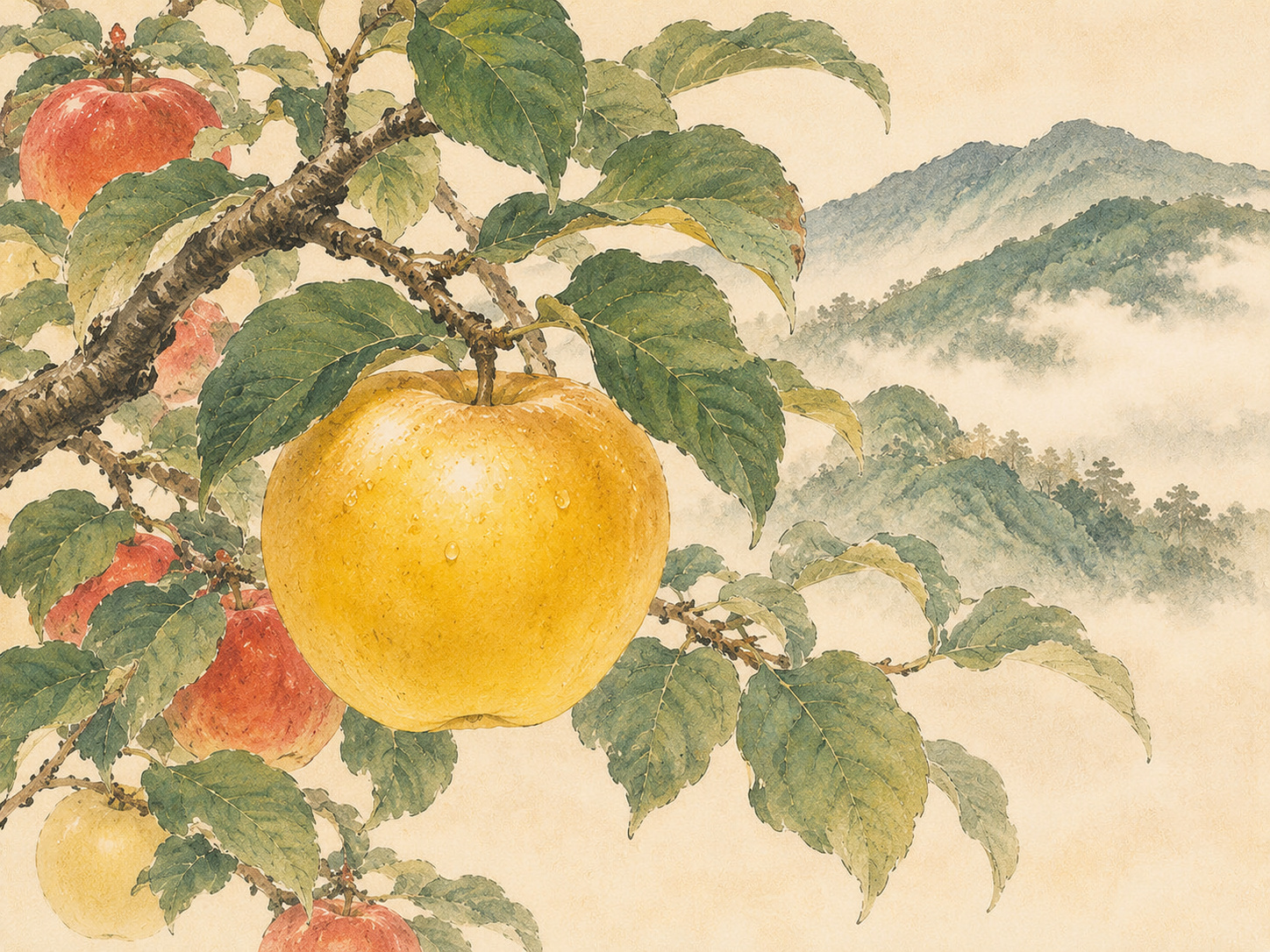
- A golden apple takes the prize
- What the 44th contest actually measured
- A family tree rooted in Gunma research
- Three apples, three different autumns
- The silkworm countryside that became apple country
- How large is Gunma’s apple economy?
- Climate change makes skin color a technical issue
- An award is not a profit statement
- Why tasting matters more than the label
- What remains after the trophies
A golden apple takes the prize
The winner did not need a crimson skin. At Gunma Prefecture’s 44th apple competition on November 12, the governor’s award for locally bred cultivars went to a Gunma Meigetsu grown by Kobayashi (小林力) of Higashiagatsuma, according to Gunma Television’s same-day report. In the other-varieties category, Matsui (松井恵一郎) of Numata received the corresponding honor for Fuji. The growers’ names and results are attributed to the broadcaster: a separate official award ledger was not available among the primary materials reviewed.
In all, 67 entries were judged—42 in the prefecture-developed division and 25 among other varieties. The organizer, the Gunma Horticultural Association, designed the annual contest to improve fruit quality and introduce the harvest to consumers. It was held at the prefectural government building in Maebashi, where exhibits were also offered for sale.
The two winners tell a larger story. A yellow apple created by Gunma’s own breeders shared the spotlight with one of Japan’s most recognizable national cultivars. Their coexistence captures the industrial choices facing a regional orchard economy: differentiation, consistency, changing temperatures and the search for customers who value more than the familiar red skin.
What the 44th contest actually measured
Gunma’s November 6 event notice divided the entries into two groups, local cultivars including Yoko and Gunma Meigetsu, and other varieties such as Fuji. Judging was scheduled from 10:30 a.m. until noon, followed by a public display and a lottery-based opportunity to buy exhibited fruit at 3 p.m. Fresh produce was also sold separately from the competition entries.
Gunma Television said judges examined coloration, shape and sugar content. It did not publish a complete scoring rubric, the relative weight of each criterion or a full list of award recipients. The report also relayed the horticultural association’s assessment that earlier seasonal cooling and relatively pronounced day–night temperature differences contributed to an unusually plentiful, high-quality crop.
That description is the association’s assessment, not an independently reconstructed weather analysis. A government-building tasting event was also planned at the 31st-floor Social Marche & Kitchen GINGHAM, a useful reminder that these contests serve as public education and marketing as well as agricultural evaluation.
A family tree rooted in Gunma research
Gunma Meigetsu was not selected from a supermarket shelf; it was bred. The prefecture describes it as a cross between Akagi, another locally developed apple, and Fuji. The agricultural technology center records Akagi’s registration in 1975, the red Yoko in 1981 and Gunma Meigetsu in 1991. Breeding a perennial fruit tree requires selection, cultivation trials and patience across growing seasons.
The resulting Gunma Meigetsu is typically yellow, with a blush on the sun-facing side, strong sweetness and relatively mild acidity. Prefectural descriptions also note that it can develop translucent, sugar-rich regions known in Japan as “mitsu.” That is a varietal tendency, not a promise that each fruit will contain visible honeyed flesh.
In botanical and commercial terms, a locally developed variety is a form of accumulated knowledge. It combines horticultural science with growers’ experience of orchard conditions. Gunma’s subsequent cultivars, including Oze no Beni and Benizuru, show that the work did not end with a single successful apple.
Three apples, three different autumns
Yoko is strikingly red and generally harvested in mid-to-late October. Gunma Meigetsu typically follows around late October to early November, while Fuji becomes central to the harvest in November across much of the Tone–Numata region. The resulting season has a progression of flavors, colors and orchard work, rather than one fixed harvest date.
The varietal split in this year’s awards is meaningful. Local breeding offers distinctiveness, while Fuji remains a familiar comparison point for many consumers. Gunma’s challenge is to make room for both: an apple people already know and another they may need to taste before understanding why growers value it.
A contest cannot prove that one variety is universally superior. Sugar readings do not capture every aspect of taste, and a prize does not establish average prices or consumer demand across the whole market. Variety matters because it gives orchards different ways to respond to customers and climate.
| Cultivar | Registration year | Notes |
|---|---|---|
| Akagi | 1975 | Locally bred red apple |
| Yoko | 1981 | Bright red, balanced sweet–tart taste |
| Gunma Meigetsu | 1991 | Yellow apple, Akagi × Fuji |
The silkworm countryside that became apple country
Gunma’s apple economy has roots in agricultural change. Minakami Town’s November 2024 bulletin describes farmers in the Tone–Numata region shifting away from sericulture and toward apple production from the 1950s. Fruit growing was a long-term change in how households used land and labor, not a scenic tradition that simply appeared fully formed.
In Agatsuma, Gunma’s own agricultural office traces apple cultivation to the early Showa period, with new planting expanding around Kita-Karuizawa and Sawada after World War II. Dwarfing techniques became more widespread from the 1970s, helping accelerate the growth of orchards and alter the labor required to maintain them.
Over time, proximity to hot-spring resorts and mountain tourism created a commercial advantage. Roadside stands and pick-your-own orchards gave visitors a direct relationship with growers. An apple bought after a trip to the mountains can carry a story about place that an anonymous wholesale carton rarely tells.
How large is Gunma’s apple economy?
Gunma’s 2026 contest notice cites Ministry of Agriculture statistics for the 2025 crop: 389 hectares planted and 5,740 metric tons harvested. Its principal producing areas include Numata, Minakami and Shibukawa. Other prefectural material estimates about 210 hectares in the Tone–Numata region alone, but that is a regional approximation rather than the same full-prefecture statistical series.
The numbers do not tell us total farm revenue or the share sold at orchard gates. Those measures would require price, packaging and distribution data. Still, they suggest why differentiation can matter to a producer that competes with the country’s much larger northern apple-growing centers.
In 2025, prefectural agricultural notices described around 200 orchards offering direct sales or apple picking in the Tone–Numata area. A visitor can sample a variety, ask how it was grown and return for another harvest. That direct connection can be particularly valuable for a yellow apple that some shoppers do not recognize on sight.
Climate change makes skin color a technical issue
For red-skinned apples, warm conditions can make reliable pigmentation harder to achieve. Gunma’s agricultural research center has publicly identified insufficient red coloration as a climate-related challenge and highlighted Gunma Meigetsu’s commercial advantage: a yellow cultivar does not depend on the same intensity of red skin color.
This is not a claim that yellow apples are immune to warming. Heat can also affect sunburn, pests, fruit quality and orchard management. Growers still need suitable cultivars, careful canopy management, appropriate harvesting and, where necessary, replacement trees. Gunma officials were publicly discussing these concerns in a 2017 prefectural assembly session.
The horticultural association’s favorable 2026 crop assessment is one season’s observation. It should not be mistaken for evidence that longer-term warming risks have disappeared. The future of orchard research lies in adapting to variability, not assuming every autumn will repeat this one.
An award is not a profit statement
An orchard investment has a long timeline: selecting trees, training their shape, pruning, thinning, protecting fruit, harvesting and finding a buyer. Replanting older blocks can leave a farm without full production for years. Labor availability and access to visitors are as important to competitiveness as a variety’s reputation.
Gunma’s regional agricultural offices have described work on dwarfing, replanting and producing fruit suited to consumer preferences. Prize-winning quality may attract attention, but the effect on farm income cannot be calculated without transaction prices, volumes and sales trends.
Nor can the contest results establish export growth, guaranteed premiums or new nationwide demand for the governor’s award apples. Separating the publicly recognized quality of a selected fruit from the economics of an entire industry is essential to useful agricultural journalism.
Why tasting matters more than the label
An apple variety is easier to understand after one bite than after a page of promotional copy. A tasting brings sweetness, acidity, juiciness, firmness and aroma into the same conversation. A buyer accustomed to red Fuji might discover that a pale yellow Meigetsu suits a different occasion or palate.
Yet sweetness is not an objective score for pleasure. A soluble-solids reading gives useful information, but does not determine universal preference. Handling and storage also affect a fruit’s condition. Fruit festivals and contests work best when they invite comparison rather than prescribe one “best” taste for everyone.
That may be the educational value of the 44th competition’s public-facing design. Breeding achievements from a research station meet the judgment of real consumers. The outcome is an opportunity for growers to explain what makes their harvest worth choosing.
What remains after the trophies
The November 12 results honor two growers in different parts of the prefecture, and two distinct traditions of apple cultivation. A cultivar bred in Gunma took the top local-bred award; Fuji won the parallel category. Behind both are decades of horticultural experimentation, changing rural livelihoods and sustained work in the orchard.
The questions still requiring reporting include a full official awards list, the precise grading scale, grower-level economics, heat and frost losses, farm succession, and whether recognition changes buying behavior. This account does not claim direct interviews with the winning growers or independent verification of their apples’ laboratory measurements.
The real contest extends beyond November. If Gunma can keep developing apples that perform in a changing climate and give consumers clear reasons to seek them out, its growers will be competing on knowledge and identity—not merely on the color of a peel.
Sources and reporting limitations
Winning grower names and category counts are reported by Gunma Television, not in the prefecture’s advance notice. The 2025 harvest totals are historical statistics, not 2026 crop results. Contest prizes do not measure market prices or industry earnings.
- Gunma Prefecture: 44th apple competition announcement, November 6, 2026
- Gunma Television: 67 entries and reported governor’s award recipients, November 12, 2026
- Gunma Agricultural Technology Center: varieties and registration dates
- Gunma Agri Net: original apple varieties and parentage
- Gunma environmental portal: apple growing and climate adaptation
- Gunma Prefecture: Agatsuma orchards and history of apple cultivation
- Minakami Town: November 2024 town bulletin on orchards and sericulture transition
- Gunma Prefecture: agricultural developments, October 2026
- Gunma Prefecture: local agricultural activities, November 2026
- Gunma Assembly: 2017 discussion of warming and fruit varieties
- Gunma Prefecture: 43rd apple competition (2025)