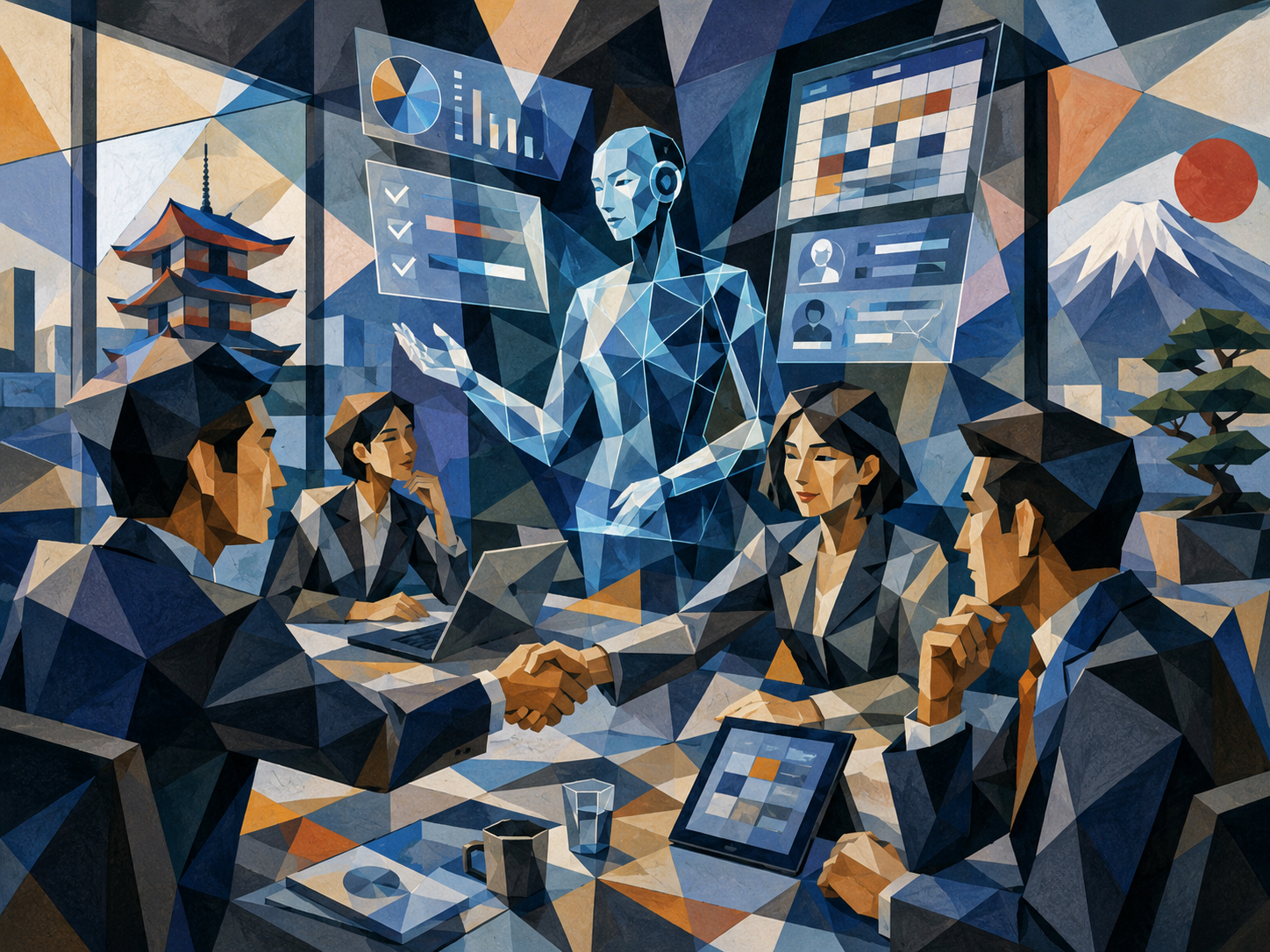
Japanese sales has long been a business of showing up. A salesperson visits the client, presents a business card, reads the room, learns the hierarchy, understands who must be persuaded before the meeting can become a decision, and waits patiently while trust is built. It is not the fast-closing world celebrated in Silicon Valley sales books. In Japan, a proposal usually comes after relationship. A quotation comes after reassurance. A contract comes after internal consensus.
Now AI is entering that room. Asulever announced that “Gorilla Sales AI Shodan” would officially debut on June 24, 2026. According to the company’s PR TIMES release, the service is designed to begin talking with prospects as soon as an inquiry arrives, conduct discovery, organize the customer’s issues and, where needed, complete scheduling. The company frames the problem as a familiar one for growing sales teams: difficulty hiring strong salespeople, exhaustion as meetings increase, inconsistent results between representatives, slow follow-up and lost opportunities before a lead becomes a real meeting.
The name is loud. “Gorilla Sales” is not the language of a conservative Japanese enterprise sales department. But that is what makes the story useful. In the age of generative AI, serious business change often first arrives wearing a strange product name. Email, CRM, online meetings, marketing automation and sales force automation all began as disruptions. Eventually they became ordinary office infrastructure.
What was announced
Asulever says Gorilla Sales AI Shodan performs real-time customer conversation from first contact through discovery, issue sorting and scheduling. The company argues that B2B firms have improved lead generation through webinars, ads and digital campaigns, but that many still lose opportunities after the lead arrives because initial follow-up, discovery and appointment setting are slow or uneven.
The important point is that this is not merely an AI writing tool. It places AI at the front of the sales process. Generative AI first entered sales through email drafting, meeting summaries and proposal outlines. Then it moved into chatbots and FAQ handling. Now products are moving toward the hottest moment in a funnel: the first inquiry, when a prospect still wants to talk.
Japan’s sales culture: business cards, visits and consensus
To understand why this matters, it helps to remember what Japanese sales has been. In the postwar growth era, trade between manufacturers, suppliers, trading houses, banks and corporate customers often operated through long-term relationships. A sales representative was not simply a closer. The representative understood the client’s internal process, protected the buyer’s position, prepared material for the buyer’s boss and helped the client avoid embarrassment after implementation.
Two words matter: nemawashi and ringi. Nemawashi means quietly preparing the ground before a formal decision. Ringi means circulating a written approval through an organization. To outsiders, this can look slow. Inside the system, it reduces conflict at the implementation stage. A salesperson selling into Japan must therefore do more than pitch. They must help the buyer build internal consensus.
That is why Japanese sales is not only about charm. It rewards people who can prepare precise materials, listen to silence, understand internal approval routes, answer small questions consistently and stay responsible after the contract. If AI enters this culture, speed alone will not be enough. The AI must support the consensus process rather than pretend that a single chat equals a sale.
Why sales AI now?
There are three reasons. The first is labor shortage. Japan’s aging society makes hiring difficult across industries, and sales is no exception. Strong salespeople are hard to recruit and slow to train. Even when firms try to standardize top-performer behavior, much of that performance is tacit knowledge.
The second reason is that the entrance to sales has moved online. Leads once came from referrals, exhibitions, phone calls and visits. Today they come from search, ads, social media, webinars, document downloads and comparison sites. By the time a customer asks for information, they may already be comparing several vendors. A slow reply can remove a firm from the shortlist.
The third reason is that generative AI has become conversational enough to move from content production into workflow. A CRM screen can record activity. A chatbot can answer basic questions. But if a system listens, asks follow-up questions, sorts needs, checks calendars and hands structured context to a human, it is no longer just content software. It is business execution.
What research says about sales AI
A 2026 research paper on live sales support noted that when customers ask detailed product questions, representatives often spend 25 to 65 seconds searching internal databases or CRM systems. Its SalesCopilot prototype combined speech-to-text, question detection and retrieval-augmented generation to surface candidate answers in an average of 2.8 seconds.
Those numbers matter for Japan. A customer’s small doubt can decide whether an internal approval process continues. If a sales team can instantly find relevant examples, pricing rules, implementation conditions, comparison points and available meeting times, the representative is no longer trapped in a memory contest. AI becomes a co-pilot, not just a replacement.
But the prerequisite is not magic. Company information must be clean. Product details must be current. CRM records must be trustworthy. Pricing rules must be machine-readable. FAQ answers must be maintained. Personal data and confidential information must be governed. In other words, sales AI exposes the real condition of a company’s knowledge management.
From the 2025 digital cliff to the sales floor
Japan has spent years discussing the “2025 digital cliff,” the warning that old systems, black-box processes and shortages of IT talent could impose enormous economic costs if firms fail to modernize. Sales DX is part of that same story. A company can have cloud accounting and digital ads while still running sales through private notes, unsearched emails and the memories of senior staff.
The hidden legacy in sales is often not software alone. It is the unstructured knowledge of what customers ask, why deals fail, which objection matters, which internal stakeholder blocks approval and which document finally moves a buyer forward. Many firms have introduced SFA tools, but if representatives do not enter useful data, the organization still cannot learn.
AI meeting tools could change that if they structure the first conversation, classify questions, record pain points and pass useful context to the next human. The shift would be from heroic selling to organizational learning.
The risks: trust, disclosure and responsibility
The phrase “AI conducts sales meetings” naturally creates concern. Should a customer always know they are speaking with AI? Who is responsible if the AI gives a wrong price, delivery date or contractual interpretation? Where is sensitive information stored? Can a human salesperson later correct an AI’s overpromising without damaging trust?
Japanese buyers may appreciate convenience, but B2B trust remains central. The buyer wants to know who will take responsibility after implementation. A good AI can reduce the first layer of friction. A bad AI can make the vendor seem evasive, careless or impersonal.
That means the winning design is unlikely to be pure automation. AI is strong at first discovery, pre-explanation, scheduling, FAQ handling, notes and document organization. Humans remain strong at relationship building, exceptions, negotiation, responsibility and reading the client’s internal politics. The best sales organizations will not be those that replace people with AI. They will be those that use AI to give people more time for the work only people can do.
What it means for small and midsize firms
Large companies can buy CRM, marketing automation, sales force automation and AI infrastructure. But Japan’s economy depends heavily on small and midsize firms. For them, sales AI may be less about futuristic automation and more about answering inquiries quickly when they do not have enough people.
That said, SMEs often have the hardest data problems. Product explanations may live in the president’s head. Prices may be in spreadsheets. Customer history may be scattered across email. Sales notes may be paper. Before AI can sell, the company must write down what it knows.
That may be the real value of the shift. AI forces a company to convert tacit sales knowledge into shared knowledge. It asks: What do customers ask first? What do they fear? What information proves value? What must happen before a meeting becomes a proposal? What should always be escalated to a human?
Japan.co.jp’s view
The Gorilla Sales AI Shodan story should not be dismissed as a novelty because of its name. It points to a deeper transition from person-dependent selling to structured selling. Sales will remain human. But human does not have to mean manual.
Japan’s sales culture has real strengths: care for the customer, long-term relationships, careful implementation, deep service and respect for the buyer’s internal process. Those strengths are not easily automated. But slow first response, scattered knowledge, dependence on star performers and weak training loops are problems AI can help reduce.
As AI enters the sales meeting, Japanese firms should not ask only whether machines can sell. They should ask what parts of sales should never have depended on memory, delay and personal exhaustion in the first place. The future may not be AI replacing the salesperson. It may be AI clearing enough clutter that the salesperson can finally do the human part better.
Key takeaways for readers and companies
| Question | How to read it |
|---|---|
| What happened? | Asulever announced Gorilla Sales AI Shodan, an AI service for first-contact discovery, issue sorting and scheduling. |
| Why does it matter? | It targets Japan’s sales-labor shortage, slow inquiry response and overreliance on star performers. |
| Historical context | Japanese sales has traditionally depended on visits, trust, nemawashi and consensus. AI is entering the earliest stage of that process. |
| Success conditions | Clean product data, current FAQs, CRM discipline, pricing rules, human escalation and clear data governance. |
| Japan.co.jp view | AI is more likely to reorganize sales work than erase it. The winners will be teams that use AI to protect trust and free human time. |
Sources and references
This article draws on Asulever’s PR TIMES announcements, its webinar materials, Reuters reporting on Japanese corporate AI adoption, the U.S. Department of Commerce’s Japan digital-economy overview, World Economic Forum analysis of Japan’s DX challenge, academic research on real-time AI support in live sales calls, and business-culture analysis of selling in Japan. Product details and service conditions may change.
- PR TIMES: Official Gorilla Sales AI Shodan announcement.
- PR TIMES: Launch webinar and sales-DX problem framing.
- PR TIMES: Webinar archive announcement.
- Reuters: Japanese firms using or considering AI robots.
- U.S. Department of Commerce: Japan digital economy and AI policy context.
- arXiv: Enterprise Sales Copilot and real-time support in live sales calls.