- A basketball lesson that begins before the whistle
- The itinerary—and what it cannot tell us
- A return visit, rather than a first introduction
- The local athlete who helped build Gifu SHINE
- The engineering of a basketball wheelchair
- The rules make inclusion a matter of strategy
- From Rome in 1960 to Japan’s silver medal
- Two schools, two routes to the same court
- Why the athletes must remain the main characters
- What it takes to keep a regional team visible
- After November 13, the important questions begin
A basketball lesson that begins before the whistle
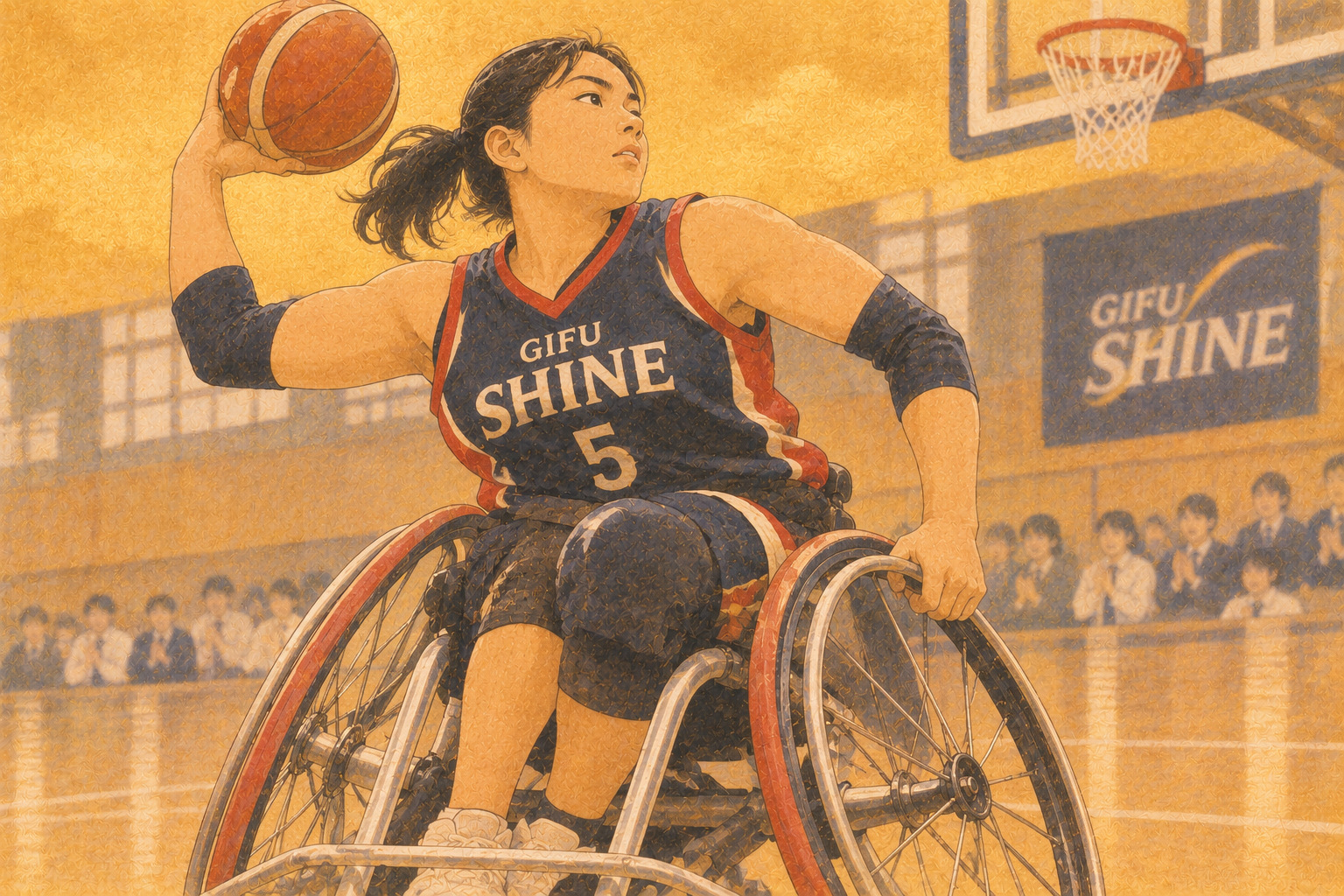
On November 13, athletes from the Gifu SHINE wheelchair basketball club are scheduled to enter the gymnasium at Gifu Municipal Seika Junior High School. The prefecture expects 268 third-year students. The session will begin with athletes discussing their experiences, followed by an opportunity for students to try the sport. The news is an advance announcement, published November 6, not an account of a completed event. But it offers a window into a deeper question: what does it mean to carry the legacy of a Paralympic Games into ordinary Japanese school life five years after Tokyo 2020? Wheelchair basketball is a fast, tactical sport, not merely a demonstration of mobility or an exercise designed to inspire sympathy. Its athletes are competitors with specialized skills that are easy to underestimate until a newcomer attempts the game.
The itinerary—and what it cannot tell us
Gifu Prefecture has specified a November 13 session from 10:35 a.m. to 12:25 p.m. at the school in Kagashima Seika, Gifu City. A talk about how players entered wheelchair basketball, their experiences and the appeal of parasport is scheduled for 10:35–11:10. Student participation in wheelchair basketball is scheduled for 11:15–12:25. The announced 268 students represent a planned attendance figure rather than a counted audience. The notice does not identify the individual visiting athletes or report the precise instructional exercises. Neither can anyone credibly describe student reactions yet. A subsequent report could examine those missing details, but an advance feature must preserve the distinction between an organizer’s plan and an event that has already happened.
A return visit, rather than a first introduction
Seika Junior High has already appeared in Gifu Prefecture’s wheelchair basketball outreach schedule. In January 2026, the sports division announced a visit for approximately 200 first-year students. Its notice named three planned instructors: Yoshitaka Ikedo, Tomohiko Nasu and Daisuke Fukami. The program combined an athlete talk with practical activity, and some of the sports chairs were to be supplied on loan by manufacturer Matsunaga Seisakusho. The November event instead targets third-year students and has its own timetable. Announcements alone do not demonstrate either class took place exactly as planned or that particular learning outcomes were achieved. What they do reveal is an attempt to develop a continuing relationship between a local school and athletes rather than a one-off publicity appearance.
The local athlete who helped build Gifu SHINE
The history of the club emerges in a detailed 2022 account published by Ena City. It identifies Yoshitaka Ikedo, a resident of Gujo, as Gifu SHINE’s founder and captain at that time. The city reported on his talk to pupils at Nagashima Elementary School, where his experiences provided a basis for a discussion about working within one’s circumstances and considering the perspectives of others. That historical record provides a human context for the club’s public educational role. It is not evidence that Ikedo will appear at the November 13 session, whose participants are not named in the new announcement. Nor does it provide a complete founding date, current roster, recent standings or certified national titles for the team. Those details need separate confirmation rather than attractive invention.
The engineering of a basketball wheelchair
At first glance, the distinctive angled rear wheels suggest that the chairs have been modified for appearance. In fact, their camber is integral to handling: it can improve turning characteristics and help protect players’ hands in the frequent close encounters of competition. Other features may include a bumper, anti-tip casters and a seat tailored to the athlete’s functional needs and style of play. Wheelchairs are not identical, and equipment choices involve trade-offs between maneuverability, stability and straight-line movement. The Japanese Paralympic Committee describes how changing the wheel angle affects those characteristics. An athlete must simultaneously manage the chair’s momentum, the ball, opponents and teammates. That combination makes the sport demanding even for people accustomed to conventional basketball.
The rules make inclusion a matter of strategy
Wheelchair basketball uses the same court dimensions, basketball and basket height as the running game. Five athletes take the floor per side. Yet the rules reflect the mechanics of wheelchair use: players may make up to two pushes while holding the ball, but three consecutive pushes constitute traveling, and double dribble is not called in the usual way. Classification is even more distinctive. Players receive functional classifications from 1.0 through 4.5, and the combined value of a team’s five athletes on court must not exceed 14.0. This is not a scoreboard measuring personal merit. It is a framework intended to make competition accessible to athletes with different functional abilities while introducing genuine tactical choices about lineups, roles and substitutions.
From Rome in 1960 to Japan’s silver medal
Wheelchair basketball has been on the Paralympic program since the first Games in Rome in 1960. The sport developed in Japan during the following decade and was present at the 1964 Tokyo Paralympics. Japan’s men won their first Paralympic basketball medal at Tokyo 2020, which was held in 2021, finishing with silver after a 64–60 loss to the United States in the final. The achievement brought national recognition to a sport that had long been sustained by local clubs and participants. The Gifu government explicitly places its school exchanges within the legacy of the Tokyo Games. But that history does not make every local athlete a Tokyo 2020 medalist, and no such claim is supported for the participants in the scheduled Seika visit.
Two schools, two routes to the same court
An additional Gifu announcement points to another outreach event one day earlier. The prefecture’s human rights policy office plans a November 12 wheelchair basketball experience for all 51 students at Hichiso Junior High School, with three Gifu SHINE athletes expected to attend. That program is framed as human rights education; the Seika exchange is presented by the regional sports division as part of Paralympic legacy work. The distinction reveals something about Japanese local policy. The same sport can serve different purposes across departments, from introducing high-performance athletics to encouraging encounters that challenge stereotypes. Neither event has occurred as of the November 6 reporting cutoff, so their outcomes, actual attendance and participant testimony cannot be asserted.
Why the athletes must remain the main characters
The simplest account of an encounter between wheelchair basketball players and students might be that children learned how difficult life can be with a disability. Such an account would miss the point of an elite sport. Players make technical and tactical choices under pressure. They compete, train, communicate, lose games and win them. An effective school visit should allow students to recognize sporting excellence alongside an understanding of accessibility. Experiencing a chair may offer an appreciation of unfamiliar physical tasks, but it cannot reproduce the lived experience of disability. Nor should an activity be judged successful merely because adults hoped it would build empathy. Better evidence would include students’ own reflections, subsequent participation opportunities and whether schools sustain engagement with parasport over time.
What it takes to keep a regional team visible
Organizing one gymnasium session requires sports chairs, scheduling, transport, instructors and a safety plan. Establishing a lasting link between schools and local sport demands more: opportunities to watch real games, volunteer, learn coaching skills or join accessible recreational programs. These possibilities are not guaranteed by the announcements. The sources reviewed did not establish Gifu SHINE’s current membership, budget, training schedule or competitive ranking, and the article does not substitute unrelated wheelchair basketball clubs’ statistics. Questions about equipment access and participation are therefore reporting directions, not claimed findings. One lesson of the Paralympic movement is that the visibility of elite events means little without opportunities close to where people actually live.
After November 13, the important questions begin
The prefectural notice fixes a day, a place, a planned audience and a schedule. It does not measure whether prejudices changed, whether students became fans, or whether any children will seek further involvement. Those are questions for follow-up reporting after the visit. For now the event has a clear and modest value: a regional school intends to put students in contact with the people who play the sport, rather than rely exclusively on videos or abstractions. A meaningful legacy is built incrementally, through recurring opportunities that allow participants to learn from the skill and judgment of real athletes. The reporting should return to Seika after November 13, verify what happened, and see whether the encounter leads anywhere beyond a single school morning.
Sources and reporting method
Event details are advance announcements, not observed outcomes. Competition rules and history draw on official bodies; the 2022 athlete profile and January 2026 program are identified as historical records.
- Gifu Prefecture: November 13 Seika Junior High exchange
- Gifu Prefecture: January 2026 Seika school visit
- Gifu Prefecture: November 12 Hichiso school program
- Ena City: founder Yoshitaka Ikedo’s 2022 school talk
- Japan Wheelchair Basketball Federation: rules and classifications
- Japanese Paralympic Committee: wheelchair basketball
- Sasakawa Sports Foundation: history and Tokyo 2020 silver
- Japan Basketball Association: federation and Tokyo results
- Gifu Prefecture: sports policy and programs
- I’mPOSSIBLE: education handbook for wheelchair basketball