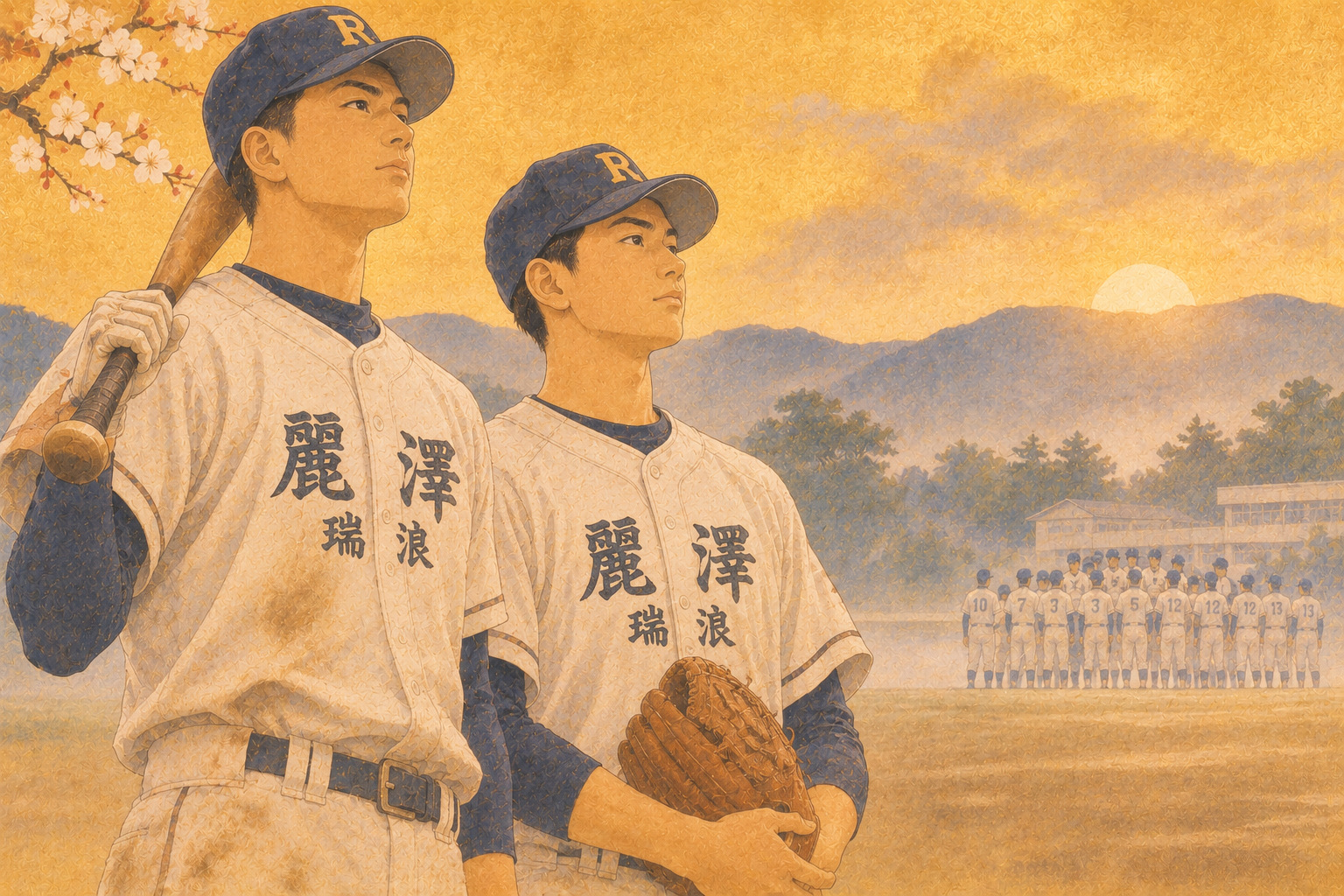
- When a baseball team is almost too small to exist
- Exactly what Gifu selected
- The two-player chapter
- The rebuilding appeared in August
- Three one-run games in September
- Why Japan created a 21st-century berth
- A school rooted in a longer educational experiment
- Not a story about a school with no resources
- A nomination asks broader questions
- What comes next
When a baseball team is almost too small to exist
At one point in the autumn of 2022, Reitaku Mizunami High School had just two members in its hardball baseball club, according to reporting by the Gifu Shimbun. It joined a combined team to take part in competition. Four years later, the school in Mizunami, Gifu Prefecture, is the prefecture’s nominee for a special route into Japan’s national spring high school baseball tournament. The nomination, announced November 5, does not mean the school has qualified for Koshien. It does mark a substantial change in fortunes for a program that had once lacked enough players to field a team on its own. That contrast makes the story worth telling—but it also deserves more than an uplifting headline.
Exactly what Gifu selected
The Gifu High School Baseball Federation named Reitaku Mizunami as its 21st-century slot recommendation for the 99th National High School Baseball Invitational Tournament in 2027. The federation cited the school’s top-eight performance in the autumn prefectural tournament. The distinction matters: this is a prefectural nomination, not a place in the national draw. Nine regional candidates are scheduled to be named on December 11. A selection committee is then scheduled to award the two national 21st-century berths on January 29, 2027. Until then, words such as “qualified” or “Koshien-bound” would be misleading.
The two-player chapter
Local newspaper coverage of the November 5 announcement says the club had only two members during the 2022 autumn tournament and therefore experienced competition as part of a combined team. Such arrangements allow schools facing inadequate player numbers to participate rather than abandon a season outright. That fact is compelling on its own, but the available reports do not provide a complete roster history, the identities of those two students, or verified accounts of their experiences. It would be tempting to invent a speech, a lonely practice scene, or a heroic coach. The documented facts are more useful: the program was severely depleted, and by 2026 it had rebuilt enough to win meaningful games.
The rebuilding appeared in August
The school’s own August 17 report says Reitaku Mizunami won all three of its autumn district preliminary games: 4–0 over Nakatsugawa Technical on August 10, 5–3 over Tajimi Technical on August 13, and 6–1 over Toki Commercial on August 15. The school described it as the first district-title sweep in the hardball club’s history. That is a better measure of organizational progress than a sentimental label alone. A team must recruit and retain enough participants, practice together and perform in real contests. How those improvements were organized remains a question for interviews; the scores demonstrate the competitive result.
Three one-run games in September
The prefectural tournament demanded even greater resilience. On September 6 Reitaku Mizunami beat Tajimi Technical 6–5. It then defeated Teikyo Kani 7–6 in a 10-inning tiebreaker. In the quarterfinal against Seki Shoko, its run ended with a 5–4 walk-off loss. The school’s October 1 account describes the finish as its fourth top-eight appearance, and its first in six years. Taken together, the three results describe a team living on the narrowest margins. The point is not that a future trip to Koshien has already been earned; it is that the program became competitive enough for those margins to matter.
Why Japan created a 21st-century berth
The spring invitational has always differed from the summer championship, whose national field emerges through regional elimination tournaments. The 21st-century selection category was introduced in 2001 to recognize schools embodying valuable forms of high school baseball beyond the most obvious win-loss record. Historical selection explanations describe factors such as overcoming low participation, balancing academics and athletics, inventive training, contribution to community life and consistent performance despite disadvantages. In 2017, officials outlined those principles in a Japanese parliamentary education committee hearing. Modern application depends on the current tournament rules, however, not simply on a historical description. The category is selective: the 2027 process ultimately has just two berths.
A school rooted in a longer educational experiment
Reitaku Mizunami opened in 1960 as a Mizunami branch of Reitaku High School, became a separate school in 1962 and established a full-time program in 1963. It is part of the Hiroike educational tradition associated with Chikuro Hiroike and its emphasis on moral education. The school explains its name, Reitaku, through an image in the Chinese classic I Ching: two interconnected springs replenishing one another. The metaphor of mutual support resonates with a team-oriented sport, though there is no basis to assert that the philosophy itself caused the baseball revival. According to the school’s published May 2026 profile, its high school enrolled 360 students and operated an extensive residential campus.
Not a story about a school with no resources
An accurate account must acknowledge what the program has as well as what it lacked. The school lists a dedicated baseball ground and an indoor practice facility accommodating multiple hitters. It is a private school with residential education options, not a school whose facilities have been shown to be entirely inadequate. Its past shortage of players was real; that does not justify inventing wider hardship. The questions that would improve the feature through original interviews are practical ones: How did recruitment change? Who helped keep the program alive? What did its former joint-team arrangement teach the players and coaches? How did its academic and athletic schedules fit together?
A nomination asks broader questions
The 21st-century category is designed to notice more than tournament position, yet competitive achievement still matters. Gifu’s federation reported the top-eight finish, while the school’s score sheets document the games behind it. The federation’s brief announcement did not publish a detailed scoring rubric or a full account of community service and academic achievement for this particular nomination. Those aspects should not be inferred simply from the fact that the school was selected. The broader stakes are familiar well beyond Japan: as youth participation fluctuates, maintaining a viable team may be an achievement before any trophy is won.
What comes next
December 11 and January 29 are the dates to watch. Reitaku Mizunami could advance further in the process, or the prefectural endorsement may be the highest recognition it receives this season. Either way, the outcome of the autumn tournament is fixed: three consecutive one-run decisions, a six-year wait for the quarterfinals to return, and a prefectural nomination. In 2022 two members could not make a team alone. In 2026 the school could compete, win, lose narrowly and be put forward for national consideration. That is a complete, verifiable story even before the spring invitations are decided.
Sources and reporting method
Match scores, school history and selection deadlines were checked against federation and school records. The two-player detail is attributed to Gifu Shimbun; the category’s history to institutional materials. Exact grounds for nomination remain incompletely public.
- Gifu High School Baseball Federation — 2027 nomination
- Reitaku Mizunami — autumn quarterfinals and scores
- Reitaku Mizunami — district preliminary title
- Reitaku Mizunami — school history and profile
- Reitaku Mizunami — baseball club facilities
- Gifu Shimbun — November 5 nomination and two-player history
- Japan High School Baseball Federation — tournament selection
- Japan House education committee — historical selection principles
- Hiroike Gakuen — institutional history
- Sports Navi — 2026 match record