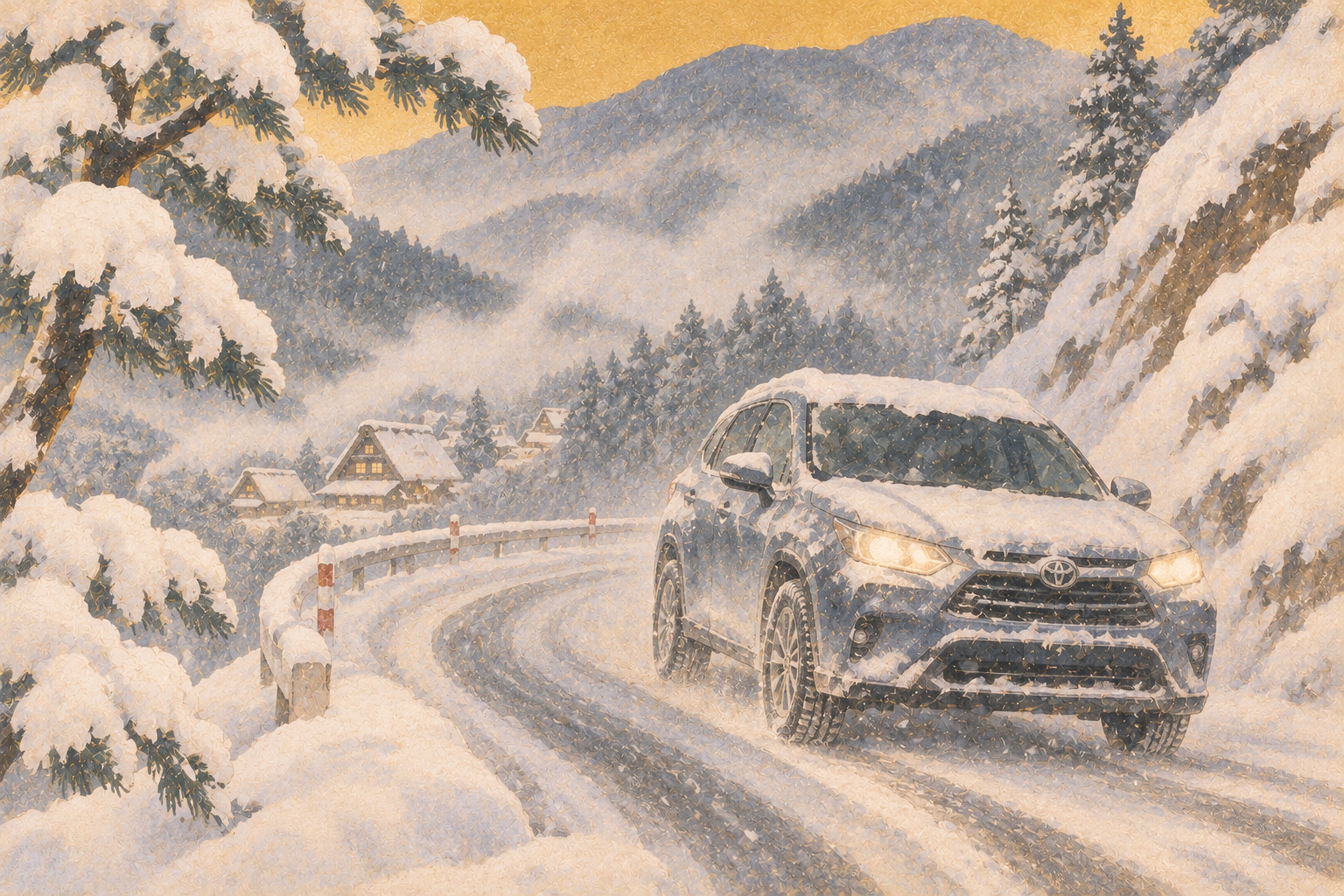
- A winter postcard, and a road that can suddenly stop
- Why Hida is not an ordinary winter drive
- The physics behind an innocent-looking tire
- Winter equipment is also a legal matter
- Why the discussion began before this winter
- A multilingual problem—not a problem caused by one nationality
- All-season tires are not a universal solution
- The road map is not the road report
- The older history behind the winter scenery
- A practical decision before the keys turn
A winter postcard, and a road that can suddenly stop
Winter in Japan’s Hida region looks like a travel advertisement: snow on Takayama’s dark wooden facades, white roofs over Shirakawa-go’s farmhouses, and quiet mountain roads leading toward hot springs. The same weather can turn a holiday drive into a stranded-car incident that disrupts a road used by residents, delivery vehicles and buses. A driver may get moving on snow only to discover that the vehicle cannot brake or negotiate a bend safely.
Gifu Shimbun reported on November 6 that prefectural police organized a meeting at Takayama Police Station to address disruption caused by vehicles arriving on ordinary, non-winter tires. About 30 representatives of Takayama, Hida and Gero cities, Shirakawa village, tourism bodies and national and prefectural offices discussed prevention. The meeting is a documented response to a recurring problem; the report does not, by itself, supply a new verified count of collisions or closures.
Why Hida is not an ordinary winter drive
The historic towns and mountains of northern Gifu are connected by roads that climb through valleys and cross shaded slopes. Conditions can change over a short distance. A street in central Takayama may look clear while a bridge, high pass or north-facing road remains icy. Visitors arriving from warmer parts of Japan, or from overseas cities with little snow, may underestimate the difference.
Takayama’s official tourism office advises studless winter tires even when there is no visible snowfall and recommends trains or buses for visitors uncomfortable with icy-road driving. For travelers coming from the Tokyo and Kanto area it gives a broad guideline of mid-November through late April for winter tires, while singling out higher-elevation Okuhida and early or late hours as particular concerns. Those are seasonal planning recommendations, not a statement that every road is frozen throughout that period.
The physics behind an innocent-looking tire
Four-wheel drive can help a vehicle pull away, but it does not repeal the limits of tire grip. Braking and cornering require friction just as acceleration does. Japan Automobile Federation (JAF) tested six types of tire equipment on packed snow and ice in Hokkaido in 2017, braking from 40 kilometers per hour under controlled conditions.
On packed snow, ordinary summer tires took 29.9 meters to stop, compared with 17.3 meters for studless winter tires—about 1.7 times as far. On polished ice, the corresponding figures were 105.4 and 78.5 meters. These are measurements from a controlled test using new tires, not a prediction of how far a particular rental car will travel in Hida. But they explain why a car that seems controllable on a straight section can become dangerous near a junction or downhill bend.
Winter equipment is also a legal matter
Gifu Prefecture’s Hida office explicitly warns that driving on a snow- or ice-covered road without required anti-slip measures violates Japanese traffic requirements under Road Traffic Act Article 71(6) and the prefectural implementing rules. The practical responsibility is to have appropriate winter tires or chains according to the vehicle and conditions—not merely to assume that a careful driver can manage on summer tires.
Expressway rules deserve separate attention. Central Nippon Expressway Company (NEXCO Central) distinguishes winter-tire restrictions from stricter chain controls. Under the latter, even a car fitted with studless winter tires may need chains to continue. In severe weather a route may be closed altogether. The relevant restrictions, chain compatibility and manufacturers’ mounting instructions must be checked rather than guessed.
Why the discussion began before this winter
The November 2026 meeting builds on earlier attempts to interrupt the problem before cars reach the mountain roads. Japan’s national rental-car association says representatives from Gifu and Aichi attended a prefectural-police coordination meeting on December 19, 2025. They discussed asking renters about their destinations, providing winter tires for snowbound routes and explaining Japanese road rules and safe driving practices to international customers.
That sequence reveals an operational problem: safety advice delivered at the entrance to a snowy village may arrive too late. A visitor may already have rented a car in an airport city where the streets were dry. A useful system would deliver clear equipment requirements when the traveler reserves a vehicle, collects the keys, chooses a route and checks into accommodation. Whether those interventions have actually reduced disruptions cannot be measured from meeting notices alone.
A multilingual problem—not a problem caused by one nationality
International travelers are among the visitors who rent cars for Takayama and Shirakawa-go, but a lack of snow-driving knowledge is not confined to any nationality. Domestic tourists from snow-free regions face the same physical hazards. Advisories that simply say “studless” or “chains” without showing when each is required may fail travelers who have never encountered the terminology.
Shirakawa-go’s tourist association tells English-speaking visitors to equip vehicles with studless tires during the snow season and strongly recommends four-wheel drive. That recommendation does not mean four-wheel drive substitutes for suitable tires. Rental operators, accommodation providers and travel platforms can help by communicating requirements before the journey and in languages customers understand.
All-season tires are not a universal solution
An all-season label can be misleading when travelers assume it means winter-mountain readiness. In JAF’s packed-snow test, all-season tires stopped in 22.7 meters: better than summer tires at 29.9 meters, but behind studless tires at 17.3 meters. On the ice test, all-season tires required 101.1 meters—much closer to the ordinary tires’ 105.4 meters than to the studless tires’ 78.5 meters.
Performance depends on the actual tire, road condition and equipment rules, including how a specific tire marking is treated during restrictions. Travelers should check their rental company’s exact fitment and whether compatible chains are carried. If the conditions exceed the vehicle or driver’s capabilities, choosing not to drive is the safer alternative.
The road map is not the road report
Before setting off, visitors should check weather forecasts and official restrictions for the actual route. Gifu Prefecture maintains an information hub for prefecture-managed roads, including closures and road images. Its Takayama civil-engineering office published the 2026–27 seasonal-closure notice updated November 6, while cautioning that planned opening and closing dates can shift with snowfall.
National-road conditions are covered through Ministry of Land, Infrastructure, Transport and Tourism services such as Hida Road Guide, while NEXCO Central supplies expressway notices. A navigation app may suggest a road that is subject to seasonal closure or abrupt restrictions; a route appearing on a screen is not proof that it is open. Local official information and posted road signs take precedence over an itinerary.
The older history behind the winter scenery
Takayama’s preserved old town emerged from a much longer transport and commercial history. It was developed as a castle town under Kanamori Nagachika in the late sixteenth century and became territory directly administered by the Tokugawa shogunate in 1692. Merchants, timber and mountain routes shaped its place in regional life. Snow-covered shopfronts and streets now draw photographers and visitors, but they also remain part of a functioning city.
Other winter attractions tell a similar story. Shirakawa-go’s steep thatched roofs reflect generations of adapting architecture to heavy snowfall. The appeal of these places rests partly on the physical environment that makes access demanding. Tourism, road clearance and everyday life have to operate together; the visitor’s vehicle is not separate from that shared system.
A practical decision before the keys turn
Ask the rental provider whether suitable winter tires are installed on all required wheels, whether chains are available and compatible, and whether a planned route crosses places subject to special controls. On departure day, check the forecast, closure notices and the time you might arrive at higher ground. Leave extra margin, increase following distance, avoid abrupt steering or braking, clear snow from the roof and windows and carry appropriate warm-weather emergency supplies.
Public transport can be a better decision than driving for people unfamiliar with mountain winter conditions, although rail and bus services may also be disrupted during severe weather. The November police meeting is ultimately about protecting two groups at once: visitors who have come to enjoy the winter landscape, and the people whose daily lives depend on those same roads.
Sources and reporting method
Official road-safety guidance, transport rules and tourism advice are distinguished from the local newspaper report on the meeting. Test measurements are identified as such, not presented as live Hida road conditions.
- 岐阜新聞(2026年11月6日):冬季の飛騨地域、ノーマルタイヤ車両トラブル防げ
- 岐阜県飛騨県事務所:冬期運転時の冬用タイヤ着用に関する注意喚起
- 高山市観光公式サイト「飛騨高山旅ガイド」:よくある質問・冬の旅
- 白川郷観光協会:季節と冬用タイヤに関するFAQ
- JAF:走れても止まれない、雪道のノーマルタイヤ(試験条件・結果)
- JAF:雪道・アイスバーンでの運転の注意点
- JAF:オールシーズンタイヤの特性と限界
- NEXCO中日本:冬場に高速道路を走行する場合の注意点
- 岐阜県道路維持課:道の情報・通行規制等
- 岐阜県高山土木事務所:2026–27年冬期閉鎖情報(11月6日更新)
- 全国レンタカー協会:2025年12月の冬季タイヤ交通障害対策会議への参加
- JNTO:飛騨高山の冬の観光と町並みの歴史
- JNTO:高山城下町の発展と1692年の幕府直轄化