- A policy meeting and a demographic turning point
- What the official figures actually measure
- Manufacturing is where the change is most visible
- How central Japan became a destination
- What the fourth-phase plan attempted
- Language is infrastructure
- The pressures beyond the factory gate
- A national labor reform is approaching
- Who gets to define successful coexistence?
- The test for Gifu’s next five years
A policy meeting and a demographic turning point
Gifu Prefecture announced on November 5 that its headquarters for foreign-talent participation and multicultural coexistence would convene to discuss a successor to the fourth-phase policy. The existing framework, drafted in March 2022, runs through the end of fiscal 2026. The announcement is a procedural milestone, not evidence that the prefecture has enacted a new immigration or integration program. That distinction matters in a debate too easily framed as either an economic emergency or an abstract cultural argument.
Behind the announcement is a measurable transformation. Gifu had 80,766 foreign residents at the end of 2025, according to prefectural statistics drawing on national immigration records. They are not simply workers hired to keep a plant running. They include family members, students, parents, long-term residents and children growing up in Japanese schools. The policy question is whether public services and local institutions are catching up with the communities they already serve.
What the official figures actually measure
Two official statistics illuminate different parts of Gifu’s changing population. The 80,766 figure counts registered foreign residents at the end of December 2025. Separately, the Gifu Labour Bureau recorded 47,534 foreign workers employed by 6,094 establishments at the end of October 2025. Workers were up 3,801, or 8.7 percent, from a year earlier. It would be incorrect to subtract one total from the other and call the difference “nonworking migrants”: the systems have different coverage, legal definitions and reference dates.
The longer-term trend is nevertheless unmistakable. In 2015, the labor bureau counted 21,451 foreign workers at 3,194 establishments. A decade later both figures had nearly or more than doubled. An increase of this scale affects not only recruitment but also transportation, rentals, schools, clinics and emergency communications across the prefecture.
Manufacturing is where the change is most visible
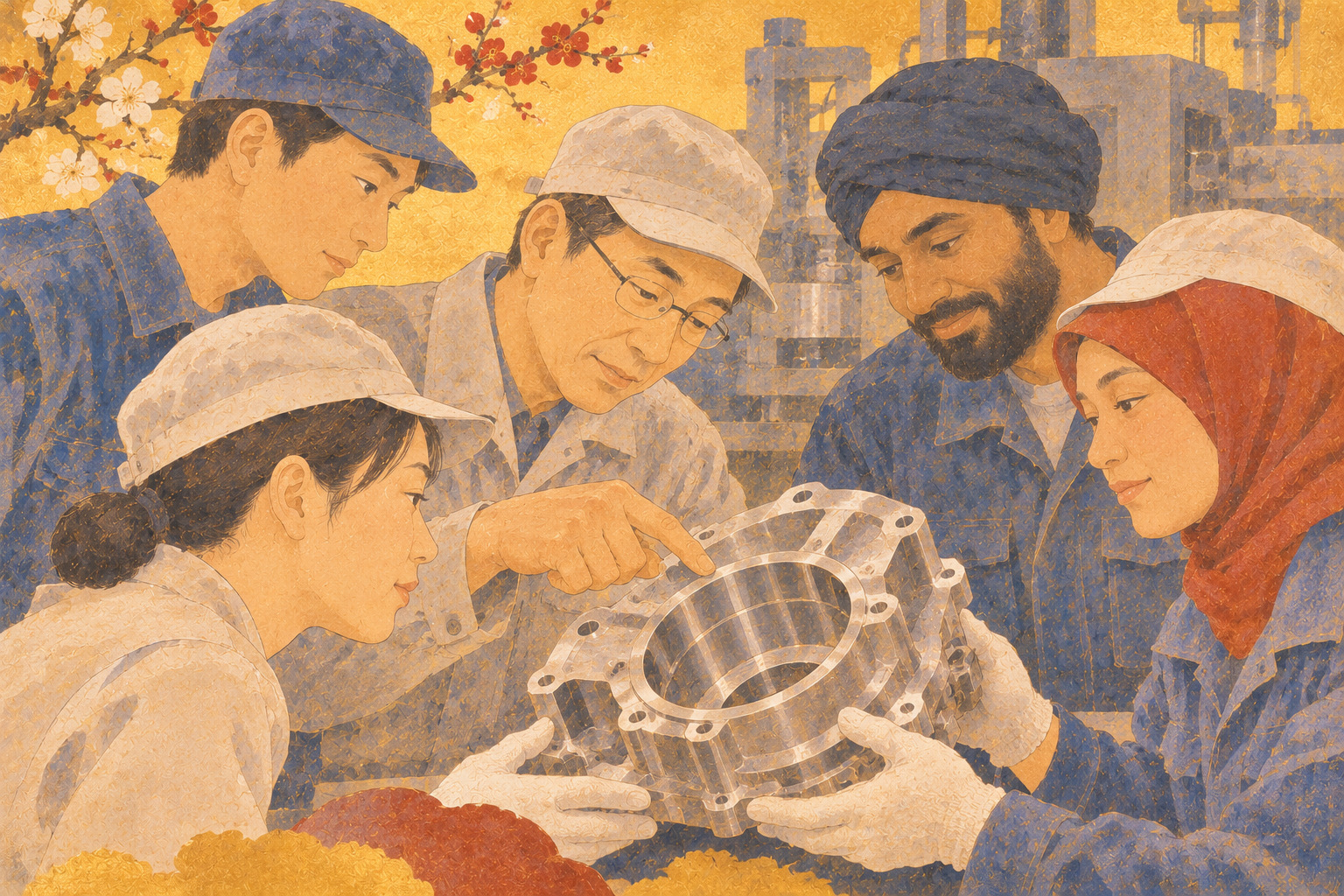
Manufacturing employed 21,945 foreign workers in Gifu in October 2025, 46.2 percent of the prefectural total. This reflects the region’s industrial base: automotive components, machinery, metalworking and other industries that depend on reliable production and skilled teams. Policy cannot stop at asking whether firms can find enough people. It must also consider training, workplace safety, understandable contracts, advancement and how experienced staff transmit specialist knowledge.
The labor force is diverse in legal status as well as origin. The labor bureau counted 16,031 workers with residence statuses based on personal or family circumstances, 15,727 technical interns, and 11,626 in professional or technical status categories. Those categories imply different rights, obligations and employer arrangements. A single description of “foreign labor” obscures differences that matter when designing policy.
How central Japan became a destination
Gifu’s story sits within the history of industrial central Japan. Following reforms to Japan’s immigration framework around 1990, people of Japanese ancestry and their families from South America gained additional routes to live and work in Japan. Manufacturing communities in the wider Tokai region developed new social networks and, over time, permanent family lives. Cities such as Minokamo and Kani became familiar settings for conversations about multilingual education and municipal services.
More recent migration has widened the picture. In the labor bureau’s October 2025 data, Vietnamese nationals accounted for 12,363 foreign workers, followed by 9,553 Filipinos, 5,319 Brazilians and 5,278 Chinese nationals. These are worker counts, not a full census of residents by nationality. The different figures matter because a policy designed for short-term employment cannot automatically meet the needs of a child starting school or an older resident seeking medical care.
What the fourth-phase plan attempted
Gifu’s present plan is formally titled the Fourth Gifu Prefecture Basic Policy for Active Participation of Foreign Human Resources and Multicultural Coexistence. Covering fiscal 2022 through 2026, it seeks a society in which all residents can work and live more comfortably. The policy is available not only in Japanese but also in English, Chinese, Portuguese, Tagalog and Vietnamese, reflecting the reality that government information must reach people across language barriers.
The next plan offers an opportunity to demand clearer measures of performance. Which municipalities provide consistent interpretation? Can newcomers find Japanese classes that fit shift work? Are emergency alerts understood? What do students and parents say about school support? These are questions for reporting and evaluation, not confirmed new government commitments. The November announcement alone does not say which metrics or budget allocations the next plan will adopt.
Language is infrastructure
Learning Japanese is often described as an individual responsibility. Yet access to lessons is shaped by shifts, childcare, transport and the availability of local instruction. On November 2, Gifu announced recruitment of conversation partners for a prefecture-sponsored online Japanese course scheduled for ten Sunday sessions from December 2026 to February 2027. It pairs language practice with ordinary interaction between residents.
That is one concrete initiative, not proof that language gaps have been solved. Participation and course completion would be useful measures, as would evidence of whether learners find medical, workplace and administrative encounters easier afterward. The available announcements do not establish those outcomes. For a community where people work rotating schedules, flexibility may be as consequential as the number of classes listed on a website.
The pressures beyond the factory gate
Disaster readiness reveals why multicultural policy cannot be confined to workplace recruitment. In September 2026, Gifu announced a safety course for foreign residents in Kasamatsu, explaining risks such as earthquakes and heavy rainfall to people unfamiliar with Japanese disaster procedures. The prefecture also lists medical-interpreter referral support, foreign disaster-preparedness leaders and multilingual information services among its initiatives.
The hard questions arise when the familiar systems fail. Will a worker on a night shift receive an evacuation message in time? Can a patient understand consent procedures during treatment? Can a parent navigate school notices and meetings? These are practical tests of institutions, and they require coordination among employers, public agencies, educators and community organizations.
A national labor reform is approaching
Japan is also preparing to replace the Technical Intern Training Program with a new Employment for Skill Development system, scheduled to begin April 1, 2027. The Immigration Services Agency explains that the old program was framed around international contribution through technical training, while the new system expressly pursues skills development and workforce supply in sectors facing shortages. Under specified conditions, it also provides routes for workers to change employers based on their wishes.
For Gifu manufacturers and service providers, this transition may reshape training, recruiting and worker-support arrangements. It does not mean every existing visa category vanishes at once or that all workplace problems will be resolved on launch day. Transitional rules, industry-specific requirements and actual enforcement will determine outcomes. The prefecture’s new policy should be judged alongside this changing national framework.
Who gets to define successful coexistence?
Businesses have clear responsibilities: lawful employment, safe workplaces and communication that makes rights and duties understandable. Prefectural and municipal authorities must account for a wider experience of life, including housing, schools, healthcare and disaster services. Neither side can assume the other will handle everything outside a job description. The institutions that work best will coordinate rather than leave residents navigating disconnected systems.
Foreign residents themselves must also be part of the conversation. Some arrived recently; others have built decades of local history and hold positions of responsibility in their neighborhoods. A government agenda that measures only worker recruitment or support-service attendance risks overlooking participation, trust and representation. Whether the next plan builds meaningful resident input into its evaluation remains to be seen.
The test for Gifu’s next five years
The immediate news is modest but consequential: the prefecture has initiated deliberations on the policy that follows fiscal 2026. Meeting papers, minutes, any draft policy and a final decision need to be monitored before describing new measures as settled. Until that documentation is available, it is not possible to say what additional resources or new targets will be approved.
The larger challenge is already visible in the numbers. Gifu’s factories, classrooms and neighborhoods are tied to people who came from elsewhere and now contribute to the prefecture’s future. Their presence is no longer a marginal demographic footnote. The success of the next framework will depend less on ceremonial language than on whether residents can work safely, learn, navigate public services and play an active role in shaping the places they call home.
Sources and reporting method
This article separates official announcement dates from policy decisions and distinguishes resident counts from employment records. It is based on published evidence available before the edition date.
- Gifu Prefecture, November 5 headquarters-meeting announcement
- Gifu Prefecture, fourth-phase multicultural policy (2022–26)
- Gifu Prefecture, foreign-resident statistics
- Gifu Prefecture, 2026 disaster education initiative
- Gifu Labour Bureau, foreign-employment notification statistics (October 2025)
- Gifu Labour Bureau, detailed foreign-worker tables
- Gifu Prefecture, multicultural services and resident information
- Gifu Prefecture, 2026 online Japanese conversation project
- Immigration Services Agency, Employment for Skill Development Q&A
- Gifu Shimbun, decade-long demographic analysis, April 2026
- Gifu Prefecture, major prefectural plans
- Gifu Prefecture, statistical picture of the prefecture