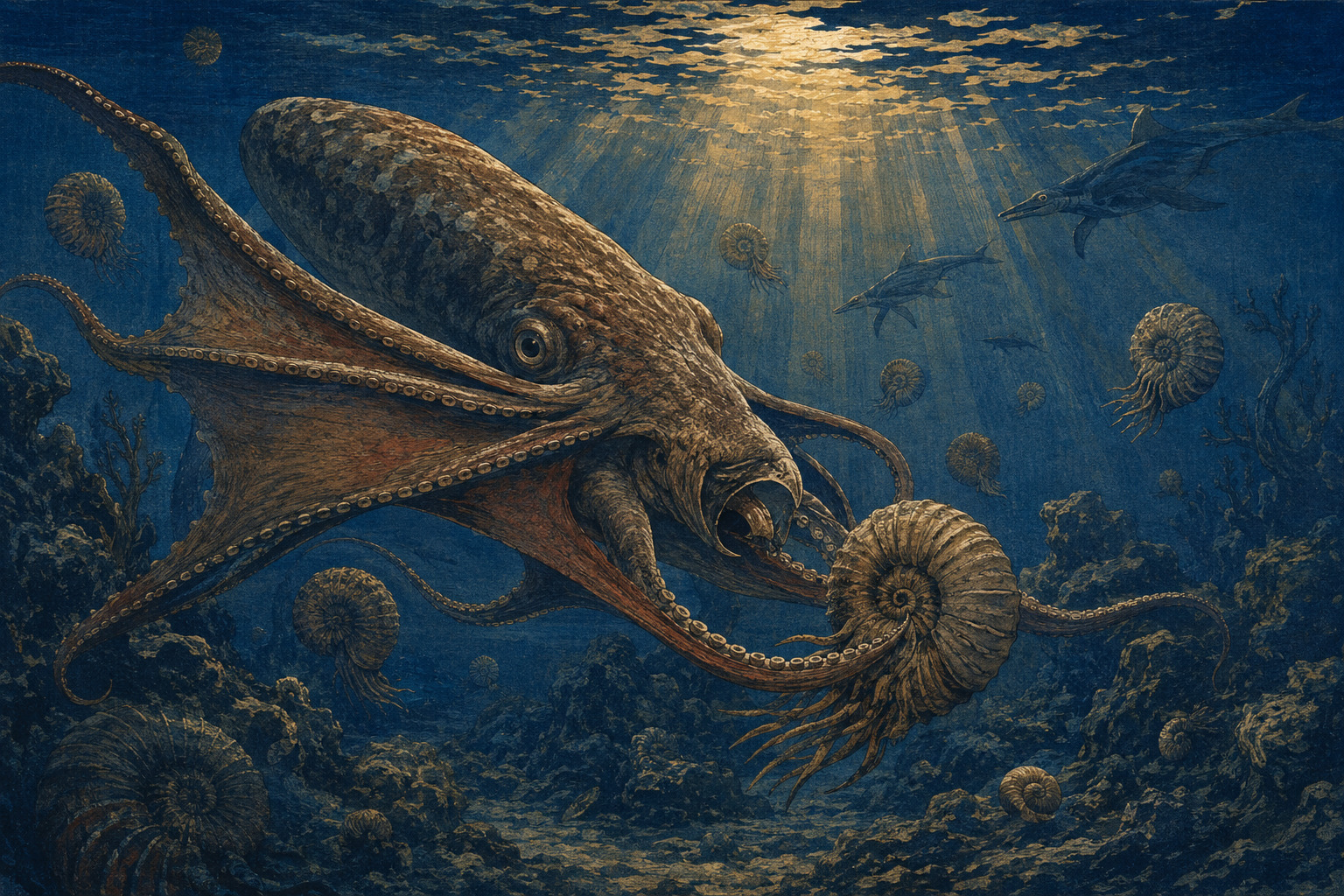
The monster that survived is a beak
A black, curved beak is all that remains of the animal at the centre of the year’s most theatrical fossil story. There is no outline of a 19-metre body, no fossil arm, sucker, eye, fin, stomach or brain. There are paired jaws—the hard, chitin-based cutting and crushing apparatus that sits where an octopus’s arms meet. In ordinary language, “beak” and “jaw” describe the same feeding structure from different angles; it is not bone and not a vertebrate jaw.
In Science on April 23, 2026, Shin Ikegami, Yasuhiro Iba and colleagues reported 12 newly detected jaws, including juveniles, and reanalysed 15 specimens described in earlier literature. The 27 fossils came from Late Cretaceous rocks in Hokkaido and Vancouver Island. Their shapes led the team to unite material previously divided among five named species into two species of Nanaimoteuthis, now interpreted as cirrate, or finned, octopuses.
The larger species is not an invented cryptid. Its jaw is real, three-dimensional and worn through use. Yet every step beyond that jaw has a confidence level. Classification compares anatomy. Length applies mathematical relationships from living animals. Diet reads damage. Behaviour interprets asymmetry. A responsible “real kraken” story begins with that ladder.
Two species, two phases of gigantism
The older and longer-ranging Nanaimoteuthis jeletzkyi occurs in rocks dated to about 100–72 million years ago. From jaw-to-body equations, the team estimated about 3–8 metres total length. The later N. haggarti appears by roughly 86 million years ago and persisted to about 72 million years ago; it produced the largest jaw and the headline range of about 7–19 metres.
Juvenile jaws gave the researchers more than static maximum sizes. Growth-related changes in dimensions and jaw pigmentation suggested that the later species grew more rapidly, pointing to evolutionary acceleration toward gigantism. That is a population-level reconstruction from a small fossil sample, not an annual growth diary for one animal, but it supplies a biological route from the older giant to the later supergiant.
| Species | Approximate record | Estimated total length | What is directly fossilised |
|---|---|---|---|
| N. jeletzkyi | 100–72 million years ago | About 3–8m | Mineralised jaws, including newly detected material |
| N. haggarti | About 86–72 million years ago | About 7–19m | Larger mineralised jaws with extensive wear |
These are total-length estimates, not mantle lengths or measured fossil spans. A long-armed octopus can have a very different mass from a squid of equal tip-to-tip length. No fossil mass was calculated with the certainty of a scale reading. “Largest-ever octopus” is a defensible shorthand for the estimate; “largest invertebrate ever proved” is stronger than the evidence warrants.
Why Hokkaido and Vancouver Island belong in one story
Modern maps place Japan and Canada on opposite sides of the Pacific. The fossils record parts of an ancient North Pacific realm. In Hokkaido, thick marine beds of the Yezo Group accumulated in a forearc basin near an active continental margin. Across the ocean, the Nanaimo Group preserved another Cretaceous marine succession on and around Vancouver Island. Ammonites and other fossils date the enclosing rock.
The jaws were sealed in calcareous concretions—hard nodules created as minerals cemented sediment around organic remains. Rapid local chemistry can protect an object from flattening and decay. The original beak was chitinous; earlier mineralogical work on these jaws found fluorapatite, interpreted as a diagenetic replacement or alteration of that original material. The fossils preserve architecture, not pristine Cretaceous chitin.
This matters because a normal octopus body is a preservation disaster. Muscles, skin and arms decay; the shell has been reduced or lost. Exceptional Lebanese limestones preserve ghostly Cretaceous octopuses with body outlines, but most deposits do not. The North Pacific concretions saved the small hard working part, while the rest of the “kraken” vanished.
Digital fossil mining destroys the rock—and saves the data
The new specimens were not simply spotted protruding from a cliff. The Hokkaido group’s “digital fossil-mining” turns a rock into an image volume. A destructive tomography system removes the specimen in closely spaced layers and photographs each newly exposed surface in colour. The sequence can be stacked into a three-dimensional dataset; the physical rock is consumed, but its interior is recorded digitally.
That distinction is important. This is not a non-destructive medical CT scan, and “AI found the fossil” does not mean a chatbot recognised an octopus. A zero-shot detection and visualisation pipeline searches vast image volumes for objects not represented in conventional training sets, separates their surfaces and makes minute wear visible. Human specialists still decide whether an object is biological, which anatomy it represents and where it belongs on the cephalopod tree.
The method had already transformed the same laboratory’s view of Cretaceous squid. A 2025 Science paper reported 263 tiny jaws representing 40 squid species, 39 described as new, where only one such fossil had been known from the target rocks. In January 2026, the AI-assisted system detected Uluciala rotundata in a South Dakota rock volume, interpreted as the oldest known sepioid. The giant octopus study is therefore the third chapter of a developing instrument, not a one-off image trick.
How a jaw becomes a 19-metre animal
Researchers measured corresponding dimensions in 12 living species of finned octopus, then modelled how jaw size scales with head and total body length. They inserted fossil measurements into those relationships. Different living species give different jaw-to-body proportions, so the answer is a range: roughly 6.6–18.6 metres for the largest N. haggarti, rounded in public communication to 7–19 metres.
This is standard comparative biology, but it is not a tape measure. It assumes that an extinct early cirrate fell within the proportional space sampled by living cirrates. If its arms were unusually short, the upper estimate would shrink; if unusually long, it might not. Large-octopus studies have also warned that beak allometry can be imprecise because proportions vary among species and individuals.
| Statement | Evidence level | Reason |
|---|---|---|
| Large Cretaceous octopuses lived in the North Pacific | Direct + comparative | Large, diagnostic fossil jaws from dated rocks |
| N. haggarti was 7–19m long | Modelled estimate | Allometry from 12 living cirrate species |
| It regularly processed hard prey | Strong functional inference | Repeated chips, scratches, cracks and adult wear |
| It ate ammonites and bony fish | Plausible, not identified | Suitable contemporaneous hard prey; no linked gut contents |
| It killed mosasaurs | Speculation | No bite-marked reptile, stomach content or encounter fossil |
| It possessed human-like handedness or high intelligence | Behavioural inference | Asymmetric wear may reflect lateralised use; no brain is preserved |
A jaw worked almost to destruction
Adult fossil jaws show large chips, scratches and fractures around the biting surfaces. In the most worn examples, accumulated loss approached one tenth of jaw length. Cracks radiating through loaded regions point to repeated high forces rather than a single accident after burial. Juvenile jaws are less damaged, making a life-history signal more plausible than random geological breakage.
The team interpreted the pattern as dynamic crushing of hard skeletons. Ammonites, other shelled molluscs, crustaceans and bony fish shared these seas and are reasonable candidates. Modern octopuses bite, pull, drill and dismember a wide menu. Size would have allowed Nanaimoteuthis to attack large animals, but capability is not a fossilised meal.
No gut content has been tied to either species, and no ammonite shell, fish bone or marine-reptile fossil has been identified with a diagnostic Nanaimoteuthis bite. Independent palaeontologists have therefore welcomed the wear evidence while cautioning that the menu remains unknown. The beaks prove work. They do not name what was between them.
Did an invertebrate sit at the top of the food web?
The paper’s larger evolutionary claim is that a giant invertebrate occupied a top-predator role during an era conventionally narrated through vertebrates. Sharks, bony fishes and marine reptiles had dominated large marine predator guilds for hundreds of millions of years. A seven-to-19-metre octopus able to crush hard structures would disrupt that simple picture.
“Apex predator,” however, can mean either an animal with no routine adult predator or the highest trophic consumer in a measured food web. Fossil jaws alone cannot quantify diet, population density or who ate whom. Large mosasaurs might have attacked these octopuses; marine reptiles with cephalopods in their stomachs are known, though not this genus. Conversely, a giant octopus could have preyed on fishes, smaller reptiles or carcasses. The encounters have not been preserved.
The secure conclusion is ecological parity: N. haggarti was large enough and mechanically equipped to enter the same upper predator conversation as marine vertebrates. Saying it “ruled” every Cretaceous sea goes farther. The evidence comes from the North Pacific, not a global census, and depth and hunting style remain uncertain.
Chipped on one side: a fossil trace of preference?
The left and right jaws did not wear equally. The authors interpreted this repeated asymmetry as lateralised behaviour: individuals may have presented or crushed prey preferentially from one side, a distant analogue of handedness. They further argued that individualised side use could indicate advanced behavioural control.
That is provocative, not absurd. Living octopuses coordinate eight semi-autonomous arms through a distributed nervous system, and experiments have found individual arm preferences or side biases in some tasks. Yet other work found arm selection strongly influenced by which eye saw the target and described it as opportunistic rather than a consistent left-right rule.
Asymmetric wear could encode repeated behaviour, anatomy, prey orientation, injury or an unrecognised mechanical bias. The fossil does not contain a brain and cannot be given a cognition test. “Possible lateralised use” is the observation’s careful form; “proof that a Cretaceous octopus was intelligent” is a press-release interpretation.
What did it look like?
Classification as Cirrata supplies the broadest silhouette. Living cirrates—the finned octopuses that include dumbo octopuses—carry paired fins on the mantle, webs between arms and rows of fleshy cirri alongside suckers. Most known living species inhabit deep water and are modest in size. The fossils imply that their early history included a dramatically different giant form.
But a beak cannot tell us skin colour, arm-web depth, fin outline, posture or exact arm proportions. Even habitat is not settled by a reconstruction: the rock’s depositional setting and the animal’s living range are related but not identical, because bodies and concretions can move before final burial. Every complete image—including this newspaper’s hero—is an evidence-informed work of art.
One biological idea does connect the jaws and body plan. Coleoid cephalopods reduced the heavy external shell of ancestral forms, gaining a flexible, manoeuvrable body, while retaining a strong central beak. The authors propose that powerful jaws plus loss of external armour also helped vertebrates and octopuses converge on large, mobile predatory lives. It is an attractive hypothesis; a pair of fossil species cannot establish it as a universal requirement.
Eighteen years of names, now rearranged
The 2026 result rewrites specimens that had been accumulating since the 2000s. In 2008, Kazushige Tanabe and colleagues described eight exceptionally preserved North Pacific lower jaws and erected Nanaimoteuthis jeletzkyi, then treated as a vampyromorph relative, alongside two cirrates placed in Paleocirroteuthis. Hokkaido material produced N. yokotai in 2010 and further large coleoid jaws in 2015; additional records followed in 2017 and 2023.
Jaw taxonomy is difficult because detached upper and lower pieces may not be found together, growth changes shape, and unrelated cephalopods can converge on similar cutting tools. The 2026 study had more specimens, juveniles, full three-dimensional surfaces and an expanded comparison. It synonymised Paleocirroteuthis with Nanaimoteuthis, placed several named forms into N. jeletzkyi or N. haggarti, and left incomplete material that could not be securely compared at a broader identification.
| Year | Milestone | Why it matters now |
|---|---|---|
| 2008 | Eight Hokkaido and Vancouver Island lower jaws described | Established the three-dimensional North Pacific beak record |
| 2010 | A large Turonian Hokkaido jaw named N. yokotai | Extended the Japanese record and size evidence |
| 2015–23 | More large Hokkaido coleoid jaws documented | Built the comparative collection later revised |
| 2025 | Digital fossil mining reveals 263 squid jaws | Shows how much cephalopod history remained hidden in rock |
| Jan. 2026 | Zero-shot AI pipeline detects an early sepioid | Demonstrates automated object discovery in huge image volumes |
| Apr. 2026 | 27 jaws revised into two giant finned-octopus species | Combines taxonomy, allometry, growth and wear |
The “oldest octopus” changed two weeks earlier
Octopus history is unusually vulnerable to one spectacular specimen because soft bodies so rarely fossilise. In 2000, a small animal from Illinois’s roughly 307-million-year-old Mazon Creek deposit was named Pohlsepia mazonensis and widely repeated as the oldest octopus. On April 8, 2026—only about two weeks before the giant-octopus paper—a synchrotron study mapped a radula with a nautiloid pattern. It reclassified the specimen as Paleocadmus pohli, a decayed nautiloid, not an octopus.
The correction removed a famous Palaeozoic anchor and made mid-to-late Mesozoic origins for crown octopuses more consistent with the unambiguous fossil record. Exceptional Lebanese fossils around 95 million years old preserve eight-armed forms such as Keuppia and Styletoctopus, including reduced internal shell structures. Nanaimoteuthis adds early finned octopuses and pushes that cirrate record several million years older, according to the 2026 analysis.
A different Carboniferous fossil, Syllipsimopodi bideni, was described in 2022 as a ten-armed early vampyropod—part of the broader lineage containing octopuses and vampire squid, not a modern octopus. Its identity remains disputed: a 2023 critique argued that it may be a previously known stem coleoid, and the original authors defended the distinction. The tree’s deep root is still an active argument, not a straight procession of “oldest octopuses.”
A Cretaceous ocean crowded with giants
Nanaimoteuthis lived alongside ammonites, sharks, teleost fishes, plesiosaurs and, later in its range, mosasaurs. The later Cretaceous produced very large representatives in several lineages. Some ammonites reached around two metres across; marine reptiles exceeded ten metres; other soft-bodied coleoids may have approached giant-squid dimensions.
Comparisons make headlines but can mislead. The giant squid’s often-cited maximum of roughly 12–13 metres includes two exceptionally long feeding tentacles; an octopus has eight arms and no such pair. A 17- or 18-metre mosasaur carried a skeleton and a different body density. Length alone is not mass, fighting ability, speed or trophic rank.
The better comparison is evolutionary. Several unrelated hunters found ways to combine sensory systems, rapid movement and forceful mouths in the same productive seas. Nanaimoteuthis shows that the radiation did not reserve the upper size classes for vertebrates. It does not tell us which giant would win an imaginary fight.
From hafgufa to the scientific giant squid
The word “kraken” belongs to human cultural history, not Cretaceous taxonomy. Medieval Norse literature described immense sea beings such as the hafgufa; early modern maps and natural histories filled northern waters with island-like monsters. Erik Pontoppidan’s 1752 Natural History of Norway made the kraken famous as an animal so vast that sailors could mistake its back for land. Pierre Denys de Montfort’s 1802 engravings fixed the many-armed ship attacker in European visual culture.
Reports of enormous stranded or captured squid gradually moved part of the monster into zoology. Japetus Steenstrup established Architeuthis dux, the giant squid, in 1857 from physical remains including beaks. The first photographs of a living giant squid in its natural habitat came in 2004, after centuries of stories and carcasses; modern records put the largest reliably measured animals at about 13 metres.
Giant squid encounters may have helped sustain kraken traditions, but folklore rarely has one origin. Whales, floating reefs, unusual waves, decomposing carcasses and narrative invention all accumulated. Nanaimoteuthis vanished from the present fossil record at least 72 million years before anyone sailed the Norwegian Sea. No human memory connects it to the legend.
What the study changes—and what it leaves open
The paper changes three broad pictures. Early finned octopuses were not necessarily small adjuncts to vertebrate ecosystems. Cretaceous North Pacific coleoids were more diverse and ecologically important than their sparse traditional record suggests. And a working surface, digitally recovered from rock, can preserve a history of feeding after the soft body has disappeared.
It leaves equally important questions. Are the allometric equations reliable outside the living sample? Did the animal cruise in open water, hunt near the bottom or use both? What prey produced each class of wear? Did asymmetry reflect preference, anatomy or injury? How common were the giants, and why do they disappear after about 72 million years? Were they truly at the apex, or enormous members of a food web that also consumed them?
Answers could come from more concretions, upper and lower jaws found together, preserved gut contents, distinctive bite marks, chemical signals, finer growth series and biomechanical testing. Publishing three-dimensional models and analysis code will let other teams challenge measurements without possessing the original rock. Digital fossils do not remove interpretation; they make interpretation auditable.
The real animal is stranger than the monster
A mythical kraken arrives complete: enormous, intentional and hungry for ships. A fossil animal arrives in fragments. Its body length is an interval. Its meals are scratches. Its possible preference for one side is a difference in wear. Its identity changes as collections and methods improve. That incompleteness can seem less satisfying, but it is what makes the finding scientific.
The 2026 team has made a strong case that giant finned octopuses occupied the Late Cretaceous North Pacific and that the larger species repeatedly subjected its beak to punishing loads. Even the conservative end of the size estimate overturns the image of early octopuses as minor, soft-bodied prey. The upper end evokes a monster because it tests the scale we thought the lineage could reach.
So the “real kraken” is neither a hoax nor the creature in the illustration. It is 27 jaws, two revised species and a set of testable calculations. It ruled no shipwreck legend. It earned something harder: a place among the great predators of ancient seas, with the limits of that place still visible in the evidence.
Primary sources and further reading
- Ikegami et al., “Earliest octopuses were giant top predators in Cretaceous oceans,” Science 392:406–410 (April 23, 2026): central paper on classification, size, growth, wear and lateralisation.
- Hokkaido University, “Earliest octopuses were giant top predators in Cretaceous oceans”: author list, abstract and paper information.
- Niigata University Brain Research Institute, joint research release: 27-jaw sample, living-species comparison, age ranges, wear, AI method and funding.
- Natural History Museum, “Largest ever octopus was top predator in dinosaur-era oceans”: independent curatorial context and qualified discussion of size and diet.
- Tanabe et al., “Late Cretaceous octobrachiate coleoid lower jaws from the North Pacific regions” (2008): eight three-dimensional jaws from Hokkaido and Vancouver Island and their mineralisation.
- Tanabe & Hikida, “Jaws of a New Species of Nanaimoteuthis from the Turonian of Hokkaido” (2010): early Japanese taxonomic record.
- Tanabe et al., Late Cretaceous large soft-bodied coleoids from Hokkaido (2015): further jaw-based evidence and named forms later reconsidered.
- Tanabe et al., additional Late Cretaceous octobrachian jaws from Hokkaido (2017): expansion of the collection.
- Tanabe & Misaki, Upper Cretaceous non-belemnitid coleoid jaws from Hokkaido (2023): most recent pre-revision regional synthesis.
- Hokkaido University, “Origin and radiation of squids revealed by digital fossil-mining” (2025): method background and the recovery of 263 squid jaws.
- Ikegami et al., “Origin and radiation of squids revealed by digital fossil-mining,” Science (2025): peer-reviewed method application.
- Hokkaido University, zero-shot AI discovery of Uluciala rotundata (2026): institutional explanation of automated digital fossil detection.
- Sugiura et al., “The oldest sepioid cephalopod from the Cretaceous discovered by Digital fossil-mining with zero-shot learning AI” (2026): peer-reviewed AI pipeline application.
- Fuchs et al., “New octopods from the Late Cretaceous of Hâkel and Hâdjoula, Lebanon” (2009): exceptionally preserved early octopods and reduced shell structures.
- Clements et al., “Synchrotron data reveal nautiloid characters in Pohlsepia mazonensis” (2026): reclassification of the supposed Carboniferous octopus.
- Whalen & Landman, Syllipsimopodi bideni from the Bear Gulch Lagerstätte (2022): proposed Carboniferous vampyropod.
- Klug et al., “Revisiting the identification of Syllipsimopodi bideni” (2023), and the authors’ reply: the continuing debate over deep coleoid history.
- Lalas, allometric equations for body-size estimates from large octopus beaks (2009): utility and variability of beak-based reconstruction.
- Roscian et al., three-dimensional beak shape and ecology in modern cephalopods (2022): functional-comparative background.
- Byrne et al., “Does Octopus vulgaris have preferred arms?” (2006), and “Octopus arm choice is strongly influenced by eye use”: mixed modern evidence relevant to lateralisation.
- Smithsonian National Museum of Natural History, Giant Squid: specimen-based history and maximum recorded size.
- Natural History Museum, sea monsters and the kraken: cultural history and the scientific giant squid.
Editorial note: The peer-reviewed paper was published April 23, 2026 (April 24 in Japan); this feature is dated for the July 19 Marine Special. The fossils are mineralised jaws, not complete bodies. Total length is an allometric interval based on 12 living finned-octopus species. Hard-prey feeding is inferred from wear; individual prey, attacks on marine reptiles and exact food-web rank are not directly preserved. Asymmetric wear supports possible lateralised use, not a fossil measurement of intelligence. “Kraken” is a cultural metaphor with no historical link to animals that disappear from the known record at least 72 million years before humans. The hero image is an editorial illustration, not a scientific reconstruction.