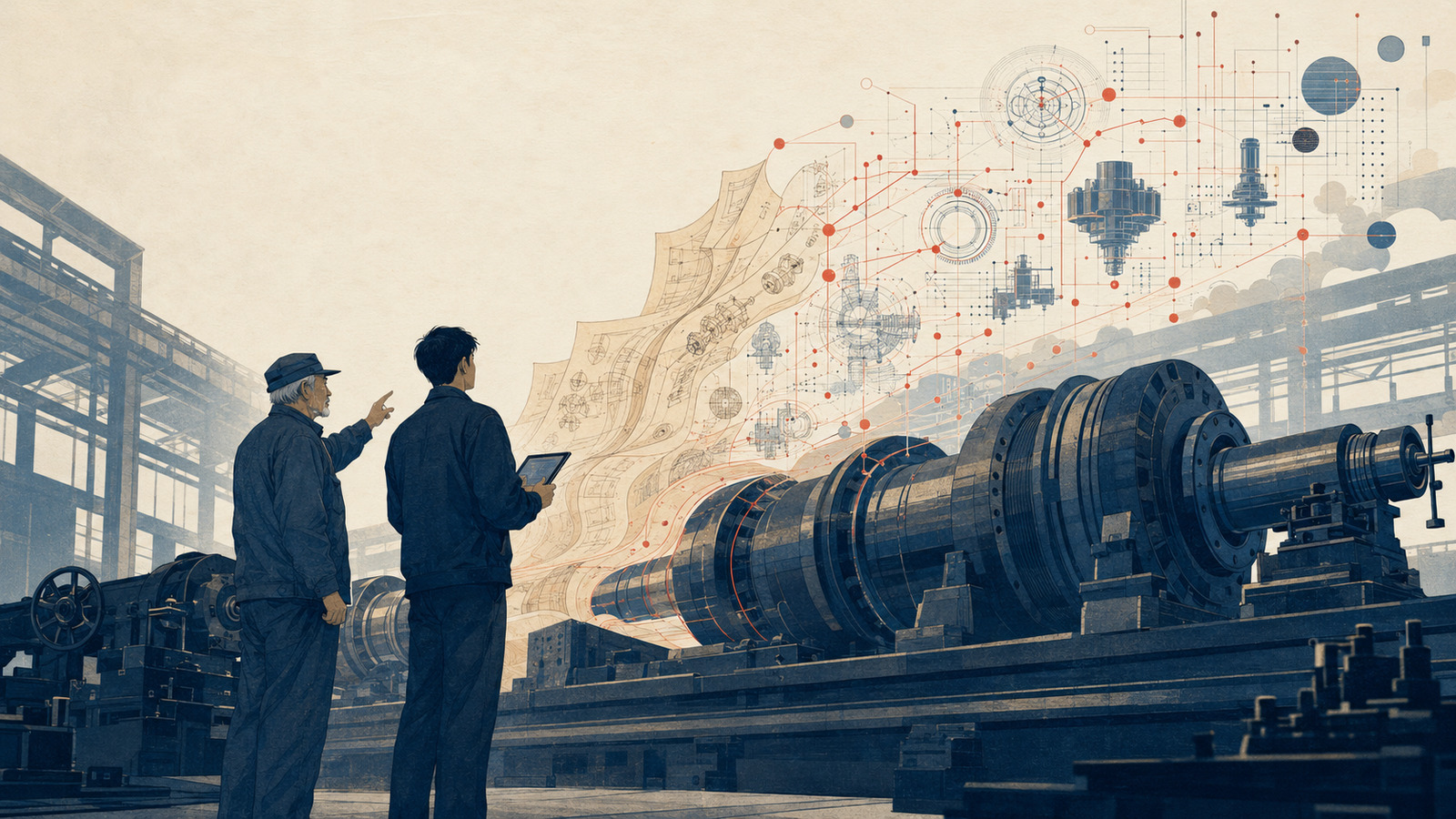
Somewhere in a Japanese engineering office, a veteran remembers six or seven digits. The number is not a password. It is the part code that opens a path through decades of custom machinery: the drawing, the supplier, the old quotation, the failed component, the revision that finally worked. A younger colleague knows what the part does but not the number. Without the veteran, the archive can become practically invisible.
That small scene explains the large promise in a July 23 announcement from CADDi. Furukawa Industrial Machinery Systems, the 440-person maker of pumps, crushers, conveyors, bridges and industrial plants, is using the company’s manufacturing AI data platform to connect drawings with procurement, cost, nonconformance and design-change information. The intention is to make accumulated knowledge searchable by names and dimensions instead of requiring perfect recall of a part code.
“Moving institutional memory into AI” is a compelling description. It is also easy to misunderstand. Furukawa is not uploading a human mind, and CADDi has not announced autonomous control of pumps or crushers. The work described is more foundational: unifying fragmented records, extracting structure from engineering drawings, creating new routes to retrieve them and changing quotation workflow. AI becomes an access layer over evidence produced by people and machines.
That distinction matters. If a company confuses generated answers with authoritative engineering records, it can make knowledge faster and less reliable at the same time. If it preserves provenance, revisions and human responsibility, it can turn the archive from a burial ground into working infrastructure.
What Was Announced—and What Was Not
CADDi says Furukawa Industrial Machinery Systems has deployed its platform across information used by design, procurement and production management. Drawings can be found by words such as a component name or dimension. Related nonconformance reports, cost data and past design changes can be connected through the part record. CADDi Quote is being used to replace a process in which requests for quotation were sent separately by email to each supplier.
The vendor reports that access to certain drawing information, previously taking as long as half a day, has fallen to two hours or less. The company’s own team has set a goal of cutting quotation lead time by 50%. The grammar is important: one is presented as an early result; the other is a target around which work has begun. No independently audited savings, error-rate results, payback period or enterprise-wide adoption rate were published.
The project grew beyond a search-tool purchase after a workshop brought together about 25 key people and next-generation leaders from multiple departments. According to CADDi, they mapped a larger opportunity: connect not only drawings but histories of design changes, quality failures and cost decisions. A skeptical procurement leader came to view the platform as an organizational data layer rather than another document viewer.
The Company Is 22 Years Old—and 151 Years Old
The headline needs a corporate-history footnote. Furukawa Industrial Machinery Systems Co., Ltd. was legally established on May 19, 2004. It is a wholly owned operating company of Furukawa Co., formerly Furukawa Mining. The 150-year description refers to the industrial lineage: founder Ichibei Furukawa began managing the Kusakura Copper Mine in Niigata in 1875 and took over the Ashio Copper Mine in 1877.
The machinery line took a more specific shape in 1900, when a machine shop was created at Ashio to make and maintain pumps and mining equipment. Crushers went on sale in 1907. Pump sales extended beyond the mine during the 1920s and into the general market in 1954. An Ashio machinery operation was separated from the mine in 1942; the Oyama plant opened in 1944. Belt-conveyor sales began in 1958, bridge work in 1968, and the current industrial-machinery company inherited the business in 2005 before merging Furukawa Otsuka Iron Works in 2008.
So the company is not a 151-year-old legal shell. It is a young corporate entity carrying an old technical inheritance. That is exactly why institutional memory is a more useful concept than corporate age. Knowledge survives reorganizations only when records, practices, people and responsibility remain connected.
The Ashio Inheritance Includes a Warning
Furukawa’s mining origin cannot be told only as a triumph of modernization. Ashio became one of Japan’s defining pollution disasters. Mine wastewater and ore residues damaged the Watarase River, fisheries, health and downstream rice fields from the late nineteenth century. The Ministry of the Environment treats it as a foundational episode in Japan’s pollution history. Furukawa’s own official history acknowledges that development was prioritized and that serious harm emerged in the river basin.
This history belongs in an article about memory because organizations tend to digitize what they already value. Drawings, quotations and successful designs are obvious assets. Complaints, near misses, environmental damage, rejected alternatives and the assumptions behind a bad decision can be harder to preserve. Yet they may be the most valuable records of all.
An AI system trained only on “what shipped” may reproduce yesterday’s blind spots more efficiently. A mature industrial memory must also retain why a design was changed, what failed in service, which environmental limit tightened and who bore the cost of an earlier method. The point is not to assign a nineteenth-century event to a 2004 company. It is to recognize that a 150-year lineage contains liabilities and learning as well as inventions.
What This Manufacturer Actually Builds
Today’s company is far from a nostalgic workshop. Its official profile lists pumps, steel structures and bridges, crushers, mills, pelletizers, classifiers, belt conveyors, environmental equipment, recycling plants, service and construction. Its pumps move abrasive slurry from shield-tunneling faces and sludge through wastewater facilities. Its material machinery crushes rock, ore and industrial feedstocks. Its conveying systems move excavated earth through constrained routes.
The firm’s product guide lists equipment used for the Tokyo Bay Aqua-Line, the Tsukuba Express, Tokyo’s Central Circular Shinjuku Route and the Bosporus crossing in Turkey. It says more than 12,000 of its sludge pumps operate at roughly 2,200 wastewater-treatment sites. The guide also describes SICON, an enclosed hanging belt conveyor designed to limit spillage, dust and noise while following curved routes.
This is custom, long-lived capital equipment. A quotation may depend on geometry, material, load, site conditions, supplier capability and lessons from a machine built years earlier. The drawing is not merely an image. It is a junction where design intent, purchasing history, manufacturing method, quality evidence and field experience meet. Losing the path to it is more than an administrative inconvenience.
Institutional Memory Is Not One Database
People often speak of “the company’s knowledge” as if it were a file collection. In practice, industrial memory has several forms, and AI reaches each one differently.
| Layer of memory | Examples in industrial machinery | What a data platform can do | What still requires people |
|---|---|---|---|
| Explicit records | Drawings, specifications, quotations, orders, inspection reports, revisions | Extract fields, index content, link records, search by text or geometry | Approve authoritative versions and interpret contractual meaning |
| Exception memory | Nonconformances, rework, supplier failure, field complaints, abandoned designs | Connect a problem to the part, supplier, cost and corrective action | Judge causation, severity and whether the lesson transfers |
| Tacit skill | How a veteran hears cavitation, reads wear, negotiates a tolerance or chooses a supplier | Help structure interviews, retrieve analogous cases and expose patterns | Demonstrate, practice, challenge and validate under real conditions |
| Relational knowledge | Who can machine an unusual alloy, which customer accepts a redesign, who must be consulted | Reveal transaction histories and collaboration networks | Maintain trust, consent, context and fair judgment |
| Organizational routine | How design, procurement, production and service resolve an urgent change | Standardize handoffs, permissions and alerts | Own the decision and adapt when the routine does not fit |
The platform announced by CADDi is strongest in the first two rows and can support the others. Calling all five “data” too quickly risks erasing the difference. A drawing can be scanned. A judgment has to be elicited, tested and taught.
The Tyranny of the Part Code
A six- or seven-digit part code is a compact key. In a stable system it is wonderfully precise. But a key is useful only when people know which lock it opens. CADDi’s account says some workers effectively had to remember the code before they could reach the drawing; paper records and order information were difficult to connect; quality and cost data sat elsewhere.
This is a familiar legacy-system problem. A database can be digital and still depend on oral tradition. The interface tells a new employee, “enter part number,” while the organization’s real instruction is, “ask Tanaka-san which part number.” Search is therefore not a cosmetic feature. It changes who is allowed to begin a question.
CADDi Drawer says it combines keyword retrieval with analysis of two-dimensional drawings and similarity search. In principle, a user can begin with a name, dimension or related shape, find candidate drawings, then follow links to order and quality evidence. That replaces a brittle single key with multiple routes into the archive.
Multiple routes also create a new responsibility. Similar does not mean interchangeable. Two parts may look alike while differing in heat treatment, tolerance, customer approval or revision status. A useful system must show why a result appeared and display the controlled source—not merely return a plausible answer.
From Search to a Manufacturing Knowledge Graph
The deeper idea is connection. A drawing alone says what engineers intended at one revision. A purchase order says where and at what price a part was sourced. A nonconformance says what did not meet requirement. A corrective action says what changed. A service report says what happened after delivery. When those records share reliable identifiers, a question can move across the life of a component.
Consider a designer asked to modify a slurry pump for a more abrasive environment. Search might identify geometrically similar impellers, the alloys previously quoted, suppliers with relevant work, inspection failures and field modifications. AI can rank cases and summarize evidence. The engineer can then spend less time reconstructing the archive and more time deciding whether the precedent applies.
That is closer to a manufacturing knowledge graph than a chatbot. The value comes from relationships among controlled records. Language models may provide a conversational door, and computer vision may read drawings, but the underlying strength is data engineering: identity resolution, metadata, revision control, permissions and links.
CADDi itself changed strategy in 2024, folding its parts-procurement business into a manufacturing AI data-platform vision and ending the former model of supplying parts and assemblies. Its current products emphasize Drawer for engineering and supply-chain data and Quote for standardized procurement workflow. Furukawa’s deployment is therefore both a customer project and a test of CADDi’s own corporate reinvention.
Two Hours Is Progress; Fifty Percent Is a Hypothesis
The early metrics are practical. If drawing retrieval that could consume half a day now takes no more than two hours, an engineer or buyer recovers time in the same week. If individual supplier emails are removed from quotation workflow, the organization also gains a common record of who received what and when.
But productivity should not be counted only as minutes saved. Search quality matters. Does the system retrieve the current drawing? Does it miss a relevant nonconformance? Does a user understand why a result is ranked highly? How often is a suggested similar part rejected by an expert? Faster retrieval of the wrong revision is negative productivity.
The 50% quotation target should therefore be paired with measures of bid coverage, supplier response, purchase-price variance, engineering rework and quality outcomes. A shorter cycle is valuable only if it preserves—or improves—the quality of the decision. Publishing baselines and definitions would make the case much more useful to the wider manufacturing sector.
A Fourth-Year Employee Can Ask a Better Question
One of the most revealing details in CADDi’s announcement is not technical. A fourth-year employee used CADDi Quote to request prices from multiple suppliers and began learning their specialties. Work that had been routed through experienced intermediaries became a way for a younger person to build judgment.
This is the hopeful version of AI-assisted knowledge transfer. The system does not give the employee instant expertise. It lowers the cost of exploring evidence and creates more occasions to compare outcomes. The worker can see that one supplier excels at a material, another at a process, and a third at an urgent lead time. Experience still accumulates, but the first steps are no longer blocked by invisible keys.
There is a less hopeful version. If management treats the system as permission to remove mentors, younger workers may learn to accept rankings without understanding machining, failure or supplier economics. Search can become a substitute for apprenticeship rather than an amplifier of it. The design of work—not the model alone—decides between those futures.
Why Tacit Knowledge Resists Uploading
Japanese organizational theorist Ikujiro Nonaka described knowledge creation as a continuing movement between tacit and explicit knowledge: people share experience, articulate parts of it, combine it with existing records and internalize the result through action. The theory is useful here because it rejects a one-way archive. Knowledge is not preserved merely by writing it down; it is recreated through use.
A veteran’s phrase—“this casting sounds wrong”—may bundle vibration, frequency, load, temperature, memory of past failures and attention to a condition the speaker cannot yet name. A transcript preserves the sentence, not the skill. To make it useful, a team may need audio or sensor data, photographs, labeled examples, counterexamples, inspection results and repeated practice with the veteran present.
AI can help elicit and organize such evidence. It can ask follow-up questions, cluster similar failures and retrieve cases during training. It cannot guarantee that the hidden cause has been captured. The safest claim is not “tacit knowledge has become data.” It is “the organization has created a better experiment for making part of that knowledge explicit.”
Japan’s 2026 Manufacturing Problem
The timing is national. Japan’s 2026 White Paper on Manufacturing Industries treats recruitment, retention and skills transfer as linked problems in a shrinking labor force. It reports that companies use a mixture of extended employment, manuals, mentoring, video and digital tools; use of AI for skills transfer is more common among larger manufacturers. A separate section presents data platforms as a way to turn scattered factory information into value.
The pressure is not only retirement. Modern factories often contain layers of systems installed at different times: paper drawings, local file servers, custom databases, ERP, production software and supplier email. METI’s 2025 legacy-systems report argues that digital transformation is constrained when old systems are difficult to understand, expensive to change and tied to disappearing expertise.
Furukawa’s case sits at the intersection. It is small enough—440 people—that the loss of a few specialists can matter greatly, but its products carry more than a century of accumulated variation. It cannot solve the problem by asking every veteran to write a perfect manual before retirement. It needs to make existing evidence easier to traverse while deliberately creating new evidence around exceptions and judgment.
The Safety Boundary Around Industrial AI
Drawings, supplier prices, quality failures and customer configurations are among a manufacturer’s most sensitive assets. Centralizing them increases usefulness and the consequences of unauthorized access. Permissions must follow roles and projects; exports and downloads should be logged; supplier and customer restrictions must survive ingestion; retention and deletion rules must be enforceable.
Factory security adds a second boundary. METI’s cyber/physical guidance emphasizes that connected factory systems must be designed around business and operational risk. A searchable engineering archive should not quietly become an uncontrolled path into operational technology. Network segmentation, change control, vendor access and incident response belong in the productivity case.
AI governance adds a third. Japan’s AI Guidelines for Business and NIST’s risk framework stress lifecycle governance, measurement, documentation and human oversight. In this setting, every answer should preserve source links and revision dates. High-consequence recommendations—materials, tolerances, safety factors, approved suppliers, corrective actions—should require accountable human approval.
- AI may retrieve, compare, classify and draft.
- The controlled drawing, specification and quality record remain the source of truth.
- Engineers and authorized managers approve design, supplier and safety decisions.
- Every material answer should expose provenance, revision, permissions and uncertainty.
- Errors and rejected suggestions should be captured as training and governance data.
Protecting the Custom Promise
Furukawa describes one-off custom engineering as a promise to customers—something that must not be changed. Standardization can sound hostile to that identity. If every project is unique, why make historical work easier to reuse?
Because custom does not mean amnesiac. An engineer should not redraw a solved interface, repeat a failed tolerance or solicit a supplier that cannot perform the process simply to prove that a project is bespoke. Reuse at the evidence level can create more room for invention at the customer-problem level.
The project’s economic logic is therefore not to turn Furukawa into a catalog manufacturer. It is to shorten the uncreative portions of customization: finding precedent, reconstructing supplier history, checking known failures and preparing quotations. The time released can be used for alternative suppliers, proposal engineering, field reliability and the hard part of custom design.
What Success Should Look Like
A durable scorecard needs more than logins and search counts. The company should be able to show that knowledge is easier to reach, decisions are better, younger workers grow and the archive remains governed.
| Outcome | Evidence worth measuring | Failure signal |
|---|---|---|
| Findability | Median and worst-case retrieval time; successful searches without a part code; recall of relevant controlled drawings | Fast answers that omit the current revision or a critical quality record |
| Quotation | Lead time, supplier response, bid coverage, purchase-price variance and workload by step | A 50% faster process with fewer credible bids or more downstream changes |
| Quality | Repeat nonconformances, rework, field failures and use of prior corrective actions | The same failure recurs despite being “in the system” |
| Skills transfer | Time for new employees to perform defined tasks, mentor review and ability to explain a recommendation | High tool use with weak engineering understanding or automation bias |
| Resilience | Supplier alternatives identified, continuity when specialists retire and recovery from system outage | A new dependence on one platform, one data steward or one model |
| Governance | Provenance coverage, permission tests, incident rate, correction time and audit trails | Untraceable summaries, leaked drawings or obsolete records presented as current |
These measures would also clarify return on investment. Time saved is real, but the largest value may come from an avoided repeat failure, a faster redesign, a preserved supplier option or the ability of a new employee to make a sound decision years earlier than before.
Memory That Can Answer Back
The oldest image in this story is a mine machine shop founded to keep equipment working at Ashio. Its institutional memory lived in the hands of fitters, on drawings, in repairs and in the sound of a pump under load. The newest image is a younger specialist asking a platform to surface related drawings, costs and failures.
The distance between those scenes is not a straight march from craft to automation. It is a change in how evidence travels. Paper became files; files became databases; databases became connected records; AI now offers new ways to search and interpret them. At every stage, some knowledge becomes more visible and some context risks being lost.
Furukawa Industrial Machinery Systems has made an important start because it is attacking the hidden prerequisite of industrial AI: before an agent can advise, the organization must know which records belong together, which version is authoritative and who can judge the answer. The vendor-reported early results are promising but incomplete. The 50% quotation goal remains to be proved; the quality and governance results remain to be published.
If the project succeeds, the victory will not be that a 150-year-old manufacturer has frozen its past inside a model. It will be that the past has become easier to question, harder to lose and safer for the next generation to challenge. Institutional memory will not have become artificial. It will have become available.
Sources, method and disclosure
The July 23 deployment details and performance claims come principally from CADDi, the technology vendor, including a customer comment supplied in CADDi’s release. They are not an independently audited case study. Japan.co.jp checked the company’s identity, legal age, products and industrial history against Furukawa Industrial Machinery Systems and its parent, and placed the project in the context of government, academic and technical guidance. The reported reduction in drawing-access time is an early operational result; the 50% reduction in quotation lead time is a target, not a completed result.
- CADDi: July 23, 2026 announcement of the Furukawa Industrial Machinery Systems deployment
- CADDi: detailed customer case on design and procurement-data access
- Furukawa Industrial Machinery Systems: official company profile
- Furukawa Industrial Machinery Systems: official corporate history
- Furukawa Industrial Machinery Systems: product and project guide
- Furukawa Co.: official history from the 1875 copper-mining origin
- Furukawa Co.: 2025 introduction to the industrial-machinery subsidiary and its operations
- Furukawa Co.: Integrated Report 2025
- Ministry of the Environment: Japan’s experience with pollution, including Ashio
- Ministry of the Environment: history of water pollution in Japan
- METI: 2026 White Paper on Manufacturing Industries
- METI: 2026 white-paper section on recruitment, retention and skills transfer
- METI: 2026 white-paper section on AI and digital diversification in manufacturing
- METI: 2025 report on legacy systems and digital transformation
- METI and MIC: AI Guidelines for Business, 2026 appendix
- METI: Cyber/Physical Security Guidelines for Factory Systems, version 1.1
- NIST: Artificial Intelligence Risk Management Framework
- Ikujiro Nonaka, “A Dynamic Theory of Organizational Knowledge Creation,” 1994
- CADDi: platform description, CADDi Drawer and CADDi Quote
- CADDi: 2024 transition to an AI data-platform strategy