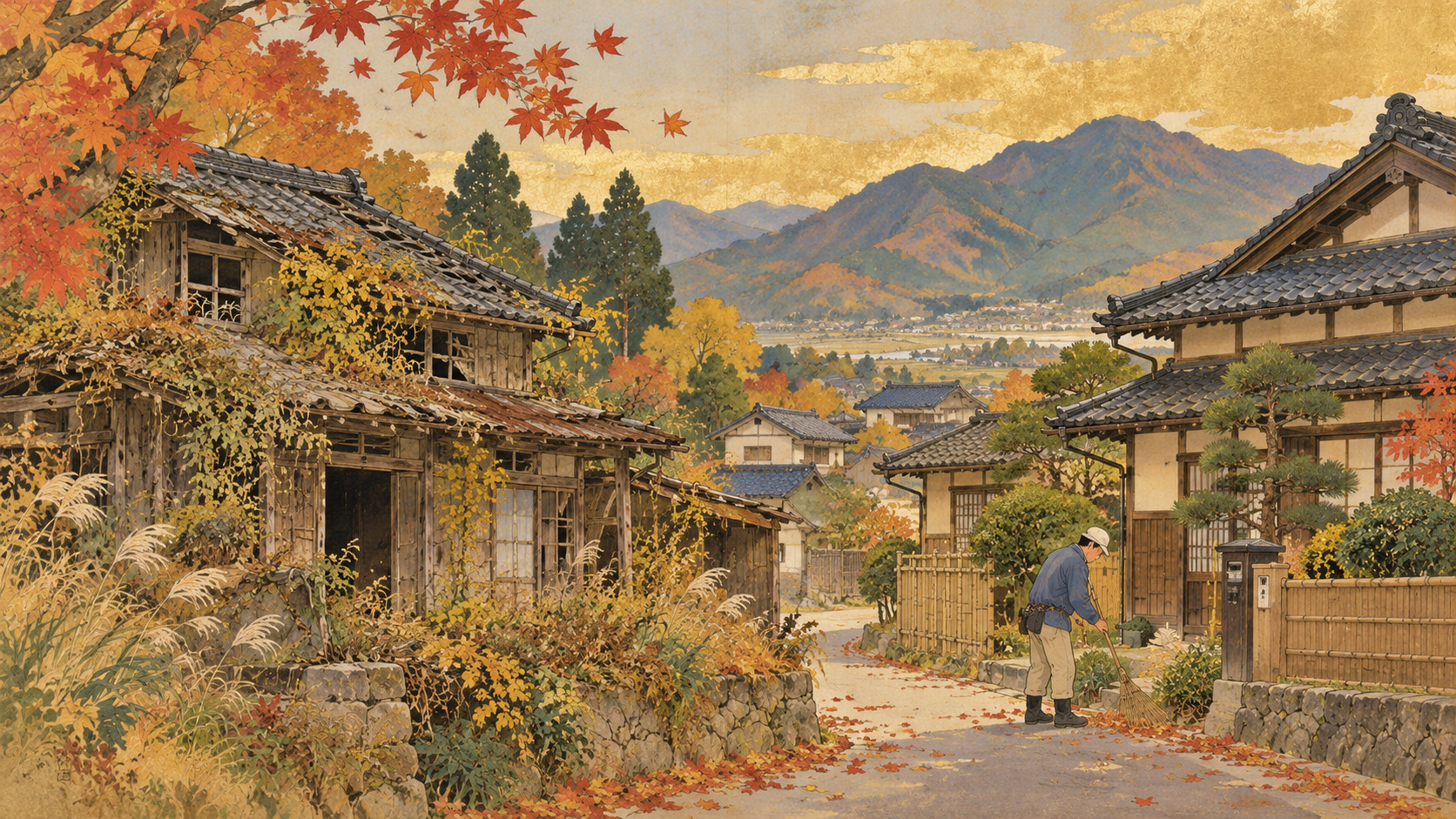
The business of caring for a house nobody lives in
In Koriyama, a real estate company has begun offering an unusual kind of property service: visiting a house whose owner lives elsewhere, checking for deterioration and sending a report. FG Network’s recently introduced monthly inspection service was featured by Fukushima TV on October 24, 2026. The company checks such problems as leaks, floor damage, signs of theft and wildlife intrusion.
It is a modest service with a much bigger implication. An empty property may remain in limbo for years before a family decides to sell, rent, renovate or demolish it. Keeping that property from deteriorating could become an increasingly important form of local work.
The 131,000 figure needs explaining
The official figure comes from Japan’s 2023 Housing and Land Survey, not a door-to-door census carried out in 2026. Fukushima Prefecture reported 131,000 vacant housing units out of 862,900, a vacancy rate of 15.2%. That was 7,500 more vacant units than the 2018 survey recorded.
Crucially, vacancy does not mean dereliction. Of the 131,000, approximately 60,800 were vacant rental units, 3,900 were offered for sale, 3,700 were second homes and 62,600 fell into the category excluding rentals, sale listings and second homes. The latter group can include inherited family homes, but it should not be equated automatically with abandoned buildings.
The difference between an apartment and an inherited farmhouse
Housing type changes the problem. Fukushima’s official breakdown identifies 62,600 vacant detached houses; about 52,900 were outside the rental, sale and second-home categories. By contrast, most vacant apartment units were listed as rentals. A landlord seeking tenants is solving a different problem from siblings who inherit a farmhouse several hours from where they live.
These categories also explain why the province-wide vacancy count cannot be treated as an inventory of properties available to bargain hunters. Ownership, physical condition, listings, accessibility and inheritance arrangements all matter.
Why monthly visits have value
An unoccupied building continues to age. A slipped roof tile can create a leak; a small plumbing defect can become major damage; weeds can encroach on a neighbor’s property. Checking a house periodically cannot guarantee that repair costs will fall, but it can identify problems before they become harder to address.
Fukushima TV described FG Network accepting instructions from owners who have not decided what to do with their properties. The service buys time for decision-making, rather than promising that every property can be profitably sold.
Winter is not the same across Fukushima
Fukushima encompasses coastal Hamadori, the central Nakadori corridor and the snowier Aizu region. A management plan that works in one location may be inadequate in another. Frozen pipes and heavy snow create risks different from coastal wind, dampness and storm damage.
FG Network told local television it was considering winter services including draining water pipes and snow removal in areas with heavy snowfall. Those were prospective additions, not proof that every such service was already available. Roof work, especially in winter, also involves substantial worker safety risks.
A housing surplus born from changing households
Japan’s postwar expansion created vast stocks of owner-occupied housing and suburban homes. Later demographic changes left more houses without successors: adult children moved for employment, households grew smaller and owners died or moved into care. The vacant-home problem is therefore about generations and the geography of opportunity, not simply real estate prices.
In Fukushima, total housing stock increased by only 1,600 units between 2018 and 2023, while vacant units increased by 7,500. It is a reminder that keeping the number of homes stable does not mean keeping them occupied.
The disaster is part of the story, but not the whole explanation
The 2011 earthquake, tsunami and Fukushima Daiichi nuclear accident profoundly disrupted housing and migration in parts of the prefecture. Some communities faced evacuation orders, prolonged displacement and complicated decisions about returning home. Official prefectural recovery information traces how evacuation zones have changed over time.
Yet it would be misleading to attribute every vacant home in Fukushima to the nuclear disaster. Aging and migration predate 2011 and affect many regions of Japan. A credible accounting distinguishes ordinary demographic vacancy from properties affected by evacuation and reconstruction.
The law is shifting toward prevention
Japan’s Act on Special Measures Concerning the Promotion of Measures for Vacant Houses was enacted in 2014. Amendments effective December 2023 strengthened provisions addressing properties whose condition may deteriorate into a hazardous state, including the category of poorly managed vacant houses. Municipal authorities have tools to request action from owners.
Separately, registration of inherited real property became mandatory in April 2024. Generally, heirs must apply within three years after learning that they inherited the property, with transitional rules for older inheritances. Failure without good reason can lead to an administrative fine of up to ¥100,000. Registration clarifies ownership; it does not solve the physical maintenance problem by itself.
From inspection services to a new local supply chain
Regular visits can lead to demand for gardening, cleaning, pest and wildlife control, roof inspection, water-system maintenance, renovation planning and eventual real estate transactions. Some work requires licensed or appropriately qualified specialists. For small companies, this suggests a possible service network beyond traditional brokerage.
But the apparent size of the opportunity is deceptive. Some owners cannot be identified or reached, some inherited properties have unresolved legal claims, and some buildings cost more to renovate than their likely sale price. The existence of 131,000 vacancies does not establish 131,000 paying customers.
Government programs and the limits of subsidies
Fukushima’s Vacant House Comprehensive Support Program helps municipalities provide assistance for renovation, demolition and housing inspections. Requirements differ by municipality and applicants should not assume that every property qualifies. Fukushima City also publishes support information through its vacant-house bank.
For people relocating into 12 municipalities affected by evacuation orders, a 2026 prefectural subsidy program covers eligible vacant-home renovation and clearance, subject to conditions and budget limits. The stated ceiling is ¥2.5 million for renovation and associated clearance after a specified owner contribution, or ¥500,000 for clearance alone. These are program limits, not unconditional cash grants.
A bargain home is not a bargain until the work is priced
A house listed at an inviting price can conceal problems with seismic resilience, insulation, plumbing, access, property boundaries, title or exposure to natural hazards. Buyers need realistic renovation budgets and access to healthcare, employment, shops and transportation. A rural home’s affordability is inseparable from the cost of living in it.
Property inspections, title verification and local consultation matter more than a seductive listing photograph. Public support programs may improve the economics, but cannot replace due diligence.
The larger question: keeping communities livable
Fukushima’s emerging vacant-home services reflect a broader shift in regional Japan: housing preservation is becoming part of community maintenance. Keeping a property secure can protect neighbors and leave open the possibility of a future household or business.
There are important limits to what the available evidence establishes. FG Network’s number of customers and revenue have not been independently documented here, nor has a credible size estimate for Fukushima’s vacant-home management market been established. The next reporting task is to follow actual conversions from vacant buildings into usable homes—and to find out who benefits.
Sources and verification
Based on official prefectural and government materials and Fukushima TV reporting on October 24. No direct interview with the business was conducted.