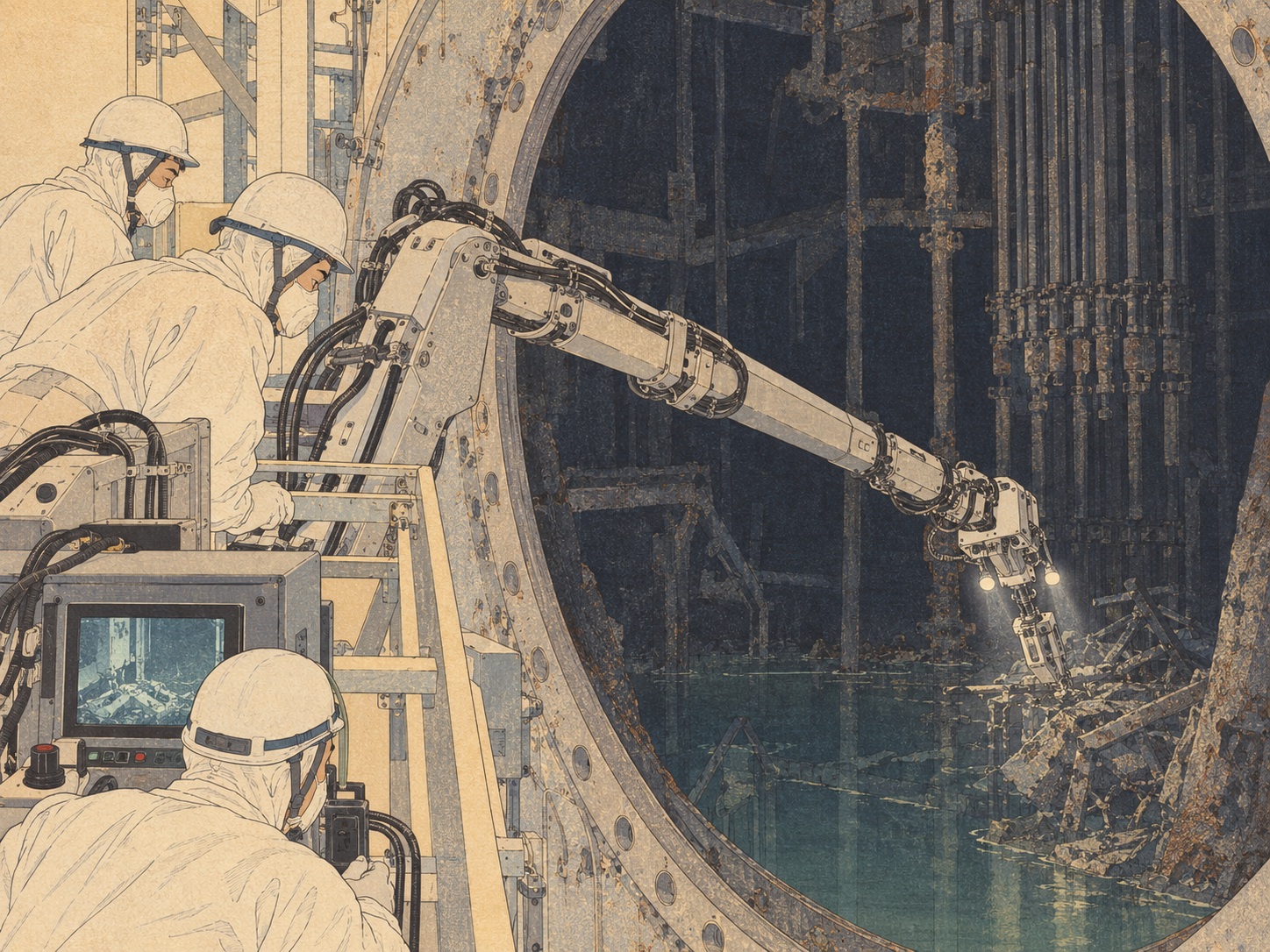
At Fukushima Daiichi Unit 2, one of the most difficult parts of the decommissioning process is again being approached by machine rather than by people.
Tokyo Electric Power Company Holdings began a new internal investigation of Unit 2’s primary containment vessel on October 2, using a remotely operated robotic arm about 22 meters long and weighing roughly 4.6 tons. The arm is being sent into an environment where radiation levels remain too high for workers to enter.
Before TEPCO can remove the debris, it has to understand it
The central technical challenge at Fukushima Daiichi is fuel debris: material created when nuclear fuel and surrounding reactor structures melted during the March 2011 accident and later cooled into irregular solid masses.
Its exact form, distribution, hardness, composition and radiation characteristics vary by location. No complete map exists.
TEPCO has already carried out small trial retrievals at Unit 2 using other equipment. Jiji/The Japan Times reports that about 0.9 grams of debris has been removed over two rounds.
That number makes clear where the decommissioning program really stands. Fukushima is not yet in a phase of large-scale debris removal. It is still learning how to find, reach, characterize and handle the material safely.
Unit 2 did not suffer the same building explosion—but it is not easy to enter
The March 11, 2011 earthquake and tsunami cut off external and emergency power at Fukushima Daiichi, leading to severe core damage in Units 1, 2 and 3.
Units 1 and 3 suffered large hydrogen explosions that heavily damaged their upper reactor buildings. Unit 2 did not experience the same visible building explosion, but abnormalities occurred around its suppression chamber and it is believed to have been a major pathway for radioactive releases.
A building that looks less damaged from the outside is not therefore an easier decommissioning environment.
Radiation inside the Unit 2 containment vessel remains extremely high more than 15 years later. Direct human entry is not possible.
A 22-meter multipurpose arm
The robotic arm has been developed over years for Unit 2 internal investigation and trial debris retrieval.
It is remotely extended through a narrow penetration into the containment vessel. Different end tools can be attached for imaging, cutting, measurement or debris sampling.
The engineering difficulty is not simply its length. High radiation can degrade electronics. A long articulated structure can flex and vibrate. Small positioning errors at the base become large errors at the tip. Operators must work at long distance using cameras and sensors rather than direct line of sight.
First, cut away the obstacles
The route into Unit 2 is partially blocked by existing structures.
TEPCO says rails and cables associated with equipment once used to insert and withdraw control rods are believed to obstruct the robot’s access.
The current work therefore includes using high-pressure water jets to cut those obstructions and create a path.
That is more than housekeeping. The route being opened now may become part of the access path future, larger debris-retrieval equipment will need.
Three-dimensional data will design the next machine
Video alone is not enough for engineering.
The arm is intended to collect detailed three-dimensional information around the lower reactor-pressure-vessel area, pedestal structures and the floor of the containment vessel.
Pre-accident drawings exist, but the interior no longer matches the original design. The core melt involved extreme heat, structural deformation and long-term exposure to water and radiation.
Future retrieval equipment has to be designed for the plant that exists now, not the plant that existed in 2011.

The robotic-arm program is already behind its earlier schedule
TEPCO had previously expected the new Unit 2 investigation to begin around summer 2026.
Jiji/The Japan Times reports that the schedule slipped after a malfunction was found in the robotic arm and parts had to be replaced. Earlier investigation plans have also been delayed by accumulated deposits, camera replacement and access problems.
At Fukushima Daiichi, delay is not an unusual exception. It is part of the technical reality.
Nearly every difficult task is being performed for the first time, in places people cannot enter, using equipment that itself has to survive conditions rarely encountered elsewhere.
The roadmap and the speed of the actual work are different things
Japan’s government and TEPCO have long described Fukushima Daiichi decommissioning as a 30- to 40-year project.
But fuel-debris retrieval carries far more uncertainty than many other tasks, including spent-fuel removal or contaminated-water management.
TEPCO’s own fuel-debris portal describes debris retrieval as the next major stage of decommissioning following stabilization and contaminated-water measures.
That “stage,” however, begins with extremely small steps. A sample is removed, analyzed, and used to refine tools and procedures before the scale can increase.
Why Unit 2 went first
All three damaged reactors contain fuel debris, but Unit 2 became the leading candidate for trial retrieval.
One reason is that earlier internal inspections had produced comparatively useful information about the pedestal area. In 2019, equipment was used to touch deposits and confirm that some material could be moved.
That experience helped lead to telescopic trial-retrieval equipment and now to the larger robotic arm.
Lessons learned at Unit 2 are expected to inform retrieval planning for Units 1 and 3 as well.
Why 0.9 grams matters
Measured by mass, about 0.9 grams is tiny.
Measured as engineering data, it is far more valuable.
Laboratories can analyze the sample’s chemical composition, uranium and plutonium content, mixture with structural materials, physical hardness and radiation characteristics. Those results affect how debris might be cut, grasped, packaged and stored.
In August 2026, TEPCO released detailed analysis results from the second sample taken from Unit 2.
The trial program is therefore not only an attempt to increase retrieved mass. It is a research program into an unknown material.
Even a broken robot becomes useful information
The technical harshness of decommissioning is revealed not only by what works, but by what fails.
High radiation, humidity, narrow spaces and long-distance remote control create failure modes unlike those found in ordinary industrial robotics.
The parts replacement that contributed to this year’s delay therefore also becomes design information for future systems. Reliability, redundancy, maintainability and the ability to recover from failure will directly affect how fast larger-scale retrieval can proceed.
The next step may still be measured in grams
Jiji/The Japan Times reports that TEPCO plans another debris-retrieval effort in 2027, with an amount likely to be only several grams.
The relevant question is not whether several grams is small. It is whether TEPCO can remove several grams safely and repeatedly using a process that can eventually be expanded.
TEPCO has studied multiple concepts for larger-scale retrieval, including approaches that keep the work area in air and approaches that use water shielding. Better internal data should help narrow those choices.
Fifteen years later, people still cannot go inside
More than 15 years after the accident, the Unit 2 containment vessel remains a place where human workers cannot simply enter and work.
That fact defines the decommissioning challenge.
This is not conventional demolition, where engineers survey a structure, send crews in, cut it apart and remove the pieces. Fukushima requires one machine to see, another to cut, another to retrieve, and specialized systems to transport and contain what comes out.
And before those machines can be designed, yet another machine has to go in and map the environment.
The reality behind the “40-year decommissioning” is a sequence of small advances
Fukushima Daiichi is often discussed through one large number: 30 to 40 years.
On site, progress looks much smaller. Advance a 22-meter arm. Cut a rail. Replace a camera. Measure a structure. Retrieve less than a gram. Analyze it. Redesign the next tool.
Each step can look almost trivial from outside. None is optional.
The Unit 2 investigation that began October 2 is not yet the large-scale removal of fuel debris. It is the creation of the map that makes future removal possible.
The real schedule for Fukushima is therefore not only the dates printed in a roadmap. It is the rate at which engineers can turn an invisible, unreachable reactor interior into something measurable enough for the next machine to enter.
Sources and references
- 東京電力ホールディングス — 「2号機PCV内部調査・試験的取り出し作業の着手について」2026年10月2日。
- 東京電力 — 「燃料デブリ ポータルサイト」2026年10月1日「2号機 PCV内部調査・試験的取り出し作業の状況」ほか。
- 東京電力 — 「燃料デブリ ポータルサイト」燃料デブリ取り出しの方針・全体像。
- 東京電力 — 「福島第一原子力発電所の廃炉に向けた取り組みの進捗状況等について」2026年6月2日。
- 経済産業省 — 廃炉・汚染水・処理水対策チーム会合/事務局会議(第148回)、燃料デブリ取り出し準備。
- Jiji / The Japan Times — “Tepco begins long-delayed probe of Fukushima reactor’s interior,” October 2, 2026.
Reporting cutoff: October 6, 2026, 6:40 a.m. JST. TEPCO primary materials confirm the October 2 start of Unit 2 PCV internal-investigation/trial-retrieval work. The approximately 22-meter length, 4.6-ton weight, six-month duration, roughly 0.9 grams recovered to date and a possible several-gram 2027 retrieval are attributed to Jiji/The Japan Times. The timing and final method for full-scale fuel-debris retrieval remain unresolved.
Why it matters
The new arm is mapping and clearing the path inside Unit 2 so engineers can design future debris-retrieval equipment around the reactor as it actually exists.
Where things stand
Fuel-debris retrieval remains at gram scale more than 15 years after the meltdowns.
What to watch
The six-month investigation, another trial retrieval in 2027, equipment reliability and selection of a larger-scale retrieval method.