A robot that walks is not yet a robot that rescues
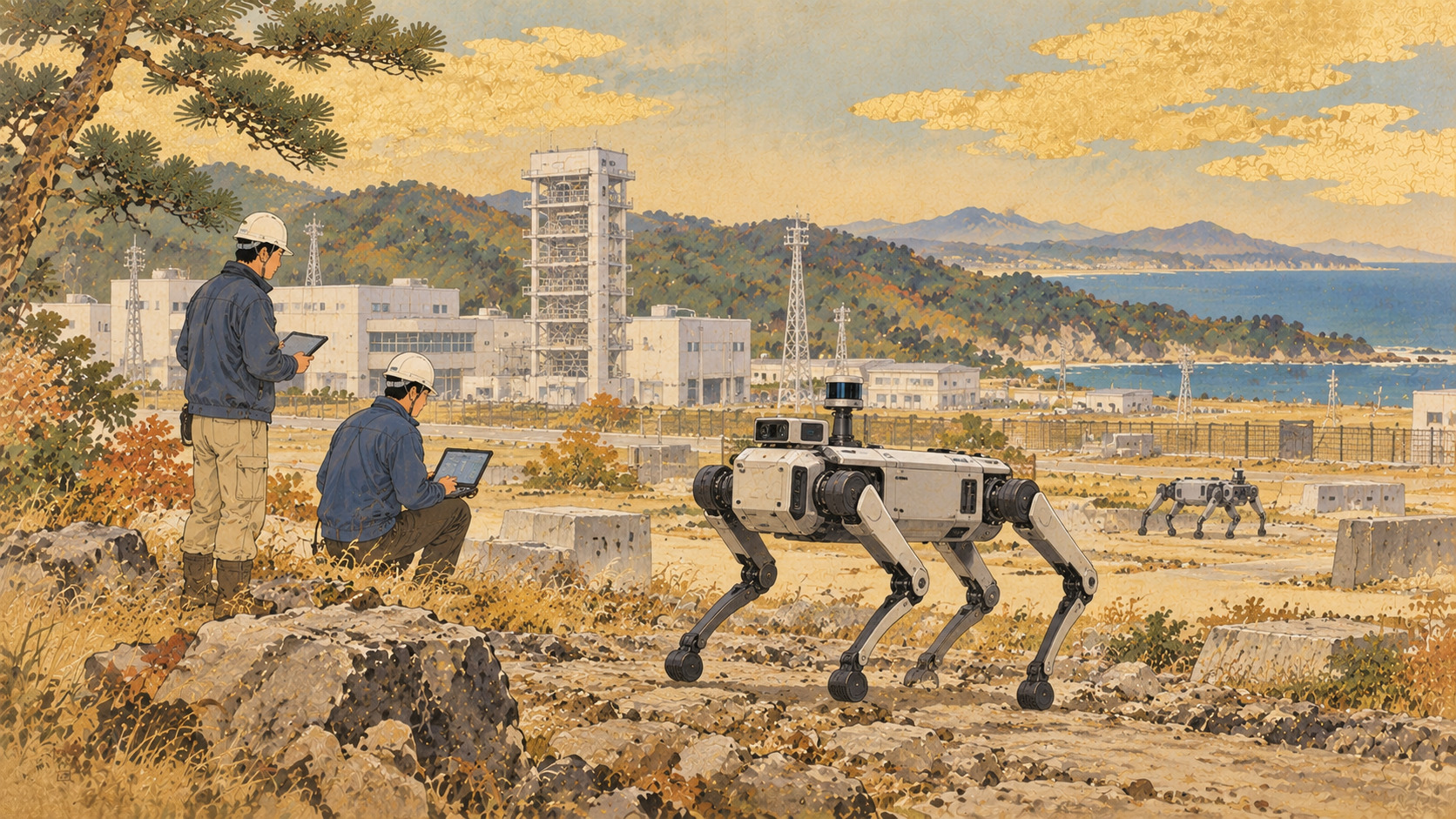
Imagine a machine stepping through a damaged industrial corridor before any worker enters. It must find stable footing, interpret what its sensors see and stop safely when conditions exceed its abilities. That is the ambition behind quadruped robotics, and it gives a small technology gathering in Fukushima a significance beyond a spectacle of mechanical legs.
On October 14, 2026, Fukushima Prefecture scheduled a workshop at the Fukushima Robot Test Field in Minamisoma on physical AI and robot development. Its official program named Kufusha Inc., a resident company, for a talk and a demonstration of a Go2 quadruped using Sim2Real techniques. Crucially, the document is an advance event notice, not a post-event performance assessment. It does not establish successful deployment at a nuclear plant or disaster scene.
The company behind the demonstration
The named presenter, Kufusha Inc. (株式会社クフウシヤ), was founded in 2014 and is headquartered in Sagamihara, Kanagawa Prefecture. Its representative director is Takeichiro Onishi, and it operates a Minamisoma office in room 10 of the Fukushima Robot Test Field research building. Its website describes robotics development and consulting, including navigation, control and system integration.
That geographic arrangement matters. Fukushima is not merely a stop on a touring demonstration circuit; the company maintains a development presence at the public test site. Its published case studies address quadruped locomotion, autonomous inspection and transferring trained control policies from simulations onto hardware. Those studies remain company-reported work rather than independent certification.
What engineers mean by physical AI
Generative AI can produce convincing text and pictures without touching the physical world. A mobile robot must convert information into force and motion. Sensors estimate its surroundings and its own state; software selects actions; actuators move joints; feedback corrects errors as the robot shifts its weight. For a four-legged platform, friction, terrain geometry and timing are inseparable from intelligence.
A robot may walk steadily on a level demonstration floor yet lose its footing on wet grating, loose debris or broken concrete. It may detect an obstacle but fail to understand whether it can safely step over it. The meaningful test of physical AI is not whether a machine can move once, but whether it can keep moving predictably across changing conditions.
Learning to walk in a world that does not exist
Sim2Real means training or evaluating robot behavior in a virtual environment, then transferring it to a physical device. Simulation permits thousands of attempts under varied terrain and control settings without repeatedly damaging hardware. Reinforcement-learning systems can refine policies by receiving feedback for staying balanced, moving forward and satisfying other objectives.
The difficulty is the gap between a simulator and reality. Real motors heat up, surfaces vary, sensors are noisy and physical contacts are hard to model perfectly. A policy that works beautifully on a computer may fail on a real staircase. The Fukushima workshop was designed to introduce these techniques to businesses interested in decommissioning and disaster-response robotics.
Why an open staircase matters
Kufusha published a May 2026 development case involving a Unitree Go2 quadruped learning to negotiate open stairs, using reinforcement learning and Sim2Sim/Sim2Real methods. Stairs create a demanding problem: the machine must place each foot on a reliable surface while maintaining enough support to avoid a fall. A gap where a riser might normally be can defeat naive foot placement.
The company’s documentation offers evidence of its engineering priorities, not a universal guarantee that the device can climb any stairway in service. A buyer would still need repeatability data, payload and runtime limits, emergency stop behavior, maintenance expectations and evidence from the specific type of facility being inspected.
An earlier experiment with a different robot
Fukushima Robot Test Field documents an earlier Kufusha exercise on March 24, 2023 using a quadruped and a private 5G network for security inspection. The test combined low-latency high-definition images with remote operation and examined autonomous movement using LiDAR and GNSS-guided routes. Facility staff were present for the exercise.
The unit used then was Unitree’s GO1, not the Go2 named in the October 2026 workshop. This is more than a capitalization detail. Accurately distinguishing platforms and dates prevents one test’s demonstrated capabilities from being casually assigned to another machine. The 2023 exercise did not establish that a Go2 had completed a live disaster-response mission.
Why the test field exists
The Fukushima Robot Test Field grew out of a recovery strategy established after the 2011 Great East Japan Earthquake, tsunami and Fukushima Daiichi nuclear disaster. In 2014, Japan developed the Fukushima Innovation Coast Framework to create industries and jobs in the badly affected coastal region. The test field opened fully in March 2020.
Its main Minamisoma campus covers approximately one kilometer east to west and half a kilometer north to south. Facilities reproduce conditions for drones, infrastructure inspection, disaster-response operations and maritime robotics. A separate runway is located in neighboring Namie. The point is not to claim a working robot is ready for hazardous service, but to test performance and train operators in controlled approximations of those environments.
Decommissioning is not the same as disaster relief
Inspecting a nuclear facility may require reliable radiation-aware operation, contamination controls, access through tight corridors and secure data transfer around obstacles. Earthquake response imposes different burdens: unstable ground, rapidly changing hazards, unpredictable human presence and the immediate need to avoid making rescue conditions worse.
Quadruped machines could help with visual inspection, mapping and reconnaissance before humans enter. Their practical value depends on what sensors they carry, how they communicate, who can intervene and whether their failure modes are acceptable. A moving prototype is evidence of engineering progress; it is not a validated replacement for trained responders.
China’s hardware, Japan’s engineering choices
Go2 is a quadruped platform from Chinese manufacturer Unitree. Its use by a Japanese developer should not be confused with a domestically manufactured robot. At the same time, commercial platforms can provide valuable foundations for Japanese software, perception, navigation and integration research, reducing the cost of early experiments.
Kufusha also describes work on an original quadruped. But the record examined does not establish production volumes, government procurement contracts or commercial deployment at Fukushima Daiichi. Cross-border sourcing also brings questions of maintenance, data governance, software dependability and hardware supply that future buyers will have to assess.
The regional economic test
Fukushima’s innovation strategy embraces six industrial areas, including decommissioning, robotics and drones, energy, agriculture, healthcare and aerospace. Its ambition is not simply to host more demonstrations: it is to attract research activity, industrial employment and sustainable companies to Hamadori and nearby municipalities. A company with a real local laboratory is more consequential than a one-day visitor.
Yet one cannot measure regional revitalization from a robot walking across a test area. The reviewed sources do not establish how many new local jobs, contracts or enduring partnerships this particular October workshop generated. Those are questions for follow-up reporting rather than projections that should be presented as results.
The next milestone is reliable repetition
A serious operating test should disclose terrain conditions, repeat runs, successful completion rates, power consumption, autonomy boundaries and how the robot behaves when signals or sensors fail. For facilities that cannot tolerate a mistake, emergency intervention and recovery procedures are as important as impressive locomotion.
The value of Minamisoma’s test field is that it provides room to discover failure before failure becomes a public emergency. If researchers can explain not only what their robots achieve but also when they stumble and why, Fukushima’s emerging robotics industry will have something more durable than a dramatic demonstration: evidence on which others can build.
Sources and verification
Based on prefectural, METI, test-field and company material. No direct reporting at the event or independent performance testing was conducted.
- Fukushima High-Tech Plaza: October 14 workshop notice
- Kufusha: company profile
- Kufusha: robotics case studies
- Fukushima Robot Test Field: quadruped and private 5G test
- Fukushima Robot Test Field: facilities and mission
- METI: Fukushima Innovation Coast Framework
- Fukushima Innovation Coast: mission and sectors
- Japan Patent Office: Kufusha company profile