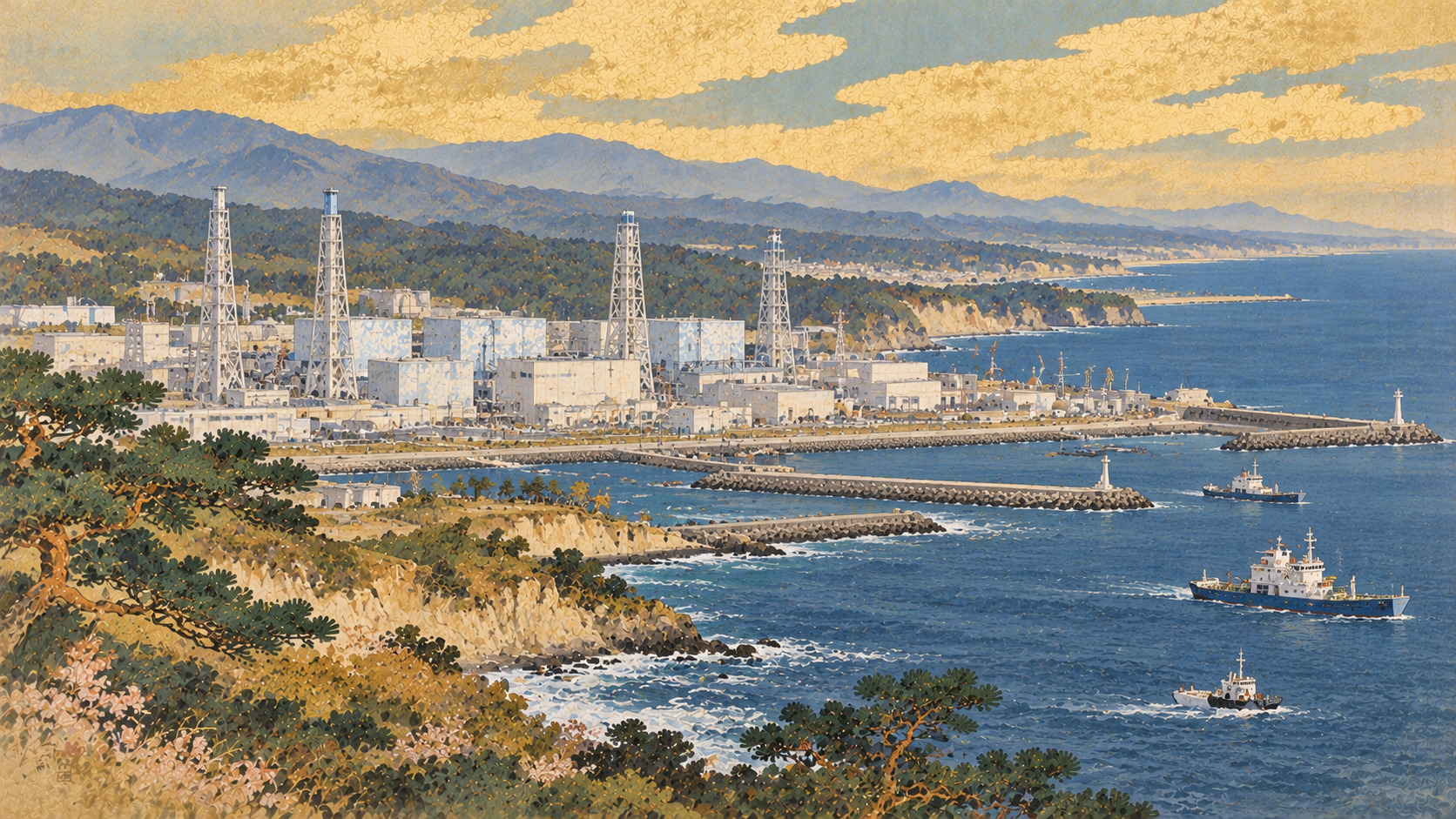
The twenty-fifth release is a milestone, not a verdict
On October 26, 2026, Tokyo Electric Power Company began another batch of water discharge at Fukushima Daiichi. Its October announcements identify the operation as the seventh release of fiscal 2026 and the twenty-fifth since the program began in August 2023. The previous batch finished just three days earlier, on October 23.
The sequencing is documented. What the sequence means is more complicated. Measurements address regulatory performance; the people who fish, export seafood, study radiation and scrutinize the government ask additional questions about trust, oversight and long-term accountability.
A planned 7,800 cubic meters—not a completed total
TEPCO’s fiscal-year plan calls for approximately 7,800 cubic meters of treated water in this seventh release, with an estimated 1.5 trillion becquerels of tritium before dilution. Its full fiscal 2026 plan schedules eight releases totaling about 62,400 cubic meters and approximately 11 trillion becquerels of tritium. These are planned quantities, subject to later actual-volume reporting.
It would be inaccurate to claim the seventh batch had already been fully discharged on October 29. TEPCO’s current portal still identified an active release at that date, and its published chronological notices show the sixth batch beginning October 5 and ending October 23.
What exactly is ALPS-treated water?
The Advanced Liquid Processing System, or ALPS, is designed to remove many radionuclides from contaminated water generated during the continuing management of the damaged reactors. Tritium, a radioactive form of hydrogen incorporated into water molecules, is not readily separated by the conventional ALPS process. The phrase “treated water” therefore does not mean the liquid contains no radioactivity.
Before discharge, TEPCO uses measurement and confirmation tanks to analyze its contents. For regulated radionuclides other than tritium, the company says it checks that the sum of concentration-to-limit ratios remains below one. Seawater dilution follows. These are separate steps with separate measurements and failure conditions.
How the tritium limits compare
TEPCO uses a concentration target below 1,500 becquerels per liter after seawater dilution. Japan’s regulatory concentration limit for tritium discharge is 60,000 becquerels per liter; the World Health Organization’s drinking-water guideline reference is 10,000 becquerels per liter. In that arithmetic, 1,500 is one-fortieth of the regulatory figure and about one-seventh of the WHO figure.
The WHO comparison is a reference point, not an assertion that seawater should be consumed as drinking water. Equally, a concentration limit is not identical to the total activity discharged. A proper account tracks concentration, volume and total radionuclide activity together.
The difference between a sample date and a news date
Fukushima Prefecture says it observes the discharge facilities on site and checks daily tritium sampling from diluted water while discharges are under way. Its October 29 information page shows measured concentrations of 180 to 200 becquerels per liter on October 16–21, from the previous release period.
Those figures cannot legitimately be described as measurements from the entire twenty-fifth operation. Readers should distinguish the date a website is updated from the dates water was sampled. That elementary discipline matters especially when a process runs through multiple batches.
The latest seafood results—and what they do not show
In a notice updated October 29, Fukushima Prefecture reported radioactive cesium was not detected in any of 76 marine seafood samples spanning 51 species collected October 15–20. That is a specific finding for the samples tested, the radionuclide measured and the applicable detection limits. It is not proof that every conceivable radionuclide in every fish was absent.
Nor is a cesium result in seafood a measurement of tritium concentration in the latest discharge. Both forms of monitoring matter, but they answer different questions. Confusing them can make an otherwise sound figure misleading.
From reactor emergency to tank farms
The history begins with the March 11, 2011 earthquake and tsunami and the ensuing nuclear accident. Cooling water, groundwater intrusion and contaminated structures created a prolonged water-management challenge. Treatment and storage tanks became a defining feature of the site, while decommissioning operations competed for space and resources.
The Japanese government approved a policy for controlled ocean discharge, and the first release began August 24, 2023. The decision involved technical standards, alternative approaches and sustained opposition among stakeholders. Reducing it to either a routine plumbing task or an unqualified environmental catastrophe misses the complexity of the record.
International observers and laboratories
The International Atomic Energy Agency is involved in a monitoring framework requested by Japan. On October 1, Japan’s Fisheries Agency announced planned sampling and checks in Fukushima waters for October 14 and 16, involving IAEA specialists and nominated laboratories from China, South Korea and Switzerland.
Interlaboratory comparisons test whether different analytical organizations produce compatible findings. The existence of an announced participation plan should not be confused with publication of every final result. Such reports, and their methods, are what independent scrutiny should examine.
For fisheries, a measurement is not a market
Fukushima’s fishing communities were affected by the disaster long before the first treated-water discharge. The costs include interruptions to operations, disrupted distribution chains, consumer perceptions and the practical work of rebuilding the industry. A laboratory result may satisfy a standard without instantly restoring buyer confidence or livelihoods.
Those realities justify reporting on compensation, export access, catch volumes and the experiences of fishing households. They do not justify changing the scientific meaning of a sample result. Economic consequences and radiological assessments deserve separate, equally rigorous examination.
Layers of oversight, distinct questions
Tank analysis, dilution-system monitoring, nearshore water samples, seafood tests and third-party laboratory comparisons are complementary rather than interchangeable. Each can reveal or fail to reveal a different part of the system. The most useful public record makes collection dates, analytical thresholds, abnormal-operation rules and test methods accessible.
As of October 29, TEPCO’s portal described a discharge in progress and characterized nearby seawater monitoring as showing no significant change. That is the company’s current reported assessment, not an unconditional guarantee about all future environmental effects.
What a quarter-century of batches cannot tell us
The word “twenty-fifth” gives this operation a convenient headline. It cannot by itself show whether a fisheries market has recovered or whether long-term trust has been secured. The more consequential story will be the continuity and auditability of evidence as the releases proceed.
Fukushima’s decommissioning is a multidecade undertaking. The public deserves neither an unsupported all-clear nor alarming assertions beyond the measurements. It deserves a record precise enough to challenge, check and understand—one release at a time.
Sources and verification
Based on primary sources available through October 29, 2026. No independent laboratory analysis or direct interviews were conducted.
- TEPCO: October 2026 release announcements
- TEPCO: discharge plan and performance
- Fukushima Prefecture: ALPS discharge and sampling
- Fukushima Prefecture: operational inspections
- Fukushima Prefecture: fishery monitoring October 29
- Fisheries Agency: IAEA and overseas laboratory verification
- NRA: additional IAEA-linked monitoring
- TEPCO: ALPS treated-water FAQs