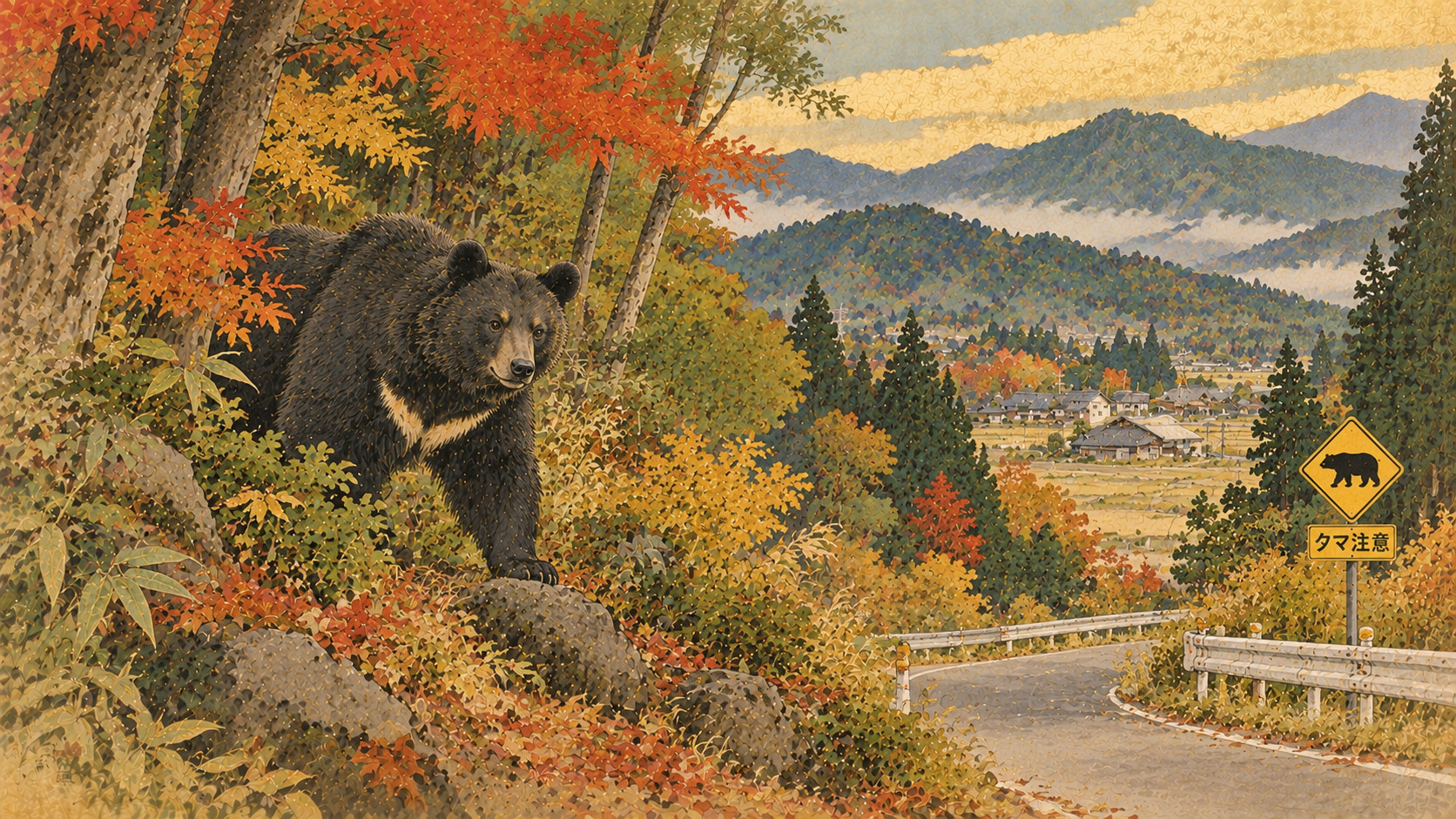
A bear on a highway on an ordinary Thursday
Shortly after 8 a.m. on October 29, a man in his sixties driving along National Route 115 in Matsukawa, Fukushima City, struck a bear that was crossing the road. According to Fukushima TV, the animal was approximately one meter long, the car’s bumper was damaged and the driver escaped injury. The bear ran away. Police shared information with municipal authorities and increased vigilance in the area. There is no independently established account of whether the bear was hurt or where it went. The encounter illustrates the risks created where transport corridors intersect wild habitat.
Elsewhere in Fukushima, three bears crossed another road
On the same day, police-based local reports described three bears crossing a prefectural road in Yanaizu, in the Aizu region, at about 4:30 p.m. The estimated sizes were one animal of 1.5 meters and two of 0.5 meters. Their grouping suggests an adult and young animals, but the report does not independently establish their relationship. A separate sighting of an approximately 1.5-meter bear on a municipal road in Shirakawa was reported on October 28. These are individual notices, not an exhaustive census of wildlife movement.
Why a warning remains in force even as sightings fall
Fukushima Prefecture’s autumn Asian black bear advisory runs from September 1 through November 30 and covers the entire prefecture. In an October 27 update, the prefectural government said reported sightings were trending down, but that by the end of August there had already been seven incidents of human injury affecting ten people, exceeding the previous year’s comparable concern cited in its notice. Those injury figures are explicitly through August; they are not a verified count for late October. Fewer reports do not establish that close encounters are harmless.
The species behind the warning
The Japanese black bear, or Asian black bear (Tsukinowaguma), is native to forested parts of Honshu. It consumes varied seasonal foods and depends in part on acorns and other tree nuts before winter. Japan’s Environment Ministry emphasizes that the abundance of these foods can influence autumn appearances near settlements. That ecological relationship, however, does not prove that any particular October 2026 sighting resulted from a food shortage. Local nut-crop measurements and movement studies would be necessary for that conclusion.
An important change on the Pacific side
Fukushima’s Iwaki regional office reported that bears had historically been confirmed mainly in mountain areas of Aizu and Nakadori, but that the first confirmed bear within Iwaki City was documented on July 31, 2025, in Kawamae. Further confirmations followed in 2026. A handful of observations cannot establish the size of a new breeding population. They do, however, change the practical geography of public safety: residents and hikers in locations that once seemed comparatively unlikely to encounter a bear need access to current information.
Fukushima’s disaster history does not explain every sighting
The 2011 earthquake, tsunami and nuclear accident transformed settlement and land use in parts of Fukushima. Depopulation and the declining maintenance of some rural landscapes can plausibly affect the boundary between people and wildlife. But it would be an unsupported leap to attribute the October 29 collisions or sightings to nuclear evacuation, radiation, or a single demographic trend. Habitat changes, discarded food, fruit trees, seasonal food availability and animal movement require separate local evidence. A serious account of Fukushima must resist reducing every development to the disaster.
A sighting map is not a bear population survey
The prefecture maintains an online bear sighting map built partly from police reports and partly from public submissions. Its own explanatory notes caution that totals on the map need not match the police-derived statistical series, and that preliminary entries may be corrected. One wandering animal could prompt many reports. Conversely, an unseen bear may generate none. These limitations matter when interpreting claims of a dramatic rise or fall in bear numbers: sightings are indicators of reported human contact, not a direct animal census.
The policy dilemma: prevention, protection and control
Fukushima’s Fourth Asian Black Bear Management Plan runs from April 2022 to March 2027. It explicitly seeks stable long-term populations alongside reduced harm to people, farming and forestry. The prefecture also says 2025 marked a record year for both sightings and human injuries and prepared a special control program for fiscal 2026. These positions are not inherently contradictory. Wildlife management must weigh urgent safety hazards, habitat protection, the risk of attracting bears near homes, and the consequences of intervention. The merits of any intervention depend on evidence about individual situations.
Practical protection often starts with ordinary chores
The prefecture advises residents not to leave food scraps, vegetables, fruit or pet food outdoors. Bears that learn to find calories near people may return. Japan’s Environment Ministry also recommends reducing attractants such as unmanaged fruit trees, improving visibility at settlement edges and using properly designed barriers for vulnerable farmland. Hikers and farm workers should check recent sightings, avoid solitary travel when possible and use sound to reduce the chance of surprising an animal. None of these measures eliminates risk, but together they reduce avoidable encounters.
If you see a bear, do not run toward or away from it
Official Japanese guidance stresses keeping calm, not approaching for photographs, and slowly increasing distance without running. Situations at close range require specific safety training and context; a brief article cannot promise an outcome or replace local emergency guidance. The Environment Ministry maintains current visitor guidance for national parks and the prefecture provides local alerts. Report sightings from a safe location to the appropriate local authority or police, rather than attempting to confront an animal.
The next measure of success
The driver in the October 29 collision was not hurt, but that outcome should not become complacency. A sensible public response would assess where injuries occur, whether roadside notices reach people, how well attractants are controlled, whether official sighting information is timely and how interventions affect wildlife. Fukushima’s story is not simply one of bears coming down from the mountains. It is about how a region with villages, farms, forests and busy roads defines a safer shared landscape without mistaking fear for knowledge.
Sources and reporting notes
Based on Fukushima Prefecture and Environment Ministry documents and contemporary local coverage. No direct interviews with witnesses, residents or wildlife experts were conducted.