The future of street sport depends on both freedom to participate and the judgment to keep participants safe.
A street-sports festival meets a typhoon
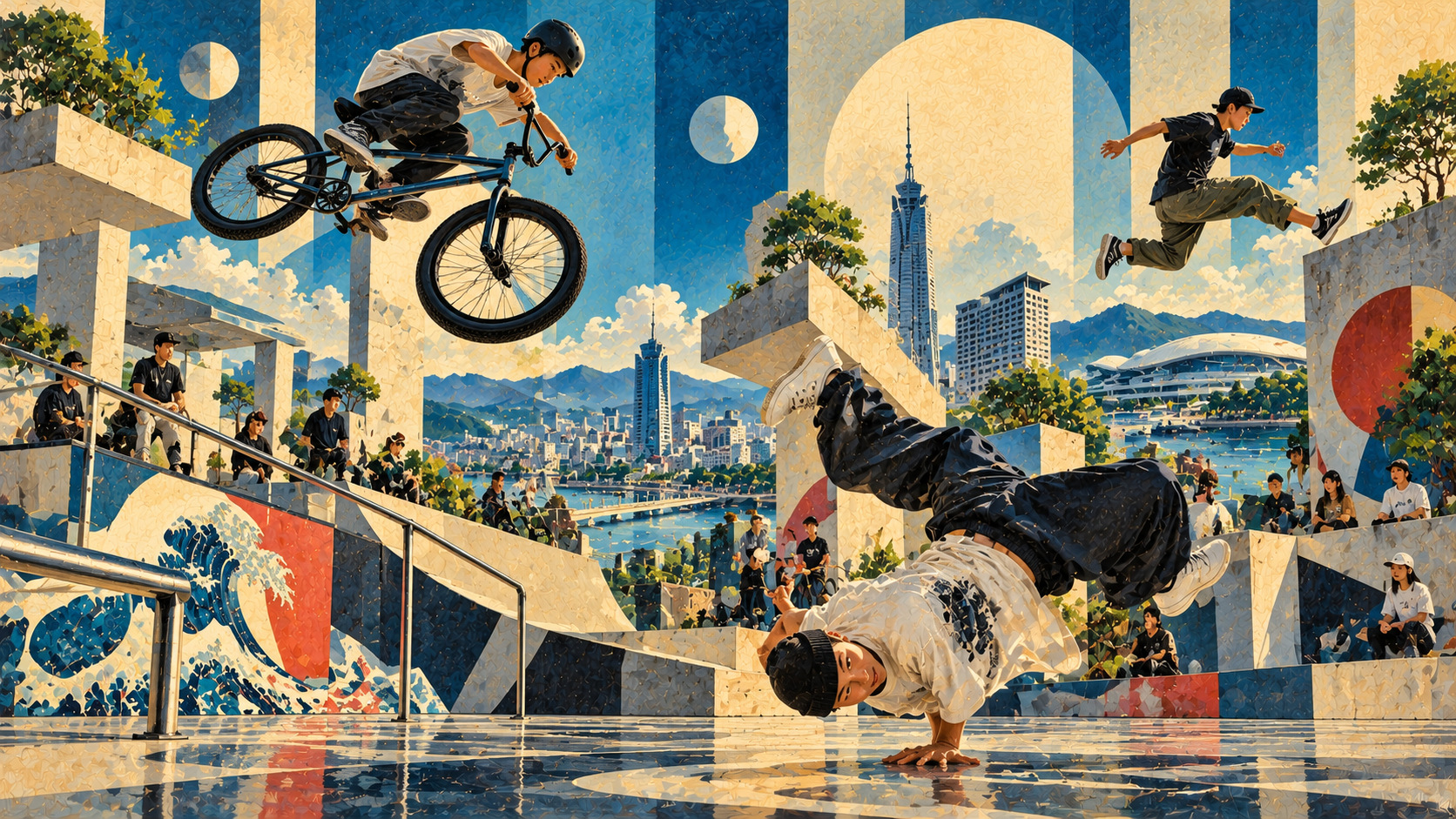
Fukuoka was preparing for a weekend of BMX riding, breaking, double dutch and freestyle basketball at CAITAC SQUARE GARDEN, a shopping complex in the Kego district. The ambition of FUKUOKA URBAN SPORTS PARK 2026 is straightforward: move disciplines often practiced in small specialist communities into a public setting where children and passersby can watch, listen and try.
But the most consequential announcement before the October 24–25 festival concerned the weather. At noon Japan time on October 23, organizers said Saturday’s outdoor parkour and slackline trial sessions would be canceled because of approaching Typhoon No. 30. On Sunday, the all-style 4-on-4 dance battle Represent. has also been canceled. The remaining Sunday program awaits a decision expected around noon Saturday.
What the organizers actually confirmed
The festival is run by the FUKUOKA URBAN SPORTS PARK executive committee. Entry for watching and trying activities is generally free, with some paid elements. Official notices place it at CAITAC SQUARE GARDEN, 1-15-38 Kego, Chuo Ward, Fukuoka City.
Indoor hands-on sessions were still planned to operate Saturday under the October 23 update. The organizers warned that participating children’s dance teams might withdraw without advance notice. Visitors should not mistake an advertised timetable for a guarantee that every performance will go ahead.
Two battles give Saturday its rhythm
Saturday’s program identifies DOUBLE DUTCH ONE’S, a head-to-head double-dutch battle, and GroovMix, a one-on-one freestyle basketball competition, at the complex’s second-floor WHASK space. Both promise an audience something different from an ordinary athletics meet: skill organized around timing, music, style and improvisation.
The Fukuoka Sports Foundation had also announced a livestream of those competitions beginning at 12:40 p.m. Japan time on October 24. A scheduled stream should not be confused with verified evidence that performances subsequently occurred; this story is written ahead of the event.
The importance of an invitation to try
The original program offers trial sessions in pickleball, breaking, BMX, freestyle football and basketball on Saturday, and double dutch, pickleball and other activities on Sunday. Some were planned outdoors and were therefore subject to weather changes.
This distinction between spectatorship and participation is the event’s most interesting idea. A child might discover that a borrowed ball or a short supervised trial is a more accessible route into sport than joining an established competitive team. Whether visitors continue practicing afterward is an empirical question the festival has not yet answered.
Breaking began as culture, not an Olympic product
Breaking emerged in the Bronx in New York during the 1970s through the creativity of African American and Puerto Rican young people. The World DanceSport Federation identifies toprock, footwork, power moves and freezes among its central movement foundations. Each element offers room for personal vocabulary and response to music.
Breaking reached the Olympic stage at Paris 2024, broadening its visibility without erasing its roots in neighborhood parties and battles. The distinction matters in Fukuoka: a street dancer is not merely an athlete completing predetermined gymnastic requirements, and the audience is not simply watching a score.
BMX and the invention of a different sporting language
BMX freestyle park made its Olympic debut at the Tokyo 2020 Games, held in 2021. Unlike racing, it is judged on dimensions such as originality, difficulty, style and execution. A run requires risk management, spatial awareness and compositional judgment as well as physical courage.
For a newcomer, the spectacular trick is the obvious attraction. For an experienced rider, the story is often in the transition between tricks, the control of a landing or the selection of a route through the ramps. Organized trial sessions also require suitable safety measures; an advanced performance is not an invitation to imitate it unsupervised.
Rope, rhythm and the basketball as an instrument
Double dutch uses two turning ropes and complex timing; freestyle basketball places ball handling and physical expression at the center. In both, music and personal style transform everyday objects into performance tools.
Their inclusion alongside parkour and BMX refuses an old division between “proper sport” and street culture. It asks audiences to admire athletic excellence expressed through different traditions while preserving the identities of those communities.
Why hold it in a shopping complex?
Kego lies close to Fukuoka’s Tenjin commercial district. A program inside a multipurpose urban property encounters shoppers and families who would rarely attend a specialist BMX or dance competition. The venue becomes an experiment in how a city distributes attention and space.
The same location illustrates the logistical vulnerability of outdoor practice. A rooftop, courtyard or temporary obstacle area can be useful in good weather and unsuitable in strong winds. Organizers have to weigh excitement against weather, access and the safe return journeys of participants.
A wider weekend of food and local exchange
The property’s management announced a related autumn event involving produce associated with Okagaki Town and food workshops, alongside the sports program. The ambition is to connect regional agriculture, urban visitors and youth culture in a single weekend.
Such cooperation can create opportunities for small producers and retailers. It does not, on its own, establish how much revenue was generated, how many new customers were gained or whether sports participation increased. Those outcomes would require post-event reporting and data.
The questions after the crowd leaves
If urban sports are to become part of Fukuoka’s civic fabric, regular practice spaces, sensible regulations, coaching, safe equipment and neighborly accommodation matter as much as an annual festival. Participation also means giving beginners and people with disabilities a meaningful chance to take part.
The promise is cultural as well as athletic. Young people can learn to perform in public, accept criticism, collaborate across disciplines and improvise solutions. Yet a short festival is only the beginning; continuity depends on what exists the other 363 days of the year.
What readers need to know for October 25
As of the organizer’s October 23 noon notice, Sunday’s Represent. battle is canceled. Saturday’s outdoor parkour and slackline trial sessions are also canceled, while indoor Saturday trials remain scheduled. Other Sunday activities were awaiting a decision expected October 24 at noon.
This report cannot verify future attendance, results or performances. Readers intending to travel should check the organizer’s website for the latest adjustments. Even when its schedule contracts, the event offers a useful question for Japan’s cities: can street sport find a permanent place in public life?
Sources and further reading
Based on the organizer’s October 23 noon update. Remaining Sunday activities await confirmation; no on-site reporting or direct participant interviews were conducted.
- FUKUOKA URBAN SPORTS PARK 2026 — official program and October 23 typhoon notice
- Official trial-session timetable
- Fukuoka Sports — official event listing
- CAITAC SQUARE GARDEN — weather advisory October 22
- CAITAC Holdings — October 16 event announcement
- World DanceSport Federation — history of breaking
- Union Cycliste Internationale — Olympic debut of BMX freestyle