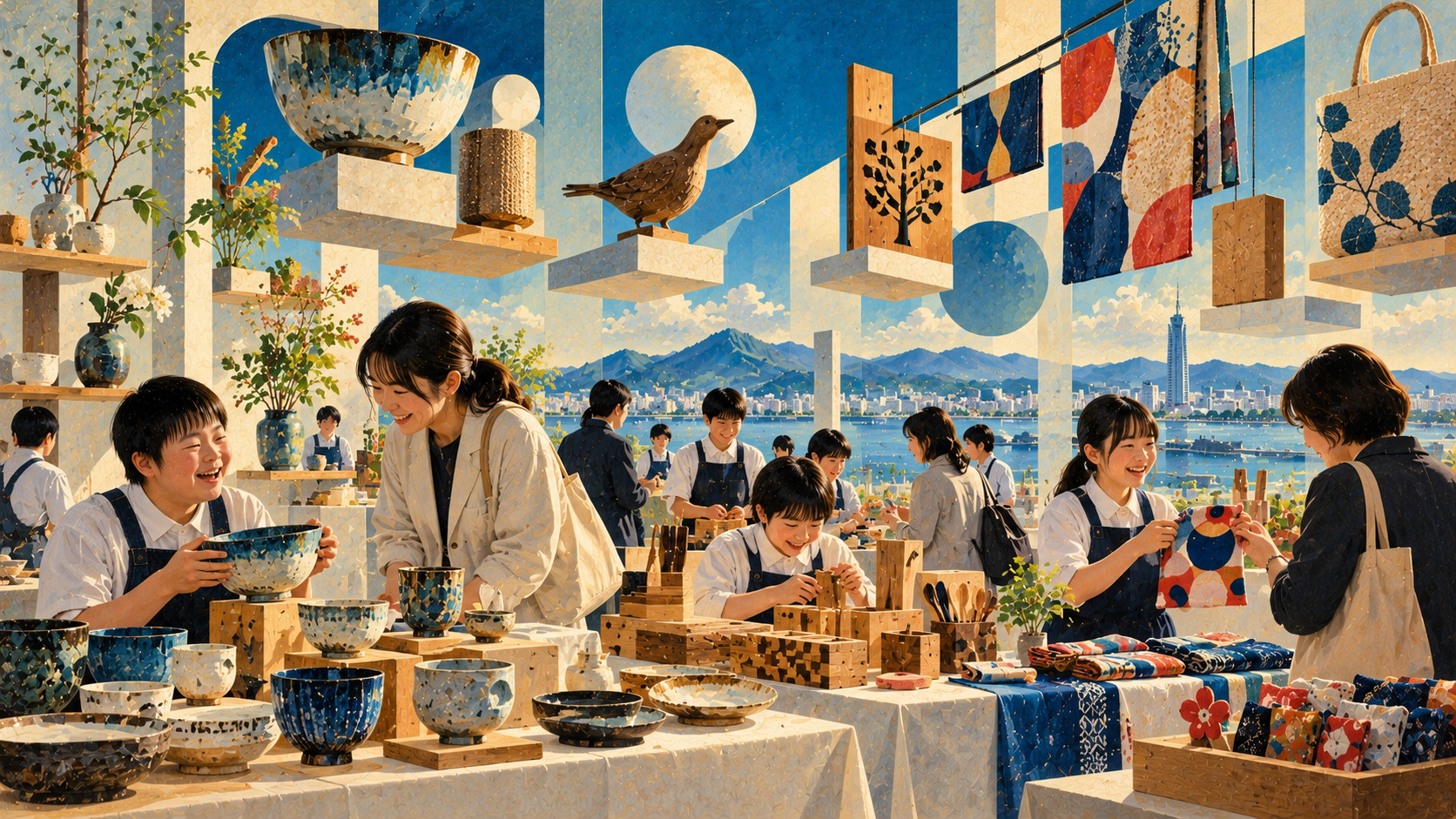
A market is a test of craftsmanship—not a scorecard for a student’s worth.
An ordinary purchase with an unusual classroom behind it
A temporary market is coming to the lobby of the Fukuoka Prefectural Government building. The makers and sellers will be students at prefectural special-needs schools, presenting products created as part of their vocational education. The prefecture announced the initiative on October 23.
A purchase offers a simple interaction often missing from discussions about disability and schooling: a buyer evaluates an object, asks a question, pays for it and takes it home. Behind that transaction is a lesson about skill, responsibility, communication and the expectations of a real customer.
The scheduled dates—and a cancellation
The prefecture’s updated notice says the October 26 opening was canceled because of the forecast approach of Typhoon No. 30. The remaining listed dates are October 27, November 5 and November 10–13. Sales are scheduled for approximately 11:30 a.m. to 1:30 p.m. in the first-floor lobby of the prefectural government building.
The organizer warns that weather may force further changes. The notice does not establish that any sales have occurred as of this October 25 edition. Readers intending to attend should check the latest notice rather than rely on the initial schedule.
Why vocational learning is more than making things
Practical education in Japanese special-needs schools can teach much more than a technical task. Depending on the student and program, the process may include following instructions, cooperating with classmates, checking finished work, planning a schedule, communicating with others and learning what a customer needs.
Japan’s Ministry of Education requires career guidance and educational planning that supports students in making their own decisions about future pathways. It would be inaccurate to imagine that all schools use a single curriculum, produce the same goods or measure each student by identical workplace expectations.
When the customer becomes part of the lesson
An object made in a classroom becomes different when a stranger considers buying it. Is its finish appealing? Can it be used reliably? Is the price fair? Does its maker understand which details matter to the person taking it home? These are questions that extend beyond technique.
At the same time, education cannot be reduced to revenue. A student may gain confidence, practice communication or discover a preference without selling the most products. Those outcomes require observation and the student’s own account rather than a flattering assumption from an observer.
A parallel effort puts skills in front of employers
Fukuoka has also scheduled a skills observation event on November 19 at Fukuoka Koto Gakuen, a prefectural special-needs upper-secondary school in Chikushino. Businesses are invited to watch students demonstrate skills, followed by an exchange between employers and teachers. Approximately 30 companies are expected, subject to registration.
The sales event and employer gathering are separate programs. Both make practical learning visible beyond school walls, but neither announcement is evidence of a new employment agreement or a verified graduate placement.
Japan’s national employment record
According to Japan’s labor ministry, private employers counted 704,610 workers with disabilities in the June 2025 reporting snapshot, an all-time high. Their actual employment rate was 2.41%, below the then-applicable statutory quota of 2.5%. Only 46% of reporting firms met the legal requirement.
Those data describe employers nationwide, not the specific graduates participating in Fukuoka’s market. They cannot establish job satisfaction, working conditions or retention, and they should never be presented as outcomes attributable to the sales event.
From protected opportunity to meaningful choice
Japan’s postwar disability-employment framework evolved through vocational rehabilitation, employment quotas and later legal duties concerning discrimination and reasonable accommodation. Schools have increasingly been expected to prepare students not simply for one prescribed job category but for choices shaped by abilities, aspirations and support needs.
Some students may pursue employment with mainstream companies; others may choose supported work, further education or different community pathways. Success should not be defined by a single destination. Agency—the student’s opportunity to express a preference—belongs at the center.
The buyer’s role is not charity
Visitors can approach the products as they would any other handmade goods: consider workmanship, usefulness and price. A sale can be mutually satisfying without turning the student into a sentimental symbol. Respect also means recognizing that individuals communicate in different ways and may receive help from teachers.
What the market can demonstrate is a short encounter with real customers. Whether that experience transfers to future work depends on teaching, follow-up, support and a broader labor market prepared to recognize a person’s skills.
Questions that still need answers
The prefecture’s notice does not disclose a complete verified list of participating schools, individual makers, products, prices, income arrangements or career outcomes. Responsible follow-up reporting would ask how students participate in design and manufacture, who sets prices, what happens to proceeds and how the experience is discussed afterward.
Interviews with students require care and appropriate consent, but their own perspectives are essential. The most useful measure of this initiative may not be the money changing hands in the prefectural lobby. It may be whether young people leave with greater freedom to choose what comes next.
Sources and verification
Based on Fukuoka’s revised event notice, employer skills showcase, MEXT curriculum and MHLW employment statistics. Participating schools, exact products, prices, proceeds and students’ views remain unverified. The October 26 date was canceled.