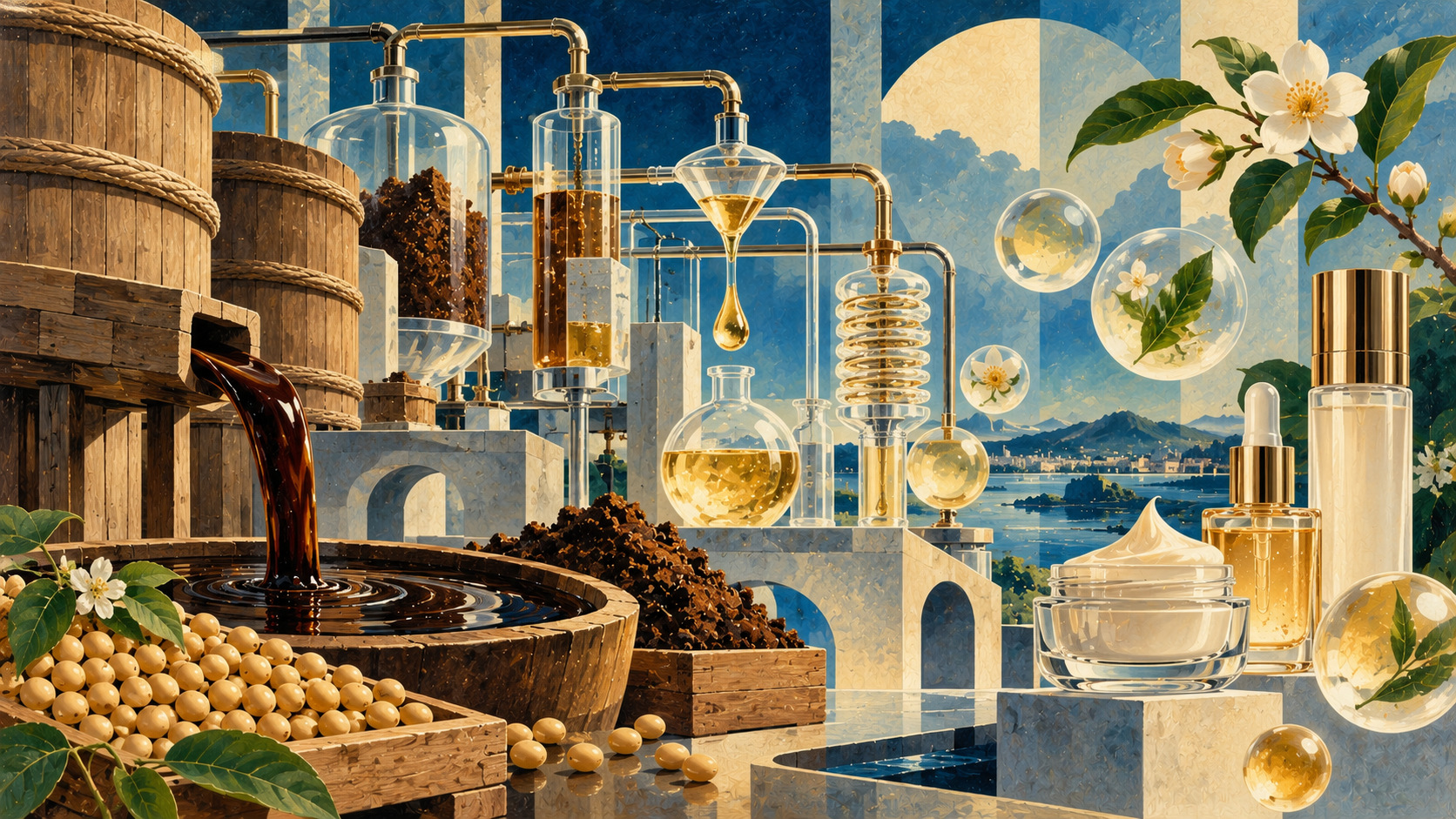
The 2026 news is an award—not the invention of a process that dates back more than a decade.
A skincare ingredient hiding in the soy-sauce press
After soy sauce has been brewed and pressed, manufacturers are left with a dense byproduct: soy-sauce lees. In Fukuoka, a company has learned to recover a valuable class of skin-related molecules from that material. On October 22, the prefectural government announced that Genuine R&D, based in Fukuoka City’s Hakata Ward, had been selected for the 2026 Chairman’s Award of Japan’s 3R Promotion Council.
The award recognizes a commercialized process for extracting and purifying what the prefecture calls natural human-type ceramides. The presentation ceremony is scheduled for October 26 in Tokyo. The discovery is not newly made in 2026; the new event is recognition of a technology developed and refined over many years.
What exactly comes out of the residue?
Ceramides are a diverse family of lipids. In human skin they help form the layered material between cells in the stratum corneum, together with cholesterol and fatty acids, controlling water loss and protecting the barrier. That biological role explains why cosmetic formulators are interested in ceramide ingredients.
The Japanese designation “natural human-type ceramide” describes a claimed molecular correspondence with ceramides associated with human skin. It does not mean the ingredient is extracted from humans. The source here is fermentation-related material. Chemistry, purity and finished-product formulation must be assessed separately from marketing descriptions.
The microbiology inside a traditional food
Soy sauce production depends on fermentation. Ingredients such as soybeans and wheat are processed with koji and other microorganisms, the mixture is matured, and liquid is separated from solids. The resulting lees have conventionally been handled as an industrial byproduct, including possible use in animal feed.
Genuine R&D’s work grew from studies of fungi, including koji molds and mushrooms, and the company’s interest in free-form ceramides. The prefecture says its proprietary method made it possible to purify these materials from residues of soy sauce and other fermented foods. The publicly available summaries do not prove that every listed feedstock achieves the same commercial yield.
The project began more than a decade ago
Records at the Fukuoka Research Commercialization Center for Recycling Systems trace a joint effort to the 2011–2013 research years. The Fukuoka Soy Sauce Brewing Cooperative served as research leader. Genuine R&D and prefectural research institutions were among the participants.
The Center describes a method to recover the cosmetic ingredient with high purity and stability, and notes that residue left after extraction can still be directed to livestock feed. It was a collaboration linking brewers’ material streams, public-sector research and a company capable of commercialization—not a sudden laboratory announcement this autumn.
An old industry meets a different economy
Soy sauce belongs to the long history of Japanese food fermentation, with distinctive regional preferences and established networks of small and large producers. In Kyushu, regional soy-sauce styles and local brewing businesses remain part of daily food culture and manufacturing.
An ingredient moving from a brewing plant to a cosmetics supply chain crosses categories that traditional industrial statistics tend to keep apart. This is the significance of the case: one material stream could support more than one type of value, provided separation, quality control and distribution actually work at commercial scale.
The important second step: what happens to the leftovers?
Recovering a premium ingredient would be a limited environmental advance if the remainder simply became a fresh waste problem. The project’s own published account says the material left after ceramide extraction can be used as livestock feed. A 2019 award description also pointed to feed with improved storage characteristics.
Yet the public sources reviewed do not establish how much of the stream is currently processed, what fraction actually becomes feed, or the resulting avoided disposal tonnage. Those figures would be necessary for a defensible claim about waste reduction at an industrial scale.
This is not the first prize
The public research record lists a 2018 resource-circulation technology award from a Ministry of Economy, Trade and Industry bureau. In 2019, the company was also recognized with an environment minister’s award for its reuse achievement. The 2026 3R Promotion Council Chairman’s Award adds another official recognition.
That timeline changes how the story should be told. Calling the technology a first-time October 2026 discovery would erase at least a decade of development. The relevant question today is what sustained innovation, collaboration and commercialization have accomplished since the initial work.
The science of moisturizers needs its own evidence
There is substantial scientific literature on ceramides in the human skin barrier. Reviews have also identified benefits of some ceramide-containing topical formulations for hydration and barrier function. But a positive result for a category of products cannot automatically be transferred to every specific ingredient or cosmetic made with it.
The chemical species, concentration, companion lipids, process temperature and final formulation matter. A 2024 scientific review emphasizes that even the way ceramides are incorporated can affect performance. The available award notices do not constitute independent clinical trials of Genuine R&D’s particular product.
The numbers an investor would want
“High purity” and “stable” are technical claims that invite quantitative questions. What assay is used? What is the recovered ceramide mass per tonne of lees? How consistent are lots? How much energy, water and solvent does extraction require? What are production costs, annual volumes and contracted demand?
The documents reviewed here do not supply a comparable full set of those measures, nor current sales figures or customer names. Without them it is premature to describe a disruptive global cosmetics business or to calculate the process’s full environmental advantage.
Why the process matters beyond one ingredient
Upcycling food-processing residues has become a recurring ambition in the circular economy. Its hard part is translating a chemically interesting byproduct into something customers can buy consistently, under documented specifications and appropriate product-safety controls.
Fukuoka’s story involves several actors that often work in separate worlds: brewers supplying feedstock, public institutes validating recovery, a specialist company refining material, cosmetics manufacturers considering purchase and agricultural operations capable of using the remainder. Whether all links can scale is the unresolved commercial test.
An award in Tokyo, an accountability question in Fukuoka
The 2026 ceremony is scheduled for October 26, from 2 to 3:30 p.m., at KKR Hotel Tokyo. As of this October 25 edition, it has not happened. The prefecture has announced selection for the award, not a newly concluded export contract or a new cosmetics launch.
Follow-up reporting should ask the company and project partners for independent data: tons of lees recovered, purity and production yield, confirmed product lines, feed re-use rates, environmental accounting and how the technology has evolved since the earlier awards.
A different way to measure waste
A batch of soy sauce may produce not only a familiar seasoning but also a stream containing molecules valuable in another industry. The idea is appealing, but its achievement rests on the unglamorous details: reliable separation, clean processes, stable formulations, economics and buyers.
That is what makes this Fukuoka case compelling. It puts a measurable industrial question behind an imaginative image: can the remnants of one of Japan’s oldest food traditions become a dependable material for modern skincare while leaving less to discard? The award is real; the scale of the opportunity remains to be measured.
Sources & Method
Verified against Fukuoka Prefecture’s October 2026 announcement, the recycling center’s project archive and peer-reviewed skin-science reviews. Production scale, yields, financial results and trials of specific marketed formulations were not independently confirmed.
- Fukuoka Prefecture, October 22, 2026 award announcement
- Fukuoka Recycling Research and Commercialization Center, 2011–2013 project
- Recycling Center, 2019 environmental award and spent-material use
- 3R Promotion Council, official award program
- Scientific review: ceramides, the skin barrier and formulation
- Peer-reviewed review of ceramide-containing topical preparations