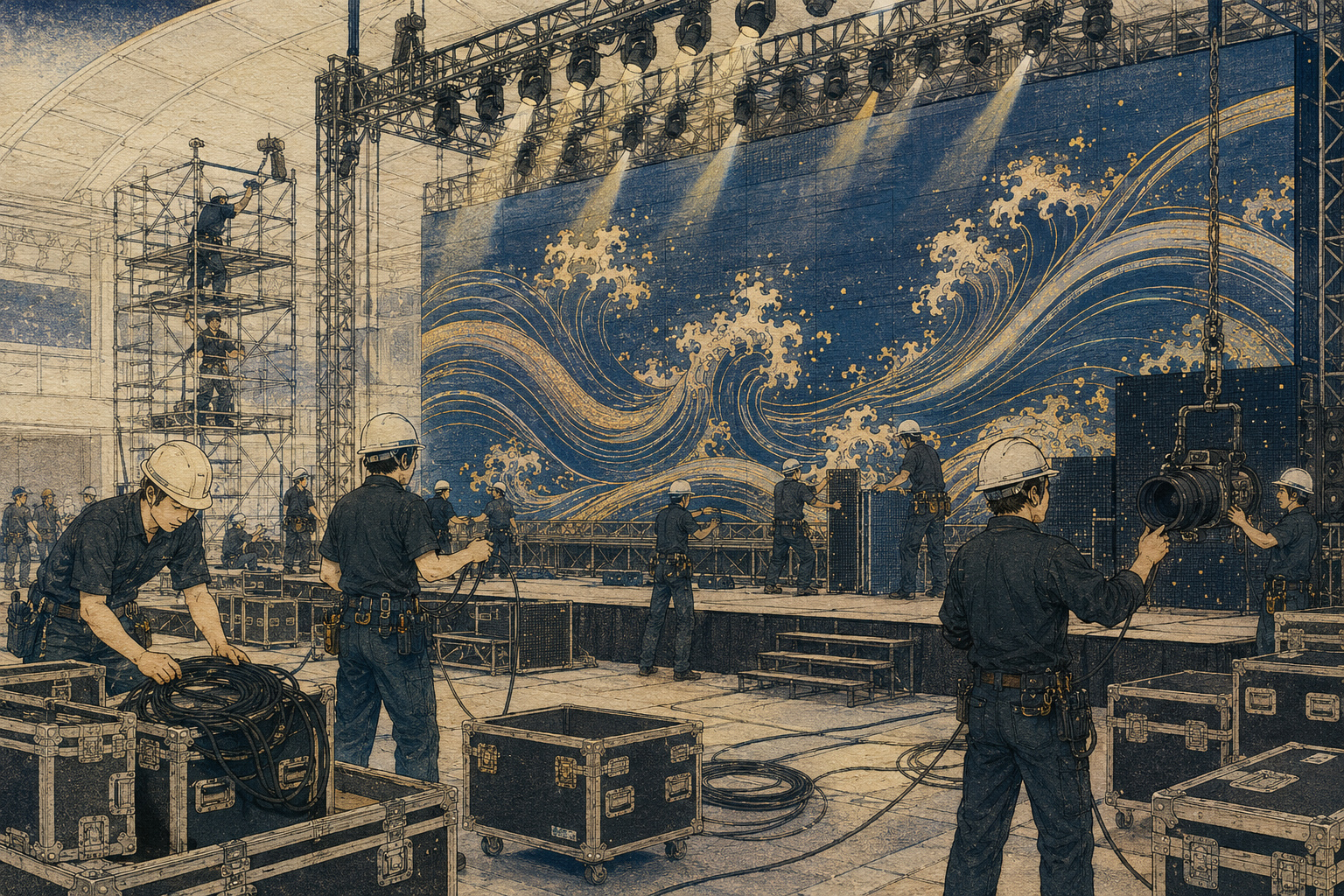
The story begins not with a gleaming trade-show floor, but with a gap in a rental plan. POINTYES says it was preparing a Jiangsu cultural-tourism event in Tenjin Central Park for June 18, 2024 and could not readily arrange the roughly 360-inch LED screen it wanted in Fukuoka. The company’s answer was unusually direct: it bought the screen itself.
That purchase gave a business founded around digital gateways a physical center of gravity. POINTYES was established in Fukuoka in June 2015 by representative director Ren Shunli. Its older corporate profile lists agency work for Alipay and WeChat Pay, social media and video advertising, multilingual content-management systems, cross-border e-commerce and real estate. Its newer sites present a broader operation: LED walls, sound reinforcement, lighting, live streaming, photography and video, stage construction, equipment rental, web systems and artificial-intelligence tools.
On July 28, 2026, the company said it had joined the Fukuoka Convention & Visitors Bureau as a supporting member and would strengthen event production across Fukuoka and Kyushu. Three days later it announced P-MIX Studio, Mac software designed to gather videos, images, music, PDFs, subtitles and logos into one show-control interface. Another release introduced S-Pro, a simpler tool for placing freshly shot photographs into a music-backed slideshow without first exporting a video.
The sequence matters. This is not merely a rental company adding more boxes to a warehouse. It is a small, privately held company trying to own a chain: build the content, carry and assemble the display, provide the sound and light, operate the show, record the result, distribute the story and write software around problems its crew encounters backstage.
The screen that changed the direction of the company
The 2024 release described a modular wall eight meters wide and 4.5 meters high—a 16:9 rectangle with a diagonal just over nine meters, or about 361 inches. POINTYES advertised 3.91-millimeter pixel pitch, 3,840-hertz refresh, 5,000-candela-per-square-meter brightness and IP65-rated panels. It said the system could be used indoors or outdoors and assembled in different sizes.
Those specifications describe possibilities, not a finished event. Pixel pitch is the distance between adjacent light points; at 3.91 millimeters, an eight-meter-wide image is approximately 2,046 pixels across. Refresh rate matters when cameras film the screen, but flicker-free results still depend on shutter settings, scan behavior, processing and testing. An IP rating for a panel does not make every connector, power-distribution box, data line, support structure or work practice weatherproof. A bright wall can overcome daylight; it can also produce glare, draw substantial power and become a large surface exposed to wind.
The company’s current rental catalog shows how the inventory has been divided into products. It lists a three-by-two-meter wall at ¥308,000 per day, a 4.5-by-2.5-meter 200-inch wall at ¥660,000, the eight-by-4.5-meter system at ¥1.76 million, and other sizes. It also lists 500-by-500-millimeter P3.91 IP65 panels and NovaStar controllers. These are advertised figures on the company’s own site, not independent market averages or complete event quotations. Transport, labor, truss or ground support, ballast, power, signal distribution, operator hours, rehearsal, overtime, permits and restoration may change the delivered cost.
| Company-listed item | Advertised daily price | Approx. US dollars | What a buyer still needs to establish |
|---|---|---|---|
| 3 × 2 m LED wall | ¥308,000 | $1,934 | Pixel dimensions, support method, transport, crew and content testing |
| 4.5 × 2.5 m / 200-inch wall | ¥660,000 | $4,144 | Exact aspect ratio, controller, power, installation and operator scope |
| 8 × 4.5 m / 361-inch outdoor wall | ¥1,760,000 | $11,052 | Wind plan, structural responsibility, ballast, weather stop rules, power and redundancy |
| 500 × 500 mm P3.91 panel | ¥11,000 | $69 | Quantity, spares, receiving cards, calibration and compatible cabinet batches |
The dollar conversions use the reference rate displayed on this page and are not transaction quotes. More important, multiplying panel prices is not a safe way to estimate a show. An LED wall is a system. The visible square is only the most photogenic part.
What “one-stop” production actually has to connect
An organizer may reasonably prefer one accountable supplier. Content designers can know the exact canvas before making graphics. Camera operators can test how the screen photographs. The lighting desk can avoid colors and exposure levels that destroy the image. The audio team can place speakers without blocking sightlines. A single production manager can maintain one cue list instead of reconciling five.
Fewer handoffs can reduce delay and ambiguity. They do not eliminate specialist work. The wall must be loaded in without damaging the venue, supported within engineering and venue rules, supplied by correctly distributed power, mapped to the processor, calibrated, tested with final content and protected from the public. The show caller needs a reliable communications path to video, audio, lighting, stagehands, performers and venue staff. The streaming crew needs isolated audio, capture hardware, a network plan, privacy permissions and a failure message. Every item needs an owner.
| Production layer | Question before contract | Evidence before doors open |
|---|---|---|
| Structure and venue | Who designs, approves, builds and signs off the support or rigging? | Venue approval, load/ballast plan, exclusion zone and inspection record |
| Power | What is the real maximum and normal load, and who supplies distribution? | Circuit schedule, grounding, protection, cable ramps and tested backup |
| Video signal | What is the native pixel map from playback device to LED processor? | End-to-end test, spare signal path, saved configuration and black frame |
| Content | Who owns aspect ratio, codecs, fonts, subtitles and last-minute versions? | Approved master folder, checksum/version log and rehearsal cue sheet |
| Sound and lighting | Who controls coverage, radio frequencies, sightlines and camera exposure? | Sound check, lighting focus, frequency coordination and show-call protocol |
| Recording and stream | Who owns consent, music rights, network capacity and failure recovery? | Release process, rights list, local recording, line test and outage slate |
| Safety and closeout | Who can stop the show, and who documents incidents and damage? | Emergency roles, weather thresholds, egress check and signed handover |
Japan’s Theatre and Entertainment Technology Association, JATET, maintains standards and safety materials covering theater machinery, lighting, sound, electrical connections, work from ladders and elevated platforms, load-in and stage communications. Its 2025 stage-communications guideline updated a standard first issued in 1995. That history is a reminder: the most advanced screen on a stage still depends on people being able to warn one another quickly and unambiguously.
P-MIX turns a backstage frustration into software
P-MIX Studio is the clearest expression of POINTYES’s effort to connect its digital origins with its new physical work. The software arranges media as “scene cards.” An operator can prepare video, still images, music, PDF pages, subtitles and logos, preview the next item silently, and then send it to the program output for an LED screen or projector. The company lists CUT, MIX and fade-to-black transitions, keyboard and MIDI control, layers and looping.
The interface can be displayed in 49 languages. That is useful for multinational crews, but the distinction in the company’s own release is important: P-MIX does not translate the presentation, subtitle file, PDF or video content. Multilingual content still needs translation, review, typeface support, line-breaking, pronunciation guidance and a person empowered to correct errors.
The August 1 press release promoted a ¥19,800 one-time license at an introductory ¥5,000 and emphasized no monthly fee. The current public product page now offers a seven-day full-feature trial, a ¥19,800 one-time license for the current major version, and a ¥980-per-month subscription that includes future updates. In other words, the launch release no longer describes the full pricing choice. A customer should check the live product page, license terms, supported macOS versions and update policy at purchase.
POINTYES also published a hypothetical cost comparison: three operators plus rented playback and switching equipment at roughly ¥160,000, versus one operator, an existing Mac and the introductory app at roughly ¥30,000 for a first event. It calculated an 81 percent reduction. This was a company-designed illustration—not a documented customer outcome, benchmark or guarantee. The release itself notes that personnel, inputs, outputs, streaming and backup requirements vary by event.
| P-MIX statement | Publicly supported | Not established publicly |
|---|---|---|
| Scene-based video, image, audio, PDF, subtitle and logo playback | Described on the product page and release; trial offered | Performance with every codec, resolution, adapter and Mac model |
| Preview/program workflow and external output | Described and demonstrated by the developer | Independent latency, dropped-frame, crash and recovery measurements |
| 49-language interface | Explicitly claimed; content is not auto-translated | Quality review of every interface translation |
| Smaller crew may operate some events | Plausible for a prebuilt, limited-input show | A universal one-person requirement or a safe substitute for backup |
| Market adoption | Product is publicly offered | Downloads, paid users, repeat users, named customers or incident history |
The right test is not whether one Mac can play every asset during a demonstration. It is whether an operator can recover at 7:58 p.m. when a keynote speaker brings a revised deck, one video uses an unsupported codec, the display handshake changes, the sound file is normalized badly and the event must begin at eight. Simplification is valuable when it shortens recovery. It is dangerous when it disguises a single point of failure.
For a school ceremony or modest corporate meeting, one rehearsed operator and one primary machine may be proportionate—provided there is at least a known fallback. For a paid broadcast, safety-critical cue, international congress or large concert, a duplicate playback path, independent switching, locally stored assets, spare adapters, recorded safety content and another trained person may still be necessary. “One laptop” is an operating option, not a resilience strategy.
Fukuoka was an event city long before MICE had a name
Modern event-industry language can make the gathering seem invented by convention centers. Hakata’s calendar says otherwise. Hakata Matsubayashi, the ceremonial root of today’s Hakata Dontaku, is said to date to 1179. Hakata Gion Yamakasa traces its traditional origin to 1241, when the monk Enni is said to have been carried through a plague-stricken town while sprinkling purifying water. Their historical details have accumulated legend, but their operational truth is plain: routes, roles, costumes, objects, rehearsals, crowd movement, sound and timing have been coordinated here for centuries.
The technology changed while the civic habit persisted. Fukuoka Civic Hall opened in 1963 with concert, theater and conference functions and served the city for 61 years. Sony’s giant Jumbotron at the 1985 Tsukuba Expo showed what an electronically assembled public image could become: a 2,000-inch descendant of an earlier light-emitting screen. The efficient blue LEDs developed by Isamu Akasaki, Hiroshi Amano and Shuji Nakamura in the 1980s and 1990s made bright full-color and white-light applications far more practical; the three shared the 2014 Nobel Prize in Physics.
Fukuoka’s purpose-built venue network expanded in parallel. Marine Messe Fukuoka opened in 1995, the year the city hosted the Universiade. Hakataza opened in 1999 as a theater able to present kabuki, musicals, Takarazuka and concerts. Fukuoka International Congress Center followed in 2003. Marine Messe B opened in 2021 with capacity for as many as 6,000. On March 28, 2025, the new Fukuoka Civic Hall opened with a roughly 2,000-seat large hall, an 800-seat middle hall and a 150-seat small hall, inheriting the old hall’s role.
1179 — Traditional origin attributed to Hakata Matsubayashi, ancestor of Dontaku.
1241 — Traditional origin attributed to Hakata Gion Yamakasa.
1963 — Fukuoka Civic Hall opens; it closes after 61 years in March 2025.
1985 — Sony displays a 2,000-inch Jumbotron at the Tsukuba Expo.
1995 — Marine Messe Fukuoka opens; Fukuoka hosts the Universiade.
1999 / 2003 — Hakataza and Fukuoka International Congress Center open.
2014 / 2015 — Meeting Place Fukuoka is created; POINTYES is founded the next year.
2021 — Marine Messe Fukuoka B opens.
2024 — POINTYES says a hard-to-source wall leads it to buy its 361-inch system.
2025 — A second airport runway begins service and the new civic hall opens.
2026 — POINTYES announces FCVB supporting membership and P-MIX/S-Pro.
The lineage is not a claim that a modular LED wall is a new yamakasa float. It shows why event production belongs to a wider civic history. The craft is the temporary assembly of attention: helping a crowd see, hear and move together, then taking the structure apart without erasing the memory.
A convention economy built around an Asian gateway
MICE stands for meetings, incentive travel, conventions and exhibitions or events. The acronym gathers together very different occasions—a medical congress, corporate reward trip, trade exhibition and cultural festival—but they share a supply chain. Visitors need transport, hotels, interpretation, food, security, signs, registration, temporary labor, staging, communications and media. The city describes services as about 90 percent of its economy, so a successful event spreads work well beyond the room where the keynote speaks.
Fukuoka created Meeting Place Fukuoka in April 2014 as a specialist one-stop organization for bidding and supporting business events. The city’s geography helps. The airport is close to the center; Hakata Port faces Asian routes; Kyushu’s rail network converges on Hakata Station. On March 20, 2025, Fukuoka Airport’s second runway entered service. Eight days later the expanded international terminal held its grand opening with greater security-processing capacity and a substantially larger post-security commercial area.
By the Japan National Tourism Organization’s definition—at least 50 participants from at least three countries including Japan, excluding online attendees—Fukuoka hosted 131 international meetings in 2024. That was 1.6 times the previous year and placed the city third in Japan. Nationally, 1,702 qualifying meetings drew about 1.241 million attendees, including about 159,000 from overseas.
Recovery was incomplete. Japan’s 2024 meeting count was only 58.6 percent of the 2019 total, although foreign attendance had returned to 82.8 percent. That gap suggests larger attendance per recovered meeting and an uneven post-pandemic market. A local supplier should not build its investment case from one rebound percentage. It needs a balanced book across congresses, concerts, hotel banquets, civic programs, school events, festivals, exhibitions and corporate meetings.
The 2026 calendar shows the scale Fukuoka seeks. The Asia Oceania Geosciences Society meeting was scheduled for August 2–7 at Fukuoka International Congress Center and Marine Messe B, with about 4,000 participants from roughly 50 countries expected. The Japanese Society for Palliative Medicine scheduled its June congress across the convention center and both Marine Messe halls, with 8,000 expected. These are organizer forecasts, not attendance results. They nevertheless show why regional capacity is more than a building: thousands of cues, files, name signs, microphones, meals, hotel rooms and journeys have to agree for a few days.
Why a Kyushu-based supplier can matter
A local supplier can visit a venue before the bid, measure the load-in path, learn the house power and make a second trip without an airline ticket. Spare panels and cables can be hours rather than a flight away. Local crews know where trucks can wait, which hall rules are strict, how rain moves through an outdoor park and whom to call when a schedule slips. Money spent on storage, transport, freelance labor and repair may circulate within the regional economy.
POINTYES also brings a cross-border origin. Its early payment and multilingual-web work was aimed partly at Chinese-speaking commerce. Its current portfolio includes a company-reported 1,000-person incentive dinner at the Hilton Fukuoka Sea Hawk, a cultural event connected to Jiangsu and an opera at Fukuoka Civic Hall. Those examples suggest a niche at the boundary of inbound events, Chinese-language relationships, content and production. They are self-published case studies; no independent client evaluation was located.
The opportunity is wider than Fukuoka City. Kyushu’s organizers often face a choice between bringing equipment and senior crew from a distant metropolitan supplier or assembling several local specialists. A regional integrator may reduce freight, handoffs and translation. It can also collaborate with established sound companies, riggers, electricians, interpreters, staging houses and venue technicians rather than pretending to replace them.
That collaborative boundary is crucial. The company’s public pages do not disclose employee count or distinguish, for each job, staff from subcontractors. Buyers should ask who will actually appear on site, which company employs them, what qualifications and venue experience they have, what insurance applies, who owns design liability and whether substitutions require approval. Small-company flexibility is an advantage only when the responsibility chart is bigger than the founder’s phone.
Small crews need stronger systems, not heroic fatigue
Live events celebrate invisibility. If the program begins on time, the audience never sees the missing adapter found at noon, the mislabeled file corrected during sound check or the panel replaced before doors. That encourages a dangerous mythology: a talented operator can save anything. The result can be chronic overtime, undocumented improvisation and knowledge stored in one person.
JATET’s 2026 safety handbook for stage-sound equipment covers load-in, ladders, elevated work platforms, appropriate clothing and fall-arrest equipment. Its machinery group has separately studied accidents in small halls, schools, gymnasiums and commercial facilities. Smaller venues and events are not exempt from professional risk; they may have fewer house technicians and less forgiving infrastructure.
- Scope matrix: every deliverable, exclusion, subcontractor and approval owner.
- System drawing: power, signal, network, audio, control and backup paths.
- Asset manifest: serials or unit counts, firmware, spares and maintenance status.
- Show file: cue list, version-controlled media, contact sheet and stop authority.
- Recovery plan: black screen, frozen playback, lost audio, rain, wind, illness and network outage.
- Closeout: incident/near-miss log, damage record, media handoff and client review.
P-MIX could help if it makes that discipline easier—one visible scene order, fewer hidden desktops, a known preview state and faster last-minute replacement. It would be stronger with a published hardware-compatibility list, versioned release notes, offline license behavior, sample stress tests, crash-recovery instructions, exportable show reports and a clear major-version support policy. In professional markets, trust grows not only from adding features but from documenting limits.
Training matters too. The Fukuoka Global MICE School, run since fiscal 2019 by the city and convention bureau, combines lectures with field experience and is designed to introduce students to the industry. The city says more than 100 students participate annually in its MICE learning initiatives. Technical production needs to be visible inside that pipeline: cable safety, stage communications, accessible presentation design, media rights, network basics and the quiet discipline of a load-out at midnight.
Rental can support sustainability—but LED is not automatically green
A rental model can spread one modular system across many users and repair a failed cabinet rather than discard an entire display. Local storage may reduce some long-haul freight. A bright LED wall may replace printed scenery or materials made for one event. Those are possibilities, not a life-cycle conclusion.
Large displays consume electricity. Trucks move heavy panels and structures. Electronics contain embodied materials and eventually become waste. Maximum brightness may be unnecessary indoors. An organizer who wants a sustainability claim should ask for measured kilowatt-hours at the actual brightness, transport distance and vehicle type, equipment life, repair rate, packaging, end-of-life route and the amount of temporary material genuinely avoided—not simply repeat that LEDs are efficient.
JNTO acknowledges that MICE creates economic and social benefit while carrying high environmental impacts through the movement of people and goods. ISO 20121:2024 asks event organizations of every size to manage social, economic and environmental effects, including rights and legacy. Neither framework awards automatic virtue to a particular screen. The principle is management: set a baseline, make a choice, measure the result and state what remains.
POINTYES could turn its local position into an advantage by publishing power ranges for typical wall sizes, using reusable cable protection and packaging, tracking panel repair, consolidating transport and offering a post-event resource report. It could also measure local freelance spend and training hours. Sustainability is not only carbon; decent work, accessibility, neighborhood effects and durable regional skills belong in the account.
The right scoreboard for the next three years
Membership announcements and equipment photographs are leading indicators at best. The test of this expansion is whether the company becomes a dependable part of Kyushu’s production fabric without outrunning its systems or finances. Because current employee, revenue and profit figures are not public, outsiders cannot determine how large the event operation is or how much risk the LED purchase placed on the balance sheet.
A large screen is a depreciating asset with storage, repair, transport and utilization costs. A low advertised rental price can win attention and still lose money after crew time and freight. A high price can be good value if it includes engineering, rehearsal, redundancy and an experienced team. The useful metric is contribution after delivery cost, not the number of square meters shown on a website.
| Expansion claim | Evidence worth publishing | Why it matters |
|---|---|---|
| Regional service is growing | Paid events by prefecture, venue type and repeat-customer share | Separates broad availability from recurring demand |
| Integration lowers cost | Comparable quotes, actual crew hours, freight and change-order totals | Tests the one-stop premise without hiding scope |
| Shows are reliable | On-time starts, incidents, near misses, backup activations and recovery time | Turns “professional quality” into accountable operations |
| P-MIX reduces complexity | Named deployments, configuration, operator count and before/after results | Replaces a hypothetical estimate with field evidence |
| The region benefits | Kyushu supplier spend, freelance days, apprenticeships and repair work | Shows whether value remains locally |
| Production is sustainable | Energy, transport, reuse, repair, waste and accessibility measures | Prevents a technology label from becoming an impact claim |
Clients have a role in that maturity. They should request itemized scopes, compare equivalent levels of backup, pay deposits and change orders on time, allow enough rehearsal, and resist cutting the least visible safety position because nothing failed last time. Public venues and convention organizations can help small suppliers by making technical rules, load-in conditions, approved connection points and procurement pathways easy to find.
POINTYES’s own history offers the most persuasive reason to watch. The company did not begin by declaring itself a full event producer. It encountered a missing piece, bought it, learned around it and then began writing tools for the friction surrounding it. That pattern—solve a concrete local problem, then widen carefully—is how a small business can become infrastructure.
Fukuoka has spent centuries assembling temporary cities of attention, from Matsubayashi processions and Yamakasa routes to opera houses, waterfront exhibitions and scientific congresses. The technology in the center keeps changing. Lantern, curtain, projector and LED wall each ask the same question of the people behind them: can everyone see, hear, understand and return safely?
A 361-inch screen can make a company look large for an evening. The more meaningful achievement would be quieter: a crew that documents what it knows, a client that returns, a student who becomes a skilled technician, a panel repaired instead of discarded, a failure caught by the backup nobody in the audience noticed. That is how a little company earns a lasting place backstage—and how an event economy becomes regional rather than merely located in a region.
Reporting notes and principal sources
This article reviews public information available through August 11, 2026 at 8:06 AM JST. Company services, equipment specifications, inventory, case studies and software functions are attributed to POINTYES and were not treated as independently verified performance. Dollar equivalents use ¥159.25 per US dollar. Forecast attendance for 2026 events is not reported as final attendance.
- POINTYES corporate profile: June 2015 founding, ¥8 million capital, representative and original business lines
- POINTYES current services, July 28 supporting-membership announcement and self-published case studies
- POINTYES 2024 release: reason for purchasing the 361-inch wall and company-stated specifications
- POINTYES rental catalog: current advertised wall sizes, daily prices, controllers and panel inventory
- POINTYES release: P-MIX features, launch pricing and hypothetical cost comparison
- P-MIX current product page: trial, one-time and subscription options
- POINTYES release: S-Pro purpose, language support and launch terms
- Fukuoka Convention & Visitors Bureau: 131 qualifying international meetings in 2024 and JNTO criteria
- JNTO: 2024 national international-meeting count, attendance and comparison with 2019
- Fukuoka City: MICE definition, economic role and learning programs
- FCVB: history and structure of the Fukuoka Global MICE School
- FCVB: planned scale and venues for AOGS 2026
- FCVB: planned scale and venues for the 2026 Japanese Society for Palliative Medicine congress
- Fukuoka City chronology: Marine Messe in 1995 and International Congress Center in 2003
- Fukuoka City: Marine Messe B’s 2021 opening and maximum capacity
- Fukuoka Civic Hall: March 28, 2025 opening and hall functions
- Hakataza: 1999 opening and performance history
- Hakata Machiya Folk Museum: traditional 1179 origin of Hakata Matsubayashi
- Hakata Machiya Folk Museum: traditional 1241 origin of Hakata Gion Yamakasa
- Fukuoka Airport: second runway and international-terminal expansion in 2025
- Sony: light-emitting large-screen history and 1985 Jumbotron
- Nobel Prize: efficient blue LEDs and the 2014 physics prize
- JATET: 2026 stage-sound safety handbook and technical guidance
- JATET machinery group: safety materials and study of accidents in small facilities
- JNTO: sustainability opportunities and burdens in MICE
- ISO 20121:2024 event-sustainability management standard