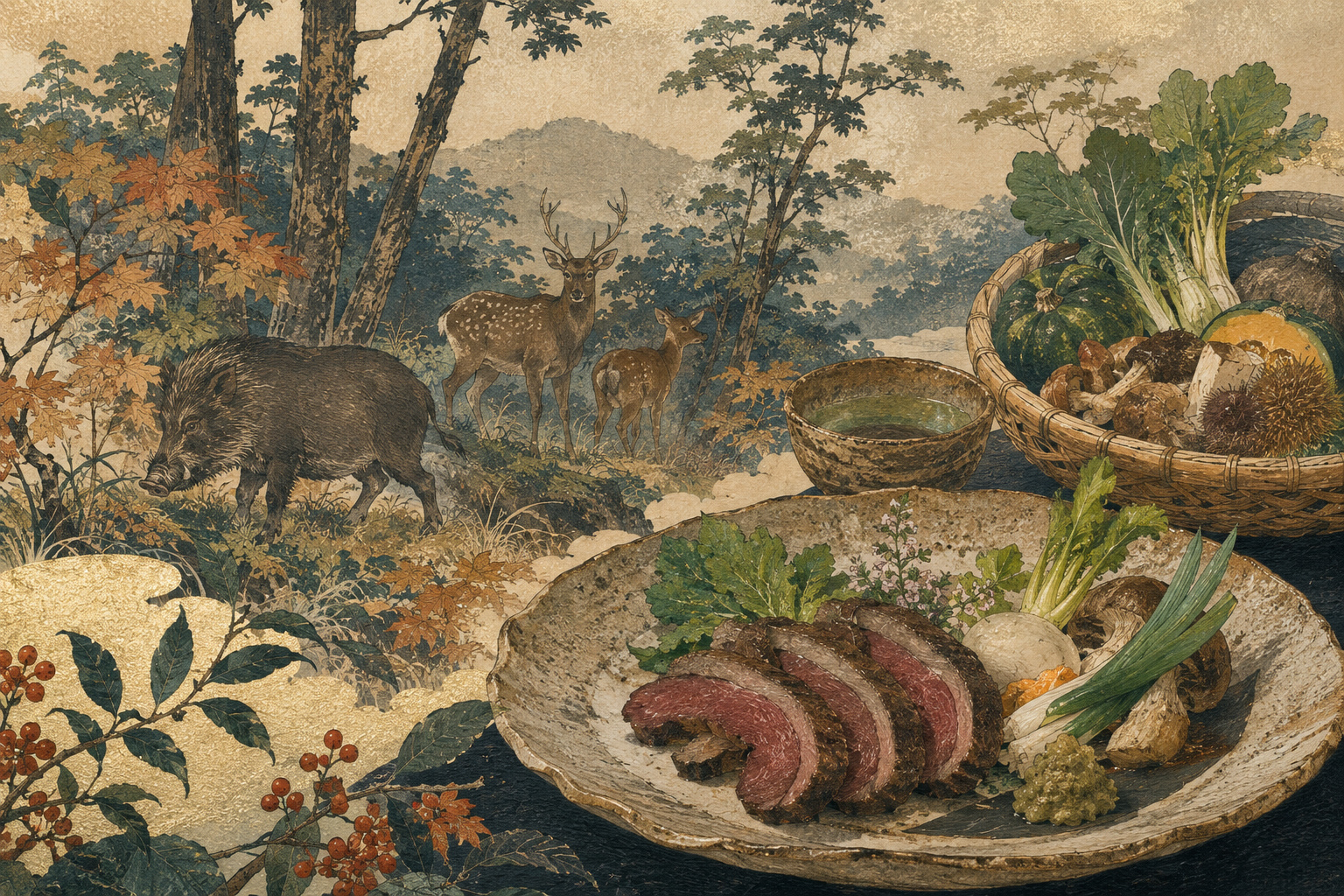
The clock begins before the animal reaches the door. Somewhere beyond the edge of a Fukuoka field, a trap has closed or a shot has been taken. The carcass now carries two incompatible stories. To the farmer, it may represent seedlings uprooted in a night, a broken fence and another reason to wonder whether next season is worth planting. To a cook, it might contain deep-red venison or pale-ribboned boar with the character of the woods.
Between those stories stands a processing room: washable walls, knives, hooks, thermometers, records and the authority to say no. The most important skill inside is not romantic but selective. An animal that is diseased, badly damaged, contaminated, improperly handled or too slowly delivered must be rejected from the human food chain. “Using everything” is an attractive slogan. Safe gibier begins by admitting that some things cannot be used.
At the Buzen Gibier Center, which the city opened in fiscal 2018, accepted carcasses are washed and inspected, suspended so they do not touch the floor, skinned and eviscerated, then cooled. The city describes a controlled aging stage before trimming, vacuum packing and rapid freezing at minus 30 degrees Celsius. A metal detector searches for fragments. An individual number connects the package to when and where the animal was caught, by whom and by what method.
That number is the quiet center of the modern gibier project. It turns an anonymous body from the mountain into a documented food product. In March 2026, Fukuoka gained another nationally certified link when “Ukiha Shizen no Gibier-niku Ukina7,” operated by Rural Pride, became the 43rd facility in the Domestic Gibier Certification system. The certificate covers deer and boar and tests compliance with hygiene, standardized cutting, labeling and traceability requirements.
Not one center, but a regional chain
The headline is easiest to understand as a map. In eastern Fukuoka, Buzen’s municipal center connects damage control with city-run resource use. In western Fukuoka, Itoshima Gibier Workshop, operated by Tracks, received national certification in 2024. Inland at Ukiha, Ukina7 joined the certified network in 2026. Downstream are direct-sale shops, online retail, campgrounds, food manufacturers and restaurants from rural towns to central Fukuoka City.
Fukuoka Prefecture has cultivated the dining end of this chain for more than a decade. It says it has held an annual Fukuoka Gibier Fair since fiscal 2013. Its approved-shop program lists venues serving the meat in forms that do not fit a single rustic stereotype: deer roast, young-deer cacciatore, boar pâté, kushikatsu, shabu-shabu, char siu and shumai.
At OLLY Befu kitchen, a 16-seat Italian restaurant near Befu Station, the bridge becomes small enough to see. A 2026 profile described the husband-and-wife operation using boar and deer from the Buzen center alongside seasonal Kyushu ingredients. The processor does not need every diner to become a hunter. It needs chefs able to turn variable cuts into something people choose twice.
The chain also runs upstream. Fukuoka’s One Health registry says the Buzen facility cooperates with pathogen monitoring and seeks to avoid simply discarding captured wildlife. Itoshima has become a training site for dismantling and processing, with a national association scheduling another session for September 2026. A center can therefore be a slaughter and cutting room, a data point, a classroom and a rural public utility at the same time.
Before “gibier,” Japan already ate the forest
The French word gibier makes the cuisine sound imported. The regulatory system and restaurant styling are modern; the food relationship is ancient. Jōmon refuse deposits and hunting tools show that deer and wild boar were among the animals eaten by communities in the archipelago thousands of years ago. Northern Kyushu’s archaeological record belongs to that wider history of hunting, gathering and fishing.
Later prohibitions did not create a simple millennium of vegetarian Japan. In 675, Emperor Tenmu’s edict restricted consumption of cattle, horses, dogs, monkeys and chickens during part of the year. Deer and boar were notably outside that list. Buddhist ideas, court rules, status, locality and necessity shaped practice unevenly. Fish remained central, while hunting and game consumption persisted especially beyond elite urban tables.
Edo-period documents puncture another tidy myth. Historical research records deer and boar damaging fields around the Kanto plain throughout the period, while dietary research finds deer salted or dried and boar and deer prepared in winter pots. Names such as botan for boar and momiji for deer are often remembered as euphemisms, alongside yamakujira—“mountain whale”—for boar. Meat might be framed as medicinal eating, but it was eating nonetheless.
In the Meiji era, beef acquired the symbolism of Western civilization. The emperor’s public association with meat eating in 1872 helped make livestock meat an emblem of modernization. Wild game, paradoxically, could seem older and lower in status even though it had never vanished. Today’s plated venison reverses the hierarchy again: the forest animal may be marketed as local, lean, artisanal and scarce.
Jōmon millennia Deer and boar bones, along with hunting tools, testify to long use of wild animals for food.
675 Emperor Tenmu’s seasonal prohibition names cattle, horses, dogs, monkeys and chickens—not deer or boar.
Edo period Game continues as preserved food, winter pots and “medicinal” meat while wildlife also damages farms.
1872 Imperial meat eating helps beef signify Meiji modernization and Western-style nutrition.
2014 Japan issues a national hygiene guideline for wild game meat after food-safety concerns.
2018 The Domestic Gibier Certification system begins; Buzen opens its municipal center in the same fiscal year.
2026 Ukiha’s Ukina7 becomes the 43rd certified facility, extending Fukuoka’s processing map.
Why the animals moved back into human space
It is tempting to say that deer and boar “invaded.” The landscape tells a more reciprocal story. Japan’s postwar rural transformation concentrated people in cities, reduced the number of residents working regularly at forest and field edges, and left more farmland idle. The satoyama border that once required constant cutting, gathering, grazing and watching became quieter in many places.
At the same time, the people expected to manage wildlife became fewer and older. The Environment Ministry has repeatedly identified decline and aging among hunters as a management problem. A 2014 legal reform created systems for prefectural capture programs and certified capture businesses, moving part of the work from volunteer-like local effort toward planned, professional operations.
These forces do not operate identically everywhere. Boar and deer respond differently to food, snow, cover, disease and capture pressure. Population estimates are models, not headcounts. The ministry’s April 2026 release put deer at a median estimate of about 3.03 million nationwide and boar at about 1.22 million, with very broad 90-percent credible ranges. The honest lesson is not a single precise number; it is that wildlife management must be monitored and revised.
Japan originally aimed to halve deer and boar populations by fiscal 2023 from the 2011 baseline. When deer remained high and the target proved unattainable, the government extended the deadline to fiscal 2028. Capture is one instrument. Effective damage control also requires fencing, removing attractants, managing habitat around settlements and targeting the particular animals repeatedly entering fields.
- A deer browsing rare understory plants can damage an ecosystem; the same species at another density is part of that ecosystem.
- A boar inside a rice field is a serious farm problem; the animal is following food, cover and learned routes.
- Population management asks how many animals a landscape can sustain and where—not whether a species is morally “bad.”
- Gibier use occurs after a capture decision. Demand for meat should not determine conservation targets.
The damage ledger leaves out despair
For fiscal 2024, the Ministry of Agriculture counted ¥18.8 billion in nationwide crop damage from wild birds and mammals, up ¥2.4 billion from the previous year. Deer accounted for ¥7.9 billion and boar for ¥4.5 billion. The reported area was 44,000 hectares and the volume 730,000 tonnes. Those are large numbers—and still an incomplete invoice.
Official explanations repeatedly warn that damage estimates do not capture a farmer’s lost will to plant, the spread of abandoned land or the eventual decision to leave agriculture. One destroyed crop can be replanted. Repeated nighttime raids change investment: fewer seedlings, fewer fruit trees, less maintenance, then no field. The landscape that made wildlife management harder becomes harder still.
There is also a forest beyond the farm ledger. The Forestry Agency recorded about 4,000 hectares of forest damage in fiscal 2024, roughly 60 percent attributed to deer. Browsing can strip understory vegetation and prevent tree regeneration; bark damage can injure planted forests. Fukuoka has carried out designated deer capture since fiscal 2016 around Mount Hiko and Inugatake to reduce ecological harm in the Yaba-Hita-Hikosan Quasi-National Park area.
Converting some captured animals into food cannot repay all of that loss. It can, however, change the final column. Without a usable outlet, a carcass creates disposal labor and cost after the already difficult work of capture. With a nearby facility and a willing market, part of the control program becomes saleable protein, local wages and a story urban consumers can taste.
| National indicator | Fiscal 2024 result | What it does—and does not—measure |
|---|---|---|
| Crop damage | ¥18.8 billion | Reported agricultural loss; excludes much ecological damage and many social consequences |
| Deer crop damage | ¥7.9 billion | Largest species category in the national agricultural total |
| Boar crop damage | ¥4.5 billion | Farm loss, not a valuation of all boar impacts or management costs |
| Processed utilization | 2,678 tonnes at 826 facilities | Meat and other recorded uses handled by surveyed processors, not every captured animal |
| Pet-food use | 830 tonnes, about 31% | A major outlet for usable material that does not become human food |
The narrow window from field to chiller
Domestic livestock arrive through a designed system. Their feed, medications, movement, slaughter and inspection can be standardized. A wild animal arrives from weather, mud, steep ground and an uncertain life history. It may have run after a shot, remained in a trap, suffered intestinal damage or been transported over mountain roads. The processor inherits every event before the door.
That is why field handling and time matter. Prompt bleeding, avoidance of digestive-tract contamination, rapid delivery and early cooling all influence safety and quality. A facility must know the capture location, time and method and must inspect the carcass and organs for abnormalities. If the chain fails, seasoning cannot repair it.
Buzen’s published method shows how value is manufactured through restraint. After the initial inspection and cleaning come skinning, evisceration and rapid cooling. The city then ages accepted meat for several days under controlled temperature and humidity, describing a process that tenderizes and reduces undesirable odor. After trimming and vacuum packing, rapid freezing at minus 30°C aims to limit drip loss. A metal detector addresses another field-specific hazard: projectile fragments.
Traceability follows the meat outward. The center says its individual number records who captured the animal, where and when, the capture method and the destination of the sold meat. National certification adds a common cut chart and labeling rules. These systems do not make wild meat identical. They make differences visible enough to manage.
“Natural” is not another word for safe
Wild meat carries a marketing halo: free-ranging, local, high in protein, connected to landscape. None of those qualities kills a pathogen. Japan’s health ministry warns that raw or undercooked deer and boar can transmit hepatitis E virus, enterohemorrhagic E. coli and parasites. Surveys have also detected Salmonella, Campylobacter, Trichinella and lung flukes in wild animals.
The rules are therefore categorical where fashion can be vague. Restaurants and retailers must obtain wild meat dismantled at a licensed meat-processing facility. Commercial processors operate under the Food Sanitation Act. Cooking must reach the center; knives, boards and other tools that touched raw meat require separation and sanitation. Freezing is useful for quality and logistics, but it is not a universal pathogen kill step.
Japan issued its national wild-game hygiene guideline in October 2014 and later updated supporting material. The Domestic Gibier Certification scheme, established in 2018, audits hygiene, cutting specifications, labeling and traceability. It gives buyers a stronger shared reference. It does not promise zero risk, certify every hunter or convert rejected carcasses into acceptable ones.
This is also where Fukuoka’s One Health language earns its place. Human health, animal health and environmental conditions meet in the same chain. Monitoring pathogens in wildlife can warn public-health and livestock systems; records from capture and processing make patterns easier to investigate. Respect for an animal is not proved by calling it clean. It is proved by handling it without denial.
| Stage | Primary question | Reason for rejection or control |
|---|---|---|
| Capture and recovery | Was the animal recovered promptly and handled cleanly? | Long delay, heat, severe damage or contamination can make food use inappropriate |
| Intake inspection | Are behavior, appearance, carcass and organs free of suspicious abnormalities? | Disease signs and unexplained lesions require exclusion under hygiene guidance |
| Processing | Can hide, viscera and meat be separated without cross-contamination? | Digestive contents, dirty tools and floor contact can spread hazards |
| Distribution | Is the product cold, labeled and traceable? | Broken temperature control or missing identity undermines accountability |
| Kitchen | Is the meat cooked through and raw-meat equipment sanitized? | Wild meat should not be served raw or undercooked |
A market must use more than the best loin
A chef can make a tender loin persuasive. A viable processing system must find uses for shoulders, shanks, trim, older animals and seasonal variation. Slow cooking, sausage, pâté, curry, dumpling filling and charcuterie are not lesser destinations; they are technologies for flavor, texture and whole-carcass value.
Fukuoka’s approved restaurant list reveals this culinary range. French and Italian kitchens can translate deer into roast or cacciatore. Chinese technique can place boar in shumai or char siu. Japanese menus can use shabu-shabu or skewers. The food becomes “regional” not because there is one authentic recipe, but because local capture and processing meet the county’s existing restaurant culture.
The lower-value fractions matter just as much. Nationally, processors utilized 2,678 tonnes of wild animals in fiscal 2024, more than double fiscal 2016. Pet food took 830 tonnes—about 31 percent. That outlet can absorb clean, suitable material for which the human-food market offers little return. Hides, antlers, bones and fat may create further products, although each adds labor, storage, regulation and uncertain demand.
Fairs help solve a different problem: unfamiliarity. Fukuoka has organized annual promotion since fiscal 2013, and 38 restaurants joined the 2026 prefectural fair. In March, a Kyushu-wide event in Tenjin even featured gibier ramen. A tasting can reduce the assumption that game must be tough or strongly scented. Repeat demand, however, depends on consistent handling long after the festival tent is gone.
- Supply is irregular: capture follows animal movement and management needs, not restaurant reservations.
- Yield is uncertain: age, sex, shot or trap damage, contamination and inspection affect what can be sold.
- Fixed costs are real: vehicles, chilled rooms, washable equipment, waste disposal, testing, records and trained labor operate even on slow days.
- Distance destroys value: a carcass too far from a plant may lose the safety and quality window before arrival.
- Every outlet counts: premium cuts alone rarely pay for the chain; processed food, pet food and non-food uses broaden recovery.
The paradox of making a pest valuable
A successful food market creates demand. Wildlife control aims, in some places, to reduce supply. That is the central paradox of commercial gibier. If restaurants come to depend on a constant volume, the conservation goal and the business goal can pull apart. The answer is not to abandon utilization; it is to keep the order of decisions clear.
First, scientists and public authorities set population and damage-management objectives. Then trained hunters or capture businesses remove designated animals under law. Only then does the processor ask which carcasses meet food standards. Marketing belongs downstream of ecology and public health, not above them.
Nor should a plate of venison distract from prevention. A fence that keeps a boar out of a field may be cheaper and more humane than repeated capture. Removing abandoned fruit, cutting cover around settlements and coordinating neighbors can reduce attractants. Targeted capture of animals that repeatedly breach defenses may work better than indiscriminate numbers far from the damage site.
The word “resource” also needs care. It can mean refusing waste after a necessary death. It can also make a living animal sound like inventory. Fukuoka’s better model is the network rather than the slogan: documented capture, a processor empowered to reject, pathogen monitoring, multiple uses, chefs who explain the ingredient and public agencies that continue to count the wildlife outside the market.
Dinner as a map of responsibility
At a Fukuoka restaurant, the finished plate may be elegant enough to conceal the argument that produced it. The sauce is glossy. The meat is sliced evenly. The forest has become garnish and menu prose. Yet the dish exists because a farmer protected a field, a trapper checked a device, a carcass reached a cold room, an inspector cut and looked, a worker wrote a number, and a cook accepted that this animal would not behave exactly like the last one.
That chain is what Fukuoka is building. Buzen offers a municipal foundation; Itoshima contributes certified processing and training; Ukiha’s 2026 certification widens the map; the prefecture’s restaurants give the meat somewhere to become culture rather than inventory. No single link solves wildlife damage. Missing any one can make the others futile.
The old history does not provide a simple moral. Jōmon hunters did not have modern crop statistics. Edo farmers did not have blast freezers, metal detectors or QR-linked records. Meiji beef eaters did not speak of One Health. What persists is negotiation across the boundary between settlement and woods: which animals may live where, what people owe the landscape, and what should happen after a life is taken.
The most honest gibier plate does not erase the boar’s night in the rice field or rename death as sustainability. It holds the contradictions together. The animal was not produced for the diner. The capture was not justified by appetite alone. But once the public decided it had to be removed, skill and infrastructure kept part of that life from becoming only a disposal problem.
That is a modest claim, and a demanding one. It requires clean rooms, short routes, rejection, cooking, data and enough customers to carry the cost. In Fukuoka, a regional food resource is not found in the forest fully formed. It is made—carefully, conditionally and one traceable animal at a time.
Reporting notes and principal sources
This article uses public information checked through August 11, 2026 at 8:06 AM Japan Standard Time. Facility dates and certification status come from municipal and national government records. The 38-restaurant figure is the prefecture’s count as of March 11, not a live census on publication day. National population figures are statistical estimates with broad uncertainty intervals. Crop-damage and utilization totals refer to fiscal 2024. Historical passages synthesize archaeological, peer-reviewed and public records; they do not treat Japan’s varied meat practices as a single nationwide custom.
- Buzen City: purpose, processing method, traceability and retail outlets of the Buzen Gibier Center
- Fukuoka One Health: Buzen Gibier Center registration and wildlife monitoring cooperation
- Ministry of Agriculture: March 4, 2026 certification of Ukina7 in Ukiha
- Ministry of Agriculture: 2024 certification of Itoshima Gibier Workshop
- Japan Gibier Promotion Association: 2026–27 processing and dismantling training schedule
- Fukuoka Prefecture: purpose and standards of the approved gibier restaurant program
- Fukuoka Prefecture: approved restaurant list, updated July 16, 2026
- Fukuoka Prefecture: annual Fukuoka Gibier Fair
- Gibierto: March 2026 profile of OLLY Befu kitchen and its use of Buzen gibier
- Ministry of Agriculture: fiscal 2024 national crop-damage statistics
- Ministry of Agriculture: fiscal 2024 wild-game utilization survey
- Ministry of Agriculture regional bureau: 826 facilities, 2,678 tonnes and pet-food share
- Environment Ministry: April 2026 deer and boar population estimates and fiscal 2028 target
- Environment Ministry: hunter decline, aging and certified capture businesses
- Forestry Agency: fiscal 2024 wildlife damage to forests
- Fukuoka Prefecture: designated deer management around Mount Hiko and Inugatake
- Health Ministry: wild-game food-safety risks, licensing and hygiene guidance
- Fukuoka Prefecture: safe handling and thorough cooking of wild meat
- Metropolitan Museum of Art: Jōmon hunting tools and evidence of deer and boar use
- Journal for the Integrated Study of Dietary Habits: game and meat culture in the Edo period
- Wildlife Conservation Japan: Edo-period deer distribution and crop damage around Kanto
- Agricultural History Society of Japan: the acceptance and ranking of meat in modern Japan