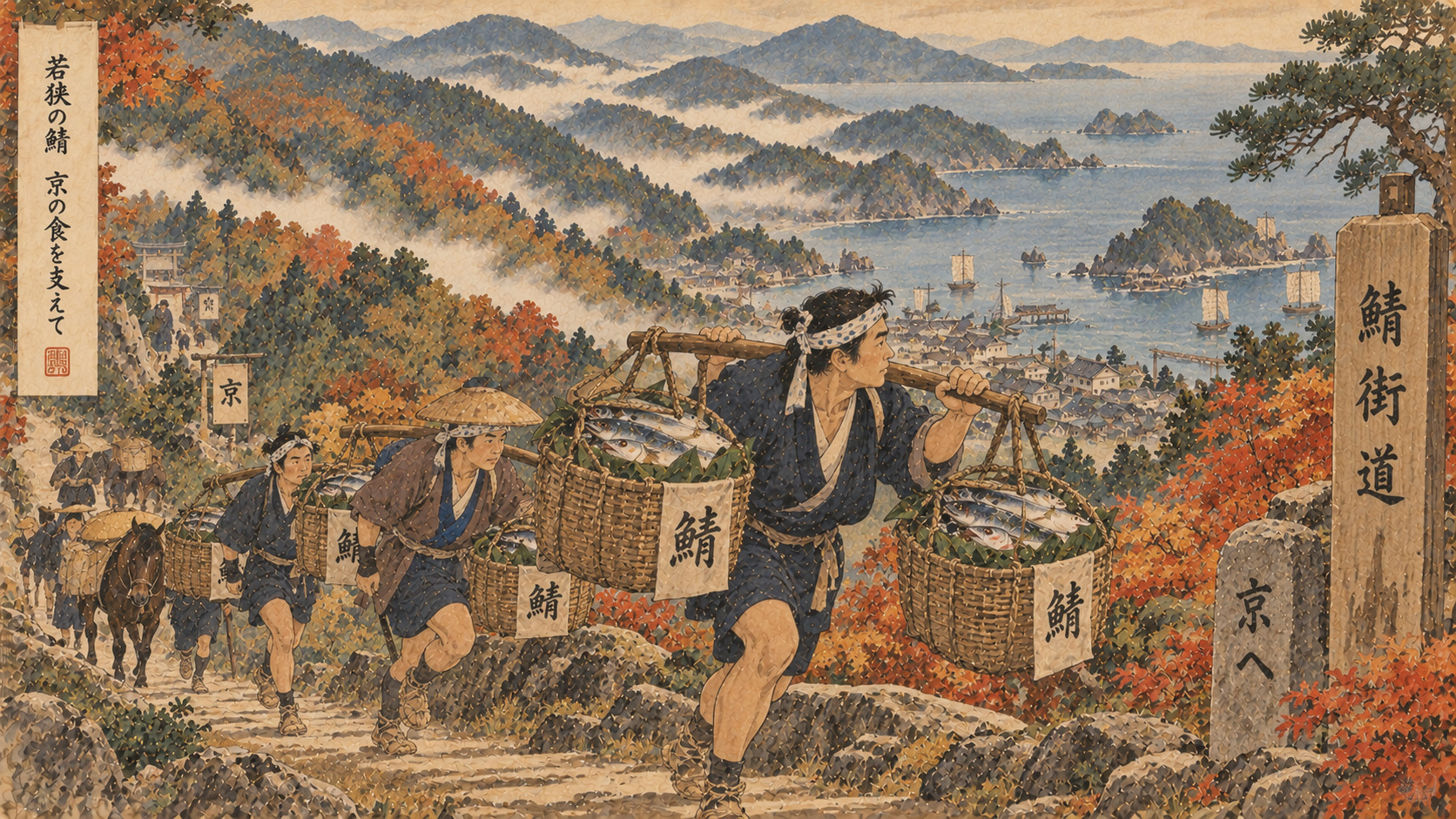
Kyoto’s celebrated food culture was sustained in part by the work of people far beyond its mountains.
The capital depended on a distant sea
Kyoto is celebrated for the refinement of its cuisine. Yet much of the history of that cuisine begins beyond Kyoto itself, over forested mountain passes on the shores of Wakasa Bay. In present-day Obama, Fukui Prefecture, fishermen, salters, merchants and porters helped connect the Sea of Japan to the old capitals. The Saba Kaido, commonly translated as the Mackerel Road, was never simply a picturesque trail. It was a supply network through which food, people, religion, skills and wealth moved in both directions.
Before the road had its modern name
Wakasa was counted among the miketsukuni, provinces that supplied food offerings to the imperial court. Salt and marine products crossed inland long before “Mackerel Road” became the familiar collective name for several routes to Kyoto. The Agency for Cultural Affairs places Wakasa within a history of exchange extending roughly 1,500 years. That does not mean an unchanged road operated throughout those centuries: the political centers, trade arrangements and routes evolved. What endured was Wakasa’s strategic position between maritime networks and inland consumers.
Obama: a port serving both ocean and inland Japan
Obama was situated at a pivotal junction. Ships arrived along the Sea of Japan coast, and routes through the mountains linked its markets to Kyoto. In 1607, according to the city’s heritage documentation, domain lord Kyogoku Takatsugu established a market near the harbor. Wholesalers, traders, boat operators and carriers crowded its commercial districts. Surviving market records refer to salted mackerel bound for Kyoto. There was nothing automatic about getting a perishable product across the mountains: the trade required buying, processing, loading, negotiations and considerable physical labor.
There was more than one Mackerel Road
Modern maps can mislead readers into imagining a single official highway. In fact, the Saba Kaido refers to a group of routes. The commercially important Wakasa Kaido passed through Kumagawa and Kutsuki toward Ohara and Kyoto. The Harihatagoe or Negorizaka route ran from the Onyu area, by Kaminegori and steep wooded passes toward Shiga and the capital. Parts of the latter remain old footpaths rather than modern roads. The slogan “Kyoto is far, but only eighteen ri away” evokes a journey of about 72 kilometers, although distance varied with route and destination.
Why mackerel mattered
Mackerel was abundant and familiar in Wakasa’s marine economy, but it spoils quickly. The solution before modern refrigeration was processing: remove vulnerable parts, apply salt, and carry the fish inland. The Ministry of Agriculture, Forestry and Fisheries explains that historical carriers could make the journey over roughly a day and that salting contributed to the texture and flavor prized by Kyoto consumers. Such descriptions are part of food history, not safe modern instructions for transporting unrefrigerated seafood. Preservation changed food into a tradable product, and in doing so helped create new cuisines.
A road that shaped the table
Kyoto’s pressed mackerel sushi, or saba-zushi, uses fish cured with salt and vinegar with rice. Its association with festivals and special occasions reflects how coastal fish became prized inland. Fukui preserved different traditions as well. Heshiko is strongly salted fish fermented or matured in rice bran, typically mackerel but not exclusively. Other regional delicacies include fermented nare-zushi, Wakasa small sea bream preserved with salt and vinegar, and seasonal fish marketed as Wakasa guji and Wakasa garei. Not every dish originated specifically on the road, and the broader history of regional seafood should not be compressed into one mackerel anecdote.
Culture crossed the mountains too
The same corridors that moved fish also carried religious images, merchants, performers and ideas. In Obama and along the routes survive wooden townhouses, temples, shrines, merchant gardens and festivals showing relationships with the old capital. Kumagawa-juku is a particularly evocative former post town. The Harihatagoe trail retains moss-covered Buddhist images and traces of older infrastructure. Rather than regard Wakasa as a passive supplier to sophisticated Kyoto, we should recognize the agency of coastal merchants, craftspeople and religious communities in shaping what came back.
Recognition, and the responsibility behind it
In 2015 Japan’s Agency for Cultural Affairs designated the cultural properties and story of Miketsukuni Wakasa and the Saba Kaido as Japan Heritage. This is a national heritage-story designation, not UNESCO World Heritage inscription. It recognizes a connected cultural landscape: the port of Obama, old roads, Kumagawa, coastal settlements, local cuisine and ceremonies. Recognition can attract visitors, but it also creates a reporting obligation. Who maintains the buildings? Can successors sustain local fisheries and processing? How are the benefits of heritage tourism shared across communities? These questions demand contemporary evidence, not invented interviews.
How to experience the route today
International visitors can begin at Obama’s old port districts and the Miketsukuni Wakasa Obama Food Culture Museum, then continue to Kumagawa-juku, where the preserved architecture makes the logistics of a post town tangible. Hiking the Harihatagoe is another kind of visit: it is a demanding mountain route, not a casual paved sightseeing promenade. Visitors should check weather, trail access, navigation and local guiding arrangements rather than rely on its historical reputation. Eating saba-zushi or a small portion of heshiko afterward gives the historical account a vivid but properly situated conclusion.
The history hidden in a meal
Wakasa did not single-handedly create Kyoto cuisine. Kyoto’s cooks and the many other producing regions also shaped it. The more precise story is richer: an inland center of power depended in part upon specialized coastal knowledge, and the route joining them helped create markets, towns and customs. A mackerel carried across a ridge was not merely a fish; it was evidence of a complex society organized around trade, geography and taste. The road remains an invitation to look again at the relationship between Japan’s celebrated capitals and the communities that sustained them.
Preservation was an invention, not an afterthought
Fish did not become a prestigious product merely because carriers worked hard. Coastal processors had to anticipate the speed at which mackerel deteriorates, prepare it for a long journey and satisfy the tastes of inland buyers. Salt-curing and vinegar treatments helped create a recognizable cuisine; the combination of mackerel and seasoned rice became associated with Kyoto celebrations, while rice-bran maturation continued as part of Wakasa’s own food culture. The Ministry of Agriculture’s accounts describe the historical methods, but modern travelers should not confuse historic preservation practices with present-day food-safety advice. What began as a logistical constraint became a source of flavor and regional identity.
Wakasa also faced outward
The route’s cultural importance was not limited to the exchange between a fishing province and a capital. Obama was a maritime town connected to a wider Sea of Japan world, where cargo and ideas arrived from distant coasts before continuing inland. Local heritage records preserve stories of rare imported goods, commercial networks and religious and artistic exchange. Particular colorful anecdotes sometimes survive as local traditions rather than fully settled documentary facts, and should be identified accordingly. The key point is that Wakasa’s influence cannot be understood through a one-way model in which Kyoto simply consumed its fish. Inland culture also returned toward the coast, where residents adapted it to the rhythms of working ports and villages.
Sources and further reading
- Agency for Cultural Affairs, Japan Heritage: Miketsukuni Wakasa and the Saba Kaido
- Fukui Prefecture: Japan Heritage designation
- Obama City: Port town and the Mackerel Road
- Obama City: Harihatagoe historic route
- Obama City: Former Obama Market
- MAFF: Traditional processed mackerel
- MAFF: Heshiko of Fukui
- MAFF: Kyoto saba-zushi
- Wakasa History Museum: Miketsukuni and Saba Kaido exhibition
- Agency for Cultural Affairs: Exploring Wakasa
The Conversation Continues
Japan.co.jp welcomes documented information from fishers, processors, historians, cooks and residents who preserve the Wakasa–Kyoto trading legacy. We invite corrections and follow-up interviews, with historical traditions distinguished from verified records.