Easier to reach. Worth staying for.
The destination beyond the itinerary
There are places travelers collect and places they remember inhabiting. Fukui belongs, potentially, to the second category. The Hokuriku Shinkansen reached Fukui and Tsuruga in March 2024, dramatically improving access from Tokyo. From Kyoto and Osaka, the normal rail journey instead uses a Thunderbird limited express to Tsuruga and a transfer to the Shinkansen.
The improvement matters, but the more interesting invitation begins after the station: a room overlooking still water, cedar-lined monastery corridors, the history of a vanished castle town, seafood in a port, and an entire afternoon left open for the light over the Sea of Japan.
A garden reconstructed from memory
Yokokan Garden is a short walk from Fukui Station, yet its atmosphere can feel much farther away. Once a retreat of the Matsudaira lords, it was historically known as Osensui Yashiki. Matsudaira Shungaku bestowed the name Yokokan in 1884. The pond-centered landscape and residence draw the visitor's attention to reflections rather than spectacle.
That serenity has a difficult history. Wartime bombing destroyed its buildings. Restoration used surviving documentation, including an 1823 plan, and the reconstructed garden opened to the public in 1993. Appreciating the scene means recognizing the generations who reconstructed something that conflict had taken away.
Eiheiji: quiet with a purpose
Founded by the Zen teacher Dogen in 1244, Eiheiji is not a stage set for tourists. It remains a training monastery of Soto Zen, where routine, labor and contemplation structure the lives of practitioners. Visitors are guests in an active religious setting.
Some people come for architecture and ancient cedars; others seek insight into Zen practice. Both should respect photography restrictions, paths and the daily work of residents. Meditation experiences may require booking and should never be assumed available on arrival. Fukui's official tourism organization publishes a workable public-transport route combining Eiheiji, Ichijodani and Yokokan.
Ichijodani: meeting an ordinary lost city
The remains of Ichijodani tell a story beyond battles and famous generals. In the sixteenth century, the Asakura clan presided over an urban community in this valley. Its destruction in 1573 ended that political world, but the ground preserved traces of homes, workshops, gardens and roads.
Archaeologists have reconstructed some streetscapes from excavated evidence; those reconstructed buildings should not be described as untouched sixteenth-century originals. For a foreign visitor, that distinction is part of the fascination. The place gives texture to the lives of people usually absent from samurai-centered history.
An evening in a port or hot-spring town
The old port of Mikuni remembers a trading network that linked the Sea of Japan coast to distant markets by ship. Awara Onsen has a different history: hot water was found during irrigation-well drilling in 1883, and inns developed around the springs.
An overnight stay can transform a hurried tour. Regional cooking, an unrushed bath, a walk before dinner and a conversation with an innkeeper offer something that a sightseeing checklist cannot. Visitors should confirm dietary arrangements, transfer services, accessibility and languages directly. Famous Echizen crab is seasonal; it should not be promised to every traveler in October.
The coast where sunset becomes the destination
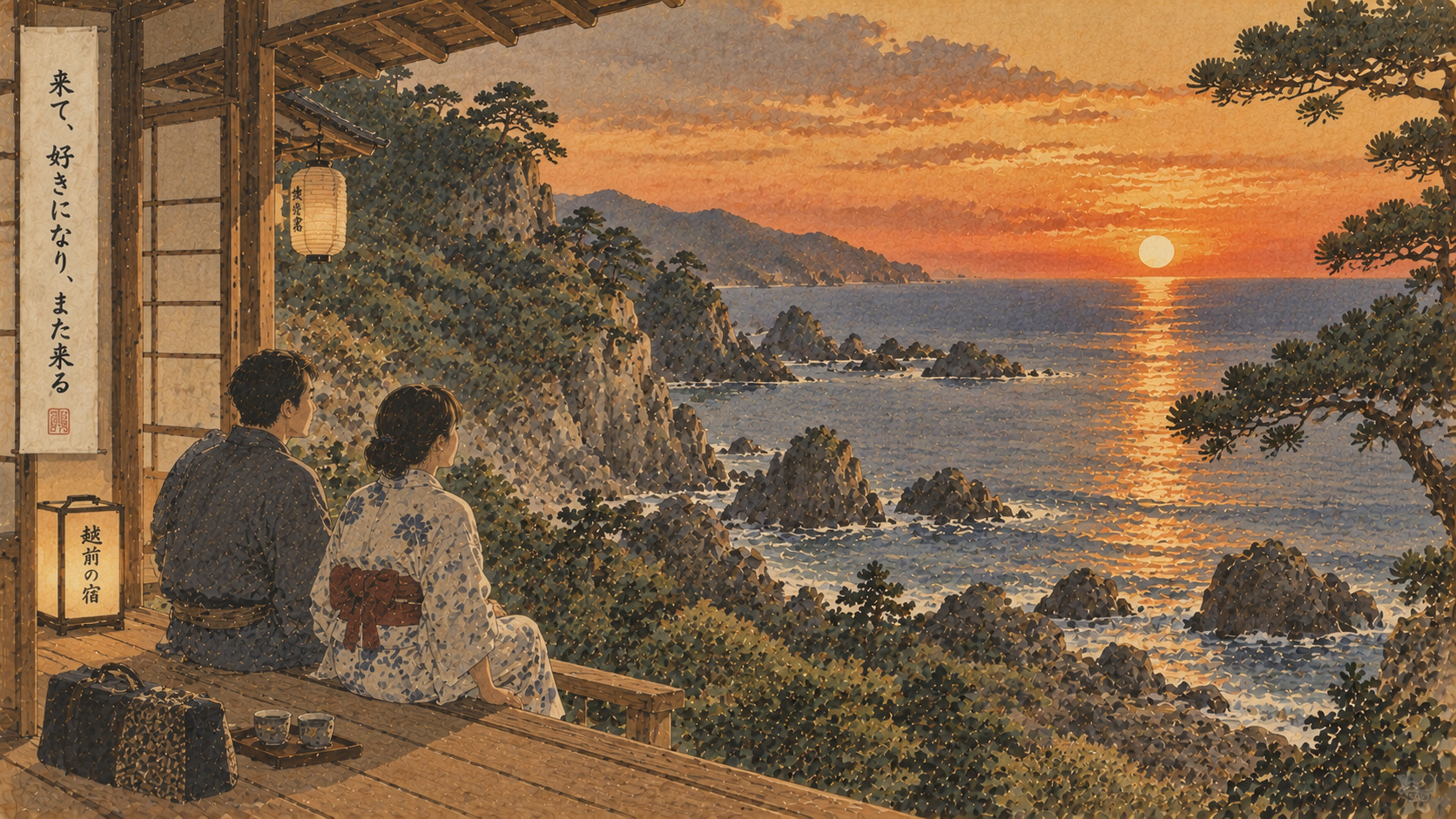
On clear evenings the Echizen Coast can seem made of layered light: cliff faces darken, boats cross the glow, and the ocean takes on a copper color. A May 2026 prefectural tourism feature charts approximately 75 kilometers of coastal driving between the Tsuruga side and the Tojinbo–Oshima area, combining the Shio-kaze Line and National Route 305.
The best-known geological scene is Tojinbo, a long stretch of striking columns and exposed cliffs. Other headlands and fishing settlements offer quieter perspectives. Between roughly May and November, offshore fishing lights may appear after sunset, weather permitting. None is guaranteed, and no photograph is worth stepping toward an unguarded cliff after dark.
Japan’s other coast, from the north
Fukui can also be part of a far longer journey: begin in Sapporo or Otaru, then travel south through Honshu's Sea of Japan-facing regions—Akita, Yamagata, Niigata, Toyama and Ishikawa—before reaching Fukui. The connective idea is the coast, not one uninterrupted train line. Ferries, trains, buses and cars may all be necessary depending on the itinerary.
Along such a journey, the historic economic geography of Japan becomes visible in fishing ports and maritime towns. It is a slower alternative to the familiar Pacific-side metropolitan circuit, but one that demands realistic planning and flexibility rather than romantic promises of seamless transport.
Three nights, four days—and room to breathe
A thoughtful four-day stay might begin with Fukui City's historic garden and an evening meal, followed by Eiheiji and Ichijodani on the second day. On day three, explore Mikuni and Tojinbo before an overnight at Awara Onsen. Reserve another day for stretches of the Echizen Coast rather than racing from landmark to landmark.
Wakasa Bay and the Mikata Five Lakes deserve their own extension; cramming the entire prefecture into the same short visit risks turning travel into transit. Local buses help with some attractions, but a hired guide or rental car gives greater flexibility along remote coastal stretches, subject to road conditions.
What visitors owe the place
A warm invitation does not cancel the practical facts: services outside cities can be infrequent, some attractions close seasonally, and winter weather makes roads and travel times unpredictable. Respect active monasteries, working harbors and residents' privacy, and verify operating details before setting out.
Fukui offers a persuasive alternative to tourism measured by the number of stops completed. Its appeal lies in the ability to remain: to watch a craftsman work, hear the river, listen to the coast in the evening—and realize there is no reason to hurry away.
The Conversation Continues
Japan.co.jp welcomes updated route and operating information, historical context, corrections and firsthand perspectives from local guides, residents and tourism organizations.
Contact the editorial deskSources and further reading
- Fukui Tourism: Echizen Coast drive and sunsets (2026)
- Fukui Tourism: Yokokan Garden
- Fukui Tourism: Tojinbo cliffs
- Fukui Tourism: Eiheiji and Ichijodani route
- Fukui Tourism: 2026–27 visitor guide
- JR West: Hokuriku–Kansai tickets and transfers
- JR West: Thunderbird limited express
- Fukui Tourism: Awara Onsen and history route
- Fukui Tourism: sunset locations and safety