A fossil forest leaves chemical fingerprints
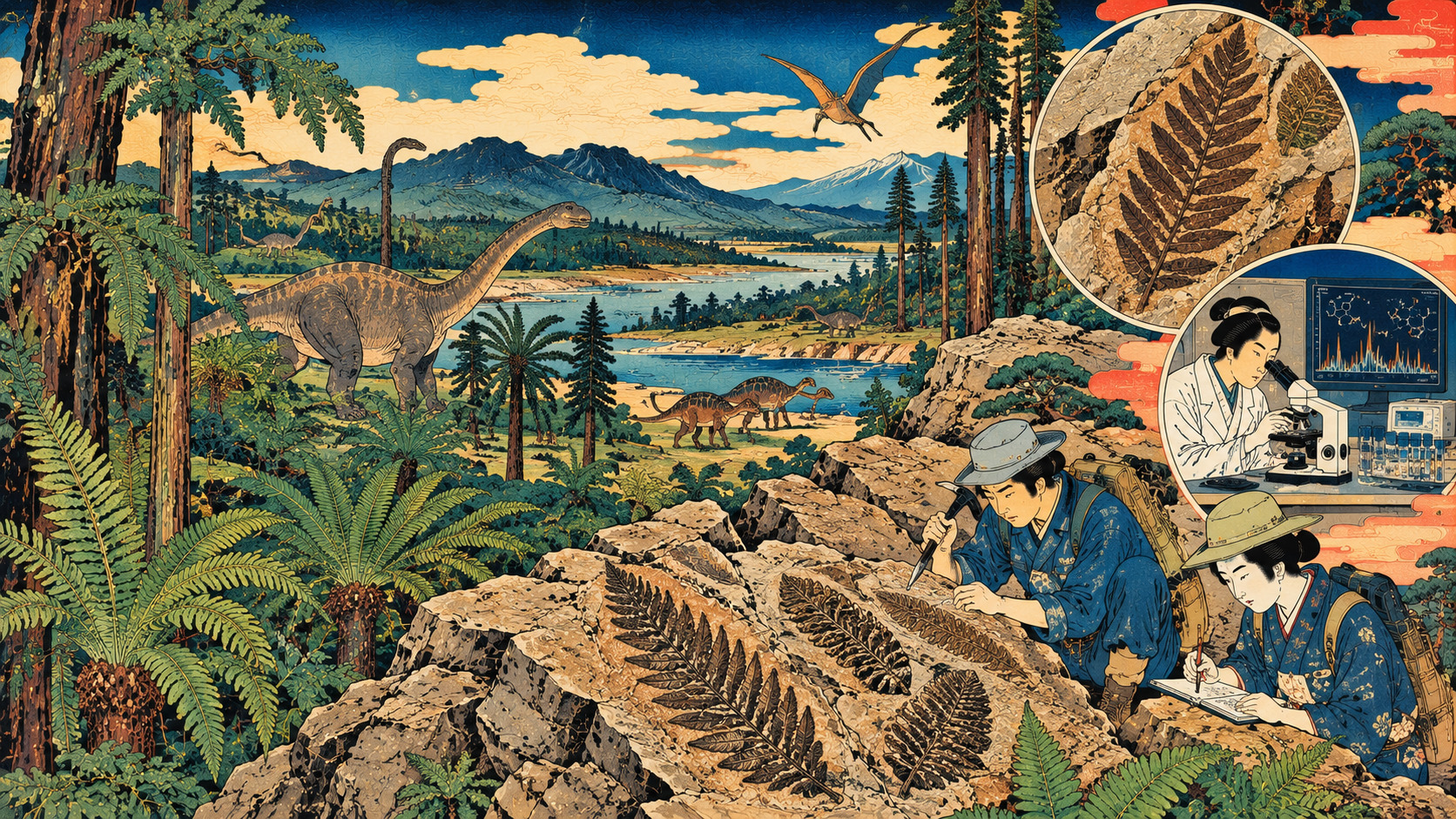
The most remarkable discoveries at Japan’s famous dinosaur quarry are not always dinosaurs. In the Early Cretaceous rocks of Kitadani in Fukui Prefecture, researchers have recovered chemical signatures from four fossil plants dating to approximately 120 million years ago. The joint team from Hokkaido University, Fukui Prefectural University and the Fukui Prefectural Dinosaur Museum analyzed compounds that may help distinguish ancient conifers from a long-extinct group of seed plants. Their findings appeared online in Organic Geochemistry on September 25, 2026, and were announced in Japan on October 28. The claim is not that living molecules or DNA were resurrected; rather, altered chemical residues still carry some botanical information.
Why Fukui is more than Japan’s dinosaur capital
Kitadani lies in Katsuyama City, in deposits assigned to the Tetori Group’s Kitadani Formation. Its rocks preserve a Lower Cretaceous river-associated ecosystem, including dinosaurs, invertebrates and plants. Fukui’s major dinosaur excavations began at Kitadani in 1989, eventually building one of the country’s best-known fossil research and museum programs. The spectacle of articulated skeletons and new dinosaur names can obscure a basic ecological question: what grew in the landscapes these animals inhabited? Leaves, twigs and the chemistry locked within them offer pieces of that answer.
The problem with identifying a leaf
Botanists routinely use reproductive structures, especially cones, seeds, fruits and flowers, to classify plants. A fossil deposit may preserve none of those. Many fossil plants are known from foliage alone, and lookalike leaves need not signal close ancestry. Chemical paleotaxonomy offers a complementary clue: if different plant groups biosynthesize characteristic families of compounds, traces of those families may persist after burial. The method cannot replace morphology or a well-supported fossil context. Its value lies in supplying another line of evidence where anatomy leaves genuine uncertainty.
Four fossils, one analytical strategy
The team used gas chromatography–mass spectrometry, or GC–MS, to separate organic extracts and identify molecular signatures from four plant fossil samples. It also compared the fossils with their host rocks, an essential test when trying to distinguish material associated with the original organisms from compounds introduced later or derived from the sediment. The study focused on aliphatic compounds, including n-alkanes and terpenoid biomarkers. Mass spectra reveal fragments that can support a proposed molecular structure, but complex degraded mixtures do not always permit an unequivocal identification.
The conifer clue in Brachyphyllum
Brachyphyllum, the fossil name applied to one type of conifer-like twig and foliage, showed a marked dominance of tetracyclic diterpanes. The researchers also described related molecules with unusually extended side chains. Their chemical pattern is consistent with non-pine-family conifers, and Hokkaido University linked its significance to araucarian relatives. Today, members of the Araucariaceae are associated mainly with the Southern Hemisphere, but their fossil history was geographically much wider. The molecules add support to evidence that such trees grew in what became Japan during the Early Cretaceous. They are not a barcode that identifies an exact modern species.
An extinct plant with a conifer-like signature
A different chemical profile appeared in Ptilophyllum, fossil foliage assigned to the Bennettitales. These extinct seed plants are familiar in Mesozoic floras but their relationships to other gymnosperms have been debated. The sample was enriched in pimarane-type diterpenoids, substances associated in broader chemistry with resin-producing conifers. That resemblance provides a new chemotaxonomic observation consistent with conifer-like biochemical traits in a bennettitalean plant. It does not by itself resolve the entire evolutionary tree of seed plants, and it should not be reported as proof that Bennettitales were modern conifers.
The quieter result: fern fossils
The study found far lower concentrations of the target terpenoids in the fern fossils than in the gymnosperm material. That contrast matters because a method becomes more informative when it can discriminate between samples, rather than detecting a generic compound everywhere. Yet preservation is uneven. Burial temperature, sediment chemistry, degradation and the original abundance of particular substances all influence what remains measurable. The results cannot be turned into a numerical census of how many conifers or ferns occupied the Cretaceous valley.
120 million years of chemistry is not a time capsule
The phrase “ancient molecules” can invite the wrong image: perfectly intact plant sap sealed in stone. The study instead discusses molecular transformation during geological burial. Some extended diterpane structures may have formed through thermal alkylation of conifer-type precursors. The published maturity indicators point to substantial heating in the oil-window range. Several proposed structures remain tentative. What endured was a recognizable chemical relationship between residues and possible source plant groups, not fresh tissue, recoverable DNA or a living organism waiting to be revived.
A landscape reconstructed from different kinds of evidence
Dinosaurs need more than bones to become ecological creatures. Fossil plants and environmental sediments offer information about habitats, potential food resources and the vegetation structure around waterways. The Kitadani chemical study contributes one more method to that reconstruction. It cannot establish from four samples which tree dominated the region, how wet a particular season was, or which dinosaur ate which plant. Those questions require broader fossils, sedimentological observations and multiple independent forms of biological evidence. The most interesting outcome is methodological rather than cinematic.
A separate discovery in the same ancient rocks
In October 2026, a different University of Tokyo-led collaboration reported preservation of chitin in freshwater bivalve fossils from the Kitadani Formation. That research studied a different organism and a different class of material, using different analytical tests. It should not be merged into the new fossil-plant findings. Taken separately, the results illustrate why Fukui’s deposits are becoming important for understanding the survival and alteration of organic materials in deep geological time. Different pathways of fossil preservation may protect different kinds of molecular evidence.
The limits the authors themselves emphasize
The Organic Geochemistry paper calls for further structural confirmation, including stronger chromatographic separation techniques, and larger sample sets before broad conclusions about Mesozoic vegetation can be generalized. Some long-chain structures are explicitly tentative. This caution is important for interpreting exciting headlines: four samples demonstrate a feasible approach and offer promising classification signals, not a complete botanical map of the Early Cretaceous Japanese archipelago. Scientists will need comparison fossils from other localities and refined chemical standards to test how reproducible these patterns are.
From spectacular skeletons to invisible evidence
Fukui’s dinosaur story has become an international cultural landmark. The new discovery shifts the camera away from jaws and claws toward branches and leaves. Using chemical traces as evidence, the researchers suggest what kinds of plants shared the ancient landscape and how an extinct group may have resembled conifers biochemically. The most compelling implication is not that scientists have recovered a prehistoric forest whole. It is that geology can retain a surprisingly selective record of what that forest was made of—and that researchers now have another way to read it.
Primary sources and reporting method
Based on university primary announcements, the original peer-reviewed abstract and Fukui Prefecture excavation records. This is documentary research without interviews or on-site reporting; tentative identifications and sample limitations are explicitly disclosed.
- Hokkaido University Japanese-language primary account
- Hokkaido University Faculty of Science research abstract
- Original journal article: Organic Geochemistry 222, 105314
- Fukui Prefecture: Kitadani excavation and geological context
- Fukui Prefecture: background on Araucariaceae fossil finds
- University of Tokyo: separate Kitadani fossil chitin discovery